Biodun Iginla, BBC News

Biodun Iginla, BBC News
Showing posts with label Syrian chemical weapons attack. Show all posts

Friday, April 13, 2018

Syria options, Russia envoy says he 'cannot exclude' war

April 13, 2018  10H:08  GMT/UTC/ZULU TIME
WASHINGTON/UNITED NATIONS - President Donald Trump and his national security aides on Thursday discussed U.S. options on Syria, where he has threatened missile strikes in response to a suspected poison gas attack, as a Russian envoy voiced fears of wider conflict between Washington and Moscow.
Worries about a confrontation between Russia, Syria’s big ally, and the West have been running high since Trump said on Wednesday that missiles “will be coming” in response to the attack in the Syrian town of Douma on April 7, and lambasted Moscow for standing by Syrian President Bashar al-Assad.
Trump tempered those remarks on Thursday and even as he consulted allies such and Britain and France, who could join in any U.S.-led strikes on Syria, there were signs of efforts to prevent the crisis from spiraling out of control.
“Never said when an attack on Syria would take place. Could be very soon or not so soon at all!” Trump wrote on Twitter, raising the prospect that an attack might not be as imminent as he seemed to suggest the day before.
Trump met his national security team on the situation in Syria later in the day and “no final decision has been made,” the White House said in a statement.
“We are continuing to assess intelligence and are engaged in conversations with our partners and allies,” it said.
That did not necessarily signal, however, that Trump was cooling to the idea of military action, especially given the high stakes in Syria. U.S. officials noted that Washington was still assessing intelligence and coordinating allies.
For graphic on overview of chemical warfare click here
Trump spoke to British Prime Minister Theresa May on Thursday and the two leaders talked about the “need for a joint response to Syria’s use of chemical weapons,” the White House said.
May’s office said they agreed on the need to deter Assad’s government from further such attacks.
Trump was also due to speak with French President Emmanuel Macron, who said France had proof the Syrian government carried out the attack near Damascus, which aid groups have said killed dozens of people, and will decide whether to strike back when all the necessary information has been gathered.
“We have proof that last week ... chemical weapons were used, at least with chlorine, and that they were used by the regime of Bashar al-Assad,” Macron said, without offering details of any evidence.
Two U.S. officials familiar with an investigation of samples from Douma and the symptoms of victims said initial indications that a mix of weaponized chlorine gas and sarin were used in the attack appeared to be correct. But U.S. intelligence agencies have not completed their assessment or reached a final conclusion, the officials said.
Russia, Syria and its other main backer, Iran, have said reports of the Douma attack were fabricated by rebels and rescue workers and have accused the United States of seeking to use it as a pretext to attack the Syrian government.
Russia said it deployed military police in Douma on Thursday after the town was taken over by government forces.
“They are the guarantors of law and order in the town,” RIA news agency quoted Russia’s defense ministry as saying.
There were signs of a global effort to head off a direct confrontation between Russia and the West. The Kremlin said a crisis communications link with the United States, created to avoid an accidental clash over Syria, was in use.

FEARS OF WAR

Vassily Nebenzia, Moscow’s ambassador to the United Nations, said he “cannot exclude” war between the United States and Russia and urged Washington and its allies to refrain from military action against Syria.
“The immediate priority is to avert the danger of war,” he told reporters. “We hope there will be no point of no return,” the envoy said.
A team of experts from the global chemical weapons watchdog, the Organisation for the Prohibition of Chemical Weapons, was traveling to Syria and will start its investigations on Saturday, the Netherlands-based agency said.
It was not clear whether Trump and U.S. allies would wait for the results of the investigation before deciding on a strike.
U.S. President Donald Trump speaks during a meeting with governors and members of Congress at the White House in Washington, U.S., April 12, 2018. REUTERS/Kevin Lamarque
U.S. Defense Secretary Jim Mattis told Congress he believed there was a chemical attack in Syria, but added a short while later that the United States had not made any decision to launch military action. He also suggested he was examining ways to prevent any strikes from triggering a broader conflict.
“I don’t want to talk about a specific attack that is not yet in the offing ... This would be pre-decisional,” Mattis told the House of Representatives Armed Services Committee.
Moscow is estimated to have dozens of aircraft at its Hmeymim air base in Syria including fighters and bombers, as well as 10 to 15 warships and support vessels in the Mediterranean.
The Syrian government and Russian forces in Syria possess truck-mounted surface-to-air missile and anti-aircraft artillery weapons systems.
Nervous world stock markets showed signs of recovery after Trump’s signal that military strikes might not be imminent.
Britain’s May won backing from her senior ministers to take unspecified action with the United States and France to deter further use of chemical weapons by Syria.
Slideshow (3 Images)
May had recalled the ministers from their Easter holiday for the meeting to discuss Britain’s response to what she has cast as a barbaric attack that cannot go unchallenged.
Russian ships had left the Tartus naval base in Syria, Interfax news agency quoted a Russian lawmaker as saying. Vladimir Shamanov, who chairs the defense committee of the lower house, said the vessels had departed the base for their own safety, which was “normal practice” when there were threats of attack.
Any U.S. strike would probably involve the Navy, given the risk to aircraft from Russian and Syrian air defenses. A U.S. guided-missile destroyer, the USS Donald Cook, is in the Mediterranean. Last year, the United States carried out strikes from two Navy destroyers against a Syrian air base after another deadly toxic gas attack on a rebel-controlled area.


Wednesday, April 11, 2018

Russia warns US that any missiles fired at Syria will be shot down

April 11, 2018  13H:13  GMT/UTC/ZULU TIME
MOSCOW - Russia has warned that any U.S. missiles fired at Syria over a suspected chemical weapons attack on a rebel enclave would be shot down and the launch sites targeted, raising the possibility of a U.S.-Russian confrontation.
A man walks with his bicycle at a damaged site in the besieged town of Douma, Eastern Ghouta, in Damascus, Syria March 30, 2018. REUTERS/Bassam Khabieh
Issuing the warning on Tuesday evening, the Russian ambassador to Lebanon also said such a clash should be avoided and Moscow was ready for negotiations. But his remarks could raise fears of direct conflict for the first time between major powers backing opposing sides in Syria’s protracted civil war.
Moscow and Washington sparred at the United Nations on Tuesday over the use of chemical weapons in Syria as Washington and its allies considered whether to strike at Syrian government forces over the alleged poison gas assault.
At least 60 people were killed in Saturday’s suspected chemical weapons attack on the town of Douma, Syrian relief workers said. An estimated 500 people were being treated for “symptoms consistent with exposure to toxic chemicals”, the World Health Organization said on Wednesday.
The Syrian government and Russia say the reports are bogus. The Kremlin said on Wednesday it hoped all sides involved in Syria would avoid doing anything that could destabilize an already fragile situation in the Middle East, and made clear it strongly opposed any U.S. strike on its ally.
After the attack, the rebel group holed up in Douma - Jaish al-Islam - finally agreed to withdraw from the town. That sealed a big victory for President Bashar al-Assad, who has now crushed the rebellion in the eastern Ghouta region near Damascus.
On the diplomatic front, Moscow and Washington stymied attempts by each other in the U.N. Security Council on Tuesday to set up international investigations into chemical weapons attacks in Syria. [
U.S. President Donald Trump on Tuesday canceled a planned trip to Latin America later this week to focus instead on talks with Western allies about possible military action to punish Assad for the suspected gas attack on a rebel-held town that had long withstood a devastating Syrian government siege.
Trump had on Monday warned of a quick, forceful response once responsibility for the attack was established.
“If there is a strike by the Americans, then ... the missiles will be downed and even the sources from which the missiles were fired,” Alexander Zasypkin, the Russian ambassador in Beirut, told Hezbollah’s al-Manar TV, speaking in Arabic.
He said he was referring to a statement by Russian President Vladimir Putin and the Russian armed forces chief of staff.
The Russian military said on March 13 that it would respond to any U.S. strike on Syria by targeting any missiles and launchers involved. Russia is Assad’s most powerful ally and its devastating air power has helped him wrest back large swathes of territory from rebels since 2015.
Zasypkin also said a clash between Russia and the United States over Syria “should be ruled out and therefore we are ready to hold negotiations”.
Earlier in the week, Russian Deputy Foreign Minister Mikhail Bogdanov said there was no threat of the situation in Syria spiraling into U.S.-Russian hostilities. TASS news agency quoted him as saying he believed common sense would prevail.

MISSILE SALVO FROM MEDITERRANEAN?

Any U.S. strike is likely to involve the navy, given the risk to aircraft from Russian and Syrian air defense systems. A U.S. Navy guided-missile destroyer, the USS Donald Cook, is in the Mediterranean.
With tensions mounting, pan-European air traffic control agency Eurocontrol warned airlines to exercise caution in the eastern Mediterranean due to the possible launch of air strikes into Syria over the next 72 hours.
Eurocontrol said that air-to-ground and cruise missiles could be used within that period and there could be intermittent disruptions of radio navigation equipment.
Both Russia and Iran, Assad’s other main ally, have warned his enemies against military action in recent days, underlining their commitment to the Syrian government they have armed and supported through years of conflict.
Ali Akbar Velayati, the top adviser to Iranian Supreme Leader Ayatollah Ali Khamenei, said during a visit to Damascus on Tuesday that an Israeli attack on an air base in Syria earlier this week would “not remain without response”.

RISK OF “UNCONTROLLABLE ESCALATION”

On Monday, U.N. Syria peace envoy Staffan de Mistura cited the air base strike along with other recent events in Syria in a briefing to the Security Council, cautioning against a “situation of uncontrollable escalation”.
Syria’s Russian-supplied air defenses shot down an Israeli F-16 jet in February during a previous bombing run against what Israel described as Iranian-backed positions in Syria.
Last year, the United States carried out strikes from two Navy destroyers against a Syrian air base after another toxic gas attack on a rebel-controlled pocket.
The U.S. and Russian militaries have sought to avoid conflict in Syria, notably last year in the Euphrates River Valley where they supported rival sides in the campaign against Islamic State militants.
However, U.S. forces in February killed or injured hundreds of Russian contractors fighting on Assad’s side during a confrontation in Deir al-Zor province.
U.S. officials said last month pro-Syrian government forces including Russian mercenaries massed near U.S. and U.S.-backed forces in the same region, but a potential confrontation was defused after the U.S. military contacted Russian officers.
French President Emmanuel Macron said on Tuesday that any military action would not target the Syrian government’s allies or anybody in particular, but rather the Syrian government’s chemical facilities.
Any U.S. strike similar to the limited one launched last year would not cause a shift in the course of the war that has been going Assad’s way since Russia intervened on his side.

DEADLY CHEMICAL ATTACK

Syrian aid workers reported more than 1,000 people injured in the reported gas attack on Douma. Doctors and witnesses said victims showed symptoms of poisoning, possibly by a nerve agent, and reported the smell of chlorine gas.
France and Britain discussed with the Trump administration how to respond to the Douma attack. Both stressed that the culprit still needed to be confirmed.
The Hague-based Organisation for the Prohibition of Chemical Weapons said Assad’s government had been asked to make necessary arrangements for an OPCW investigation team to visit shortly.
The mission will aim to determine whether banned munitions were used but not assign blame.
The Assad government and Russia both urged the OPCW to investigate the allegations, a move by the two countries that was apparently aimed at averting any U.S.-led military action.
A European source said European governments were waiting for the OPCW to carry out its inquiry and for more solid forensic evidence from the attack to emerge. Any plan by Washington and its allies to take military action was likely to be on hold until then, the source told us at Reuters.
Despite the international revulsion over chemical weapons attacks, the death toll from such incidents in Syria is only a fraction of the hundreds of thousands of combatants and civilians killed since the war erupted in 2011.

Monday, April 17, 2017

BREAKING: Trump congratulates Erdogan on referendum


  • April 18, 2017  05H:36  GMT/UTC/ZULU TIME
  •  
  • From the sectionEurope


Media captionTurkish referendum in three words

by Suzanne Gould and Biodun Iginla, BBC News, Washington DC
Donald Trump has congratulated Turkish President Recep Tayyip Erdogan on his victory in Sunday's referendum that gave him sweeping new powers.
In a phone call, the US president also thanked Mr Erdogan for supporting America's missile strike on a Syrian government airbase on 7 April.
In the poll, 51.4% of Turkish voters backed the changes.
Mr Erdogan rejected criticism from international monitors who said he had been favoured by an "unequal campaign".
"Know your place," he told the observers.
The narrow victory was ruled valid by Turkey's electoral body, despite claims of irregularities by the opposition.


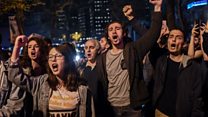
Media captionProtesters march through the Turkish capital calling for a recount

In a separate development, Turkey extended the state of emergency for three months. The measure, introduced after a failed coup last July, was set to expire in two days.
In a statement on Monday, the White House said President Trump discussed with his Turkish counterpart America's "action in response to the Syrian regime's use of chemical weapons on 4 April".
It said the two leaders "agreed on the importance of holding Syrian President Bashar al-Assad accountable".
They also discussed "the counter-ISIS [Islamic State campaign]", the statement added.
Relations between Washington and Ankara have recently been strained by several key issues.
One of Turkey's main grievances with the US is the policy started by the Obama administration of supporting Kurdish fighters in Syria who are fighting IS forces.
Turkey views the Syrian Kurdish People's Protection Units (YPG) as a terror group linked to Kurdish separatists waging an insurgency inside Turkey since 1984.
The two sides are also at loggerheads over Fethullah Gulen. Turkey accuses the cleric of orchestrating the failed coup.
Officially the Washington insists any decision on returning him to Turkey from the US remains a judicial rather than a political one.

Grey line

Monitors: 'Unlevel playing field'


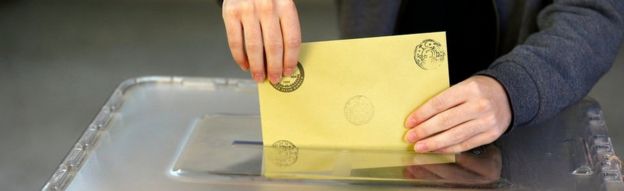
A man casts his ballot at a polling station during a referendum Aegean port city of Izmir,Image copyrightREUTERS

Despite saying that the voting day was "well administered", the Organization for Security and Co-operation in Europe (OSCE) and the Council of Europe criticised the referendum campaign, saying:
  • It was an "unlevel playing field" and the two sides of the campaign "did not have equal opportunities"
  • It was unbalanced due to the active involvement of the president and several senior officials
  • It was tarnished by a number of officials equating No supporters with terrorist sympathisers
  • State resources were misused
  • Under the state of emergency, essential fundamental freedoms were curtailed
  • Despite some measures, the legal framework remained inadequate for a genuinely democratic referendum
"In general, the referendum did not live up to Council of Europe standards," said Cezar Florin Preda, head of the Council of Europe delegation.
The council is a pan-European human rights body of which Turkey is a member.
The monitors also criticised a late change by electoral officials that allowed voting papers without official stamps to be counted. They said this move "removed an important safeguard and were contested by the opposition.
But the head of Turkey's electoral body, Sadi Guven, said the unstamped ballot papers had been produced by the High Electoral Board and were valid. He said a similar procedure had been used in past elections.

Grey line

Turkey reacts: 'Politically motivated reports'


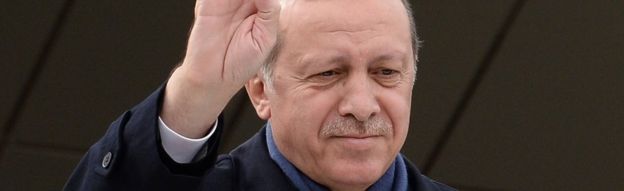
Turkish President Tayyip Erdogan greet supporters at Ankara Esenboga AirportImage copyrightGETTY IMAGES

Addressing supporters in the presidential palace in Ankara, Mr Erdogan said that Turkey did not "see, hear or acknowledge the politically motivated reports" of the monitors.
The result, he said, ended the debate on changing the constitution and creating an executive presidency, adding that the process of implementing the reforms would now begin.
He also said the country could hold a referendum on its long-stalled EU membership bid.
Additionally, Mr Erdogan said he would approve the death penalty if it was supported in a referendum or a bill was submitted to him through parliament. This would end Turkey's EU negotiations.
Earlier, Turkey's foreign ministry said the remarks by the monitors lacked impartiality. "Saying the referendum fell below international standards is unacceptable," it said in a statement.
The main opposition Republican People's Party (CHP) has demanded a recount of 60% of the votes. Its deputy head said the result should be annulled altogether.
The pro-Kurdish Peoples' Democratic Party (HDP) also challenged the vote.

Grey line

The constitutional changes

  • The president will have a five-year tenure, for a maximum of two terms
  • The president will be able to directly appoint top public officials, including ministers and one or several vice-presidents
  • The job of prime minister will be scrapped
  • The president will have power to intervene in the judiciary, which Mr Erdogan has accused of being influenced by Fethullah Gulen, the Pennsylvania-based preacher he blames for the failed coup in July
  • The president will decide whether or not impose a state of emergency

More on this story