Biodun Iginla, BBC News

Biodun Iginla, BBC News
Showing posts with label Jared Kushner. Show all posts

Sunday, July 21, 2019

BREAKING: White House's Kushner to finalize Palestinian economic plan on Middle East tour

July 22, 2019  02H39  GMT/ZULU
WASHINGTON  - White House senior adviser Jared Kushner will lead a U.S. delegation on a tour of the Middle East to finalize details of his proposed $50 billion economic development plan for the Palestinians, Jordan, Egypt and Lebanon, an administration official said on Sunday.
Kushner, Middle East envoy Jason Greenblatt, State Department official Brian Hook and Kushner aide Avi Berkowitz are expected to make make stops in Israel, Jordan, Egypt, Saudi Arabia, Qatar and the United Arab Emirates, the official said.
They leave late this month and return to Washington in early August.
ADVERTISEMENT
The official said the purpose of the trip is to “continue on the momentum that was created at the workshop in Bahrain and finalize the economic portion of the plan.”
They will also discuss the possibility of locating the development fund in Bahrain, the official said.
Kushner, U.S. President Donald Trump’s son-in-law and the plan’s main architect, sought to build support for his ambitious economic proposals for the Palestinian territories at an international meeting in Bahrain in June.
ADVERTISEMENT
Palestinians poured scorn on the Trump administration’s $50 billion investment plan to help achieve Middle East peace, but U.S. Gulf Arab allies said the economic initiative had promise if a political settlement is reached.
Kushner and Treasury Secretary Steven Mnuchin last week discussed creation of the fund with World Bank President David Malpass, the official said. The World Bank has a role in managing the fund.
The delegation was not expected to discuss Trump’s long-awaited political plan for the Middle East, and when it will be released remains unclear.

Tuesday, June 25, 2019

ANALYSIS: Israeli-Palestinian deal

by Nasra Ismail and Biodun Iginla, The Economist Intelligence Unit News Analysts
Half a plan
An underwhelming start to the “ultimate” Israeli-Palestinian deal

Americans and Arabs discuss an unrealistic economic proposal—without the parties to the conflict
IT COULD have been Davos, or any of the other conferences on the annual circuit for the world’s wealthy. Jared Kushner, the son-in-law and a senior adviser to America’s president, took the stage to offer his vision for solving the Israeli-Palestinian conflict. The combatants, he lectured, were “trapped in an inefficient framework of the past”. Their obstinacy is a barrier to turning the West Bank and Gaza into “a bustling commercial and tourist centre”. If 70 years of warfare would simply come to a halt, “we can turn this region from a victim of past conflicts into a model for commerce and advancement across the world.”
Before he took office in 2017 Donald Trump vowed to broker the “ultimate deal” between Israelis and Palestinians. To oversee the effort he chose, Mr Kushner, a real-estate developer with no experience in diplomacy or the Middle East. The result has been about as expected. There is still no political plan for resolving the underlying conflict and its many thorny issues: borders, refugees or the status of Jerusalem, and the very notion of Palestinian statehood. Its release has been repeatedly delayed; diplomats hint that it may remain on the shelf until Mr Trump’s second term, if he wins one.

Instead Mr Kushner organised this two-day confab in Bahrain. Dubbed the “Peace to Prosperity” workshop, the centrepiece is a 96-page plan that pledges $50bn worth of investment in Palestine and neighbouring countries after a peace deal. The document, to be fair, is impressive in scope. It suggests projects to boost agriculture and tourism, fix Palestine’s infrastructure and improve governance. All of this would be funded by a mix of grants, concessional loans and private-sector money, from the wealthy Gulf states and elsewhere.
Missing amidst all this detail, however, is anything about the Israeli occupation, in its various forms, of the West Bank and Gaza Strip, or of schism between the Palestinian leaders in the two territories. The plan presupposes that the noxious politics of the conflict have simply vanished. Mr Kushner proposes spending $5bn to connect the West Bank and Gaza, for example. Israel has undertaken to do this for years but never has, because the link is not simply a matter of building a monorail. It raises political and security questions for Israel. Another proposal calls for $2bn to give the Palestinians 5G wireless infrastructure. Entrepreneurs would be thrilled. But there is no mention of how to overcome objections from the Israeli army, which let the West Bank install 3G only last year (a decade after the rest of the world).
As it stands, then, the plan is thoroughly unrealistic. That is the point, Mr Kushner’s supporters argue. It is meant to offer the Palestinians a peace dividend, an incentive to accept his (perhaps) forthcoming political vision. They certainly need economic help. Unemployment in the West Bank is 17%. In Gaza it is as high as 55%. Adjusted for inflation, GDP per person is almost unchanged from 20 years ago.
But to the Palestinians this smells like a bribe from a hostile president. Mr Trump cut all American aid to them—even $25m in funding for hospitals in East Jerusalem that treat, among other things, children with cancer. He overturned decades of precedent to recognise Jerusalem as Israel’s capital. And aides hint that the political plan will give the Palestinians far less than the sovereign state along the pre-1967 borders that they demand. America’s ambassador to Israel, David Friedman, said this month that Israel had the right to annex some territory in the West Bank.
So the Palestinians are boycotting the event. Their president, Mahmoud Abbas, refused to send anyone from his government. “The deal of shame will go to hell,” he said in May. The private sector also declined invitations. Of the 5m Palestinians in the occupied territories, the only publicly-confirmed attendee is Ashraf al-Jabari, a former secret-police officer who has turned into a businessman and has cultivated unusual ties with Israeli settlers in his home town of Hebron. He also has a history of writing bum cheques
Few of the other attendees are enthusiastic. “We tried to find the lowest level of representation that wouldn’t be offensive,” quips a European diplomat in Tel Aviv. Jordan and Egypt sent only their deputy finance ministers. With the Palestinians boycotting, Arab states were reluctant to share a stage with Israeli officials. But the latter weren’t invited either because of Arab misgivings (though some Israeli businessmen did come). Even press coverage is limited: organisers did not allow most foreign journalists covering the Middle East to attend. They did accredit reporters from six Israeli outlets, who have sent slightly fawning dispatches. The country’s largest newspaper, Israel Hayom, which backs both Mr Trump and the Israeli prime minister, Binyamin Netanyahu, dubbed Bahrain the “island of hope”, an odd appellation for a kingdom that crushed a popular uprising in 2011.
And that, perhaps, points to the real outcome of the workshop. It is the most public manifestation of a long and mostly private rapprochement between Israel and the Gulf states, one the Trump administration is keen to promote. The event will do nothing to end the Israeli-Palestinian conflict. But it is another sign that the Gulf states are looking to move past that conflict. Though they are not quite ready to recognise Israel, they see it as an important regional power, an ally against a shared threat from Iran. The Palestinians have far less to offer. “All we have is our moral power,” says Mkhaimer Abu Saada, a political analyst in Gaza. That still counts for something—but less and less with each passing day.
Reuse this content

ANALYSIS AND BREAKING: US kicks off Mideast plan, with Palestinians boycotting


Stone-carrying Palestinians near Hebron stand behind a burning tyre as they protest against a US-led Middle East conference in Bahrain
Stone-carrying Palestinians near Hebron stand behind a burning tyre as they protest against a US-led Middle East conference in Bahrain AFP
ADVERTISING
Manama (Bahrain)
After a wait of two and a half years, the US administration is launching its Middle East peace plan Tuesday -- with an economic initiative that the Palestinians are boycotting.
For this most unconventional of US presidents, Donald Trump's Middle East peace-making bid is unlike decades of previous US attempts.
ADVERTISING
There is no talk of land swaps, a Palestinian state or other political issues that have vexed diplomats for decades.
The Trump administration says it will get to the political issues later.
For now, its plan will open over cocktails and dinner Tuesday evening in Bahrain at an intimate two-day "economic workshop" at a luxury hotel overlooking the Gulf.
Led by Trump's son-in-law and adviser Jared Kushner, the "Peace to Prosperity" framework dangles the prospect of $50 billion of investment in the Palestinian territories and neighbouring Arab countries over 10 years.
Listing a slew of projects to develop roads, border crossings, power generation and tourism, the framework sets an optimistic goal of creating one million Palestinian jobs.
But the Palestinian Authority and its rival Hamas have both denounced the initiative, saying it amounts to a bid by the unabashedly pro-Israel Trump to buy them off in return for not enjoying their own state.
"For America to turn the whole cause from a political issue into an economic one, we cannot accept this," Palestinian president Mahmud Abbas said Sunday.
Hundreds of Palestinians took to the streets in the occupied West Bank on Monday to denounce the conference.
Near Hebron, demonstrators burned pictures of Trump and the king of Bahrain.
They sat around a coffin that read, "No to the deal of the century", a derogatory phrase for the US president's ambitions in the Middle East.
- Trump support for Israel -
Israeli Prime Minister Benjamin Netanyahu has cast the Palestinians' stance as a sign that they are not serious about peace.
"I don't understand how the Palestinians rejected the plan even before knowing what it contained," Netanyahu said.
The right-wing Israeli leader has spoken in recent months of annexing parts of the West Bank, a move that could effectively close Palestinian hopes of their own state.
The US ambassador to Israel, David Friedman, has said that Washington could accept the annexation and the Trump administration has hinted that its political plan will not mention a Palestinian state -- a sharp shift from the goal of years of US diplomacy.
Trump has already taken landmark steps to support Israel including recognising bitterly contested Jerusalem as Israel's capital, and Kushner is a family friend of Netanyahu.
Most European allies of the United States, uneasy about the Trump administration's hawkish instincts, are staying away from Bahrain.
In attendance will be oil-rich Gulf Arab states, who would be expected to pick up the tab for the massive Palestinian investment if the plan succeeds.
Jordan and Egypt, the only two Arab nations to have signed peace deals with Israel, will also send mid-level officials.
However, Jordanian foreign ministry spokesman Sufyan al-Qudah insisted that "no economic proposal could replace a political solution that ends the occupation" of Palestinian territories by Israel.
- Success in 'failure'? -
Gulf Arab rulers have increasingly found common cause with Israel due to their shared hostility to Iran, reinforced by rising friction between Tehran and Washington.
In an apparently unprecedented step, a handful of Israeli journalists invited by the White House are flying openly to Bahrain.
Most Arab nations ban Israeli citizens unless they enter on other passports, although Bahrain -- whose Sunni rulers have especially tense relations with Iran -- is comparatively open to Israel.
Other prominent figures due to take part in the Bahrain conference are International Monetary Fund chief Christine Lagarde, World Bank President David Malpass and former British prime minister Tony Blair.
Richard LeBaron, a former US diplomat in the Middle East, said that the Trump administration fully expected that the Palestinians would stay away.
But Bahrain allows Kushner to portray Palestinian leaders as not caring about their own people as he keeps advancing Israeli interests, said LeBaron, now a senior fellow at the Atlantic Council think tank.
"The 'failure' of the Manama workshop will be success for the Trump strategy," he wrote in an analysis.
"It will permit Kushner and his colleagues to claim that they tried their best to address the situation and allow them to blame others for not cooperating."

Saturday, March 23, 2019

ANALYSIS: Trump faces flurry of investigations despite conclusion of Mueller probe


Reuters archive | US Special Counsel Robert Mueller
Special Counsel Robert Mueller submitted his report on Russian election interference to the US attorney general on Friday, closing one of the key probes into Donald Trump. But the US president still faces a host of other investigations.
ADVERTISING
Special Counsel Robert Mueller has concluded his investigation into Russian election interference and has submitted a report to Attorney General William Barr, who will decide how much of the report will be made public.
The end of the 22-month probe without additional indictments by Mueller was welcome news to some in Trump's orbit, who had feared a final round of charges could ensnare more Trump associates or even members of the president's family.
Speculation has swirled about the possible legal jeopardy faced by Donald Trump Jr., who helped arrange a Trump Tower meeting during the 2016 election campaign with a Kremlin-linked lawyer, and Trump's son-in-law Jared Kushner, who was interviewed at least twice by Mueller's prosecutors.
ADVERTISING
Mueller has charged 34 people, including former campaign chairman Paul Manafort and Trump's first national security adviser, Michael Flynn.
Twenty-five Russians were indicted on charges related to election interference, accused either of hacking Democratic email accounts during the campaign or of orchestrating a social media campaign that spread disinformation on the internet. Three Russian companies were also charged.
Five Trump aides pleaded guilty and agreed to cooperate with Mueller and a sixth, longtime confidant Roger Stone, is awaiting trial on charges that he lied to Congress about the Russia-hacked emails released by WikiLeaks and engaged in witness-tampering.
The Mueller report is currently available to only a handful of Justice Department officials while Attorney General Barr prepares to submit the "principal findings" of the report to Congress, as required by law. In a Friday letter to lawmakers, he declared he was committed to transparency and speed, adding that he might provide more information as soon as this weekend.
With no details yet released, it's not known whether Mueller's report answers the core questions of his investigation: Did Trump's campaign collude with the Kremlin to sway the 2016 presidential election? And did Trump later take steps to obstruct the probe, notably by firing his FBI director?
Trump controversially fired FBI Director James Comey in May 2017 and later admitted he did so with the "Russia thing" in mind, thus sparking calls for the appointment of a special prosecutor to investigate possible obstruction of justice.
Trump was never interviewed in person for the probe; he submitted answers to Mueller's questions in writing.
It wasn't immediately clear whether Mueller had referred any additional investigations to the Justice Department. It is also unclear what steps Mueller might take if he uncovered evidence of criminal wrongdoing by Trump, given Justice Department policy that a sitting president cannot be indicted.
But no matter the findings of Mueller's report, the investigation has already outlined Russia's attack on the US political system, revealed the Trump campaign as eager to exploit hacked Democratic emails and exposed liesby Trump aides aimed at covering up their Russia contacts.
Legal trouble brewing in New York
Nor does the conclusion of Mueller's investigation remove legal peril for the president. Trump faces a separate Justice Department investigation in New York into hush money payments made during the 2016 campaign to two women who say they slept with him years before. He has been implicated in a potential campaign finance violation by his former lawyer, Michael Cohen, who pleaded guilty and said Trump asked him to arrange the transactions. Federal prosecutors in New York have also been investigating foreign contributions made to the president's inaugural committee.
Federal and state prosecutors are pursuing "about a dozen" other investigations that have been prompted in part by the Mueller probe, the New York Times reported. The number of additional investigations that have been launched based on Mueller's work is unknown, however, since many remain secret. 
It is known that the special counsel has transferred certain lines of inquiry for possible prosecution to other US attorneys' offices, including the Southern District of New York located in Manhattan, the District of Columbia and the Eastern District of Virginia.
Other investigations focusing on the president, the Trump Organisation or his associates are "being conducted by officials from Los Angeles to Brooklyn", wrote The New York Times. About half are centred in the Southern District of New York.
“The important thing to remember is that almost everything Donald Trump did was in the Southern District of New York,” said John S. Martin Jr., a retired federal judge who was a former US attorney in the Southern District, in comments to the Times.
“He ran his business in the Southern District. He ran his campaign from the Southern District,” Martin said.
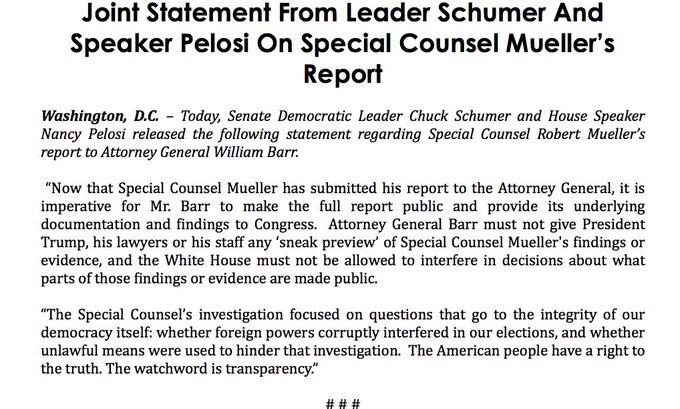
The delivery of the confidential findings on Friday set off immediate demands from Democrats for Mueller's report and the supporting evidence collected to be made public. House Speaker Nancy Pelosi and Senate Minority Leader Chuck Schumer declared it "imperative" to release the full report.
"The White House must not be allowed to interfere in decisions about what parts of those findings or evidence are made public," they said in a joint statement.
After winning back the house in November midterms, Democrats launched sweeping probes into Trump, ensuring that the special counsel would not be the only one leading an inquiry into Russian interference or possible wrongdoing by the president.
Barr has said he wants to make public as much of the report as possible, and any attempt to withhold its details are sure to prompt a clash between the Justice Department and Democratic lawmakers, who could subpoena Mueller and his investigators to testify before Congress.
California Congressman Adam Schiff, chairman of the House intelligence committee, on Friday threatened to issue a subpoena if necessary to obtain all of the evidence Mueller collected over the course of the investigation.
In a letter earlier this month, the House intelligenceforeign affairs and oversight committees asked for information on the private in-person and telephone conversations Trump has had with Russian President Vladimir Putin. On Thursday the White House rejected the request.