Biodun Iginla, BBC News

Biodun Iginla, BBC News
Showing posts with label US administration. Show all posts

Tuesday, June 25, 2019

ANALYSIS AND BREAKING: US kicks off Mideast plan, with Palestinians boycotting


Stone-carrying Palestinians near Hebron stand behind a burning tyre as they protest against a US-led Middle East conference in Bahrain
Stone-carrying Palestinians near Hebron stand behind a burning tyre as they protest against a US-led Middle East conference in Bahrain AFP
ADVERTISING
Manama (Bahrain)
After a wait of two and a half years, the US administration is launching its Middle East peace plan Tuesday -- with an economic initiative that the Palestinians are boycotting.
For this most unconventional of US presidents, Donald Trump's Middle East peace-making bid is unlike decades of previous US attempts.
ADVERTISING
There is no talk of land swaps, a Palestinian state or other political issues that have vexed diplomats for decades.
The Trump administration says it will get to the political issues later.
For now, its plan will open over cocktails and dinner Tuesday evening in Bahrain at an intimate two-day "economic workshop" at a luxury hotel overlooking the Gulf.
Led by Trump's son-in-law and adviser Jared Kushner, the "Peace to Prosperity" framework dangles the prospect of $50 billion of investment in the Palestinian territories and neighbouring Arab countries over 10 years.
Listing a slew of projects to develop roads, border crossings, power generation and tourism, the framework sets an optimistic goal of creating one million Palestinian jobs.
But the Palestinian Authority and its rival Hamas have both denounced the initiative, saying it amounts to a bid by the unabashedly pro-Israel Trump to buy them off in return for not enjoying their own state.
"For America to turn the whole cause from a political issue into an economic one, we cannot accept this," Palestinian president Mahmud Abbas said Sunday.
Hundreds of Palestinians took to the streets in the occupied West Bank on Monday to denounce the conference.
Near Hebron, demonstrators burned pictures of Trump and the king of Bahrain.
They sat around a coffin that read, "No to the deal of the century", a derogatory phrase for the US president's ambitions in the Middle East.
- Trump support for Israel -
Israeli Prime Minister Benjamin Netanyahu has cast the Palestinians' stance as a sign that they are not serious about peace.
"I don't understand how the Palestinians rejected the plan even before knowing what it contained," Netanyahu said.
The right-wing Israeli leader has spoken in recent months of annexing parts of the West Bank, a move that could effectively close Palestinian hopes of their own state.
The US ambassador to Israel, David Friedman, has said that Washington could accept the annexation and the Trump administration has hinted that its political plan will not mention a Palestinian state -- a sharp shift from the goal of years of US diplomacy.
Trump has already taken landmark steps to support Israel including recognising bitterly contested Jerusalem as Israel's capital, and Kushner is a family friend of Netanyahu.
Most European allies of the United States, uneasy about the Trump administration's hawkish instincts, are staying away from Bahrain.
In attendance will be oil-rich Gulf Arab states, who would be expected to pick up the tab for the massive Palestinian investment if the plan succeeds.
Jordan and Egypt, the only two Arab nations to have signed peace deals with Israel, will also send mid-level officials.
However, Jordanian foreign ministry spokesman Sufyan al-Qudah insisted that "no economic proposal could replace a political solution that ends the occupation" of Palestinian territories by Israel.
- Success in 'failure'? -
Gulf Arab rulers have increasingly found common cause with Israel due to their shared hostility to Iran, reinforced by rising friction between Tehran and Washington.
In an apparently unprecedented step, a handful of Israeli journalists invited by the White House are flying openly to Bahrain.
Most Arab nations ban Israeli citizens unless they enter on other passports, although Bahrain -- whose Sunni rulers have especially tense relations with Iran -- is comparatively open to Israel.
Other prominent figures due to take part in the Bahrain conference are International Monetary Fund chief Christine Lagarde, World Bank President David Malpass and former British prime minister Tony Blair.
Richard LeBaron, a former US diplomat in the Middle East, said that the Trump administration fully expected that the Palestinians would stay away.
But Bahrain allows Kushner to portray Palestinian leaders as not caring about their own people as he keeps advancing Israeli interests, said LeBaron, now a senior fellow at the Atlantic Council think tank.
"The 'failure' of the Manama workshop will be success for the Trump strategy," he wrote in an analysis.
"It will permit Kushner and his colleagues to claim that they tried their best to address the situation and allow them to blame others for not cooperating."


Saturday, December 30, 2017

Iranian protests: Government supporters in show of strength

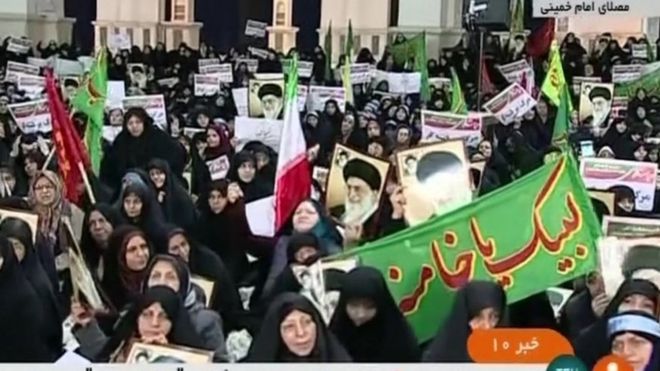
crowds carrying flagsImage copyrightIRINN
Image captionState TV showed crowds carrying flags
by Sunita Kureishi and Biodun Iginla, BBC News, Tehran
Thousands of pro-government demonstrators are attending rallies in Iran, after two days of anti-government protests.
State TV showed crowds of black-clad supporters in the capital, Tehran.
Dozens of people have been arrested during days of protests over corruption and living standards, which the vice president suggested were being organised by political opponents.
The US administration warned Iran that "the world was watching" its response.
Saturday's official rallies were organised in advance of the anti-government protests, to mark the eighth anniversary of the suppression of major street protests.
In 2009, masses came out in favour of the then-president, Mahmoud Ahmadinejad, in response to protests by reformists over a disputed election which returned him to power.
Meanwhile, the Iranian authorities are blaming anti-revolutionaries and agents of foreign powers for the protests.
They have promised that the protestors will be dealt with harshly, while admitting there is genuine and widespread discontent.

How did the anti-government demonstrations start?

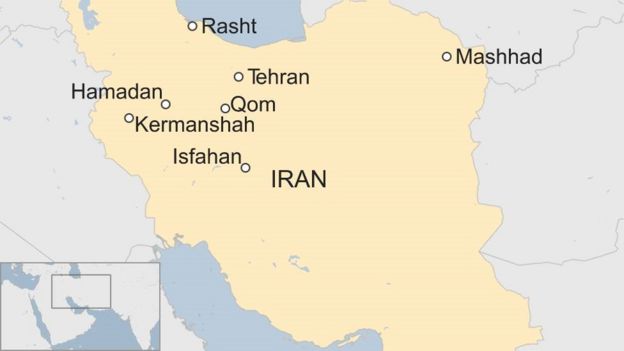
The protests started in the north-eastern city of Mashhad - the country's second most-populous - on Thursday.
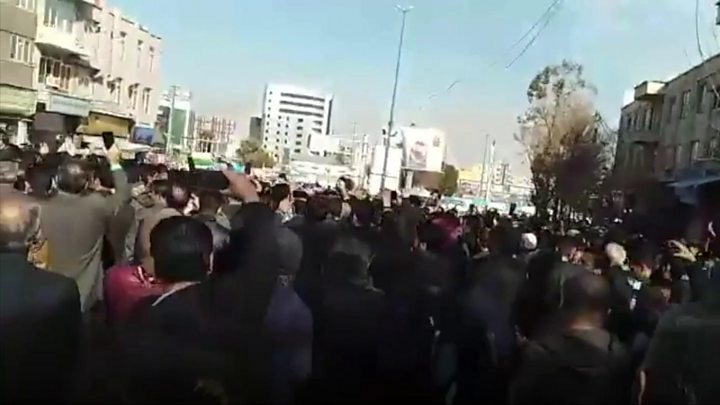
People there took to the streets to express anger at the government over high prices, and vented their fury against President Hassan Rouhani. Fifty-two people were arrested there for chanting "harsh slogans".
Media captionProtesters take to streets venting anger against authorities
The protests spread to at least half a dozen cities on Friday. In some cities police in riot gear and on motorbikes clashed with demonstrators.
Some protests developed into broader demonstrations against the authorities, calling for the release of political prisoners and an end to police beatings. It was the biggest display of public dissent since huge pro-reform rallies in 2009.
Overall, the numbers said to be taking part range from less than 100 in some places to thousands in others - but demonstrations do not appear to be taking place on a massive scale.
On social media, there are calls for more protests later on Saturday. Some reports suggested these were already taking place.

What is Iran saying about the protests?

First Vice-President Eshaq Jahangiri has suggested that government opponents are behind the protests, according to comments reported by state broadcaster IRIB.
He said: "Some incidents in the country these days are on the pretext of economic problems, but it seems there is something else behind them. They think by doing this they harm the government, but it will be others who ride the wave."
The governor-general of Tehran said that any such gatherings would be firmly dealt with by the police, who are out in force on the main roads.
Officials in Mashhad said the protest was organised by "counter-revolutionary elements", and video online showed police using water cannon.
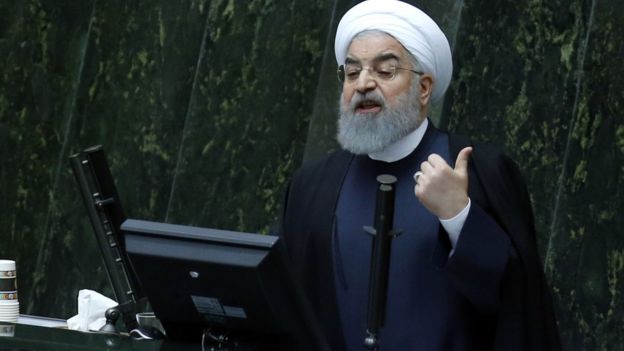
Iranian President Hassan Rouhani presents his budget for 2018-2019 on December 10, 2017Image copyrightAFP
Image captionPresident Hassan Rouhani is blamed by many for the poor state of the economy

What was the US response?

"The Iranian government should respect their people's rights, including their right to express themselves. The world is watching," White House spokeswoman Sarah Huckabee Sanders said on Twitter.
The same tweet later appeared on President Donald Trump's Twitter account.
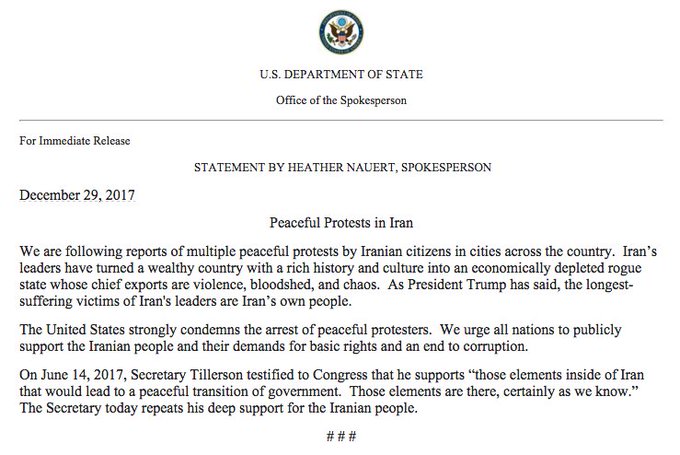
The US State Department urged all nations "to publicly support the Iranian people and their demands for basic rights and an end to corruption".

What is behind the unrest?

The protests were initially against economic conditions and corruption but appear to have turned political.
Slogans have been chanted against not just Mr Rouhani but Supreme Leader Ayatollah Ali Khamenei, and clerical rule in general.
Demonstrators were reportedly heard yelling slogans like "The people are begging, the clerics act like God". Protests have even been held in Qom, a holy city home to powerful clerics.
There is also anger at Iran's interventions abroad. In Mashhad, some chanted "not Gaza, not Lebanon, my life for Iran", a reference to what protesters say is the administration's focus on foreign rather than domestic issues.
Other demonstrators chanted "leave Syria, think about us" in videos posted online. Iran is a key provider of military support to the government of Bashar al-Assad in Syria.
It is also accused of providing arms to Houthi rebels fighting a Saudi-led coalition in Yemen, which it denies, and is an ally of Lebanon's powerful Shia movement Hezbollah.
Map showing cities in Iran where protests have occurred
Image captionProtests took place in at least half a dozen cities

Related Topics

More on this story