ROME - Italy recorded a jump in deaths from coronavirus of almost 800 on Saturday, taking the toll in the world’s hardest-hit country to almost 5,000.
In its latest desperate effort to halt the epidemic Rome ordered that all businesses must close until April 3, with the exception of those essential to maintaining the country’s supply chain.
“It is the most difficult crisis in our post-war period,” Prime Minister Giuseppe Conte said in a video posted on Facebook, adding “only production activities deemed vital for national production will be allowed”.
Conte did not specify which factories and businesses will be considered crucial to keep the country going. The government is expected to publish an emergency decree on Sunday to make the new crackdown immediately effective.
ADVERTISEMENT
Supermarkets, pharmacies, postal and banking services will remain open and essential public services including transport will be ensured.
“We are slowing down the country’s production engine but we are not stopping it,” Conte said.
Italy on Thursday overtook China as the country worst hit by the highly contagious virus.
A deserted street is pictured, after Italy reinforced the lockdown measures to combat the coronavirus disease (COVID-19) in Catania, Italy March 21, 2020. REUTERS/Antonio Parrinello
On Saturday fatalities jumped by 793 to 4,825 in the largest one-day rise since the contagion emerged a month ago.
Reported infections rose to 53,578 from 47,021, the Civil Protection Agency said. There were 2,857 people in intensive care, up from 2,655.
Lombardy, the northern Italian region around Milan which is the worst-affected by coronavirus, remains in a critical situation, with 3,095 deaths and 25,515 cases.
ADVERTISEMENT
“NO EU MEMBER CAN FACE THIS THREAT ALONE”
“What we all understand is that no member state can face this threat alone. The virus has no borders and the European Union is stronger when we show full solidarity,” EU Commission head Ursula von der Leyen told Italy’s Corriere della Sera newspaper.
Late on Friday the EU Commission moved to formalize a deal reached by EU finance ministers on March 5 to suspend EU budget rules that limit borrowing, giving Italy and other governments a free hand to fight the disease.
Slideshow (7 Images)
Italy’s failure to reduce its huge debt of 134% of gross domestic product would normally have drawn a rebuke from the EU executive, but von der Leyen said there were now other priorities.
“The Italian government will be able to put as much money into the economy as needed. Normal budget rules, debt rules for example, will not be applied at this stage,” she said.
Brussels is expected next week to unveil a plan for using the euro zone’s bailout fund, known as the European Stability Mechanism (ESM), which could unlock unlimited sovereign bond purchases by the European Central Bank.
“This work is ongoing,” Commission Vice President Valdis Dombrovskis said in an interview with Reuters.
The lockdown measures imposed in Italy and emulated by several other countries in Europe are likely to trigger a recession and heavy job losses.
Dombrovskis said the Commission is accelerating work on an EU-wide scheme to help the unemployed, scheduled for presentation in the fourth quarter.
The British government said Wednesday it plans to allow its broadcast regulator to police the internet and issue substantial fines when social media giants fail to remove "online harm".
Media minister Nicky Morgan told parliament she was "minded to" give the Office of Communications (Ofcom) the powers to oversee online user-generated content.
But she said the expanded agency -- dubbed the "first internet watchdog" by UK media -- would lack the power to take down offensive posts or block platforms that violate "their duty of care".
Those suggestions were outlined in a set of proposals published last April by the government of former prime minister Theresa May.
Prime Minister Boris Johnson took over in July and focused first on navigating the Brexit crisis.
But Britain safely left the European Union last month and his government is now preparing to stamp its own vision on the country.
Morgan and Interior Minister Priti Patel published a report outlining Ofcom's "power to issue warnings, notices and substantial fines" to companies "that facilitate the sharing of (abusive) user-generated content".
The two senior ministers stressed they were equally conscious of respecting freedoms of expression and remaining a "pro-technology government".
"We will not prevent adults from accessing or posting legal content, nor require companies to remove specific pieces of legal content," they wrote.
"The new regulatory framework will instead require companies, where relevant, to explicitly state what content and behaviour is acceptable on their sites and then for platforms to enforce this consistently."
- 'Legal but harmful' -
Ofcom was established in 2002 and began to formally oversee television and radio the following year.
But Britain has no official internet or social media regulator and is looking for ways to stop harmful online material from reaching children.
The issue gained added urgency when a British schoolgirl killed herself in 2017 after following a series of accounts about suicide and depression on Instagram and Pinterest.
"Two thirds of adults in the UK are concerned about content online, and close to half say that they have seen hateful content in the past year," Wednesday's report said.
Social media giants such as Facebook want governments to adopt a common rulebook and oversight bodies that could take the pressure off their own management teams.
"New rules are needed so that we have a more common approach across platforms and private companies aren't making so many important decisions alone," Facebook said in response to Wednesday's report.
"Any new rules need to protect people from harm without undermining freedom of expression," it added.
The big tech companies have said they also want the government to clarify how "legal content" is defined.
The Internet Association lobby, which represents companies such as Amazon and Google, said it had several "issues of concern" about Britain's plan.
These include "the scope of regulation, treatment of legal but potentially harmful content, and enforcement powers," its UK chief Daniel Dyball said.
- No executive fines -
The government has been consulting top social media managers about its proposals for over a year.
Britain's role in drafting a universal solution was boosted by Mark Zuckerberg's appointment in 2018 of former UK deputy prime minister Nick Clegg as Facebook's head of global affairs and communications.
Clegg and Zuckerberg are now setting up an oversight board at Facebook that would issue final rulings on contentious content.
The UK report said social media executives rebelled at the idea of London fining individual managers who fail to respond to the regulator's warnings.
The proposal was seen as a measure of last resort by May's media minister.
"Senior manager liability emerged as an area of concern," Wednesday's report said.
"Discussions with industry highlighted the risk of potential negative impacts on the attractiveness of the UK tech sector."
The government said it will set out its final proposals in the coming months.
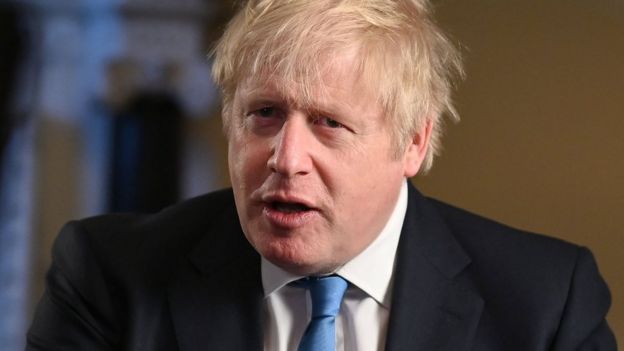
In a message released on social media an hour before the UK's departure, the prime minister said: "For many people this is an astonishing moment of hope, a moment they thought would never come.
"And there are many of course who feel a sense of anxiety and loss.
"And then of course there is a third group - perhaps the biggest - who had started to worry that the whole political wrangle would never come to an end.
"I understand all those feelings and our job as the government - my job - is to bring this country together now and take us forward."
Image captionBoris Johnson delivered a message to the nation on social media
He said that "for all its strengths and for all its admirable qualities, the EU has evolved over 50 years in a direction that no longer suits this country".
"The most important thing to say tonight is that this is not an end but a beginning," he said, and "a moment of real national renewal and change".
How did the UK mark the moment?
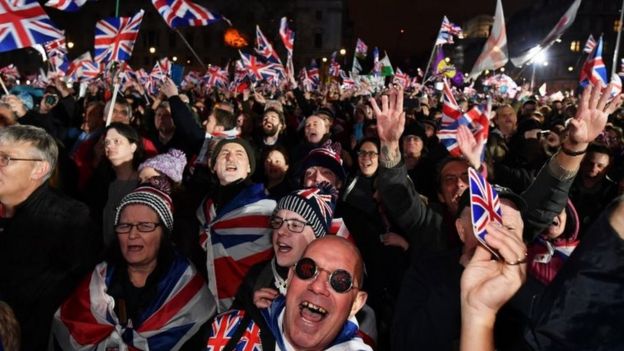
Image copyrightGETTY IMAGESImage captionBrexit supporters held a party in Parliament Square
Brexit parties were held in pubs and social clubs across the UK as the country counted down to its official departure.
Hundreds gathered in Parliament Square to celebrate Brexit, singing patriotic songs and cheering speeches from leading Brexiteers, including Nigel Farage.
The Brexit Party leader said: "Let us celebrate tonight as we have never done before.
"This is the greatest moment in the modern history of our great nation."
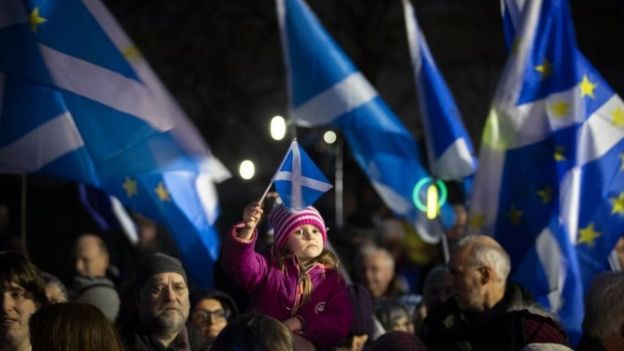
Pro-EU demonstrators earlier staged a march in Whitehall to bid a "fond farewell" to the union - and anti-Brexit rallies and candlelit vigils were held in Scotland.
Other symbolic moments on a day mixed emotions included:
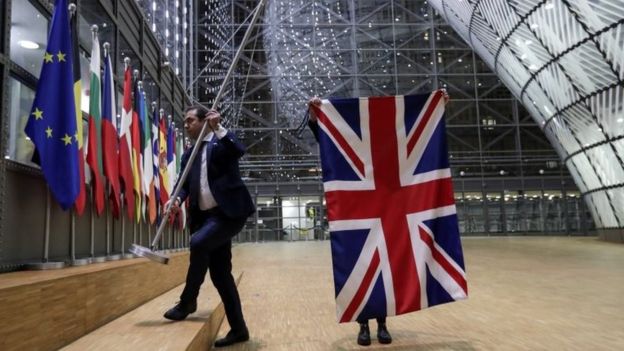
The Union flag being removed from the European Union institutions in Brussels
The Cabinet meeting in Sunderland, the first city to declare in favour of Brexit when the 2016 results were announced
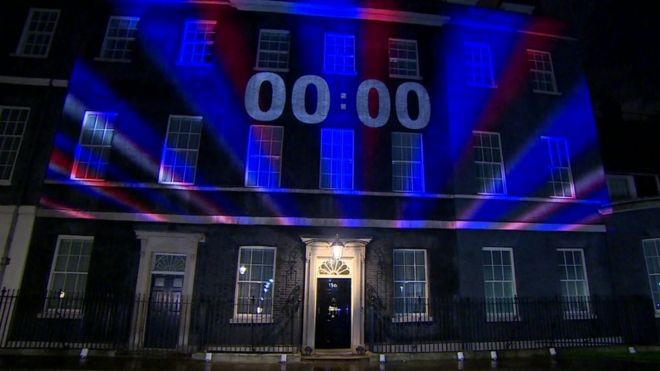
A light show illuminating 10 Downing Street and Union flags lining The Mall
A 50p coin to mark the occasion entering circulation
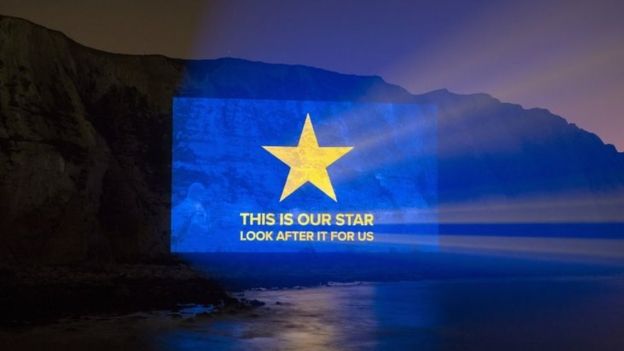
Image copyrightPA MEDIAImage captionA pro-EU group earlier projected a message on to the White Cliffs of Dover
In Northern Ireland, the campaign group Border Communities Against Brexit staged a series of protests in Armagh, near to the border with the Republic of Ireland.
At 2300 GMT, Scotland's First Minister Nicola Sturgeon tweeted a picture of the EU flag, adding: "Scotland will return to the heart of Europe as an independent country - #LeaveALightOnForScotland"
Speaking in Cardiff, Welsh First Minister Mark Drakeford said Wales, which voted to leave the EU, remained a "European nation".
Image copyrightPA MEDIAImage captionPro-EU campaigners take part in a "Missing EU Already" rally outside the Scottish Parliament
What happens now?
UK citizens will notice few immediate changes now that the country is no longer in the European Union.
Most EU laws will continue to be in force - including the free movement of people - until 31 December, when the transition period comes to an end.
The UK is aiming to sign a permanent free trade agreement with the EU, along the lines of the one the EU has with Canada.
But European leaders have warned that the UK faces a tough battle to get a deal by that deadline.
What's the reaction in Europe?
Image copyrightREUTERSImage captionOfficials remove the British flag at European Union Council in Brussels
European Commission president Ursula von der Leyen has said Britain and Brussels will fight for their interests in trade talks.
She paid tribute to UK citizens who had "contributed to the European Union and made it stronger" and said the UK's final day in the EU was "emotional".
French president Emmanuel Macron said: "At midnight, for the first time in 70 years, a country will leave the European Union.
"It is a historic alarm signal that must be heard in each of our countries."
European Council President Charles Michel warned: "The more the UK will diverge from the EU standards, the less access to the single market it will have."
What about the US?
US secretary of state Mike Pompeo said: "I am pleased the UK and EU have agreed on a £Brexit deal that honors the will of the British people.
"We will continue building upon our strong, productive, and prosperous relationship with the UK as they enter this next chapter."
Washington's ambassador to the UK, Woody Johnson, said Brexit had been "long supported" by President Donald Trump.
America's "special relationship" with the UK "will endure, flourish and grow even stronger in this exciting new era which Britain is now beginning," said Mr Johnson in a statement.
Media captionBrexit: The last four years in under two minutes
Britain joined what was then European Economic Community on 1 January, 1973, at the third attempt. Two years later the country voted by an overwhelming majority to remain in the bloc in the first nationwide referendum.
Conservative Prime Minister David Cameron held another referendum in June 2016, amid growing pressure from his own MPs and Nigel Farage's UK Independence Party.
Mr Cameron led the campaign to stay in the EU but lost by the narrow margin of 52% to 48% to the Leave campaign, fronted by fellow Conservative Boris Johnson.
Mr Cameron's successor as prime minister, Theresa May, repeatedly failed to get her version of an EU withdrawal agreement passed by Parliament and was replaced by Mr Johnson, who also failed to get his plans through.
Mr Johnson managed to secure an early general election in December last year, which he won with an 80 seat majority, on a promise to "get Brexit done".
The PM's EU withdrawal deal was approved by MPs just before Christmas, and the bill became law earlier this year.
Are you taking part in any farewell events? Share your pictures and video by emailing haveyoursay@bbc.co.uk.
Please include a contact number if you are willing to speak to a BBC journalist. You can also contact us in the following ways:






![[Gallery] Behind-The-Scenes Details About the Making of Forrest Gump](https://images.outbrainimg.com/transform/v3/eyJpdSI6IjY1ZTc2MTZiNDVjOGQ5NDY2NTY3NTM0ZDI2MDYxNTUxYTA1MmQ3ZTgzMTZhYjAwM2M2Nzc2NGIzNjM5MWVhNTIiLCJ3IjoyMzAsImgiOjE1MCwiZCI6MS41LCJjcyI6MCwiZiI6NH0.webp "[Gallery] Behind-The-Scenes Details About the Making of Forrest Gump")