Biodun Iginla, BBC News

Biodun Iginla, BBC News
Showing posts with label Melbourne. Show all posts

Wednesday, March 18, 2020

ANALYSIS: Countries groping for best coronavirus response: expert


ADVERTISING
Paris 
Sharon Lewin, director of The Peter Doherty Institute for Infection and Immunity in Melbourne and a top expert on infectious disease policy, spoke to us at France24 about the unfolding coronavirus pandemic.
Countries that got caught off-guard or did not respond to the outbreak decisively have paid a heavy price, she said. A few got ahead of the curve.
Q. What do we most urgently need to know about COVID-19?
What level of containment actually makes a difference to block transmission, and when to escalate those interventions. That is still unclear. Do you need to go Wuhan-style to completely stop it? Countries are in different phases right now.
Another unanswered question is whether you have long-term immunity if you are exposed.
Finally, what is the real mortality rate? There is a lot of confusion around that.
Q. So what IS the mortality rate?
We think it is, overall, one to two percent as compared to the number of infections. It goes up with age: over 80, up to 15 percent; 70-79, about six percent; 60-69, about three percent. Under 60, much, much less. It also rises with certain co-morbidities such as hypertension, cardiovascular disease, diabetes.
But the mortality rate is also dependent on healthcare capabilities.
Wuhan -- where the mortality rate was around eight to 10 percent -- most likely got hit harder because the virus overwhelmed the healthcare system. They were totally unprepared.
Compare that with Chinese provinces outside of Wuhan (the capital of Hubei province), where the mortality rate dropped to between one and two percent. Same virus, same population, a similar age distribution. Conclusion? The difference is related to the severity of the infection when you "present", or take action.
Outside of China, there was preparation, though in Italy the situation is alarming -- they are reporting mortality rates of about six percent across the board. Italy also has a higher proportion of elderly people than China.
Q. If a country does everything right, how much will it help?
We don’t have the data to answer that. We do know that the mortality is different in different parts of the world, but it is very unlikely to be because there are different strains of the virus. So the key factors appear to be severity of illness and healthcare capability.
Italy is an example of the consequences of being very late in recognising the problem. They reacted when they had deaths. When you are at that stage, it means that you have had virus circulating for two or three weeks already.
I give full marks to Singapore and Hong Kong, which moved much earlier. From a policy standpoint, that is much, much less acceptable to the public because the threat is hardly visible. But once you have deaths, escalating cases, and people can't get into hospitals, the public cries out for interventions.
South Korea has big numbers, but they were highly localised in two communities. It is also significant that Hong Kong and Singapore had SARS, and South Korea had MERS -- they know how these things can spread like wildfire.
Q. What is the difference in impact between lockdown and 'softer' restrictions, as in the US and Australia?
Lockdown works. As soon as Wuhan locked down, two weeks later -– exactly the incubation period of the virus –- numbers of infections started to decrease. But the question is whether you have to go that far.
In Singapore, they tested aggressively very early on and chased down cases through contact tracing. But their social distancing measures were not that extreme. They closed schools, but only for two or three weeks. Meetings were banned but people still went to work.
Q. Will the virus bounce back in places where policy interventions have worked?
In China, for example, I doubt that there's widespread immunity. You have 80,000 confirmed cases in a population of 1.5 billion. We need to know more about how some people develop immune responses to the virus without any symptoms.
Usually viruses burn out when they run out of people to infect. We talk about "R-zero" -– the number of people that each person with the virus infects. The virus will only go away with the R0 is less than 1, which means that not everyone in infecting someone else.
Will it come back? We don’t know. SARS didn’t.
Q. How would you grade China's response, and the US?
China was extremely late, and there was obviously a lot of dysfunction in December in January. But they were working with no information, and did a spectacular job of shutdown later on.
The US is surprising. The US Centers for Disease Control (CDC) is like the guru of all public health responses, and the US has done spectacular things outside of the US with Ebola, SARS, etc. But in their own backyard, they have nowhere near the success and leadership on coronavirus that the showed in responding to disease in other places.
Q. Has the US response been undermined by Trump’s leadership?
Yes. They have some outstanding people in the CDC, and they should be running the show.

Monday, February 25, 2019

ANALYSIS: How Australian abuse victim’s 'powerful' testimony sank Cardinal Pell

February 26, 2019  03H24  GMT/ZULU
MELBOURNE - “Guilty.”
There was a gasp in the Australian courtroom as the jury foreman read out the first verdict on child sex offences against Cardinal George Pell, the Vatican’s treasurer, then stunned silence as the same word was repeated for each of the four other charges he faced.
The jury of eight men and four women unanimously agreed on Dec. 11, after a four-week trial, to convict Pell of five sexual offences committed against two 13-year-old choir boys 22 years earlier in the priests’ sacristy of Melbourne’s St Patrick’s Cathedral.
They reached their decision after hearing lengthy testimony from a victim, who described how Pell had exposed himself to them, fondled their genitals and masturbated and forced one boy to perform a sex act on him. That complainant still lives in Melbourne. The other victim died in 2014.
The trial and verdict could not be reported until now due to a court-imposed suppression order, as Pell was due to face another trial on older historical child sex offence charges and the judge did not want the next jury to be prejudiced. Those additional charges were dropped on Tuesday and the judge lifted the reporting restrictions.
ADVERTISEMENT
Each of the five offences carries a maximum 10 years in jail. Pell is due to be sentenced in early March, following a mitigation plea hearing on Feb. 27.
Pell, a burly 1.9 meters (6 foot and 3 inches) tall, had sat hunched in the dock at the back of the courtroom throughout the trial. He stared straight ahead when the jury foreman said “guilty” for the first time, then turned away.
As the next four verdicts were delivered, the man described by his own lawyer as the “Darth Vader” of the Catholic Church sat with his head bowed.
Pell, the No. 3 official in the Vatican hierarchy, is the most senior Roman Catholic cleric worldwide to be convicted of such offences. His downfall brings to the heart of the papal administration a scandal over clerical abuse that has ravaged the Church’s credibility in the United States, Chile, Australia and elsewhere over the last three decades.
Pope Francis, leader of the world’s 1.2 billion Catholics, ended a conference on sexual abuse on Sunday, calling for an “all-out battle” against a crime that should be “erased from the face of the earth”. [nL5N20J0AF]

POWERPOINT DEFENSE

The December verdict followed a re-trial. Three months earlier, a first trial of the same offences had ended in a deadlocked jury that left some jurors in tears.
ADVERTISEMENT
ADVERTISING
Pell’s lawyer Robert Richter, a theatrical 72-year-old well-known in Australia after taking on the defense in some of the country’s most high-profile criminal cases, had been confident since the pre-trial hearings that this time he had a slam dunk defense.
Late in proceedings at the re-trial, Richter introduced a new witness, a fellow criminal barrister and former altar server, who had a possible alibi for Pell. The witness said he had served at a mass in late 1996 and afterwards he and his mother had chatted with Pell on the front steps of the cathedral, which the defense said meant he could not have been in the sacristy at the time of the alleged offences.
But under cross-examination, the former altar server could not remember the exact date, and his recall of other details was vague and partly contradicted another defense witness.
Richter brought out Pell’s heavy ceremonial robes, trying to demonstrate they could hardly be maneuvered to expose himself to the boys as the prosecution had alleged.
He had his star witness, a priest who had helped Pell conduct services, demonstrate how elaborately and tightly knotted the robe was around the archbishop’s waist.
There was also debate over whether the wine that the boys were caught swigging in the sacristy by Pell immediately before four of the offences took place was red, as the accuser said, or white, as the court heard was preferred by the dean of the cathedral at the time, as the defense tried to pick holes in the victim’s account.
For his closing argument, Richter rolled out a PowerPoint presentation with dozens of bullet points spelling out why, he said, it would have been almost impossible for the alleged events to have occurred.
He reminded the jury of Pell’s strenuous denials.
Russian TV lists nuclear targets in U.S.
“What a load of absolute disgraceful rubbish. Completely false. Madness,” the jury heard Pell tell police in a recording of an interview in a hotel room near Rome airport in 2016 played earlier in the trial.
“You could scarcely imagine a place that was more unlikely for committing pedophilia crimes than the sacristy of the Cathedral after mass,” Pell, who did not testify at either trial, said in the recording.

CLOSED DOOR TESTIMONY

The jury was unswayed, returning a verdict of guilty on all five charges after hearing a prosecution case based entirely on the evidence given by Pell’s surviving accuser.
That testimony was the crux of both trials.
Reporters, Pell’s supporters and abuse survivors who had filled the small court for most of the trial did not see or hear the complainant’s two-and-a-half days of testimony and cross-examination by Richter, which was conducted by video link for the jury behind closed doors. It was later outlined to the court in comments by the prosecutor.
In his closing argument to the jury, prosecutor Mark Gibson, in a quiet voice, called the accuser’s evidence “powerful and persuasive”.
“He was not a person indulging in fantasy or imagining things to the point where he now believed his own imaginative mind, but was simply telling it as it was and is,” Gibson told the court.
ADVERTISEMENT
Pell had appeared relaxed through most of his trial. Every day he sat in the dock, usually wearing a white shirt with a clerical collar, black pants and a beige jacket, writing on a large notepad and taking occasional sips of water. During breaks in proceedings he would chat with supporters.
But in the nine months since pre-trial hearings began, Pell’s health had clearly deteriorated.
Judge Peter Kidd extended bail after Pell was convicted so he could have double knee surgery in Sydney on Dec. 14, which had been postponed after the first trial.
Pell’s lawyers will now be counting on an appeal filed last week to keep him out of jail.

BREAKING: Cardinal Pell found guilty of sexual offences in Australia


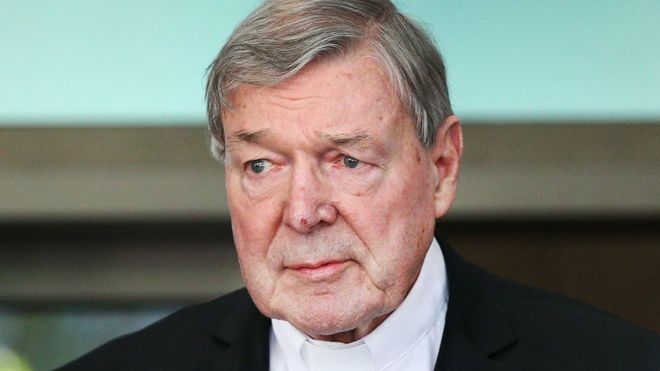
George Pell leaves Melbourne Magistrates' Court last MayImage copyrightGETTY IMAGES
Image captionGeorge Pell is the most senior Catholic cleric to be convicted of such crimes
by Louise Healy and Biodun Iginla, BBC News, Melbourne
Cardinal George Pell has been found guilty of sexual offences in Australia, making him the highest-ranking Catholic figure to receive such a conviction.
Pell abused two choir boys in the rooms of a Melbourne cathedral in 1996, a jury found. He had pleaded not guilty.
The verdict was handed down in December, but it could not be reported until now due to legal reasons.
Pell is due to be sentenced on Wednesday. His lawyers say they will appeal against the conviction.
As Vatican treasurer, the 77-year-old cardinal is one of the Church's most powerful officials.
His trial was heard twice last year because a first jury failed to reach a verdict.
A second jury unanimously convicted him of one charge of sexually penetrating a child under 16, and four counts of committing an indecent act on a child under 16.
The Catholic Church worldwide has in recent years faced a damaging series of allegations relating to sex abuse by priests, and claims that these cases were covered up.
Pell's case has drawn huge interest at a time when the Pope is attempting to address the scandals, including by holding a four-day summit in the past week.
ADVERTISEMENT

What did the court hear?

Pell was in his first year as archbishop of Melbourne in 1996 when he found the boys in the rooms of a cathedral following a mass, the jury was told.
After telling them they were in trouble for drinking communion wine, Pell forced each boy into indecent acts, the court heard.
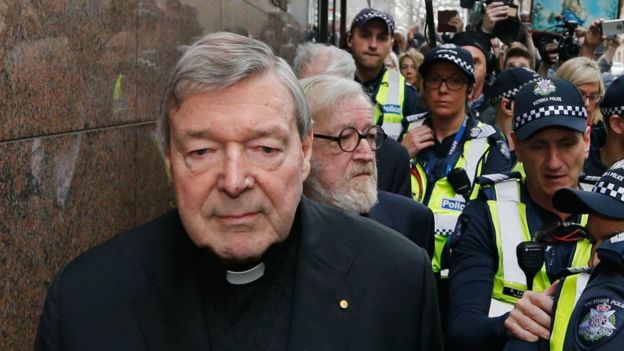
George Pell tailed by his lawyer and a police escort at a court appearance in Melbourne in May 2018Image copyrightGETTY IMAGES
Image captionPell's case has drawn huge attention around the world
The court heard testimony from one of the victims. The other victim is no longer alive.
A jury rejected an argument by Pell's lawyer, Robert Richter QC, that the allegations were fantasies contrived by the victims.

What did Pell say?

He denied all allegations against him, saying in 2017: "I am innocent of these charges - they are false. The whole idea of sexual abuse is abhorrent to me."
He has been on an extended leave of absence from the Vatican amid the court proceedings in Melbourne.