Biodun Iginla, BBC News

Biodun Iginla, BBC News
Showing posts with label biodun iginla. Show all posts

Thursday, March 26, 2020

ANALYSIS: The state in the time of covid-19


Everything’s under control

by Biodun Iginla, The Economist Intelligence Unit News Analyst


Big government is needed to fight the pandemic. What matters is how it shrinks back again afterward


Leaders


Mar 26th 2020 edition


Editor’s note: The Economist is making some of its most important coverage of the covid-19 pandemic freely available to readers of The Economist Today, our daily newsletter. To receive it, register here. For more coverage, see our coronavirus hub

IN JUST A few weeks a virus a ten-thousandth of a millimetre in diameter has transformed Western democracies. States have shut down businesses and sealed people indoors. They have promised trillions of dollars to keep the economy on life support. If South Korea and Singapore are a guide, medical and electronic privacy are about to be cast aside. It is the most dramatic extension of state power since the second world war.
One taboo after another has been broken. Not just in the threat of fines or prison for ordinary people doing ordinary things, but also in the size and scope of the government’s role in the economy. In America Congress is poised to pass a package worth almost $2trn, 10% of GDP, twice what was promised in 2007-09. Credit guarantees by Britain, France and other countries are worth 15% of GDP. Central banks are printing money and using it to buy assets they used to spurn. For a while, at least, governments are seeking to ban bankruptcy.
For believers in limited government and open markets, covid-19 poses a problem. The state must act decisively. But history suggests that after crises the state does not give up all the ground it has taken. Today that has implications not just for the economy, but also for the surveillance of individuals.
It is no accident that the state grows during crises. Governments might have stumbled in the pandemic, but they alone can coerce and mobilise vast resources rapidly. Today they are needed to enforce business closures and isolation to stop the virus. Only they can help offset the resulting economic collapse. In America and the euro area GDP could drop by 5-10% year-on-year, perhaps more.
One reason the state’s role has changed so rapidly is that covid-19 spreads like wildfire. In less than four months it has gone from a market in Wuhan to almost every country in the world. The past week logged 253,000 new cases. People are scared of the example of Italy, where almost 74,000 recorded cases have overwhelmed a world-class health system, leading to over 7,500 deaths.
That fear is the other reason for rapid change. When Britain’s government tried to hang back so as to minimise state interference, it was accused of doing too little, too late. France, by contrast, passed a law this week giving the government the power not just to control people’s movements, but also to manage prices and requisition goods. During the crisis its president, Emmanuel Macron, has seen his approval ratings soar.
In most of the world the state has so far responded to covid-19 with a mix of coercion and economic heft. As the pandemic proceeds, it is also likely to exploit its unique power to monitor people using their data (see article). Hong Kong uses apps on phones that show where you are in order to enforce quarantines. China has a passporting system to record who is safe to be out. Phone data help modellers predict the spread of the disease. And if a government suppresses covid-19, as China has, it will need to prevent a second wave among the many who are still susceptible, by pouncing on every new cluster. South Korea says that automatically tracing the contacts of fresh infections, using mobile technology, gets results in ten minutes instead of 24 hours.
This vast increase in state power has taken place with almost no time for debate. Some will reassure themselves that it is just temporary and that it will leave almost no mark, as with Spanish flu a century ago. However, the scale of the response makes covid-19 more like a war or the Depression. And here the record suggests that crises lead to a permanently bigger state with many more powers and responsibilities and the taxes to pay for them. The welfare state, income tax, nationalisation, all grew out of conflict and crisis (see article).
As that list suggests, some of today’s changes will be desirable. It would be good if governments were better prepared for the next pandemic; so, too, if they invested in public health, including in America, where reform is badly needed. Some countries need decent sick pay.
Other changes may be less clear-cut, but will be hard to undo because they were backed by powerful constituencies even before the pandemic. One example is the further unpicking of the euro-zone pact that is supposed to impose discipline on the member-states’ borrowing. Likewise, Britain has taken its railways under state control—a step that is supposed to be temporary but which may never be retracted.
More worrying is the spread of bad habits. Governments may retreat into autarky. Some fear running out of the ingredients for medicines, many of which are made in China. Russia has imposed a temporary ban on exporting grain. Industrialists and politicians have lost trust in supply chains. It is but a small step from there to long-term state support for the national champions that will have just been bailed out by taxpayers. Trade’s prospects are already dim (see article); all this would further cloud them—and the recovery. And in the long term, a vast and lasting expansion of the state together with dramatically higher public debt (see article) is likely to lead to a lumbering, less dynamic kind of capitalism.
But that is not the biggest problem. The greater worries lie elsewhere, in the abuse of office and the threats to freedom. Some politicians are already making power grabs, as in Hungary, where the government is seeking an indefinite state of emergency. Israel’s prime minister, Binyamin Netanyahu, appears to see the crisis as a chance to evade a trial for corruption.
The most worrying is the dissemination of intrusive surveillance. Invasive data collection and processing will spread because it offers a real edge in managing the disease. But they also require the state to have routine access to citizens’ medical and electronic records. The temptation will be to use surveillance after the pandemic, much as anti-terror legislation was extended after 9/11. This might start with tracing TB cases or drug dealers. Nobody knows where it would end, especially if, having dealt with covid-19, surveillance-mad China is seen as a model.
Surveillance may well be needed to cope with covid-19. Rules with sunset clauses and scrutiny built in can help stop it at that. But the main defence against the overmighty state, in tech and the economy, will be citizens themselves. They must remember that a pandemic government is not fit for everyday life. ■

Dig deeper:
For our latest coverage of the covid-19 pandemic, register for The Economist Today, our daily newsletter, or visit our coronavirus hub

This article appeared in the Leaders section of the print edition under the headline "Everything’s under control"

Reuse this contentThe Trust Project

Thursday, March 12, 2020

ANALYSIS: Covid-19: The politics of pandemics

by Biodun Iginla, The Economist Intelligence Unit News Analyst


All governments will struggle. Some will struggle more than others
LeadersMar 12th 2020 edition

TO SEE WHAT is to come look to Lombardy, the affluent Italian region at the heart of the covid-19 outbreak in Europe. Its hospitals provide world-class health care. Until last week they thought they would cope with the disease—then waves of people began turning up with pneumonia. Having run out of ventilators and oxygen, exhausted staff at some hospitals are being forced to leave untreated patients to die.
The pandemic, as the World Health Organisation (WHO) officially declared it this week, is spreading fast, with almost 45,000 cases and nearly 1,500 deaths in 112 countries outside China. Epidemiologists reckon Italy is one or two weeks ahead of places like Spain, France, America and Britain. Less-connected countries, such as Egypt and India, are further behind, but not much. (For more coverage of covid-19 see our coronavirus hub.)
Few of today’s political leaders have ever faced anything like a pandemic and its economic fallout—though some are evoking the financial crisis of 2007-09 (see article). As they belatedly realise that health systems will buckle and deaths mount, leaders are at last coming to terms with the fact that they will have to weather the storm. Three factors will determine how they cope: their attitude to uncertainty; the structure and competence of their health systems; and, above all, whether they are trusted.
The uncertainty has many sources. One is that SARS-CoV-2 and the disease it causes, covid-19, are not fully understood (see article). Another is over the status of the pandemic. In each region or country it tends to proliferate rapidly undetected. By the time testing detects cases in one place it will be spreading in many others, as it was in Italy, Iran and South Korea. By the time governments shut schools and ban crowds they may be too late.
China’s solution, endorsed by the WHO, was to impose a brutal quarantine, bolstered by mass-testing and contact tracing. That came at a high human and economic cost, but new infections have dwindled. This week, in a victory lap, President Xi Jinping visited Wuhan, where the pandemic first emerged (see article). Yet uncertainty persists even in China, because nobody knows if a second wave of infections will rise up as the quarantine eases.
In democracies leaders have to judge if people will tolerate China’s harsh regime of isolation and surveillance. Italy’s lockdown is largely self-policed and does not heavily infringe people’s rights. But if it proves leakier than China’s, it may be almost as expensive and a lot less effective (see article).
Efficacy also depends on the structure and competence of health-care systems. There is immense scope for mixed messages and inconsistent instructions about testing and when to stay isolated at home. Every health system will be overwhelmed. Places where people receive very little health care, including refugee camps and slums, will be the most vulnerable. But even the best-resourced hospitals in rich countries will struggle.
Universal systems like Britain’s National Health Service should find it easier to mobilise resources and adapt rules and practices than fragmented, private ones that have to worry about who pays whom and who is liable for what (see article). The United States, despite its wealth and the excellence of its medical science, faces hurdles. Its private system is optimised for fee-paying treatments. America’s 28m uninsured people, 11m illegal immigrants and an unknown number without sick pay all have reasons to avoid testing or isolation. Red tape and cuts have fatally delayed adequate testing (see article).
Uncertainty will be a drag on the third factor—trust. Trust gives leaders licence to take difficult decisions about quarantines and social-distancing, including school closures. In Iran the government, which has long been unpopular, is widely suspected of covering up deaths and cases. That is one reason rebellious clerics could refuse to shut shrines, even though they spread infection (see article).
Nothing stokes rumour and fear more than the suspicion that politicians are hiding the truth. When they downplay the threat in a misguided attempt to avoid panic, they end up sowing confusion and costing lives. Yet leaders have struggled to come to terms with the pandemic and how to talk about it. President Donald Trump, in particular, has veered from unfounded optimism to attacking his foes. This week he announced a 30-day ban on most travel from Europe that will do little to slow a disease which is already circulating in America. As people witness the death of friends and relatives, he will find that the pandemic cannot be palmed off as a conspiracy by foreigners, Democrats and CNN.
What should politicians do? Each country must strike its own balance between the benefits of tracking the disease and the invasion of privacy, but South Korea and China show the power of big data and mass-testing as a way of identifying cases and limiting their spread. Governments also need to anticipate the pandemic, because actions to slow its spread, such as banning crowds, are more effective if they are early.
The best example of how to respond is Singapore, which has had many fewer cases than expected. Thanks to an efficient bureaucracy in a single small territory, world-class universal health care and the well-learned lesson of SARS, an epidemic of a related virus in 2003, Singapore acted early. It has been able to make difficult trade-offs with public consent because its message has been consistent, science-based and trusted.
In the West covid-19 is a challenge to the generation of politicians who have taken power since the financial crisis. Many of them decry globalisation and experts. They thrive on division and conflict. In some ways the pandemic will play to their agenda. Countries may follow America and turn inward and close their borders. In so far as shortages crimp the world economy, industries may pull back from globalisation—though they would gain more protection by diversifying their supply chains.
Yet the pandemic also puts doctors, scientists and policy experts once again at the heart of government. Pandemics are quintessentially global affairs. Countries need to work together on treatment protocols, therapeutics and, it is hoped, a vaccine. Worried voters may well have less of an appetite for the theatrical wrestling match of partisan politics. They need their governments to deal with the real problems they are facing—which is what politics should have been about all along. ■

Monday, January 20, 2020

ANALYSIS: Isabel dos Santos: Africa's richest woman 'ripped off Angola'


Isabel dos Santos attends the screening of "BlacKkKlansman" during the 71st annual Cannes Film Festival at Palais des Festivals on May 14, 2018 in Cannes, FranceImage copyrightGETTY IMAGES
Leaked documents reveal how Africa's richest woman made her fortune through exploiting her own country, and corruption.
Isabel dos Santos got access to lucrative deals involving land, oil, diamonds and telecoms when her father was president of Angola, a southern African country rich in natural resources.
The documents show how she and her husband were allowed to buy valuable state assets in a series of suspicious deals.
Ms Dos Santos says the allegations against her are entirely false and that there is a politically motivated witch-hunt by the Angolan government.
The former president's daughter has made the UK her home and owns expensive properties in central London.
She is already under criminal investigation by the authorities in Angola for corruption and her assets in the country have been frozen.
Now BBC Panorama has been given access to more than 700,000 leaked documents about the billionaire's business empire.
Most were obtained by the Platform to Protect Whistle-blowers in Africa and shared with the International Consortium of Investigative Journalists (ICIJ).
They've been investigated by 37 media organisations including the Guardian and Portugal's Expresso newspaper.
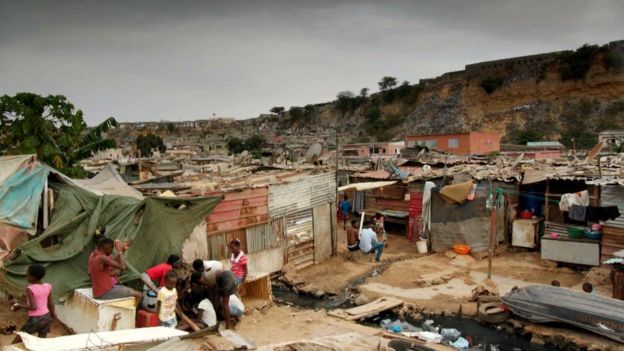
Angolan shanty town
Image captionThirty per cent of Angolans live in poverty on less than $2 a day
Andrew Feinstein, the head of Corruption Watch, says the documents show how Ms Dos Santos exploited her country at the expense of ordinary Angolans.
"Every time she appears on the cover of some glossy magazine somewhere in the world, every time that she hosts one of her glamorous parties in the south of France, she is doing so by trampling on the aspirations of the citizens of Angola."
The ICIJ have called the documents the Luanda Leaks.

The oil connection

One of the most suspicious deals was run from London through a UK subsidiary of the Angolan state oil company Sonangol.
Ms Dos Santos had been put in charge of the struggling Sonangol in 2016, thanks to a presidential decree from her father Jose Eduardo dos Santos, who kept a tight grip on his country for the 38 years he was in power.
But when he retired as president in September 2017 her position was soon under threat, even though his hand-picked successor came from the same party. Ms Dos Santos was sacked two months later.
Many Angolans have been surprised at the way that President João Lourenço has gone after the business interests of his predecessor's family.
Buildings along the Marginal promenade called avenida 4 de fevereiro, Luanda
Getty Images
Angola in numbers
  • 29 millionpopulation
  • 27-yearcivil war, fought from independence to 2002
  • $4,170average income, but this masks big disparities
  • 30%of population live in poverty - less than $1.90/day
  • 2ndbiggest oil producer in Africa. Also major diamond producer
Source: World Bank, Opec
The leaked documents show that as she left Sonangol, Ms Dos Santos approved $58m of suspicious payments to a consultancy company in Dubai called Matter Business Solutions.
She says she has no financial interest in Matter, but the leaked documents reveal it was run by her business manager and owned by a friend.
Panorama understands that Matter sent more than 50 invoices to Sonangol in London on the day that she was fired.
Ms Dos Santos appears to have approved payments to her friend's company after she was sacked.
Although some consultancy work had been carried out by Matter, there's very little detail on the invoices to justify such large bills.
One asks for €472,196 for unspecified expenses - another asks for $928,517 for unspecified legal services.
Two of the invoices - each for €676,339.97 - are for exactly the same work on the same date and Ms Dos Santos signed them both off anyway.
Matter Business Solutions invoice
Image captionThese are some of the invoices Isabel dos Santos signed off in her last week at Sonangol
Presentational white space
Lawyers for Matter Business Solutions say it was brought in to help restructure the oil industry in Angola, and that the invoices were for work that had already been carried out by other consultancy companies it had hired.
"Regarding the invoices related with expenses, it is common for consultancy companies to add expenses to invoices as a general item. This is often due to those expenses involving large amounts of paperwork... Matter can produce documentary evidence to confirm all expenses incurred."
Ms Dos Santos's lawyers said her actions with regard to the Matter payments were entirely lawful and that she had not authorised payments after she had been dismissed from Sonangol.
They said: "All invoices paid were in relation to services contracted and agreed between the two parties, under a contract that was approved with the full knowledge and approval of the Sonangol Board of Directors."
Media captionIsabel dos Santos: "I regret that Angola has chosen this path"
The ICIJ and Panorama have also uncovered new details about the business deals that made Ms Dos Santos rich.
Much of her fortune is based on her ownership of a stake in the Portuguese energy company Galp, which one of her companies bought from Sonangol in 2006.
The documents show it only had to pay 15% of the price upfront and that the remaining €63m ($70m) was turned into a low-interest loan from Sonangol.
Under the generous terms of the loan, her debt to the Angolan people didn't have to be repaid for 11 years.
Her stake in Galp is now worth more than €750m.
Ms Dos Santos's company did offer to repay the Sonangol loan in 2017.
The repayment offer should have been rejected because it didn't include almost €9m of interest owing.
Graphic shows bank account and letter from Isabel dos Santos to bank asking for transfer of funds
Image captionBank orders signed by Isabel dos Santos transferred almost $58m out of the Angolan state oil company
Presentational white space
But Ms Dos Santos was in charge of Sonangol at the time and she accepted the money as full payment of her own debt.
She was fired six days later and the payment was returned by the new Sonangol management.
Ms Dos Santos says she initiated the purchase of the stake in Galp, and that Sonangol made money from the deal as well.
"There's absolutely no wrongdoing in any of those transactions. This investment is the investment that in history has generated the most benefit for the national oil company and all the contracts that were drafted are perfectly legal contracts, there are no wrongdoings."
Her lawyers say the repayment offer in 2017 covered what Sonangol had indicated was owed.

The diamond connection

It's a similar story in the diamond industry.
Ms Dos Santos's husband, Sindika Dokolo, signed a one-sided agreement in 2012 with Angolan state diamond company Sodiam.
They were supposed to be 50-50 partners in a deal to buy a stake in the Swiss luxury jeweller De Grisogono.
But it was funded by the state company. The documents show that 18 months after the deal, Sodiam had put $79m into the partnership, while Mr Dokolo had only invested $4m. Sodiam also awarded him a €5m success fee for brokering the deal, so he didn't have to use any of his own money.
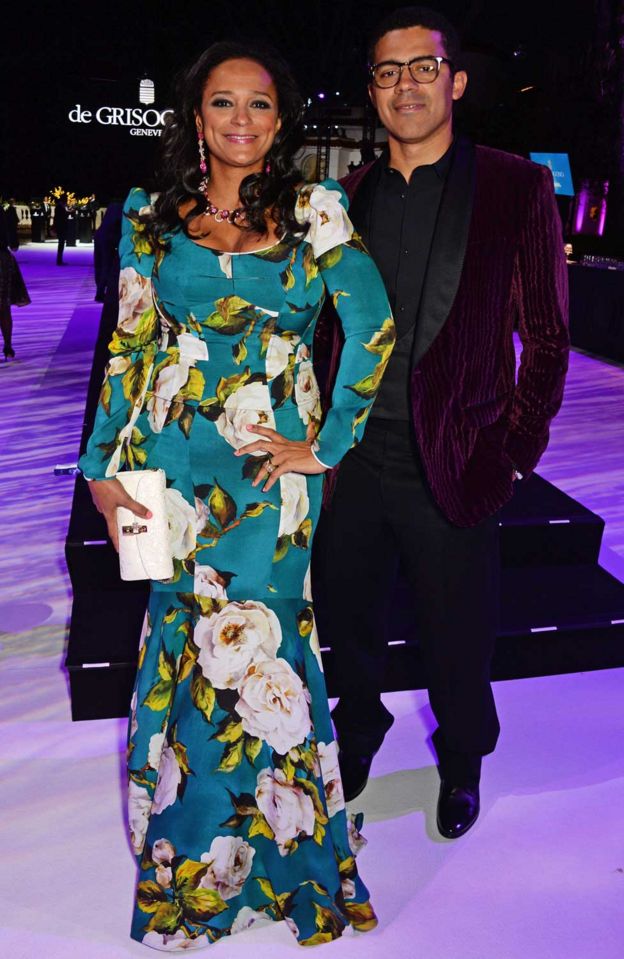
Isabel dos Santos and Sindika Dokolo attend the de Grisogono party during the 69th Cannes Film Festival at Hotel du Cap-Eden-Roc on May 17, 2016 in Cap d'Antibes, FranceImage copyrightGETTY IMAGES
Image captionIsabel dos Santos and her husband Sindika Dokolo can often be seen at film premieres and festivals with the world's stars
Presentational white space
The diamond deal gets even worse for the Angolan people.
The documents reveal how Sodiam borrowed all the cash from a private bank in which Ms Dos Santos is the biggest shareholder.
Sodiam has to pay 9% interest and the loan was guaranteed by a presidential decree from her father, so Ms Dos Santos's bank cannot lose out.
Bravo da Rosa, the new chief executive of Sodiam, told Panorama that the Angolan people hadn't got a single dollar back from the deal: "In the end, when we have finished paying back this loan, Sodiam will have lost more than $200m."
The former president also gave Ms Dos Santos's husband the right to buy some of Angola's raw diamonds.
line

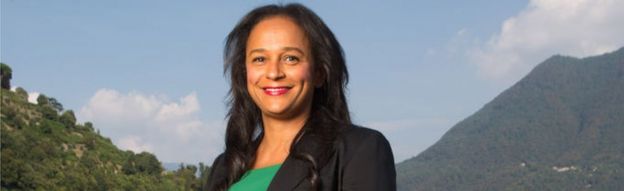
Who is Isabel dos Santos?

Isabel dos Santos wearing a Dolce & Gabbana dress during the event Forum Ambrosetti in Villa d'Este. Cernobbio, ItalyImage copyrightGETTY IMAGES
  • Eldest daughter of ex-President Jose Eduardo dos Santos
  • Married to Congolese art collector and businessman Sindika Dokolo
  • Educated in UK, where she currently lives
  • Reported to be Africa's richest woman, with a fortune of some $2bn
  • Has stakes in oil and mobile phone companies and banks, mostly in Angola and Portugal
Source: Forbes magazine and others
line
The Angolan government says the diamonds were sold at a knockdown price and sources have told Panorama that almost $1bn may have been lost.
Ms Dos Santos told the BBC she couldn't comment because she was not a shareholder of De Grisogono.
But the leaked documents show that she is described as a shareholder of De Grisogono by her own financial advisers.
Mr Dokolo did put in some money later. His lawyers say he invested $115m and that the takeover of De Grisogono was his idea. They say his company paid above the market rate for the raw diamonds.

The land connection

The leaked documents also reveal how Ms Dos Santos bought land from the state in September 2017. Once again she only had to pay a small up-front fee.
Her company bought a square kilometre of prime beachfront land in the capital Luanda with the help of presidential decrees signed by her father.
The Angolan state oil company Sonangol has a subsidiary in London.
Image captionAngolan state oil company Sonangol has a subsidiary in London where suspicious deals took place
The contract says the land was worth $96m, but the documents show her company paid only 5% of that after agreeing to invest the rest in the development.
Panorama traced some of the ordinary Angolans who were evicted to make way for the Futungo development.
Media captionAlbertina de Fatima describes living next to an open sewer in Angola
They've been moved from the Luandan seafront to an isolated housing development 30 miles (50km) from the capital.
Teresa Vissapa lost her business to Ms Dos Santos' development and is now struggling to bring up her seven children.
She said: "I only ask God to make her think a little more about our situation. Maybe she doesn't even know it, but we are suffering."
Ms Dos Santos declined to comment on the Futungo development.
But it was not the only land deal involving Ms Dos Santos that displaced the local population.
About 500 families were evicted from another stretch of the Luandan seafront after Isabel dos Santos got involved in another major redevelopment project.
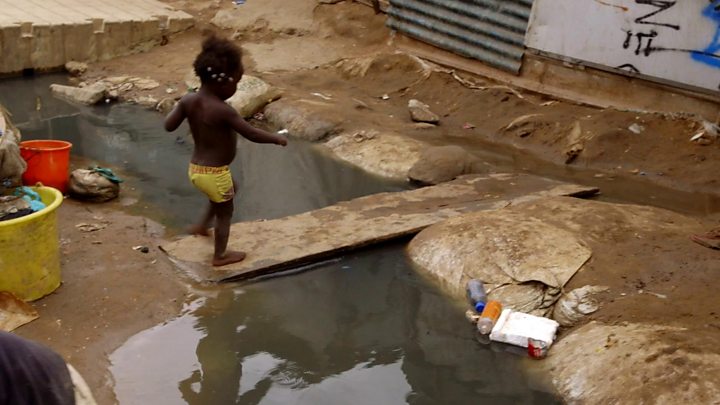
The families are now living in desperate conditions next to an open sewer. Some of their shacks are flooded with sewage whenever the tide rises.
Ms Dos Santos says there weren't any evictions linked to her project and that her companies were never paid because the development was cancelled.

The telecoms connection

The billionaire has also made big profits from the telecoms industry in Angola.
She acquired a 25% stake in the country's biggest mobile phone provider, Unitel. It was granted a telecoms licence by her father in 1999 and she bought her stake the following year from a high ranking government official.
Unitel has already paid her $1bn in dividends and her stake is worth another $1bn. But that's not the only way she got cash from the private company.
She arranged for Unitel to lend €350m to a new company she set up, called Unitel International Holdings.
Leaked documents show Isabel dos Santos signed off on loans from Unitel as both the borrower and the lender.
Image captionThe leaked documents show Isabel dos Santos signed off on loans from Unitel as both the borrower and the lender
Presentational white space
The company name was misleading because it wasn't connected to Unitel and Ms Dos Santos was the owner.
The documents show Ms Dos Santos signed off on the loans as both lender and borrower, which is a blatant conflict of interest.
Ms Dos Santos denied that the loans were corrupt. She said: "This loan had both directors' approval and shareholders' approval, and it's a loan that will generate, and has generated, benefit for Unitel."
Her lawyers say the loans protected Unitel from currency fluctuations.
Most of the companies involved in the dodgy deals were overseen by accountants working for the financial services company, Price Waterhouse Coopers (PWC). It's made millions providing auditing, consultancy and tax advice to her companies.
But PWC has terminated its relationship with the billionaire and her family, after Panorama questioned the way the company had assisted Ms Dos Santos in the deals that had made her rich.
PWC says it is holding an inquiry into the "very serious and concerning allegations".
Tom Keatinge, director of the Centre for Financial Crime and Security Studies, criticised Price Waterhouse Cooper for giving the corruption a "veneer of respectability"
Image captionTom Keatinge, director of the Centre for Financial Crime and Security Studies, criticised PWC for giving the corruption a "veneer of respectability"
Tom Keatinge, director of the Centre for Financial Crime and Security Studies, told Panorama that PWC had given legitimacy to Ms Dos Santos and her companies.
"PWC, if not facilitating the corruption, are providing a veneer of respectability that makes what's happening acceptable or more acceptable than it might otherwise be.
"So if I was at PWC I'd be conducting a pretty thorough audit of what decisions were made, and in hindsight actually: 'Did we make the wrong decision to accept this business and should we have reported what we had been presented with?'"
PWC says it strives to maintain the highest professional standards and has set expectations for consistent ethical behaviour across its global network.
"In response to the very serious and concerning allegations that have been raised, we immediately initiated an investigation and are working to thoroughly evaluate the facts and conclude our inquiry.
"We will not hesitate to take appropriate actions to ensure that we always stand for the very highest standards of behaviour, wherever we operate in the world."
Panorama: The Corrupt Billionaire is on BBC1 at 20:30 GMT on 20 January.

More on this story