
The UN’s plan offers the best hope of ending Libya’s chaos, but Italy and France are making things worse
IT IS BY FAR the preferred jumping-off point for migrants hoping to reach Europe. Jihadists use its ungoverned spaces to train and plot attacks at home and abroad. In short, Libya’s chaos is destabilising countries all around it. Yet European countries that helped set it down this path are ignoring it—or making matters worse.
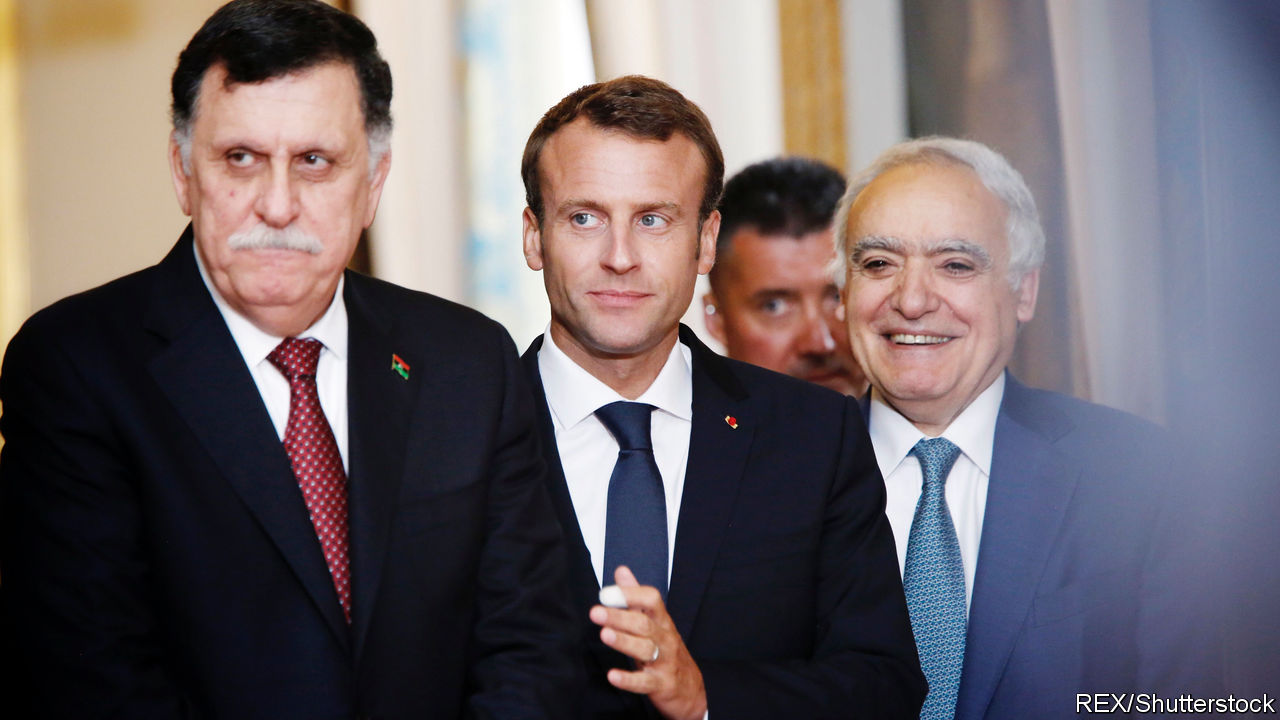
They have a responsibility—as well as a pressing interest—to help put Libya back together. That begins by getting behind the efforts of the UN and its envoy, Ghassan Salamé (pictured right).
You break it, you own it
In 2011 NATO members in effect acted as the air force of the revolution that toppled Muammar Qaddafi. The operation was led by France and Britain, with the participation of Italy (Libya’s former colonial master) and America “leading from behind”. But then the Europeans stood by as Libya descended into a civil war that left it shattered and ruled by militias.
Mr Salamé proposes to start putting the country back together with a national conference aimed at getting the country’s rival factions to lay down their arms and agree on a new constitution and electoral law. Then elections would be held. The plan is sensible, but will not be easy to implement. A UN-backed government of national accord (GNA), created in 2015 and based in Tripoli, has failed to win much support. The country’s warlords are loth to compromise.
The search for peace is made all the harder by the rivalry between France and Italy. To begin with, they disagree over which country should lead the peace process. Italy will stake its claim on November 12th by hosting an international conference on Libya (see article). This follows two summits hosted by France.
The feud is part of a broader contest. Each sees Libya as part of its sphere of influence, and each has national oil champions whose interests it promotes. More recently, their leaders have come to embody rival visions of Europe: President Emmanuel Macron of France champions an open, integrated and liberal Europe; Matteo Salvini, the interior minister and head of the Northern League (the main force in Italy’s new populist government), calls for a more nationalist Europe that is closed to migrants. Libya is caught in between.
Mr Macron sees the Libyan peace process as an opportunity to assert his leadership, while safeguarding France’s interests in the Sahel, where it has 4,500 troops fighting jihadist groups. He has brought together Fayez al-Serraj (pictured left), the head of the GNA, and General Khalifa Haftar, the country’s strongest warlord, who dominates a rival government in eastern Libya. But France’s efforts have been poorly co-ordinated with the UN and, at times, undermined it. At the last summit it hosted, in May, it was announced that Libya would hold elections by December 10th—a deadline that was never sensible nor realistic, and has now been abandoned.
Mr Salvini, for his part, suspects that Mr Macron is seeking advantage for the French oil giant, Total, by helping General Haftar. “Someone for economic motives and selfish national interest, is putting at risk the security of north Africa and, as a result, of Europe as a whole,” growls Mr Salvini. Italy’s own oil giant, Eni, is active in the west, where Italy has also made murky deals with Libyan warlords to stop people smugglers.
Other foreign powers are also stirring trouble. Egypt, the United Arab Emirates and Russia have all lent support to General Haftar—be it political, financial or military—whom they regard as a bulwark against Islamism. All this has made him only more stubborn. Last year he reportedly refused an offer by Mr Serraj to share power. This year he said he would “take action” if he did not like the result of elections.
Come together, right now
France, Italy and other powers should support Mr Salamé, who is respected by Libyans. In September he successfully negotiated a ceasefire among the militias fighting in and around Tripoli. If the conference in Italy serves to strengthen him, it will contribute to peace. If it merely encourages Libya’s strongmen to play one side off of the other, it will prolong the chaos and all the dangers that come with it.
Granted, the UN-led process is moving slower than many had hoped. But it is still the best hope for ending the mess in Libya.
They have a responsibility—as well as a pressing interest—to help put Libya back together. That begins by getting behind the efforts of the UN and its envoy, Ghassan Salamé (pictured right).
Latest stories
In 2011 NATO members in effect acted as the air force of the revolution that toppled Muammar Qaddafi. The operation was led by France and Britain, with the participation of Italy (Libya’s former colonial master) and America “leading from behind”. But then the Europeans stood by as Libya descended into a civil war that left it shattered and ruled by militias.
Mr Salamé proposes to start putting the country back together with a national conference aimed at getting the country’s rival factions to lay down their arms and agree on a new constitution and electoral law. Then elections would be held. The plan is sensible, but will not be easy to implement. A UN-backed government of national accord (GNA), created in 2015 and based in Tripoli, has failed to win much support. The country’s warlords are loth to compromise.
The search for peace is made all the harder by the rivalry between France and Italy. To begin with, they disagree over which country should lead the peace process. Italy will stake its claim on November 12th by hosting an international conference on Libya (see article). This follows two summits hosted by France.
The feud is part of a broader contest. Each sees Libya as part of its sphere of influence, and each has national oil champions whose interests it promotes. More recently, their leaders have come to embody rival visions of Europe: President Emmanuel Macron of France champions an open, integrated and liberal Europe; Matteo Salvini, the interior minister and head of the Northern League (the main force in Italy’s new populist government), calls for a more nationalist Europe that is closed to migrants. Libya is caught in between.
Mr Macron sees the Libyan peace process as an opportunity to assert his leadership, while safeguarding France’s interests in the Sahel, where it has 4,500 troops fighting jihadist groups. He has brought together Fayez al-Serraj (pictured left), the head of the GNA, and General Khalifa Haftar, the country’s strongest warlord, who dominates a rival government in eastern Libya. But France’s efforts have been poorly co-ordinated with the UN and, at times, undermined it. At the last summit it hosted, in May, it was announced that Libya would hold elections by December 10th—a deadline that was never sensible nor realistic, and has now been abandoned.
Mr Salvini, for his part, suspects that Mr Macron is seeking advantage for the French oil giant, Total, by helping General Haftar. “Someone for economic motives and selfish national interest, is putting at risk the security of north Africa and, as a result, of Europe as a whole,” growls Mr Salvini. Italy’s own oil giant, Eni, is active in the west, where Italy has also made murky deals with Libyan warlords to stop people smugglers.
Other foreign powers are also stirring trouble. Egypt, the United Arab Emirates and Russia have all lent support to General Haftar—be it political, financial or military—whom they regard as a bulwark against Islamism. All this has made him only more stubborn. Last year he reportedly refused an offer by Mr Serraj to share power. This year he said he would “take action” if he did not like the result of elections.
Come together, right now
France, Italy and other powers should support Mr Salamé, who is respected by Libyans. In September he successfully negotiated a ceasefire among the militias fighting in and around Tripoli. If the conference in Italy serves to strengthen him, it will contribute to peace. If it merely encourages Libya’s strongmen to play one side off of the other, it will prolong the chaos and all the dangers that come with it.
Granted, the UN-led process is moving slower than many had hoped. But it is still the best hope for ending the mess in Libya.
$12
for 12 weeks' access.


