BRUSSELS/HELSINKI - She may be the world’s youngest-serving head of government, but Finland’s newly appointed prime minister does not feel like a role model, 34-year-old Sanna Marin told us at Reuters on Friday.
Marin became the Nordic country’s prime minister on Tuesday, and two days later found herself rubbing shoulders at a European Union summit with leaders of 27 countries, including the powerful figures of Emmanuel Macron of France and Angela Merkel of Germany.
European Commission President Ursula von der Leyen beamed and embraced Marin warmly as they met at the Brussels summit.
ADVERTISEMENT
The appointment of a youthful woman to lead her country has been seized on by media around the globe, many of them seeing in her a “role model” for others living in societies where politics have long been dominated by older men.
“I don’t feel like a role model,” she said in an interview. “I might be for some people, but we are all just human beings: The issues matter, not the people behind the issues we are all working on. I think everyone matters.”
Marin, who started out on her political career when she was in her mid-20s, said she was spurred by climate change and a feeling “that the older generation weren’t paying enough attention” to it.
ADVERTISEMENT
She said there is no trick to her success - just hard work.
Marin, whose Cabinet of 19 ministers will include 13 women, said she would work closely with European allies.
“We are stronger together,” she said. “Neither one of us can find the solutions alone so I think that we have a platform, we have to use it.”
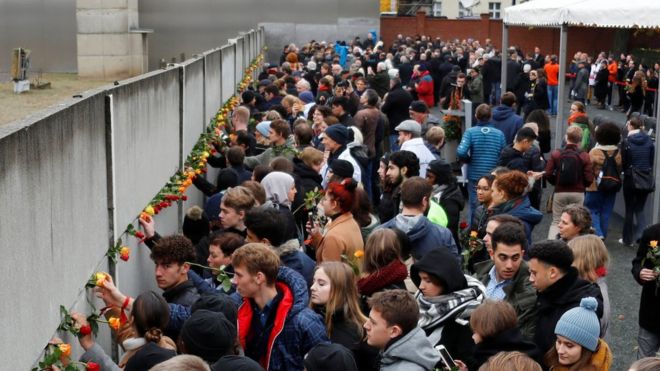
German Chancellor Angela Merkel has warned against taking democracy for granted, at a ceremony marking the 30th anniversary of the Berlin Wall's fall.
"No wall that keeps people out and restricts freedom is so high... that it cannot be broken down," she added.
The wall had separated Soviet-controlled East Berlin and capitalist West Berlin during the Cold War.
Its fall in 1989 was seen as a victory for liberal democracy, and led to Germany's reunification a year later.
However, Mrs Merkel warned on Saturday that "the values on which Europe is founded - freedom, democracy, equality, rule of law, human rights - they are anything but self-evident and they have to be revitalised and defended time and time again".
"We stand stripped of any excuses and are required to do our part of freedom and democracy," she added in a ceremony at the Berlin Wall memorial.
There has been a rise in the far-right in many European countries, while the governments of EU countries such as Poland and Hungary have been accused of undermining the rule of law.
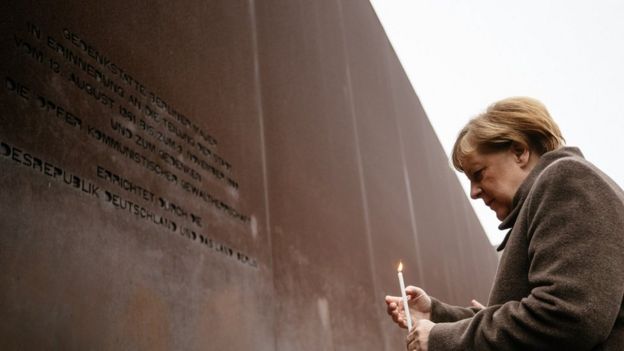
Image copyrightEPAImage captionMrs Merkel lit a candle at the memorial site
The Berlin Wall fell during the revolutions of 1989 in central and eastern Europe, in which several Soviet-imposed communist regimes were toppled following protests and political movements.
Speaking on Saturday, President Frank-Walter Steinmeier paid tribute to Germany's neighbours, saying: "Without the courage of the will to freedom of the Poles and Hungarians, the Czechs and Slovaks, the peaceful revolutions in Eastern Europe and Germany's reunification would not have been possible."
However, he added that "liberal democracy is being challenged and questioned", while foreign minister Heiko Maas said: "Power is shifting away from Europe, authoritarian models are on the rise, the United States is increasingly looking inwards".
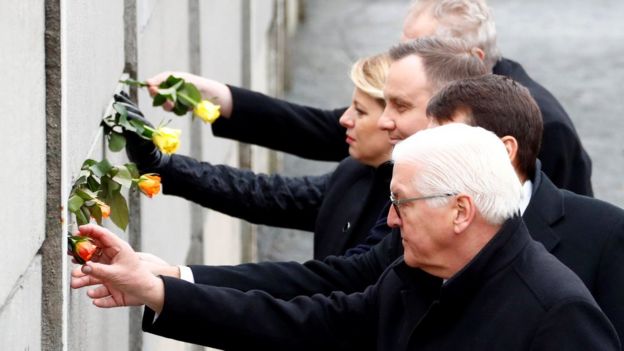
Image copyrightREUTERSImage captionThe presidents of Germany, Hungary, Poland, Slovakia and the Czech Republic attended the ceremony
US Secretary of State Mike Pompeo was not at the ceremony, but visited Berlin earlier this week.
During a speech on Friday, he warned that "freedom is never guaranteed".
He criticised the human rights records of the Russian and Chinese governments, and said: "Today, authoritarianism is once again rising."
Saturday was also the anniversary of the Kristallnacht - the night of broken glass - when thousands of Jewish homes, synagogues and businesses were attacked in Nazi Germany and Austria in 1938.
About 200 people joined a far-right protest in Bielefeld in northwest Germany in support of a Holocaust denier, while thousands of anti-fascist and left-wing groups held a counter protest, local media reported.
How did the Berlin Wall fall?
Media captionHow the BBC reported on the dramatic collapse of the Berlin Wall
After World War Two, Europe was split between what was then the Soviet Union, and its Western allies.
The Soviets eventually erected an "Iron Curtain" splitting the East from the West.
Germany was divided - with the eastern part occupied by the Soviets, and the west controlled by the US, UK and France. The Berlin Wall was built in 1961 - to stop people leaving East Berlin for West Berlin.
During the 1989 revolutions, several Soviet-imposed communist regimes in Eastern Europe were toppled as people demanded independence or greater freedoms.
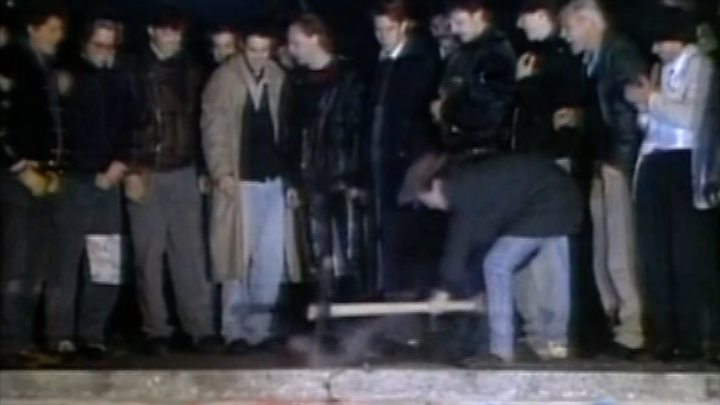
A series of mass protests in East Germany - and a mistaken announcement by a government spokesman - led to large crowds gathering at the border. Border guards eventually opened the barriers - leading to thousands rushing through, and breaking the wall with hammers and pickaxes.








![[Photos] She's A Top Olympian But We Didn't Recognize Her](https://images.outbrainimg.com/transform/v3/eyJpdSI6ImFhOWNlNjk0Y2M3YTIzYjJhOTZiYjEwMDAxZjU0M2Q4ZmYyMjdhMWNkNjUxNmUwYmM4NDdjNTk1MDRlYjI3NGUiLCJ3IjoxNjAsImgiOjkwLCJkIjoxLjUsImNzIjowLCJmIjo0fQ.webp "[Photos] She's A Top Olympian But We Didn't Recognize Her")
