Biodun Iginla, BBC News

Biodun Iginla, BBC News
Showing posts with label Ramadan. Show all posts

Friday, June 14, 2019

BREAKING: Tripoli's children struggle to study as war reaches the capital

June 14, 2019  12H:48  GMT/ZULU
TRIPOLI - For 13-year-old Taha Aboud, who dreams of becoming an engineer, war in Libya’s capital Tripoli has meant his family fleeing their home and him missing studies as they searched for a new school.
Libyan children attend class at a primary school while forces of rival government were fighting in a different port of town, in Tripoli, Libya June 10, 2019. REUTERS/Ulf Laessing
“I’m happy to be back at school. I hope to become a technology engineer one day ...I love it,” said Taha, as his father Fouad, a civil servant, signed papers this week to enroll his son in the Ben Ashour primary school, which has 1,250 students.
Up to 3,000 children face a similar plight, according to the country’s education ministry, as fighting forces dozens of schools to close, sometimes in order to house the displaced.
In the chaos, authorities have struggled to keep count of how many students are missing school, said Rashad Bishr, head of a crisis committee at the education ministry.
    Authorities have been trying to find spots for students such as Taha, who returned to school this week as classes resumed with the end of Islam’s holy month of Ramadan.
ADVERTISEMENT
Authorities, aided by the U.N. Children’s Fund (UNICEF), also organized extras classes during Ramadan to help displaced children catch up on what they missed ahead of exams set to take place at the end of the month.
“We targeted 10 schools in six municipalities ...to reach about 927 children,” said Ibrahim Farah, an educational specialist at UNICEF, adding that more activities were planned.
Authorities will give children a reduced number of questions on their exams but some were still anxious about whether they would pass.
“It will be difficult to pass the exams. We’ve missed lot,” said Aisha Rayan, 15, whose school was closed to house families fleeing the front line.
“At my old school we were taught different things with different methods.”
ADVERTISEMENT
Libya’s schools are in poor condition after years of underfunding caused by war that has raged since the toppling of Libyan leader Muammar Gaddafi in 2011.
The war arrived in Tripoli in early April and though it has not made it beyond the city’s southern defenses it has caused havoc in the suburbs. The United Nations estimates more than 650 people have been killed and more than 90,000 displaced.
Forces loyal to Khalifa Haftar in eastern Libya are seeking to take control of the capital. Haftar has set up a national government in the east parallel to the internationally recognized administration in Tripoli.

Saturday, May 25, 2019

BREAKING: Heavy fighting in Libyan capital

May 26, 2019  05H:38  GMT/ZULU
TRIPOLI  - Heavy fighting raged in the Libyan capital on Saturday as eastern forces made a new push to advance inside the city controlled by the internationally recognized government.
The Libya National Army (LNA) force of Khalifa Haftar, who is allied to a parallel government in the east, started an offensive to take Tripoli almost two months ago but has not breached the city’s southern defenses.
The LNA made a new push on Saturday morning, trying to advance on a road from the former airport - located in a southern suburb - towards the center but there was no sign of progress, residents said.
ADVERTISEMENT
Fighting had slowed in recent weeks during the holy Muslim month of Ramadan when most people fast during the day until sunset.
The battle for Tripoli has killed at least 510 people, forced 75,000 out of their homes, trapped thousands of migrants in detention centers, and flattened some southern suburbs. It has also forced closures of schools, split families on different sides of the front line, and brought power cuts.
Two ambulance workers were killed and three wounded on Thursday when their ambulance cars were hit, the World Health Organization said. It did not say who was responsible.
ADVERTISEMENT
The United Nations has been unable to negotiate a ceasefire. France has, like other European countries, called for a ceasefire but also supported Haftar as a way to fight Islamist militants in the country.
On Wednesday, Haftar, meeting French President Emmanuel Macron, ruled out a ceasefire and said he wanted to rid the capital of militias that had “infested” the U.N.-backed government of Premier Fayez al-Serraj, a French presidential official said.

Saturday, May 11, 2019

BREAKING AND UPDATE: Pakistan attack: Gunmen shot dead in Balochistan


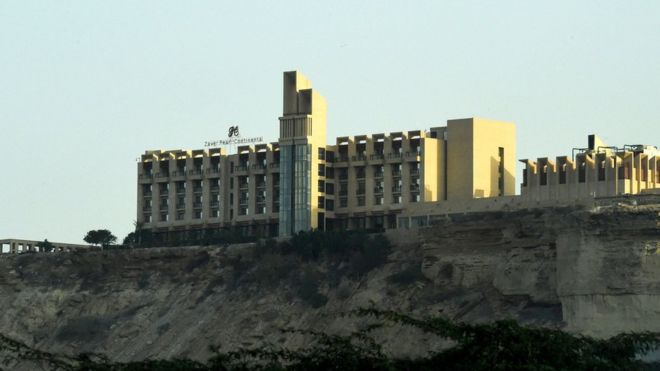
Pearl Continental Hotel in GwadarImage copyrightAFP
Image captionThe Pearl Continental Hotel is popular among foreign visitors
by Sunita Kureishi and Biodun Iginla, BBC News, Islamabad
Three gunmen who stormed a five-star hotel in the restive Pakistani province of Balochistan, killing at least one guard, have been shot dead by security forces, officials say.
The attack and subsequent siege, which targeted the Zaver Pearl-Continental Hotel in the strategic port city of Gwadar, lasted several hours.
A hotel spokesman said there were no guests and few staff due to Ramadan.
The separatist Balochistan Liberation Army said it carried out the attack.
The group said that the hotel, the centrepiece of a multi-billion-dollar Chinese project, was selected in order to target Chinese and other investors.
"Expect more attacks China and Pakistan," said a Twitter account that claimed to be linked to the group.
Militants in Balochistan oppose Chinese investment, saying it is of little benefit to local people.

What do we know about the attack?

The gunmen stormed the hotel, usually popular with top government officials and foreign visitors, at around 16:50 local time (11:50 GMT), killing at least one security guard who tried to stop them at the entrance.
Security forces entered the hotel and took part in a gun battle with the militants, before cornering them in a staircase leading to the top floor, officials said.
Due to the Muslim holy month of Ramadan, the hotel had no guests and a very limited number of staff, a Zaver Pearl-Continental spokesperson told us at the BBC.
However, earlier reports suggested that hotel guests had been evacuated safely.
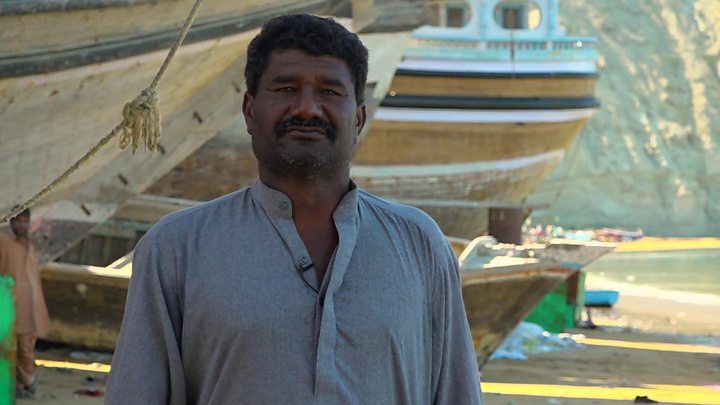
Media captionFishermen say they are no longer allowed to fish near the port
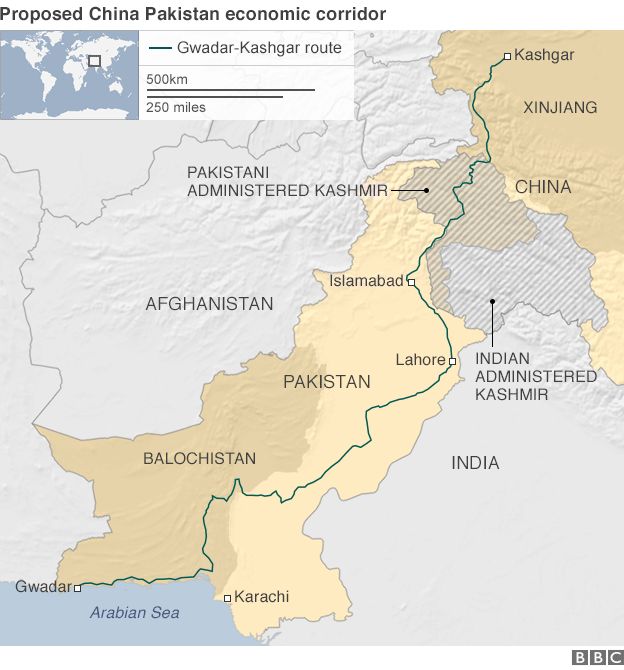
The hotel sits on a hilltop overlooking the Gwadar port on the Arabian Sea, which is being developed by China as part of the China-Pakistan Economic Corridor (CPEC), a network of roads, railway and pipelines between the two countries.
On Twitter, the Chinese embassy in Pakistan condemned the attack, which comes just weeks after gunmen killed 14 people, including 11 military personnel, in the region.
Presentational grey line

A worrying breach of security

Analysis box by Secunder Kermani, Pakistan correspondent
Gwadar is a city with a heavy military presence. It is viewed by both Chinese and Pakistani officials as the lynchpin of the CPEC, aiming to connect western China with the Arabian Sea.
When I visited the port city in late 2017 with other international journalists, we travelled in convoys guarded by armed escorts, and stayed in the same hotel that was targeted.
This attack will therefore be seen as a worrying breach of security, and it is not the first time Chinese interests have been targeted by this militant group. Last year the Balochistan Liberation Army (BLA) carried out an attack on the Chinese consulate in Karachi.
After that attack, both Pakistani and Chinese officials stressed that violence would not derail their close co-operation. But militant activity in Balochistan remains one of the major concerns about the viability of the CPEC project.
Presentational grey line

What is the situation in Balochistan?

Home to a long-running insurgency, Balochistan is Pakistan's poorest and least developed province.
It shares a large, porous border with Afghanistan and Iran.
map
Presentational white space
Its economy is dominated by natural resources, particularly natural gas, and is being transformed by major Chinese infrastructure projects on the CPEC, part of the ambitious Belt and Road initiative.
Several militant groups operate in the region, including the Pakistani Taliban, the BLA and the Sunni Muslim extremist group Lashkar-e-Jhangvi.

Related Topics

More on this story