Biodun Iginla, BBC News

Biodun Iginla, BBC News
Showing posts with label Muammar Gaddafi. Show all posts

Monday, August 5, 2019

Drone strike on town in southern Libya kills at least 43

August 6, 2019  04H:32  GMT/ZULU
TRIPOLI - A drone air strike by eastern Libyan forces on the southern Libyan town of Murzuq has killed at least 43 people, a local official said on Monday.
The attack is the second major air strike blamed on the eastern Libyan National Army (LNA) forces loyal to Khalifa Haftar after at least 44 migrants were killed in June, when a detention center in a suburb of the capital Tripoli was hit.
The LNA confirmed a strike late on Sunday on Murzuq, but denied it had targeted any civilians. The LNA had also denied it had hit the detention center but acknowledged increased air strikes on the capital as part of an offensive to seize Tripoli - home to the internationally recognized government - part of the chaos in the oil producer since 2011.
The Tripoli government opposing Haftar said dozens were killed and wounded in Murzuq.
“The air strike resulted in 43 killed and 51 wounded. This is only an initial toll of casualties,” Murzuq municipal council member Mohamed Omar told us at Reuters in a phone interview.
He said the done strike had targeted a town hall meeting where residents were holding discussions after days of clashes between rival tribesmen.
The LNA seized Murzuq at the start of this year as part of an offensive to control the oil-producing south. It later moved out to concentrate forces north where it has been trying to take the capital Tripoli in a four-month campaign.
ADVERTISEMENT
The LNA said in a statement its strike had targeted “Chadian opposition fighters,” a phrase that usually refers to Tebu tribesmen opposing them in the area.
Haftar’s LNA, allied to a parallel government based in eastern Libya, has seen its advance on Tripoli held up by robust defenses on the outskirts of the capital, and said it would start heavy air strikes after “traditional means” of war had been exhausted.
Haftar is backed militarily by Egypt and the United Arab Emirates, which see him as a bulwark against Islamists, a narrative supported by some Western countries that have been reluctant to openly criticize the former general under Muammar Gaddafi, who was toppled and killed in 2011.
The European Union said in a statement that the Murzuq strike had “claimed the lives of civilians” and those committing war crimes needed to be brought to justice. But it did not mention the LNA.
ADVERTISEMENT
The United Nations Support Mission in Libya (UNSMIL) said in a statement issued a day after the strikes that it was “extremely concerned by reports on the continuation of acts of violence in Murzuq, including a number of air strikes.” It did not mention the LNA.
Haftar’s attempt to capture Tripoli has derailed U.N. attempts to broker an end to the chaos that has prevailed in Libya since the NATO-backed overthrow of Gaddafi.

Friday, June 14, 2019

BREAKING: Tripoli's children struggle to study as war reaches the capital

June 14, 2019  12H:48  GMT/ZULU
TRIPOLI - For 13-year-old Taha Aboud, who dreams of becoming an engineer, war in Libya’s capital Tripoli has meant his family fleeing their home and him missing studies as they searched for a new school.
Libyan children attend class at a primary school while forces of rival government were fighting in a different port of town, in Tripoli, Libya June 10, 2019. REUTERS/Ulf Laessing
“I’m happy to be back at school. I hope to become a technology engineer one day ...I love it,” said Taha, as his father Fouad, a civil servant, signed papers this week to enroll his son in the Ben Ashour primary school, which has 1,250 students.
Up to 3,000 children face a similar plight, according to the country’s education ministry, as fighting forces dozens of schools to close, sometimes in order to house the displaced.
In the chaos, authorities have struggled to keep count of how many students are missing school, said Rashad Bishr, head of a crisis committee at the education ministry.
    Authorities have been trying to find spots for students such as Taha, who returned to school this week as classes resumed with the end of Islam’s holy month of Ramadan.
ADVERTISEMENT
Authorities, aided by the U.N. Children’s Fund (UNICEF), also organized extras classes during Ramadan to help displaced children catch up on what they missed ahead of exams set to take place at the end of the month.
“We targeted 10 schools in six municipalities ...to reach about 927 children,” said Ibrahim Farah, an educational specialist at UNICEF, adding that more activities were planned.
Authorities will give children a reduced number of questions on their exams but some were still anxious about whether they would pass.
“It will be difficult to pass the exams. We’ve missed lot,” said Aisha Rayan, 15, whose school was closed to house families fleeing the front line.
“At my old school we were taught different things with different methods.”
ADVERTISEMENT
Libya’s schools are in poor condition after years of underfunding caused by war that has raged since the toppling of Libyan leader Muammar Gaddafi in 2011.
The war arrived in Tripoli in early April and though it has not made it beyond the city’s southern defenses it has caused havoc in the suburbs. The United Nations estimates more than 650 people have been killed and more than 90,000 displaced.
Forces loyal to Khalifa Haftar in eastern Libya are seeking to take control of the capital. Haftar has set up a national government in the east parallel to the internationally recognized administration in Tripoli.

Thursday, April 25, 2019

BREAKING: Residential areas of Libya's capital becoming 'battlefields', says Red Cross


LNA War Information Decision, AFP | Screengrab from a video published on the Libyan strongman Khalifa Haftar's self-proclaimed Libyan National Army (LNA) War Information Division's Facebook page on April 24, 2019.
Intensified fighting for control of the Libyan capital is turning residential areas of Tripoli into "battlefields", the Red Cross said Thursday, amid a row over France’s alleged backing of military strongman Khalifa Haftar.
ADVERTISING
"The humanitarian situation in and around Tripoli has deteriorated sharply over the past three weeks," since Haftar launched an offensive on April 4 against forces loyal to the internationally-recognised Government of National Accord (GNA), the International Committee of the Red Cross said in a statement.
"More than 30,000 people are said to have fled their homes and are sheltering with relatives or in public buildings," it said, a figure which Libyan authorities and the United Nations say has risen to almost 35,000.
"Tripoli's basic services and infrastructure, such as hospitals and water pumping stations, which have already suffered from violence over the past eight years, are being weakened further," it said, referring to the insecurity in Libya since the 2011 uprising that ousted dictator Muammar Gaddafi.
ADVERTISING
Youness Rahoui, the head of office in Tripoli for the ICRC, singled out the impact of the violence, which has focused on Tripoli's southern suburbs, on residents of the capital.
"One of our greatest concerns is for civilians living near the frontlines. Densely-populated residential areas are gradually turning into battlefields," Rahoui said.
He also said it was becoming "increasingly dangerous for medical workers to retrieve the wounded, with mounting reports of indiscriminate shelling".
At least 278 people have been killed and more than 1,300 wounded in the clashes, according to the latest casualty toll from the World Health Organisation.
GNA leader excoriates France for ‘supporting a dictator’
The Red Cross’ announcement comes after Fayez-al-Sarraj, the head of the GNA, lambasted France on Wednesday for supporting Haftar, who has carved out a de facto state in the east of Libya.
Sarraj denounced Paris for backing a "dictator," in his harshest criticism yet of French diplomacy, in an interview with left-wing French daily Libération.
"We are surprised that France does not support our government that is democratic, but supports a dictator," Sarraj continued.
"When Emmanuel Macron called me, I warned him that public opinion was against France. We don't want Libyans to hate France. France still has a positive and important role to play," he said.
In a separate interview with the Le Monde on Monday, Sarraj said France was partly to blame for Haftar's offensive on Tripoli.
"The disproportional support from France towards Haftar is what made him decide to take action and abandon the political process," he said.
Although it has long been suspected of backing him, France publicly denies supporting Haftar. It says it has contact with all the actors competing for advantage in Libya.
‘A looming banking crisis’ for Haftar
One way in which militias are jostling for hegemony relates to money. Indeed, the outcome of Haftar’s offensive on Tripoli could be determined by a separate battle -- to keep open the parallel finance system that funds his soldiers.
The general has funded his eastern state with a mix of unofficial bonds, Russia-printed cash and deposits from eastern banks, accumulating debt worth around 35 billion Libyan dinars ($25.18 billion) outside the official banking system.
But diplomats and banking sources say that those sources of support might be closing, as the Tripoli-based central bank, which controls the country's energy revenues, has taken steps to curtail the operations of banks in the east.
Those banks have in recent months struggled to meet minimum deposit requirements, which could give the Tripoli central bank allied to Tripoli Premier Fayez al-Serraj the excuse to shut off access to hard currency, they said.
"There is a looming banking crisis that could undermine eastern authorities' ability to fund themselves in the near future," Claudia Gazzini, senior Libya analyst at International Crisis Group, told Reuters.
"The crisis was already in the making before the war broke out," she continued.


Sunday, April 7, 2019

BREAKING: Libya crisis: Fighting near Tripoli leaves 21 dead


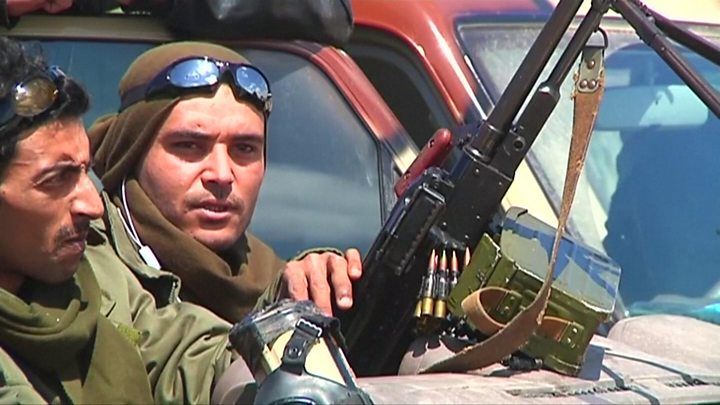
Media captionGen Haftar's forces prepare for Tripoli battle
by Rashida Adjani and Biodun Iginla, BBC News, Tripoli
Libya's UN-backed government says 21 people have been killed and 27 wounded in fighting near the capital, Tripoli.
US Secretary of State Mike Pompeo has called for an immediate halt to the fighting and called for talks.
Rebel forces under Gen Khalifa Haftar have advanced from the east with the aim of taking Tripoli.
Prime Minister Fayez al-Serraj has accused him of attempting a coup and says rebels will be met with force.
Among the dead was a Red Crescent doctor killed on Saturday. Gen Haftar's forces said they had lost 14 fighters.
Earlier the UN appealed for a two-hour truce so casualties and civilians could be evacuated, but fighting continued.
And in a statement, Secretary of State Pompeo said the US was "deeply concerned about fighting near Tripoli" and stressed the need for talks.
"This unilateral military campaign against Tripoli is endangering civilians and undermining prospects for a better future for all Libyans," the statement said.
International powers have begun evacuating personnel from Libya amid the worsening security situation.
Libya has been torn by violence and political instability since long-time ruler Muammar Gaddafi was deposed and killed in 2011.

What's the situation on the ground?

Gen Haftar's Libyan National Army (LNA) forces have been carrying out a multi-pronged attack from the south and west of the city since Thursday.
The UN said its call for a humanitarian truce had been ignored and emergency services said they had not been able to enter the areas where fighting was taking place.
However a UN spokesman told AFP that they were "still hoping for a positive response".
On Sunday the LNA said it had carried out its first air strike, a day after the UN-backed Government of National Accord (GNA) hit them with air strikes on Saturday.
Fighting has continued around the disused international airport south of the capital that Gen Haftar earlier said his forces had seized.
Forces loyal to the GNA have slowed the advance and on Sunday a GNA spokesman told Al-Jazeera TV that the GNA now intended to "cleanse" the whole of the country.

What evacuations have already taken place?

US Africa Command, responsible for US military operations and liaison in Africa, said that due to the "increased unrest" it had relocated a contingent of US forces temporarily, but gave no further details on numbers.
There were reports of a fast amphibious craft being used in the operation.
India's External Affairs Minister Sushma Swaraj said its full contingent of 15 Central Reserve Police Force peacekeepers had been evacuated from Tripoli because the "situation in Libya has suddenly worsened".
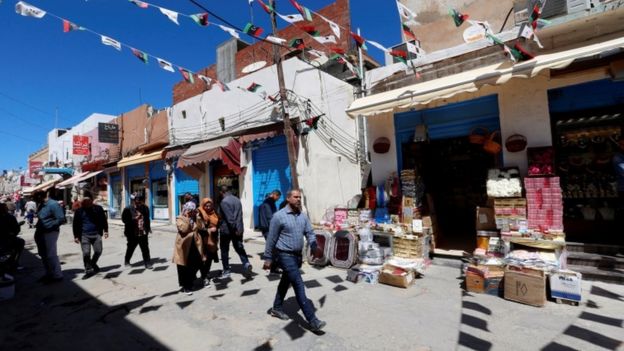
A market in Tripoli.Image copyrightREUTERS
Image captionA market in Tripoli. Residents are said to be stocking up on supplies
The Italian multinational oil and gas company, Eni, decided to evacuate all its Italian personnel from the country.
The UN is also due to pull out non-essential staff.
Residents of Tripoli have reportedly begun stocking up on food and fuel. But BBC Arab affairs editor Sebastian Usher says many of those near the fighting are remaining in their homes for now, for fear of looting should they leave.
Some fear a long operation, which Gen Haftar mounted to take the eastern city of Benghazi from Islamist fighters.

Who are the opposing forces?

Libya has been wracked by unrest since the overthrow of Col Gaddafi. Dozens of militias operate in the country.
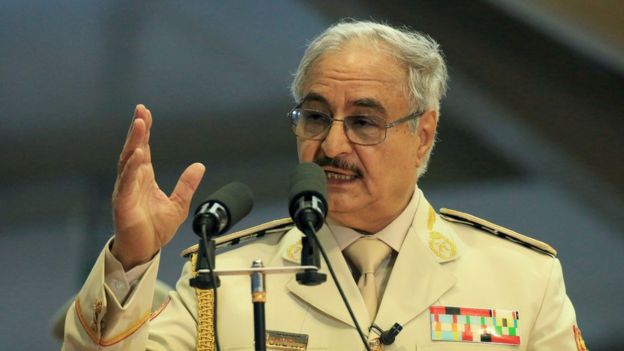
Gen HaftarImage copyrightAFP
Image captionGen Haftar has ordered his forces to advance on Tripoli
Recently they have been allying either with the UN-backed GNA, based in Tripoli, or the LNA of Gen Haftar, a tough anti-Islamist who has the support of Egypt and the UAE and is strong in eastern Libya.
Gen Haftar helped Col Gaddafi seize power in 1969 before falling out with him and going into exile in the US. He returned in 2011 after the uprising against Gaddafi began and became a rebel commander.
The unity government was created at talks in 2015 but has struggled to assert national control.
Prime Minister Fayez al-Serraj delivered a TV address on Saturday, saying he would defend the capital.
Mr Serraj said he had offered concessions to Gen Haftar to avoid bloodshed, only to be "stabbed in the back".
Presentational grey line

Back to square one?

Analysis by Rana Jawad, BBC North Africa correspondent, in Tunis
The rogue general's defiance suggests that, despite international condemnation of his recent moves, he believes he can only secure a place in Libya's future political makeup through militarily means.
Diplomats are worried, because the manner and timing of the attack means he is unlikely to back down unless he is defeated.
Few thought he would go ahead and launch this operation - which he has long threatened to do - because they believed ongoing talks that saw him go from Paris to Palermo and the UAE for more than a year would buy time until a new political settlement was reached through negotiations and an eventual electoral process.
Today, Western nations have few cards to play to de-escalate the violence and once again find themselves in a position where they may need to start from scratch.
Presentational grey line

Are peace talks planned?

UN-backed talks aimed at drawing up a road map for new elections have been scheduled for 14-16 April in the Libyan city of Ghadames.
UN envoy Ghassan Salame insisted the talks would go ahead, unless serious obstacles prevented it, saying "we won't give up this political work quickly".
UN Secretary General Antonio Guterres was in Tripoli just last Thursday to discuss the situation.
But Gen Haftar has said his troops will not stop until they have defeated "terrorism".
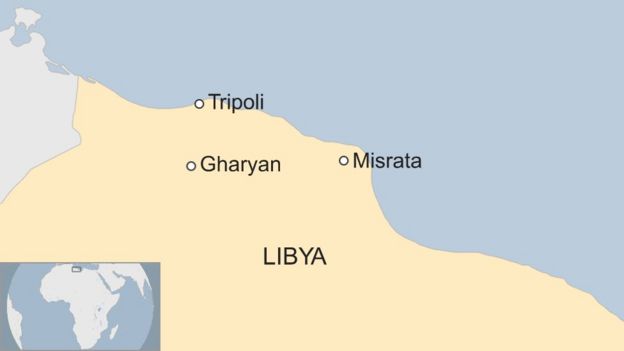
map

Related Topics

More on this story