Biodun Iginla, BBC News

Biodun Iginla, BBC News
Showing posts with label Reporters Without Borders. Show all posts

Friday, June 7, 2019

BREAKING: Investigative journalist detained in Russia on drug charges


Golunov's lawyer said he was beaten in detention
Golunov's lawyer said he was beaten in detention Meduza media outlet/AFP
ADVERTISING
Moscow
Russia has detained an investigative journalist for drugs offences, prompting protests on Friday as supporters condemned the charges as trumped-up and suggested they were punishment for his reporting.
Ivan Golunov, a reporter with Meduza, an independent Russian-language media outlet, was detained in central Moscow on Thursday and police have opened a probe into manufacturing and dealing drugs.
ADVERTISING
A police spokesman said a 36-year-old man he did not identify had been detained with five packages of mephedrone, a designer drug.
Supporters said the drugs had been planted on him.
Reporters Without Borders warned Golunov's arrest could mark "a significant escalation in the persecution" of independent journalists in Russia.
Police on Friday briefly arrested several prominent reporters as they protested with placards in the front of the headquarters of the Moscow police, including author Viktor Shenderovich and Pavel Kanygin of the opposition newspaper Novaya Gazeta.
"I am a journalist. Arrest me too," said one of the placards carried by the reporters, while another read: "A journalist is a drug kingpin. Who would believe this madness?".
"We have reasons to believe that Golunov is being persecuted for his journalistic work," Meduza general director Galina Timchenko and editor-in-chief Ivan Kolpakov said in a statement.
They described Golunov as "one of Russia's most famous investigative journalists" and said he had received threats in recent months.
- Paying the price -
The Meduza website is based in EU member Latvia to circumvent censorship from Moscow, but some of its journalists live in Russia.
"Everything indicates that the authorities are planting drugs on their targets to shut them up with a jail sentence," said Natalia Zvyagina, director of Amnesty International's branch in Russia.
In his investigations, Golunov zeroed in on everything from Russia's shady funeral industry to corruption in Moscow city hall.
The journalist's lawyer Dmitry Dzhulai said police claimed they found packages containing drugs in Golunov's backpack and apartment.
"There are a lot of facts signalling that the drugs have been planted," the lawyer told us at France24. 
He said the journalist had been beaten while in detention and pointed to numerous violations including a refusal by investigators to take swabs of Golunov's fingernails and backpack to check for handling of drugs.
"He was detained at 2.30 pm yesterday and I only got a call at 4.30 am," Dzhulai said.
- 'Ludicrous provocation' -
During his two decades in power Russian President Vladimir Putin has silenced most of his critics and muzzled independent media.
The few opposition and independent media that still operate in Russia are under huge pressure, Kremlin critics say.
Golunov's arrest sparked wide outrage.
Alexander Baunov of the Carnegie Moscow Center said Golunov was a close friend and did not take stimulants because he did not like an "altered state of mind."
Johann Bihr, the head of the Reporters Without Borders Eastern Europe and Central Asia desk, pointed to "the police's highly suspicious behaviour".
"If such methods were indeed used against such a prominent journalist...it would mark a significant escalation in the persecution of independent journalism in Russia," he said.
In an open letter, hundreds of Russian journalists demanded Golunov's immediate release.
"We believe that Ivan Golunov has become a target of a crude and ludicrous provocation," it said.
video-or-as/am/ach
Saturday, October 6, 2018

Hong Kong press freedom in question as FT journalist denied visa

October 6, 2018  10H:20  GMT/UTC/ZULU TIME
HONG KONG - Hong Kong has refused to renew a work visa for the Asia news editor of the Financial Times, who is also an official of the city’s Foreign Correspondents’ Club (FCC), a decision that shocked many in the financial hub’s international community.
The news comes two months after government officials in China and Hong Kong condemned the FCC, one of Asia’s leading press clubs, for hosting a speech by an independence activist, reigniting debate about the viability of the city’s promised freedoms.
“The Hong Kong authorities have rejected an application to renew the work visa of Victor Mallet, Asia news editor at the Financial Times,” the newspaper said in a statement.
“This is the first time we have encountered this situation in Hong Kong. We have not been given a reason for the rejection,” it said.
SPONSORED
ADVERTISING
Mallet, who is the FCC’s vice-president, did not respond immediately to a request for comment, while Hong Kong’s immigration department said it did not comment on specific cases.
In August, Mallet, who was the FCC’s acting president at the time, hosted a speech by pro-independence activist Andy Chan in a move strongly condemned by China’s Foreign Ministry.
The ministry had urged the FCC to withdraw its invitation to Chan, a founder of the pro-independence Hong Kong National Party, which was formally banned by Hong Kong authorities last month.
Authorities in Beijing and Hong Kong have said the notion of independence is inconsistent with the principle of “one country, two systems” under which the territory has been governed since Britain handed it back to China in 1997.
The principle promises Hong Kong a high degree of autonomy and freedoms not enjoyed elsewhere in China, rights which are enshrined in a mini-constitution known as the Basic Law.
Victor Mallet, a Financial Times journalist and first vice president of the Foreign Correspondents' Club (FCC), speaks during a luncheon at the FCC in Hong Kong, China, August 14, 2018. Paul Yeung/Pool via REUTERS
Mallet said in August the FCC neither endorsed nor opposed the diverse views of its speakers, fully respected the law and championed free speech and freedom.

‘EXTREMELY RARE’

The FCC said it was expecting a full explanation from the Hong Kong authorities.
“In the absence of any reasonable explanation, the FCC calls on the Hong Kong authorities to rescind their decision,” the club said in a statement late on Friday, describing the move as “extremely rare, if not unprecedented”.
Reuters received multiple messages via email and social media from foreign banking and legal professionals expressing shock at the decision.
A spokesman for the U.S. Consulate General described the rejection as “deeply troubling”.
“This decision is especially disturbing because it mirrors problems faced by international journalists in the mainland and appears inconsistent with the principles enshrined in the Basic Law,” he said.
Reporters Without Borders called on Hong Kong authorities to reverse their decision.
“This is clearly a form of retaliation for his involvement in the public talk organized in August by FCCHK, which angered Beijing by featuring a pro-Hong Kong independence activist,” the group said in a statement.
“Such action is yet another proof that the Chinese authorities are extending their policy of intimidating foreign journalists to the territory of Hong Kong,” it said.
Slideshow (2 Images)
The Hong Kong Journalists Association (HKJA) said it was shocked at the move and urged the government to reconsider and explain its decision.
“If left unexplained, it will give rise to worries that it is an act of reprisal against Mr Mallet, further undermining public confidence in freedom of speech and the press,” the HKJA said.
Twenty-two lawmakers from Hong Kong’s democratic opposition called for Mallet’s visa to be reissued.
“It is sending a very wrong message to the international community that Hong Kong is just another city in mainland China,” veteran Democrat Party legislator James To told reporters.
Some pro-establishment politicians backed the government’s move, however, saying strong messages had to be sent that Hong Kong had zero tolerance of independence calls, government-funded broadcaster RTHK reported.
New York-based Human Rights Watch said in a statement the visa rejection, together with the unprecedented banning of the Hong Kong National Party, showed a quickening downward spiral for human rights in Hong Kong.
“This is shocking and unprecedented,” it said. “The Hong Kong authorities’ visa renewal rejection - without explanation - of a journalist who’s done nothing more than his job smacks of Beijing-style persecution of critics.”
The FCC, whose members include senior lawyers, scholars and government officials besides journalists, has long portrayed itself as fostering and defending free speech.
Mallet has worked as a journalist and foreign correspondent for more than 30 years, first at Reuters and then for the Financial Times, including more than 12 years in Asia.

Wednesday, September 5, 2018

Afghanistan conflict: bomb blasts kill 20 at Kabul sports club


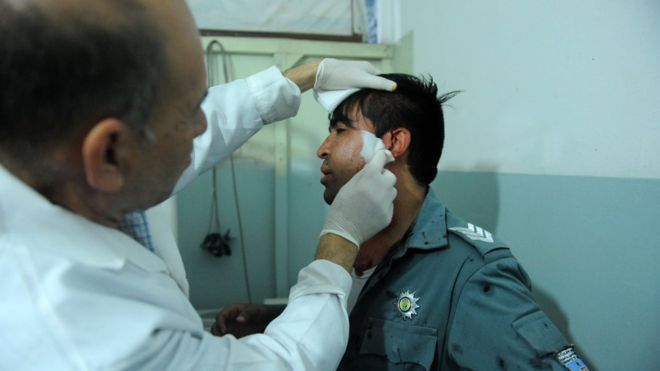
An injured Afghan soldier receives medial treatment at a hospital in Kabul, Afghanistan on 5 September 2018Image copyrightEPA
Image captionA car bomb targeted journalists and emergency services responding to an earlier suicide attack
by Sunita Kureishi and Biodun Iginla, BBC News, Kabul
A double suicide bombing at a wrestling club in the Afghan capital Kabul has killed at least 20 people and injured 70, officials say.
After a suicide bomber killed four people in the club, a second bomber in a car attacked emergency services responding to the incident.
Two journalists from the Tolo news channel were killed and four others injured by the car bomb.
The attacks happened in a predominantly Shia Muslim district of the city.
In a post on Twitter, Tolo's head, Lotfullah Najafizada, said the outlet had lost two of its best journalists.
The attack has not yet been claimed by any group but so-called Islamic State has carried out similar attacks in the Dasht-e-Barchi district.
The neighbourhood is home to many members of the Hazara minority.
Presentational grey line

You may also be interested in:

Related Topics

More on this story

Around the BBC