Beijing is drawing up a plan to remove Hong Kong's beleaguered chief executive Carrie Lam, the Financial Times reported Wednesday, after nearly five months of pro-democracy unrest.
The pro-Beijing leader has faced sustained criticism from protesters in the semi-autonomous city.
So far the central government in Beijing has given its support to her and the Hong Kong police, calling the demonstrators "rioters" and condemning the violence.
But according to the FT report, which quoted unnamed figures briefed on the deliberations, the Chinese government is drawing up a plan to replace her with an interim chief executive.
However, sources told the newspaper that the plan would be dependent on the situation in the city first stabilising so that Beijing is not seen as giving in to violence.
Lam's office did not immediately respond to a request for comment on the report.
Hong Kong has now been battered by 20 weeks of protests and with no political solution in sight, clashes have intensified each month.
Earlier this month, Lam -- who has refused to grant any major concessions to protesters -- invoked a colonial-era emergency law to ban face masks, setting off a new wave of protests and vandalism that shut down much of the city's transport network.
If President Xi Jinping decided to go ahead with the plan to remove Lam, the report said her replacement would be installed by March.
Leading candidates being considered to replace Lam reportedly include Norman Chan, former head of the Hong Kong Monetary Authority, and Henry Tang, who has also served as the territory?s financial secretary and chief secretary for administration.
A leaked audio recording emerged in September of Lam saying she would quit if she had a choice -- although she later said she had not contemplated standing down.
Lam has faced a series of political difficulties since the city's legislature returned for a new session last week.
She was unable to give her State of the Union-style policy speech after pro-democracy lawmakers repeatedly interrupted her, forcing her to deliver the address via a pre-recorded video.
HONG KONG - Hong Kong has refused to renew a work visa for the Asia news editor of the Financial Times, who is also an official of the city’s Foreign Correspondents’ Club (FCC), a decision that shocked many in the financial hub’s international community.
The news comes two months after government officials in China and Hong Kong condemned the FCC, one of Asia’s leading press clubs, for hosting a speech by an independence activist, reigniting debate about the viability of the city’s promised freedoms.
“The Hong Kong authorities have rejected an application to renew the work visa of Victor Mallet, Asia news editor at the Financial Times,” the newspaper said in a statement.
“This is the first time we have encountered this situation in Hong Kong. We have not been given a reason for the rejection,” it said.
SPONSORED
ADVERTISING
Mallet, who is the FCC’s vice-president, did not respond immediately to a request for comment, while Hong Kong’s immigration department said it did not comment on specific cases.
In August, Mallet, who was the FCC’s acting president at the time, hosted a speech by pro-independence activist Andy Chan in a move strongly condemned by China’s Foreign Ministry.
The ministry had urged the FCC to withdraw its invitation to Chan, a founder of the pro-independence Hong Kong National Party, which was formally banned by Hong Kong authorities last month.
Authorities in Beijing and Hong Kong have said the notion of independence is inconsistent with the principle of “one country, two systems” under which the territory has been governed since Britain handed it back to China in 1997.
The principle promises Hong Kong a high degree of autonomy and freedoms not enjoyed elsewhere in China, rights which are enshrined in a mini-constitution known as the Basic Law.
Victor Mallet, a Financial Times journalist and first vice president of the Foreign Correspondents' Club (FCC), speaks during a luncheon at the FCC in Hong Kong, China, August 14, 2018. Paul Yeung/Pool via REUTERS
Mallet said in August the FCC neither endorsed nor opposed the diverse views of its speakers, fully respected the law and championed free speech and freedom.
‘EXTREMELY RARE’
The FCC said it was expecting a full explanation from the Hong Kong authorities.
“In the absence of any reasonable explanation, the FCC calls on the Hong Kong authorities to rescind their decision,” the club said in a statement late on Friday, describing the move as “extremely rare, if not unprecedented”.
Reuters received multiple messages via email and social media from foreign banking and legal professionals expressing shock at the decision.
A spokesman for the U.S. Consulate General described the rejection as “deeply troubling”.
“This decision is especially disturbing because it mirrors problems faced by international journalists in the mainland and appears inconsistent with the principles enshrined in the Basic Law,” he said.
Reporters Without Borders called on Hong Kong authorities to reverse their decision.
“This is clearly a form of retaliation for his involvement in the public talk organized in August by FCCHK, which angered Beijing by featuring a pro-Hong Kong independence activist,” the group said in a statement.
“Such action is yet another proof that the Chinese authorities are extending their policy of intimidating foreign journalists to the territory of Hong Kong,” it said.
Slideshow (2 Images)
The Hong Kong Journalists Association (HKJA) said it was shocked at the move and urged the government to reconsider and explain its decision.
“If left unexplained, it will give rise to worries that it is an act of reprisal against Mr Mallet, further undermining public confidence in freedom of speech and the press,” the HKJA said.
Twenty-two lawmakers from Hong Kong’s democratic opposition called for Mallet’s visa to be reissued.
“It is sending a very wrong message to the international community that Hong Kong is just another city in mainland China,” veteran Democrat Party legislator James To told reporters.
Some pro-establishment politicians backed the government’s move, however, saying strong messages had to be sent that Hong Kong had zero tolerance of independence calls, government-funded broadcaster RTHK reported.
New York-based Human Rights Watch said in a statement the visa rejection, together with the unprecedented banning of the Hong Kong National Party, showed a quickening downward spiral for human rights in Hong Kong.
“This is shocking and unprecedented,” it said. “The Hong Kong authorities’ visa renewal rejection - without explanation - of a journalist who’s done nothing more than his job smacks of Beijing-style persecution of critics.”
The FCC, whose members include senior lawyers, scholars and government officials besides journalists, has long portrayed itself as fostering and defending free speech.
Mallet has worked as a journalist and foreign correspondent for more than 30 years, first at Reuters and then for the Financial Times, including more than 12 years in Asia.
Donald Trump has said the United States will "solve" the nuclear threat from North Korea, with or without China's help.
"If China is not going to solve North Korea, we will. That is all I am telling you," he said in an interview with UK paper Financial Times.
Pressed on whether he thought he could succeed alone, he replied: "Totally."
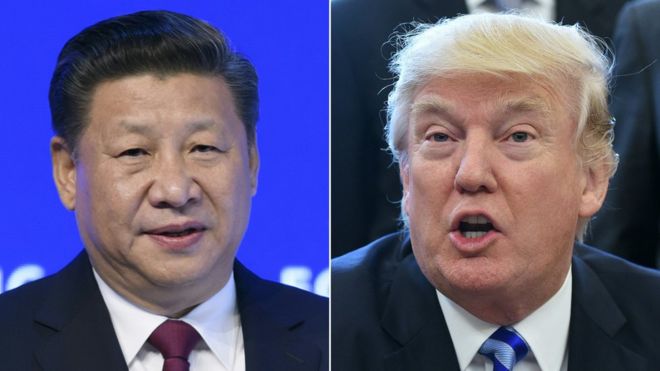
Mr Trump was speaking ahead of a scheduled visit from Chinese President Xi Jinping this week.
"China has great influence over North Korea. And China will either decide to help us with North Korea, or they won't. And if they do that will be very good for China, and if they don't it won't be good for anyone," Mr Trump told the FT.
Asked if he meant "one-on-one" unilateral action, Mr Trump said: "I don't have to say any more. Totally."
He did not give any further details on what action he would take.
Mr Trump's brief comments, published just days before the key meeting with Mr Xi at Mar-a-Lago on Thursday, are the latest in a series of warnings over North Korea's nuclear development.
There are fears that Pyongyang could eventually develop the ability to launch long-range nuclear missiles capable of striking the mainland United States.
But Mr Trump is expected to pressure China's president to do much more at their meeting this week - and he has implied that the issue of trade could be used as leverage.
The president told the Financial Times that "trade is the incentive. It is all about trade." But he said he did not plan to discuss tariffs during the meeting.
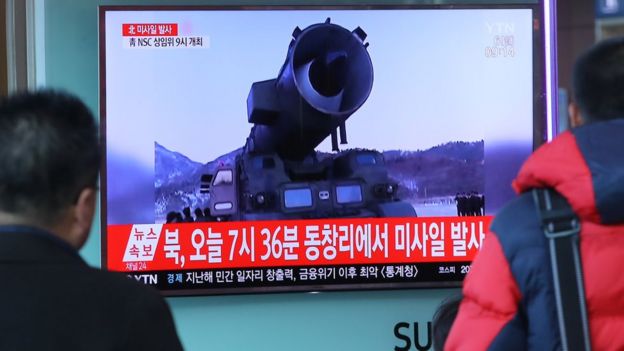
Image copyrightAFPImage captionFootage of a North Korean missile launch is broadcast on television in South Korea, 6 March
At the end of March, he signed two executive orders to deal with the US trade deficit, reviewing current rules and foreign trade abuses.
White House officials insisted China was not the focus of his orders - but it is the largest source of the US trade deficit, accounting for about $347bn (£276bn) a year, out of a total of $502bn (£400bn).
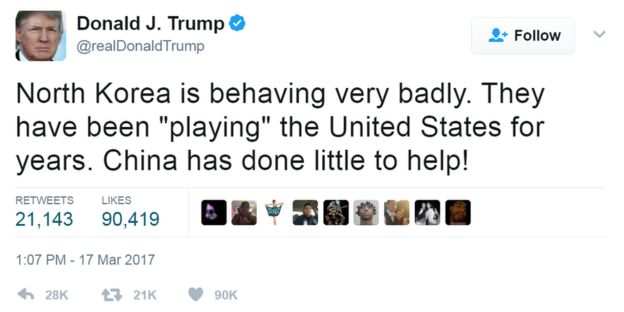
And Mr Trump himself tweeted that "the meeting next week with China will be a very difficult one in that we can no longer have massive trade deficits".
Mr Trump has not said how he will negotiate trade with China while also pressuring them to influence Pyongyang.
Analysts say China has maintained its support for Pyongyang as it fears a complete collapse of the North Korean regime could lead to Korean unification, with US soldiers based in a country with a land border with China.
It is thought that China is also concerned at the prospect of millions of North Korean refugees entering its borders.


![[Gallery] 30 Photos of Young Donald Trump You've Never Seen Before](https://images.outbrainimg.com/transform/v3/eyJpdSI6ImQ4YmQ5MDBiOTc2YmRmMDZhYTdlN2YxNWRhODI1MmQ0YjlhZDVlZTUyMzE3ZWI2ZmQ1Yzc3ZGIxYTJkMmQ1ZGIiLCJ3IjoyMzAsImgiOjE1MCwiZCI6MS41LCJjcyI6MCwiZiI6NH0.webp "[Gallery] 30 Photos of Young Donald Trump You've Never Seen Before")