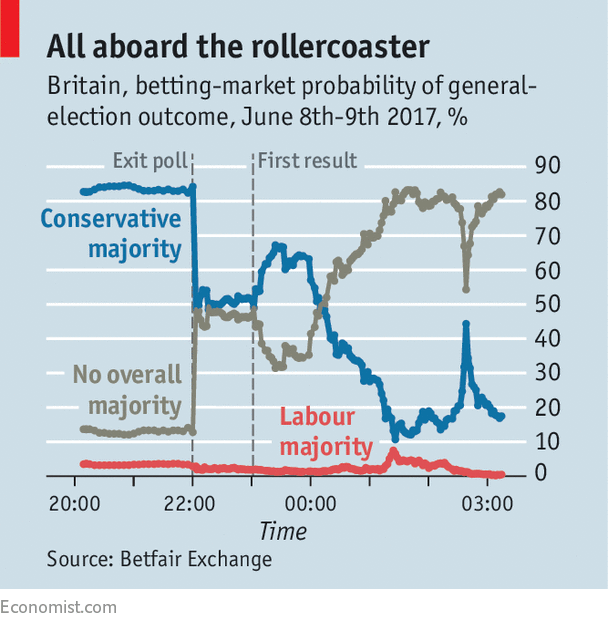
PRIME ministers expect to see their authority battered, but in the election on June 8th Theresa May suffered a grievous blow—and at her own hands, too. In the small hours, exit polls and the early vote count seemed to point not to the solid victory she had hoped for, but to the most surprising election outcome of all: a hung parliament, or at best a tiny Tory majority.
As we went to press, the Tories were losing seats in London and other urban areas, especially where voters opposed Brexit last June. Gains they hoped to make in the north and West Midlands, partly thanks to a collapse of the UK Independence Party, did not offset this. Nor did losses by the Scottish Nationalists in Scotland.
The result is a disaster for Mrs May. She chose to call the election despite having a working, if small, parliamentary majority. And she chose to focus the campaign on her claim of being “strong and stable”. She emerges a diminished figure—probably irreparably so. The Tories have a deserved reputation for being ruthless with leaders who fail to bring home victory.
A campaign designed to establish her as a strong leader could hardly have failed more spectacularly. Her manifesto came as a shock even to many in her party, especially in its attacks on business and free markets. A U-turn over financing social care made Mrs May seem weak and wobbly. Her refusal to debate directly with opponents smacked of arrogance or, worse, a deep lack of self-belief.
Jeremy Corbyn, in contrast, had a good campaign. His speeches attracted the young, who voted in droves, as well as appealing to metropolitan pro-Europeans who were strongly against Mrs May’s plans for a hard Brexit. His manifesto was festooned with far-left pledges to tax business and the rich, to nationalise the railways and utilities, and to spend lots of public money. But his message resonated with voters fed up with austerity. His success puts him and his brand of socialism firmly in charge of Labour (see article). What next? The biggest question is what will now happen to Brexit. Had Mrs May won with a substantial majority, she would shortly have begun Brexit talks (see article). But there must now be doubt about how such talks will go ahead. Both main parties accepted the result of last June’s referendum decision for Brexit. But now that voters have turned against the Tories partly because of their choice of an aggressively hard Brexit, the chances of a softer Brexit have risen.
As for what government may emerge in the case of a hung parliament, the Tories are still the largest party, so Mrs May would have first shot at forming a government that tried to secure a confidence vote in the House of Commons. That accords with the precedents of May 2010, when the Tories under David Cameron went into coalition with Nick Clegg’s Liberal Democrats, and February 1974, when after a few days Labour’s Harold Wilson formed a minority government with tacit Liberal backing.
Yet it is hard to see Mrs May winning support from any party besides the Democratic Unionists in Northern Ireland, and they will barely have enough seats for her to secure a thin majority. The Lib Dems were so badly burnt by the coalition of 2010 with Mr Cameron that they could not conceive of repeating the experience. The Scottish Nationalists are viscerally opposed to the Conservatives.
Moreover, after this dismal performance, many in her party want to dump Mrs May, even if there is no obvious candidate to put in her place. She became leader by default after Mr Cameron resigned last June. Even before the election she was being criticised for not listening to business or to her own colleagues, and for relying on too small a coterie of advisers.
If the Tories cannot form a government, Mr Corbyn will have to be given a chance instead. Although his party has many fewer seats than the Conservatives, it is likely to be seen as more acceptable by both the Lib Dems and the Scottish Nationalists—more likely as a minority government than in a formal coalition. But he would surely have to promise both parties a softer Brexit, and quite possibly a second referendum on its terms. The eventual consequences of such a link-up are hard to predict, but they might yet include a reopening of the entire Brexit decision.
The likeliest outcome may be another election. That will happen if both Mrs May and Mr Corbyn fail to form a government that wins a confidence vote. But a new poll is likely even if Mr Corbyn succeeds, for a two- or three-way coalition or a minority government will be inherently unstable. The precedent is probably not 2010, when the Tory/Lib Dem coalition lasted a full five years, but 1974 and 1923, when fresh elections were held within a year.
THE campaign to leave the European Union repeatedly urged Britain to “Take back control”. It is now a week since voters narrowly opted for Brexit, and the country has seldom looked so wildly off the rails. The prime minister has handed in his notice. The leader of the opposition is struggling to survive a coup. The pound hit a 31-year low against the dollar and banks lost a third of their value, before stabilising. Meanwhile there is talk in Scotland and Northern Ireland of secession.
Every one of these calamities was predicted in the event of a Leave victory, and yet still the country seems transfixed by what it has brought upon itself. It is time to snap out of the daze. The country needs a new leader, a coherent approach to negotiating with the EU, and a fair settlement with those nations within its own union that voted Remain. The damage to Britain’s prosperity and to its standing in the world is already grave, and will become far worse if the country now fails to “take back control” of its future.
The sick man of nowhere
Brexit’s grisly first week, and the misery ahead, have already provoked buyer’s remorse. More than 4m people have signed a petition calling for a re-run of the vote. An instant rejection of the result would be wrong. Although we regret the Brexit vote, 34m people have cast their ballot and the result was clear. A straight rematch would be no fairer than allowing England’s footballers another crack at Iceland, which inflicted a second humiliation a week after the referendum.
And yet Britain’s fate is still highly uncertain. Although Britons opted to leave the EU, Brexit comes in 57 varieties. The mildest sort would be an arrangement like Norway’s, involving continuing access to Europe’s “single market” in return for the free movement of people from EU countries and a contribution to the EU budget. At the opposite extreme, Britain could cut its ties entirely, meaning no more payments into the EU budget and no more unlimited migration—but no special access to the market which buys nearly half Britain’s exports, either. Voters were told they could have it all. They cannot.
The Norwegian option would do the least damage to the economy. It would also be the best chance to preserve the union with Scotland and Northern Ireland, both of which voted Remain. The ruling Scottish Nationalists, who lost an independence referendum in 2014, always said that Britain’s leaving the EU would justify another ballot on independence. They are right—especially since in 2014 many Scots voted to stay in Britain in order to remain in the EU. But independence would be painful: it might mean promising one day to adopt the euro and hardening the border with England, with which Scotland trades more than it does with the EU. Under a Norwegian-style deal, Scots might prefer to stick with England. The Nationalists should wait to see a deal before asking for a new referendum.
In Northern Ireland Brexit raises other problems. One is the prospect of resurrecting the border between north and south, a dismal piece of symbolism which might be avoided if Britain got a Norwegian settlement. Another shamefully overlooked snag is that Britain’s exit from Europe will break the Good Friday Agreement of 1998, in which Northern Ireland’s peace process was underpinned by the EU. This treaty has kept the peace in the UK’s most troubled region for nearly 20 years. Fixing the mess will be an urgent task for the prime minister.
Point of no Breturn
Who should that be? Tory party members, who have the final say, may favour one of the victorious Leave campaigners, a mediocre bunch who have disgraced themselves during the campaign: lying about inflated budget payments and phantom Turkish migrants, before vanishing after the vote when the Brexit hit the fan. None of them would make a worthy prime minister. And yet the very falseness of the prospectus they flogged may be their best qualification for the job. Britain’s next leader must explain to 17m voters that the illusion they were promised—all the EU’s benefits with none of its obligations—does not exist. Only when the authors of the Brexit fantasy themselves return from Brussels without this magical deal might Leave voters accept that a compromise is necessary.
European leaders are in no mood to negotiate with their bolshie neighbour. That is why Britain should delay as long as it can before invoking Article 50 of the Lisbon treaty, the mechanism for a Brexit negotiation, which sets a two-year deadline. For every extra month that the cost of Brexit sinks in, the possibility of a fudge will increase. Angela Merkel, a champion procrastinator who, like her French and Dutch counterparts, faces angry elections next year, may also feel that accommodating some British demands, such as allowing an emergency brake on the free movement of people during “surges” (perhaps applied across the EU), would be possible, though she may find it hard to sell the idea to other European leaders.
Given that nearly half of British voters did not want out, it is likely that a majority might prefer a Norwegian compromise to complete isolation. Whatever deal takes shape in Brussels will be so far from what was promised by the Leave campaign that it will surely have to be put to the British public again, through a general election, another referendum or both. It is even possible that the whole notion of Brexit may stall. A thin majority have said they would prefer life outside the EU to life inside. But it may be that, when faced with the question of whether to endorse a Norway-like deal that entails many of the costs of being in the single market without having a say in the rules, many would rather stay in the EU after all.
Negotiating over Brexit will stretch the tolerance of both British voters and European leaders. Yet the EU specialises in muddled compromises and talking its way around referendums. After months of economic hardship, and a recession-induced fall in immigration, British voters may be ready to think differently about the balance between immigration, the economy and their place in Europe. By far the most likely outcome of this sorry situation remains Brexit. But it would be wrong completely to discount the possibility of an inelegant, humiliating, and yet welcome, Breversal.