Biodun Iginla, BBC News

Biodun Iginla, BBC News
Showing posts with label Technology News. Show all posts

Thursday, May 31, 2018

Analysis: Technology and surveillance: China’s digital police state

by Xian Wan and Biodun Iginla, Technology News Analysts, The Economist Intelligence Unit, Beijing

Does China’s digital police state have echoes in the West?

The state can gather more information, more easily, than ever before. Do not underestimate the risks

THEY’RE watching you. When you walk to work, CCTV cameras film you and, increasingly, recognise your face. Drive out of town, and number-plate-reading cameras capture your journey. The smartphone in your pocket leaves a constant digital trail. Browse the web in the privacy of your home, and your actions are logged and analysed. The resulting data can be crunched to create a minute-by-minute record of your life.
Under an authoritarian government such as China’s, digital monitoring is turning a nasty police state into a terrifying, all-knowing one. Especially in the western region of Xinjiang, China is applying artificial intelligence (AI) and mass surveillance to create a 21st-century panopticon and impose total control over millions of Uighurs, a Turkic-language Muslim minority (see Briefing). In Western democracies, police and intelligence agencies are using the same surveillance tools to solve and deter crimes and prevent terrorism (see Technology Quarterly). The results are effective, yet deeply worrying.

Latest stories

See more
Between freedom and oppression stands a system to seek the consent of citizens, maintain checks and balances on governments and, when it comes to surveillance, set rules to restrain those who collect and process information. But with data so plentiful and easy to gather, these protections are being eroded. Privacy rules designed for the landline phone, postbox and filing cabinet urgently need to be strengthened for the age of the smartphone, e-mail and cloud computing.
I spy with my many eyes
When East Germany collapsed in 1989, people marvelled at the store of information the Stasi security service had garnered on them, and the vast network of informants it took to compile it. Since then the digital revolution has transformed surveillance, as it has so much else, by making it possible to collect and analyse data on an unprecedented scale. Smartphones, web browsers and sensors provide huge quantities of information that governments can hack or collect; data centres allow them to store it indefinitely; AI helps them find needles in the digital haystacks thus assembled. Technologies that once seemed a friend of freedom, allowing dissidents in dictatorships to communicate and organise more easily, now look more Orwellian, letting autocrats watch people even more closely than the Stasi did.
Xinjiang is the nightmarish extreme that the new technology makes possible: a racist police state. Fearing insurrection and separatism, China’s rulers have reinforced techniques of totalitarian control—including the mass detention of Uighurs for re-education—with digital technology. In parts of the province streets have poles bristling with CCTV cameras every 100-200 metres. They record each passing driver’s face and the car’s numberplate. Uighurs’ mobile phones must run government-issued spyware. The data associated with their ID cards include not just name, sex and occupation, but can contain relatives’ details, fingerprints, blood type, DNA information, detention record and “reliability status”. All this and more is fed into the Integrated Joint Operations Platform (IJOP), an AI-powered system, to generate lists of suspects for detention.
Totalitarianism on Xinjiang’s scale may be hard to replicate, even across most of China. Repressing an easily identified minority is easier than ensuring absolute control over entire populations. But elements of China’s model of surveillance will surely inspire other autocracies—from Russia to Rwanda to Turkey—to which the necessary hardware will happily be sold. Liberal states have an obligation to expose and chastise this export of oppression, however limited their tools of suasion.
The West must look at itself, too. These days its police forces can also have access to a Stasi’s worth of data. Officers can set up bogus phone towers to track people’s movements and contacts. Data from numberplate-readers can track a person’s movements for years. Some American cities have predictive-policing programs akin to IJOP that analyse past crimes to predict future ones. All this allows the monitoring of possible attackers, but the potential for abuse is great. Hundreds of American police officers are known to have used confidential databases to dig dirt on journalists, ex-girlfriends and others.
Watching the detectives
How to balance freedom and safety? Start by ensuring that the digital world, like the real one, has places where law-abiding people can enjoy privacy. Citizens of liberal democracies do not expect to be frisked without good cause, or have their homes searched without a warrant. Similarly, a mobile phone in a person’s pocket should be treated like a filing cabinet at home. Just as filing cabinets can be locked, encryption should not be curtailed. A second priority is to limit how long information on citizens is kept, constrain who has access to it and penalise its misuse fittingly. In 2006 the European Union issued a directive requiring mobile-phone firms to keep customers’ metadata for up to two years. That law was struck down by the European Court of Justice in 2014. Misuse of police data should be a criminal offence for which people are punished, not a “mistake” absolved by a collective apology.
A third priority is to monitor the use of AI. Predictive-policing systems are imperfect, better at finding patterns of burglary than of, say, murder. Face-recognition may produce lots of “false positive” results. AI trained with biased data—eg, patterns of arrest that feature a disproportionate number of black people—may reproduce those biases. Some sentencing algorithms are more likely to label black defendants than white ones as being at high risk of reoffending. Such algorithms must be open to scrutiny, not protected as trade secrets.
Vigilance and transparency must be the watchwords. They may enhance the technology’s effectiveness: the routine wearing of bodycams by police, for instance, appears to reduce public complaints. Consultation matters, too. A bill recently proposed in California would compel police agencies to disclose what surveillance gear they have, publish data on its use and seek public input before buying any more. If that makes progress slower so be it. Police rightly watch citizens to keep them safe. Citizens must watch the police to remain free.

Thursday, January 25, 2018

Analysis: The growing danger of great-power conflict

The next war

by Tamara Kachelmeier and Biodun Iginla, Technology News Analysts, The Economist Intelligence Unit, London/New York


How shifts in technology and geopolitics are renewing the threat

IN THE past 25 years war has claimed too many lives. Yet even as civil and religious strife have raged in Syria, central Africa, Afghanistan and Iraq, a devastating clash between the world’s great powers has remained almost unimaginable.
No longer. Last week the Pentagon issued a new national defence strategy that put China and Russia above jihadism as the main threat to America. This week the chief of Britain’s general staff warned of a Russian attack. Even now America and North Korea are perilously close to a conflict that risks dragging in China or escalating into nuclear catastrophe.

Latest updates

Why Donald Trump has become a pro-life crusader

Some hotels charge visitors for bad reviews

Paul Romer quits after an embarrassing row

Music will miss irascible, unpredictable and prolific Mark E. Smith

Five English teams are among the ten highest-earning football clubs

Remembering Ursula Le Guin, the true wizard of Earthsea

See all updates
As our special report this week on the future of war argues, powerful, long-term shifts in geopolitics and the proliferation of new technologies are eroding the extraordinary military dominance that America and its allies have enjoyed. Conflict on a scale and intensity not seen since the second world war is once again plausible. The world is not prepared.
The pity of war
The pressing danger is of war on the Korean peninsula, perhaps this year. Donald Trump has vowed to prevent Kim Jong Un, North Korea’s leader, from being able to strike America with nuclear-armed ballistic missiles, a capability that recent tests suggest he may have within months, if not already. Among many contingency plans, the Pentagon is considering a disabling pre-emptive strike against the North’s nuclear sites. Despite low confidence in the success of such a strike, it must be prepared to carry out the president’s order should he give it.
Even a limited attack could trigger all-out war. Analysts reckon that North Korean artillery can bombard Seoul, the South Korean capital, with 10,000 rounds a minute. Drones, midget submarines and tunnelling commandos could deploy biological, chemical and even nuclear weapons. Tens of thousands of people would perish; many more if nukes were used.
This newspaper has argued that the prospect of such horror means that, if diplomacy fails, North Korea should be contained and deterred instead. Although we stand by our argument, war is a real possibility (see article). Mr Trump and his advisers may conclude that a nuclear North would be so reckless, and so likely to cause nuclear proliferation, that it is better to risk war on the Korean peninsula today than a nuclear strike on an American city tomorrow.
Even if China stays out of a second Korean war, both it and Russia are entering into a renewal of great-power competition with the West. Their ambitions will be even harder to deal with than North Korea’s. Three decades of unprecedented economic growth have provided China with the wealth to transform its armed forces, and given its leaders the sense that their moment has come. Russia, paradoxically, needs to assert itself now because it is in long-term decline. Its leaders have spent heavily to restore Russia’s hard power, and they are willing to take risks to prove they deserve respect and a seat at the table.
Both countries have benefited from the international order that America did most to establish and guarantee. But they see its pillars—universal human rights, democracy and the rule of law—as an imposition that excuses foreign meddling and undermines their own legitimacy. They are now revisionist states that want to challenge the status quo and look at their regions as spheres of influence to be dominated. For China, that means East Asia; for Russia, eastern Europe and Central Asia.
Neither China nor Russia wants a direct military confrontation with America that they would surely lose. But they are using their growing hard power in other ways, in particular by exploiting a “grey zone” where aggression and coercion work just below the level that would risk military confrontation with the West. In Ukraine Russia has blended force, misinformation, infiltration, cyberwar and economic blackmail in ways that democratic societies cannot copy and find hard to rebuff. China is more cautious, but it has claimed, occupied and garrisoned reefs and shoals in disputed waters.
China and Russia have harnessed military technologies invented by America, such as long-range precision-strike and electromagnetic-spectrum warfare, to raise the cost of intervention against them dramatically. Both have used asymmetric-warfare strategies to create “anti-access/area denial” networks. China aims to push American naval forces far out into the Pacific where they can no longer safely project power into the East and South China Seas. Russia wants the world to know that, from the Arctic to the Black Sea, it can call on greater firepower than its foes—and that it will not hesitate to do so.
If America allows China and Russia to establish regional hegemonies, either consciously or because its politics are too dysfunctional to muster a response, it will have given them a green light to pursue their interests by brute force. When that was last tried, the result was the first world war.
Nuclear weapons, largely a source of stability since 1945, may add to the danger. Their command-and-control systems are becoming vulnerable to hacking by new cyber-weapons or “blinding” of the satellites they depend on. A country under such an attack could find itself under pressure to choose between losing control of its nuclear weapons or using them.
Vain citadels
What should America do? Almost 20 years of strategic drift has played into the hands of Russia and China. George W. Bush’s unsuccessful wars were a distraction and sapped support at home for America’s global role. Barack Obama pursued a foreign policy of retrenchment, and was openly sceptical about the value of hard power. Today, Mr Trump says he wants to make America great again, but is going about it in exactly the wrong way. He shuns multilateral organisations, treats alliances as unwanted baggage and openly admires the authoritarian leaders of America’s adversaries. It is as if Mr Trump wants America to give up defending the system it created and to join Russia and China as just another truculent revisionist power instead.
America needs to accept that it is a prime beneficiary of the international system and that it is the only power with the ability and the resources to protect it from sustained attack. The soft power of patient and consistent diplomacy is vital, but must be backed by the hard power that China and Russia respect. America retains plenty of that hard power, but it is fast losing the edge in military technology that inspired confidence in its allies and fear in its foes.
To match its diplomacy, America needs to invest in new systems based on robotics, artificial intelligence, big data and directed-energy weapons. Belatedly, Mr Obama realised that America required a concerted effort to regain its technological lead, yet there is no guarantee that it will be the first to innovate. Mr Trump and his successors need to redouble the effort.
The best guarantor of world peace is a strong America. Fortunately, it still enjoys advantages. It has rich and capable allies, still by far the world’s most powerful armed forces, unrivalled war-fighting experience, the best systems engineers and the world’s leading tech firms. Yet those advantages could all too easily be squandered. Without America’s commitment to the international order and the hard power to defend it against determined and able challengers, the dangers will grow. If they do, the future of war could be closer than you think.
This article appeared in the Leaders section of the print edition under the headline "The next war"

Reuse this content

Thursday, January 4, 2018

Using thought to control machines--analysis

The next frontier


Brain-computer interfaces may change what it means to be human
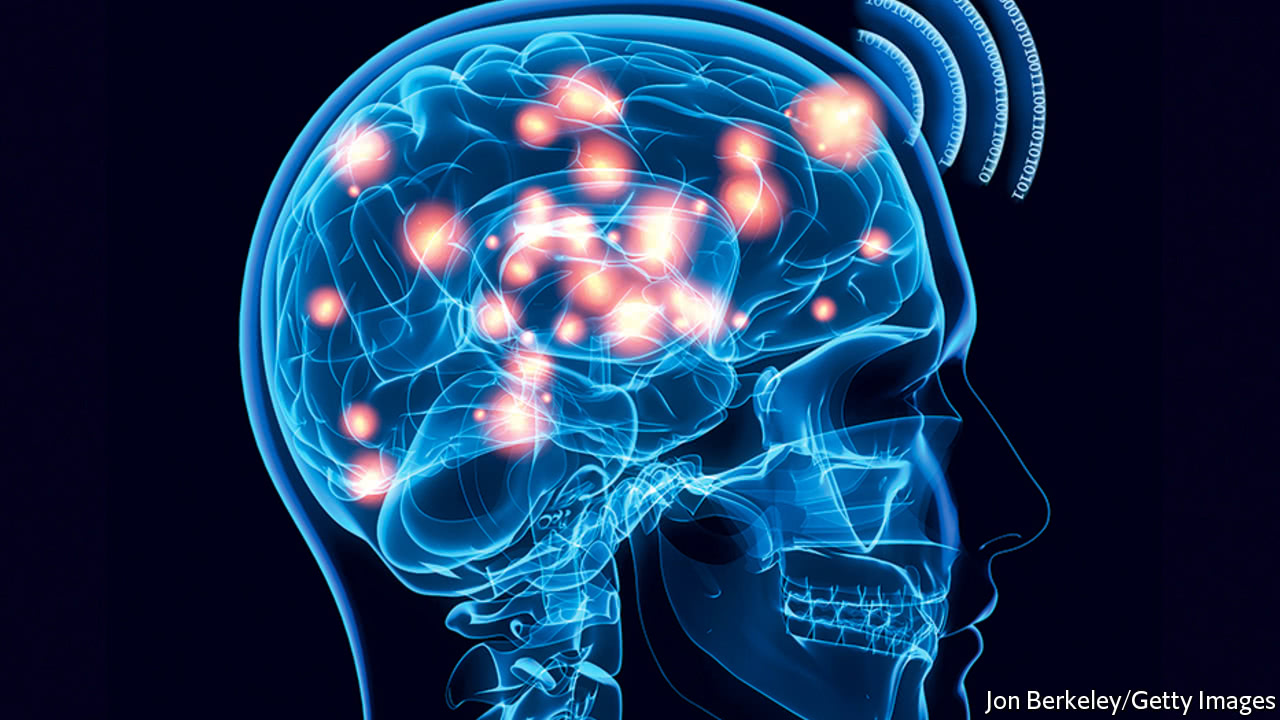
TECHNOLOGIES are often billed as transformative. For William Kochevar, the term is justified. Mr Kochevar is paralysed below the shoulders after a cycling accident, yet has managed to feed himself by his own hand. This remarkable feat is partly thanks to electrodes, implanted in his right arm, which stimulate muscles. But the real magic lies higher up. Mr Kochevar can control his arm using the power of thought. His intention to move is reflected in neural activity in his motor cortex; these signals are detected by implants in his brain and processed into commands to activate the electrodes in his arms.
An ability to decode thought in this way may sound like science fiction. But brain-computer interfaces (BCIs) like the BrainGate system used by Mr Kochevar provide evidence that mind-control can work. Researchers are able to tell what words and images people have heard and seen from neural activity alone. Information can also be encoded and used to stimulate the brain. Over 300,000 people have cochlear implants, which help them to hear by converting sound into electrical signals and sending them into the brain. Scientists have “injected” data into monkeys’ heads, instructing them to perform actions via electrical pulses.

Latest updates

See all updates
As our Technology Quarterly in this issue explains, the pace of research into BCIs and the scale of its ambition are increasing. Both America’s armed forces and Silicon Valley are starting to focus on the brain. Facebook dreams of thought-to-text typing. Kernel, a startup, has $100m to spend on neurotechnology. Elon Musk has formed a firm called Neuralink; he thinks that, if humanity is to survive the advent of artificial intelligence, it needs an upgrade. Entrepreneurs envisage a world in which people can communicate telepathically, with each other and with machines, or acquire superhuman abilities, such as hearing at very high frequencies.
These powers, if they ever materialise, are decades away. But well before then, BCIs could open the door to remarkable new applications. Imagine stimulating the visual cortex to help the blind, forging new neural connections in stroke victims or monitoring the brain for signs of depression. By turning the firing of neurons into a resource to be harnessed, BCIs may change the idea of what it means to be human.
That thinking feeling
Sceptics scoff. Taking medical BCIs out of the lab into clinical practice has proved very difficult. The BrainGate system used by Mr Kochevar was developed more than ten years ago, but only a handful of people have tried it out. Turning implants into consumer products is even harder to imagine. The path to the mainstream is blocked by three formidable barriers—technological, scientific and commercial.
Start with technology. Non-invasive techniques like an electroencephalogram (EEG) struggle to pick up high-resolution brain signals through intervening layers of skin, bone and membrane. Some advances are being made—on EEG caps that can be used to play virtual-reality games or control industrial robots using thought alone. But for the time being at least, the most ambitious applications require implants that can interact directly with neurons. And existing device ave lots of drawbacks. They involve wires that pass through the skull; they provoke immune responses; they communicate with only a few hundred of the 85bn neurons in the human brain. But that could soon change. Helped by advances in miniaturisation and increased computing power, efforts are under way to make safe, wireless implants that can communicate with hundreds of thousands of neurons. Some of these interpret the brain’s electrical signals; others experiment with light, magnetism and ultrasound.
Clear the technological barrier, and another one looms. The brain is still a foreign country. Scientists knows how it really works. little about how exactly it works, especially when it comes to complex functions like memory formation. Research is more advanced in animals, but experiments on humans are hard. Yet, even today, some parts of the brain, like the motor cortex, are better understood. Nor is complete knowledge always needed. Machine learning can recognise patterns of neural activity; the brain itself gets the hang of controlling BCIS with extraordinary ease. And neurotechnology will reveal more of the brain’s secrets.
Like a hole in the head
The third obstacle comprises the practical barriers to commercialisation. It takes time, money and expertise to get medical devices approved. And consumer applications will take off only if they perform a function people find useful. Some of the applications for brain-computer interfaces are unnecessary—a good voice-assistant is a simpler way to type without fingers than a brain implant, for example. The idea of consumers clamouring for craniotomies also seems far-fetched. Yet brain implants are already an established treatment for some conditions. Around 150,000 people receive deep-brain stimulation via electrodes to help them control Parkinson’s disease. Elective surgery can become routine, as laser-eye procedures show.
All of which suggests that a route to the future imagined by the neurotech pioneers is arduous but achievable. When human ingenuity is applied to a problem, however hard, it is unwise to bet against it. Within a few years, improved technologies may be opening up new channels of communications with the brain. Many of the first applications hold out unambiguous promise—of movement and senses restored. But as uses move to the augmentation of abilities, whether for military purposes or among consumers, a host of concerns will arise. Privacy is an obvious one: the refuge of an inner voice may disappear. Security is another: if a brain can be reached on the internet, it can also be hacked. Inequality is a third: access to superhuman cognitive abilities could be beyond all except a self-perpetuating elite. Ethicists are already starting to grapple with questions of identity and agency that arise when a machine is in the neural loop.
These questions are not urgent. But the bigger story is that neither are they the realm of pure fantasy. Technology changes the way people live. Beneath the skull lies the next frontier.