IT IS a classic startup story, but with a twist. Three 20-somethings launched a firm out of a dorm room at the Massachusetts Institute of Technology in 2016, with the goal of using algorithms to predict the reply to an e-mail. In May they were fundraising for their startup, EasyEmail, when Google held its annual conference for software developers and announced a tool similar to EasyEmail’s. Filip Twarowski, its boss, sees Google’s incursion as “incredible confirmation” they are working on something worthwhile. But he also admits that it came as “a little bit of a shock”. The giant has scared off at least one prospective backer of EasyEmail, because venture capitalists try to dodge spaces where the tech giants might step.
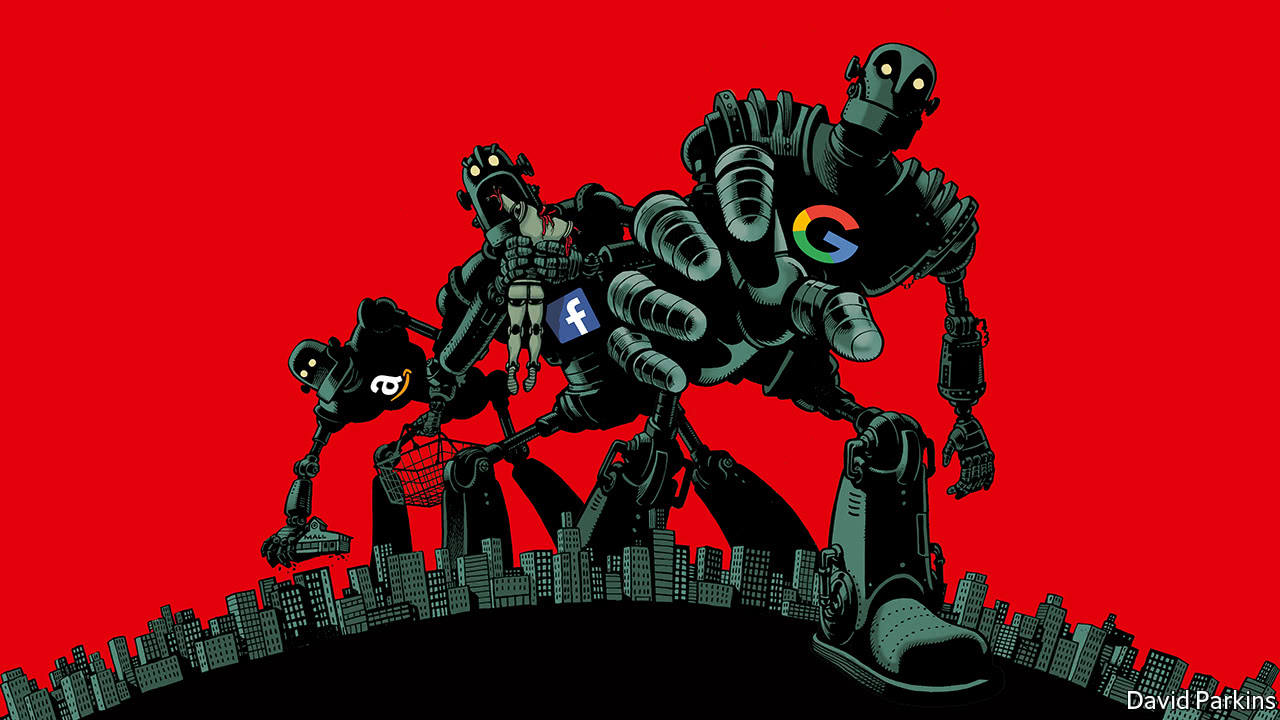
The behemoths’ annual conferences, held to announce new tools, features, and acquisitions, always “send shock waves of fear through entrepreneurs”, says Mike Driscoll, a partner at Data Collective, an investment firm. “Venture capitalists attend to see which of their companies are going to get killed next.” But anxiety about the tech giants on the part of startups and their investors goes much deeper than such events. Venture capitalists, such as Albert Wenger of Union Square Ventures, who was an early investor in Twitter, now talk of a “kill-zone” around the giants. Once a young firm enters, it can be extremely difficult to survive. Tech giants try to squash startups by copying them, or they pay to scoop them up early to eliminate a threat.
The idea of a kill-zone may bring to mind Microsoft’s long reign in the 1990s, as it embraced a strategy of “embrace, extend and extinguish” and tried to intimidate startups from entering its domain. But entrepreneurs’ and venture capitalists’ concerns are striking because for a long while afterwards, startups had free rein. In 2014 The Economist likened the proliferation of startups to the Cambrian explosion: software made running a startup cheaper than ever and opportunities seemed abundant.
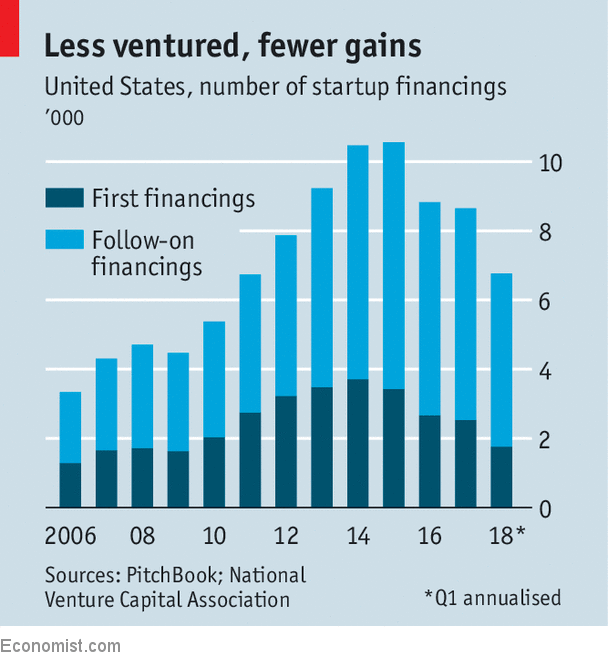
Today, less so. Anything having to do with the consumer internet is perceived as dangerous, because of the dominance of Amazon, Facebook and Google (owned by Alphabet). Venture capitalists are wary of backing startups in online search, social media, mobile and e-commerce. It has become harder for startups to secure a first financing round. According to Pitchbook, a research company, in 2017 the number of these rounds were down by around 22% from 2012 (see chart).
The wariness comes from seeing what happens to startups when they enter the kill-zone, either deliberately or accidentally. Snap is the most prominent example; after Snap rebuffed Facebook’s attempts to buy the firm in 2013, for $3bn, Facebook cloned many of its successful features and has put a damper on its growth. A less known example is Life on Air, which launched Meerkat, a live video-streaming app, in 2015. It was obliterated when Twitter acquired and promoted a competing app, Periscope. Life on Air shut Meerkat down and launched a different app, called Houseparty, which offered group video chats. This briefly gained prominence, but was then copied by Facebook, seizing users and attention away from the startup.
The kill-zone operates in business software (“enterprise” in the lingo) as well, with the shadows of Microsoft, Amazon and Alphabet looming large. Amazon’s cloud service, Amazon Web Services (AWS), has labelled many startups as “partners”, only to copy their functionality and offer them as a cheap or free service. A giant pushing into a startup’s territory, while controlling the platform that startup depends on for distribution, makes life tricky. For example, Elastic, a data-management firm, lost sales after AWS launched a competitor, Elasticsearch, in 2015.
Even if giants do not copy startups outright, they can dent their prospects. Last year Amazon bought Whole Foods Market, a grocer, for $13.7bn. Blue Apron, a meal-delivery startup that was preparing to go public, was suddenly perceived as unappetising, as expectations mounted that Amazon would push into the space. This phenomenon is not limited to young firms: recently Facebook announced it was moving into online dating, causing the share price of Match Group, which went public in 2015, to plummet by 22% that day.
It has never been easy to make it as a startup. Now the army of fearsome technology giants is larger, and operates in a wider range of areas, including online search, social media, digital advertising, virtual reality, messaging and communications, smartphones and home speakers, cloud computing, smart software, e-commerce and more. This makes it challenging for startups to find space to break through and avoid being stamped on. Today’s giants are “much more ruthless and introspective. They will eat their own children to live another day,” according to Matt Ocko, a venture capitalist with Data Collective. And they are constantly scanning the horizon for incipient threats. Startups used to be able to have several years’ head start working on something novel without the giants noticing, says Aaron Levie of Box, a cloud and file-sharing service that has avoided the kill-zone (it has a market value of around $3.8bn). But today startups can only get a six- to 12-month lead before incumbents quickly catch up, he says.
There are some exceptions. Airbnb, Uber, Slack and other “unicorns” have faced down competition from incumbents. But they are few in number and many startups have learned to set their sights on more achievable aims. Entrepreneurs are “thinking much earlier about which consolidator is going to buy them”, says Larry Chu of Goodwin Proctor, a law firm. The tech giants have been avid acquirers: Alphabet, Amazon, Apple, Facebook and Microsoft spent a combined $31.6bn on acquisitions in 2017. This has led some startups to be less ambitious. “Ninety per cent of the startups I see are built for sale, not for scale,” says Ajay Royan of Mithril Capital, which invests in tech.
This can be enriching to founders, who can go on to start another firm or provide financing to peers with smart ideas. To the extent that such exits provide more capital to spur innovation, this is no bad thing. The tech giants can help the firms they acquire grow more than they might have been able to do on their own. For example, Facebook’s acquisition of Instagram took out a would-be competitor, but it has thrived under the social-networking giant’s sway by adopting the technical infrastructure, staff and know-how that Facebook had in place.
Friend or foe?
But plenty of people in the Valley reckon the bad outweighs the good and that early, “shoot-out” acquisitions have sapped innovation. “The dominance of the big platforms has had a meaningful effect on the entrepreneurial culture of Silicon Valley,” says Roger McNamee of Elevation Partners, a private-equity firm, who was an early investor in Facebook. “It’s shifted the incentives from trying to create a large platform to creating a small morsel that’s tasty to be acquired by one of the giants.”
And when startups are bullied into selling, as some are, it is even more worrying. Big tech firms have been known to intimidate startups into agreeing to a sale, saying that they will launch a competing service and put the startup out of business unless they agree to a deal, says one person who was in charge of these negotiations at a big software firm (which uses such tactics).
There are three reasons to think that the kill-zone is likely to stay. First, the giants have tons of data to identify emerging rivals faster than ever before. Google collects signals about how internet users are spending time and money through its Chrome browser, e-mail service, Android operating system, app store, cloud service and more. Facebook can see which apps people use and where they travel online. It acquired the app Onavo, which helped it recognise that Instagram was gaining steam. It bought the young firm for $1bn before it could mature into a real threat, and last year it purchased a nascent social-polling firm, tbh, in a similar manner. Amazon can glean reams of data from its e-commerce platform and cloud business.
Another source of market information comes from investing in startups, which helps tech firms gain insights into new markets and possible disrupters. Of all American tech firms, Alphabet has been the most active. Since 2013 it has spent $12.6bn investing in 308 startups. Startups generally feel excited about gaining expertise from such a successful firm, but some may rue the day they accepted funding, because of conflicts. Uber, for example, took money from one of Alphabet’s venture-capital funds, but soon found itself competing against the giant’s self-driving car unit, Waymo. Thumbtack, a marketplace for skilled workers, also accepted money from Alphabet, but then watched as the parent company rolled out a competing service, Google Home Services. Amazon and Apple invest less in startups, but they too have clashed with them. Amazon invested in a home intercom system, called Nucleus, and then rolled out a very similar product of its own last year.
Recruiting is a second tool the giants will use to enforce their kill zones. Big tech firms are able to shell out huge sums to keep top performers and even average employees in their fold and make it uneconomical for their workers to consider joining startups. In 2017 Alphabet, Amazon, Apple, Facebook and Microsoft allocated a combined a whopping $23.7bn to stock-based compensation. Big companies’ hoarding of talent stops startups scaling quickly. According to Mike Volpi of Index Ventures, a venture-capital firm, startups in the firm’s portfolio are currently 10-20% behind in their hiring goals for the year.
A third reason that startups may struggle to break through is that there is no sign of a new platform emerging which could disrupt the incumbents, even more than a decade after the rise of mobile. For example, the rise of mobile wounded Microsoft, which was dominant on personal computers, and gave power to both Facebook and Google, enabling them to capture more online ad dollars and attention. But there is no big new platform today. And the giants make it extremely expensive to get attention: Facebook, Google and Amazon all charge a hefty toll for new apps and services to get in front of consumers.
Seeing little opportunity to compete with the tech giants on their own turf, investors and startups are going where they can spot an opening. The lack of an incumbent giant is one reason why there is so much investor enthusiasm for crypto-currencies and for synthetic biology today. But the giants are starting to pay more attention. There are rumours Facebook wants to buy Coinbase, a cryptocurrency firm.
Regulators will be watching what the giants try next. Criticism that they have been too lax in approving deals where tech firms buy tiny competitors that could one day challenge them has been mounting. Facebook’s acquisition of Instagram and Google’s purchase of YouTube, before it was obvious how the pair might have taken on the giants, might well have been blocked today. To fight back against the kill-zone, regulators must closely consider what weapons to wield themselves.
NOT long ago, being the boss of a big Western tech firm was a dream job. As the billions rolled in, so did the plaudits: Google, Facebook, Amazon and others were making the world a better place. Today these companies are accused of being BAADD—big, anti-competitive, addictive and destructive to democracy. Regulators fine them, politicians grill them and one-time backers warn of their power to cause harm.
Much of this tech lash is misguided. The presumption that big businesses must necessarily be wicked is plain wrong. Apple is to be admired as the world’s most valuable listed company for the simple reason that it makes things people want to buy, even while facing fierce competition. Many online services would be worse if their providers were smaller. Evidence for the link between smartphones and unhappiness is weak. Fake news is not only an online phenomenon.
But big tech platforms, particularly Facebook, Google and Amazon, do indeed raise a worry about fair competition. That is partly because they often benefit from legal exemptions. Unlike publishers, Facebook and Google are rarely held responsible for what users do on them; and for years most American buyers on Amazon did not pay sales tax. Nor do the titans simply compete in a market. Increasingly, they are the market itself, providing the infrastructure (or “platforms”) for much of the digital economy. Many of their services appear to be free, but users “pay” for them by giving away their data. Powerful though they already are, their huge stockmarket valuations suggest that investors are counting on them to double or even triple in size in the next decade.
There is thus a justified fear that the tech titans will use their power to protect and extend their dominance, to the detriment of consumers (see article). The tricky task for policymakers is to restrain them without unduly stifling innovation.
The less severe contest
The platforms have become so dominant because they benefit from “network effects”. Size begets size: the more sellers Amazon, say, can attract, the more buyers will shop there, which attracts more sellers, and so on. By some estimates, Amazon captures over 40% of online shopping in America. With more than 2bn monthly users, Facebook holds sway over the media industry. Firms cannot do without Google, which in some countries processes more than 90% of web searches. Facebook and Google control two-thirds of America’s online ad revenues.
America’s trustbusters have given tech giants the benefit of the doubt. They look for consumer harm, which is hard to establish when prices are falling and services are “free”. The firms themselves stress that a giant-killing startup is just a click away and that they could be toppled by a new technology, such as the blockchain. Before Google and Facebook, Alta Vista and MySpace were the bee’s knees. Who remembers them?
However, the barriers to entry are rising. Facebook not only owns the world’s largest pool of personal data, but also its biggest “social graph”—the list of its members and how they are connected. Amazon has more pricing information than any other firm. Voice assistants, such as Amazon’s Alexa and Google’s Assistant, will give them even more control over how people experience the internet. China’s tech firms have the heft to compete, but are not about to get unfettered access to Western consumers.
If this trend runs its course, consumers will suffer as the tech industry becomes less vibrant. Less money will go into startups, most good ideas will be bought up by the titans and, one way or another, the profits will be captured by the giants.
The early signs are already visible. The European Commission has accused Google of using control of Android, its mobile operating system, to give its own apps a leg up. Facebook keeps buying firms which could one day lure users away: first Instagram, then WhatsApp and most recently tbh, an app that lets teenagers send each other compliments anonymously. Although Amazon is still increasing competition in aggregate, as industries from groceries to television can attest, it can also spot rivals and squeeze them from the market.
The rivalry remedy
What to do? In the past, societies have tackled monopolies either by breaking them up, as with Standard Oil in 1911, or by regulating them as a public utility, as with AT&T in 1913. Today both those approaches have big drawbacks. The traditional tools of utilities regulation, such as price controls and profit caps, are hard to apply, since most products are free and would come at a high price in forgone investment and innovation. Likewise, a full-scale break-up would cripple the platforms’ economies of scale, worsening the service they offer consumers. And even then, in all likelihood one of the Googlettes or Facebabies would eventually sweep all before it as the inexorable logic of network effects reasserted itself.
The lack of a simple solution deprives politicians of easy slogans, but does not leave trustbusters impotent. Two broad changes of thinking would go a long way towards sensibly taming the titans. The first is to make better use of existing competition law. Trustbusters should scrutinise mergers to gauge whether a deal is likely to neutralise a potential long-term threat, even if the target is small at the time. Such scrutiny might have prevented Facebook’s acquisition of Instagram and Google’s of Waze, which makes navigation software. To ensure that the platforms do not favour their own products, oversight groups could be set up to deliberate on complaints from rivals—a bit like the independent “technical committee” created by the antitrust case against Microsoft in 2001. Immunity to content liability must go, too.
Second, trustbusters need to think afresh about how tech markets work. A central insight, one increasingly discussed among economists and regulators, is that personal data are the currency in which customers actually buy services. Through that prism, the tech titans receive valuable information—on their users’ behaviour, friends and purchasing habits—in return for their products. Just as America drew up sophisticated rules about intellectual property in the 19th century, so it needs a new set of laws to govern the ownership and exchange of data, with the aim of giving solid rights to individuals.
In essence this means giving people more control over their information. If a user so desires, key data should be made available in real time to other firms—as banks in Europe are now required to do with customers’ account information. Regulators could oblige platform firms to make anonymised bulk data available to competitors, in return for a fee, a bit like the compulsory licensing of a patent. Such data-sharing requirements could be calibrated to firms’ size: the bigger platforms are, the more they have to share. These mechanisms would turn data from something titans hoard, to suppress competition, into something users share, to foster innovation.
None of this will be simple, but it would tame the titans without wrecking the gains they have brought. Users would find it easier to switch between services. Upstart competitors would have access to some of the data that larger firms hold and thus be better equipped to grow to maturity without being gobbled up. And shareholders could no longer assume monopoly profits for decades to come.
SAN FRANCISCO - A German man has come forward as the former Twitter Inc employee who shut down the account of U.S. President Donald Trump for 11 minutes this month on his last day of work at the social network.
FILE PHOTO: The masthead of U.S. President Donald Trump's @realDonaldTrump Twitter account is seen on July 11, 2017. @realDonaldTrump/Handout/File Photo via REUTERS
The technology news website TechCrunch published an interview on Wednesday with Bahtiyar Duysak, whom it called a 20-something with Turkish roots who was born and raised in Germany. He was a temporary contract worker in San Francisco for Twitter, the website said.
SPONSORED
Duysak, who had not previously been identified as the person behind the takedown, told TechCrunch that he considered Trump’s temporary silencing a “mistake” and never thought the account would get deactivated.
It was not a planned act, he said. Rather, he said, the chance to shutter the account fell into his lap near the end of his scheduled final shift, and he decided to take it.
“There are millions of people who would take actions against him if they had the possibility. In my case, it was just random,” Duysak said in a video of the interview posted online. He wore a gray sweater emblazoned with the American flag.
Twitter on Wednesday would not confirm whether Duysak was the ex-employee in question or answer other questions. Reuters could not immediately reach Duysak.
FILE PHOTO: U.S. President Donald Trump gestures as he speaks at the White House in Washington, U.S., November 27, 2017. REUTERS/Kevin Lamarque
BuzzFeed News, citing two anonymous sources, reported separately that Duysak was the ex-employee responsible.
Duysak is a former volunteer security guard at a Muslim community center in California, BuzzFeed reported. Trump has been critical of Muslims, calling during the 2016 U.S. presidential campaign for a “total and complete shutdown” of Muslims entering the United States.
The takedown of Trump’s account on Nov. 2 sparked concerns among Twitter users over how much power employees have over sensitive accounts and whether abuse of their power could lead to international incidents.
Twitter said in a statement on Wednesday: “We have taken a number of steps to keep an incident like this from happening again.”
Duysak did not shed much light on the incident. Near the end of his last day at the San Francisco-based company, an alert came to him that someone had reported Trump’s account for an unspecified violation, he said.
Duysak put the wheels in motion to deactivate it, TechCrunch said, although the account did not go offline until hours later. Neither Duysak nor TechCrunch explained the delay.
“I didn’t hack anyone. I didn’t do anything which I wasn’t authorized to do,” he said.
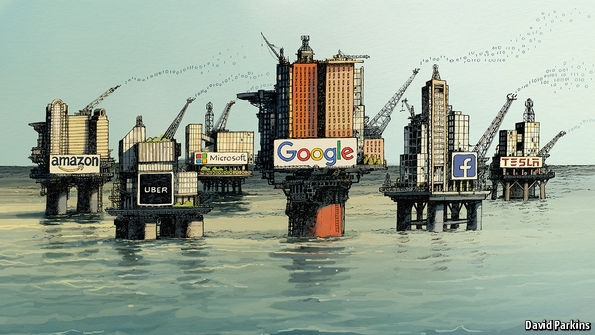
A NEW commodity spawns a lucrative, fast-growing industry, prompting antitrust regulators to step in to restrain those who control its flow. A century ago, the resource in question was oil. Now similar concerns are being raised by the giants that deal in data, the oil of the digital era. These titans—Alphabet (Google’s parent company), Amazon, Apple, Facebook and Microsoft—look unstoppable. They are the five most valuable listed firms in the world. Their profits are surging: they collectively racked up over $25bn in net profit in the first quarter of 2017. Amazon captures half of all dollars spent online in America. Google and Facebook accounted for almost all the revenue growth in digital advertising in America last year.
Such dominance has prompted calls for the tech giants to be broken up, as Standard Oil was in the early 20th century. This newspaper has argued against such drastic action in the past. Size alone is not a crime. The giants’ success has benefited consumers. Few want to live without Google’s search engine, Amazon’s one-day delivery or Facebook’s newsfeed. Nor do these firms raise the alarm when standard antitrust tests are applied. Far from gouging consumers, many of their services are free (users pay, in effect, by handing over yet more data). Take account of offline rivals, and their market shares look less worrying. And the emergence of upstarts like Snapchat suggests that new entrants can still make waves.
But there is cause for concern. Internet companies’ control of data gives them enormous power. Old ways of thinking about competition, devised in the era of oil, look outdated in what has come to be called the “data economy” (see Briefing). A new approach is needed.
Quantity has a quality all its own
What has changed? Smartphones and the internet have made data abundant, ubiquitous and far more valuable. Whether you are going for a run, watching TV or even just sitting in traffic, virtually every activity creates a digital trace—more raw material for the data distilleries. As devices from watches to cars connect to the internet, the volume is increasing: some estimate that a self-driving car will generate 100 gigabytes per second. Meanwhile, artificial-intelligence (AI) techniques such as machine learning extract more value from data. Algorithms can predict when a customer is ready to buy, a jet-engine needs servicing or a person is at risk of a disease. Industrial giants such as GE and Siemens now sell themselves as data firms.
This abundance of data changes the nature of competition. Technology giants have always benefited from network effects: the more users Facebook signs up, the more attractive signing up becomes for others. With data there are extra network effects. By collecting more data, a firm has more scope to improve its products, which attracts more users, generating even more data, and so on. The more data Tesla gathers from its self-driving cars, the better it can make them at driving themselves—part of the reason the firm, which sold only 25,000 cars in the first quarter, is now worth more than GM, which sold 2.3m. Vast pools of data can thus act as protective moats.
Access to data also protects companies from rivals in another way. The case for being sanguine about competition in the tech industry rests on the potential for incumbents to be blindsided by a startup in a garage or an unexpected technological shift. But both are less likely in the data age. The giants’ surveillance systems span the entire economy: Google can see what people search for, Facebook what they share, Amazon what they buy. They own app stores and operating systems, and rent out computing power to startups. They have a “God’s eye view” of activities in their own markets and beyond. They can see when a new product or service gains traction, allowing them to copy it or simply buy the upstart before it becomes too great a threat. Many think Facebook’s $22bn purchase in 2014 of WhatsApp, a messaging app with fewer than 60 employees, falls into this category of “shoot-out acquisitions” that eliminate potential rivals. By providing barriers to entry and early-warning systems, data can stifle competition.
Who ya gonna call, trustbusters?
The nature of data makes the antitrust remedies of the past less useful. Breaking up a firm like Google into five Googlets would not stop network effects from reasserting themselves: in time, one of them would become dominant again. A radical rethink is required—and as the outlines of a new approach start to become apparent, two ideas stand out.
The first is that antitrust authorities need to move from the industrial era into the 21st century. When considering a merger, for example, they have traditionally used size to determine when to intervene. They now need to take into account the extent of firms’ data assets when assessing the impact of deals. The purchase price could also be a signal that an incumbent is buying a nascent threat. On these measures, Facebook’s willingness to pay so much for WhatsApp, which had no revenue to speak of, would have raised red flags. Trustbusters must also become more data-savvy in their analysis of market dynamics, for example by using simulations to hunt for algorithms colluding over prices or to determine how best to promote competition (see Free exchange).
The second principle is to loosen the grip that providers of online services have over data and give more control to those who supply them. More transparency would help: companies could be forced to reveal to consumers what information they hold and how much money they make from it. Governments could encourage the emergence of new services by opening up more of their own data vaults or managing crucial parts of the data economy as public infrastructure, as India does with its digital-identity system, Aadhaar. They could also mandate the sharing of certain kinds of data, with users’ consent—an approach Europe is taking in financial services by requiring banks to make customers’ data accessible to third parties.
Rebooting antitrust for the information age will not be easy. It will entail new risks: more data sharing, for instance, could threaten privacy. But if governments don’t want a data economy dominated by a few giants, they will need to act soon.