Biodun Iginla, BBC News

Biodun Iginla, BBC News
Showing posts with label Tijuana (Mexico). Show all posts

Thursday, January 24, 2019

U.S. will return asylum seekers to Mexico today


January 25, 2019  09H:08  GMT/UTC/ZULU
MEXICO CITY/NEW YORK - The U.S. government will return the first group of migrants seeking asylum in the United States to the Mexican border city of Tijuana on Friday, U.S. and Mexican officials said, marking the start of a major policy shift by the Trump administration.
Migrants from Central America are seen escorted by U.S. Customs and Border Protection (CBP) officials after crossing the border from Mexico to surrender to the officials in El Paso, Texas, U.S., in this picture taken from Ciudad Juarez, Mexico December 3, 2018. REUTERS/Jose Luis Gonzalez
The policy dubbed the Migrant Protection Protocols (MPP) and first announced on Dec. 20 will return non-Mexican migrants who cross the U.S. southern border back to wait in Mexico while their asylum requests are processed in U.S. immigration courts.
The plan is aimed at curbing the increasing number of families arriving mostly from Central America who say they fear returning to their home countries due to threats of violence. The Trump administration says many of the claims are not valid.
The program will apply to arriving migrants who ask for asylum at ports of entry or who are caught crossing illegally and say they are afraid to return home.
Children traveling on their own and some migrants from “vulnerable populations” could be excluded on a case-by-case basis, the Department of Homeland Security said in a fact sheet.
SPONSORED
ADVERTISING
“The MPP will provide a safer and more orderly process that will discourage individuals from attempting illegal entry and making false claims to stay in the U.S., and allow more resources to be dedicated to individuals who legitimately qualify for asylum,” the DHS said.
(graphic: tmsnrt.rs/2Rhk5VT)
Illegal crossings at the southern border have dropped dramatically since highs reached in previous decades, but in recent years more families and unaccompanied children from El Salvador, Honduras and Guatemala are migrating to the United States and asylum applications have ballooned.
Last year, about 93,000 people sought asylum at the southern border, up 67 percent from 2017, according to U.S. government data.
Asylum seekers are typically granted the right to stay in the United States while their cases are decided by a U.S. immigration judge, but a backlog of more than 800,000 cases means the process can take years.
Now, the U.S. government says migrants will be turned away with a “notice to appear” in immigration court. They will be able to enter the United States for their hearings but will have to live in Mexico in the interim. If they lose their cases, they will be deported to their home countries.
Mexico has said it will not accept anybody facing a credible threat in Mexican territory.
But immigration advocates fear Mexican territory is not safe for migrants who are regularly kidnapped by criminal gangs and smugglers, and have raised concerns that applicants will not be able to access proper legal counsel to represent them in U.S. courts.
It is unclear how Mexico plans to house what could be thousands of asylum seekers for the lengthy duration of their immigration proceedings. Some Mexican border towns are more violent than the cities the Central Americans left behind.
The Trump administration says it is relying on a U.S. law that allows migrants attempting to enter the United States from a contiguous country to be removed to that country. But the policy will likely be challenged in court since claiming asylum is protected under both international and U.S. law.
Several of Trump’s signature immigration policies, including some attempting to reduce asylum applications, have been halted by U.S. federal courts.
Trump backs Maduro rival amid massive protests
Trump argues that the asylum system is abused, calling a process by which many migrants are freed in the United States to await immigration trial “catch and release.”
Trump is demanding $5.7 billion in funding for a wall along the Mexican border, triggering a U.S. partial government shutdown that stretched to its 34th day on Thursday and has left 800,000 federal workers without pay.

Friday, November 30, 2018

BREAKING: Jobs in Mexico replace American dream for some caravan migrants

TIJUANA (MEXICO)


    © AFP | Denny Guevara, 26, has found work at a supermarket in Mexico; his next dream is to make enough money to send for the wife and three children he left behind in Honduras

    TIJUANA (MEXICO)- 
    Stranded on the US-Mexican border with little hope of entering the United States, thousands of people from a migrant caravan are letting go of their American dream and settling on a Mexican one.
    Under a work program set up by the Mexican government, 2,250 migrants in the northern border city of Tijuana -- out of the roughly 6,000 who trekked here in the caravan from Central America -- have signed up to get jobs, visas and social security benefits in Mexico.
    The program is designed to induce them to stay here, rather than press on to the United States, where wages are higher but where President Donald Trump has made his hostility toward the migrant "invasion" plain.
    But it is a long process: just 15 migrants have actually been employed so far.
    - 'I'll do well' -
    Denny Guevara, a 26-year-old Honduran man, is one of them.
    "It turns out this was my destiny," he says, smiling ear to ear as he carefully arranges bottles of honey on the shelves of a Tijuana supermarket, the Smart & Final.
    "What I wanted was a better life, to escape the violence in my country, an opportunity to find work."
    He managed to do that without ever reaching the United States.
    In the week since he arrived in Tijuana, which sits across from San Diego, California, he has managed to find a job and get residence papers.
    "My plan is to stay here. I think I'll do well," he says.
    Looking smart in his navy blue uniform, the former bank employee says he still can't get over the seemingly endless abundance of products on Mexican supermarket shelves, which look more like American ones than Honduran.
    "This is still all pretty new. I'll have to get used to it little by little," he says.
    His next dream: to make enough money to send for the wife and three children he left behind in Honduras.
    First, he needs to find a place to live.
    He is currently staying at the shelter set up for the caravan, where "there's nowhere to wash your clothes and you have to stand in a long line to shower," he says.
    - 'I've done it before' -
    Yansy Lopez, a 23-year-old Salvadoran woman, is pushing her crying baby in a stroller as she snakes through the line for breakfast at the shelter.
    There are hundreds of people ahead of her, and she is in a hurry: she needs to get to a job interview.
    "They're offering me 12 hours a day packing boxes, from Monday to Saturday, for 2,000 pesos (about $100) a week," she says enthusiastically.
    She did the same job back in El Salvador for a US clothing brand, but left after members of one of the country's notoriously violent gangs tortured and killed her stepson.
    She made the same salary there, plus bonuses.
    "I was the fastest, I packed more boxes than anyone," she says.
    "If they give me the job here -- well, I've done it before," she adds with a smile.
    - 'Felt like giving up' -
    Edwin Garcia, a 27-year-old auto mechanic from Honduras, has also found work in the same supermarket as Guevara, stacking fruits and vegetables in symmetrical pyramids in the produce aisle.
    "I'd never had a decent job before," he says.
    He left Honduras because he was too poor to even buy milk for his baby daughter, he says.
    His new job "is like a dream that I haven't woken up from yet. I'm trying to take it all in... It's a beautiful thing to feel like I'm integrating into (Mexican) society."
    He says he is still traumatized by the trek to the border.
    "I walked a lot of the way. I felt like giving up in Mexico City. 'I can't go on,' I said to myself," he says, choking back tears.
    "But I looked at my pictures of my daughter, and that made me want to try. And here I am."

    Tuesday, November 27, 2018

    BREAKING AND UPDATE: Migrant caravan: Trump defends tear gas on Mexico border

    November 27, 2018  14H:18  GMT/UTC/ZULU TIME
    Related Topics


    Media captionUS closes border crossing after migrant rush

    by Melissa Gruz and Biodun Iginla, BBC News, Washington
    US President Donald Trump has defended the use of tear gas on a crowd of migrants, including children, trying to cross the US-Mexico border on Sunday.
    Border agents were forced into action because they were "being rushed by some very tough people", Mr Trump said.
    Critics have accused the Trump administration of a draconian response, while Mexico has demanded the US investigate its use of tear gas.
    Mexico says it has deported nearly 100 migrants who attempted to enter the US.
    Sunday's confrontation broke out after a migrants' march in Tijuana spiralled out of control, with hundreds of migrants attempting to breach barriers separating Mexico from the US.
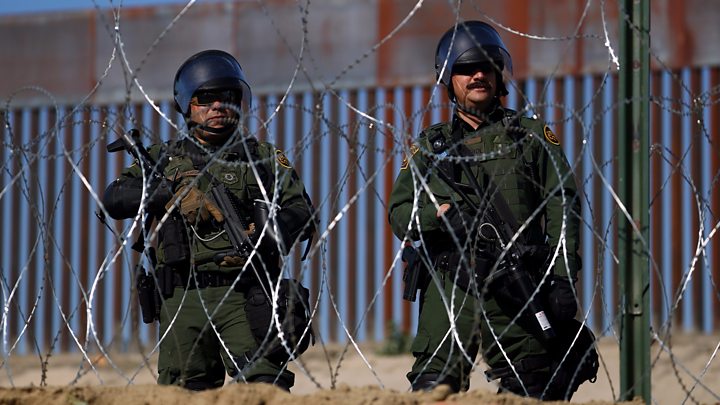
    US Customs and Border Protection, which polices the border, said its personnel had been assaulted and hit by stones.
    Women and children were among those trying to protect themselves from tear gas fired by the authorities, sparking condemnation from activists and some politicians.

    What did Mr Trump say?

    Speaking in Mississippi, Mr Trump said the border agents were right to use tear gas. "Here's the bottom line: Nobody's coming into our country unless they come in legally."
    ADVERTISEMENT
    He added that the gas used was "very safe" and was a "very minor form" of tear gas.
    However, this was disputed by some journalists at the scene, who said the tear gas was painful even from a significant distance away.
    According to the Centers for Disease Control and Prevention (CDC), tear gas can cause a burning sensation in the eyes and mouth, shortness of breath, and burns or rashes. Prolonged exposure can lead to blindness or breathing problems.
    The Chemical Weapons Convention prohibits the use of tear gas in war, but allows it for domestic law enforcement purposes.
    Homeland Security Secretary Kirstjen Nielsen has defended the use of tear gas, saying border agents were entitled to "self-defence".
    However, Mexico's foreign ministry sent the US government a diplomatic note expressing its concern about the use of non-lethal weapons, and calling for a full investigation.
    Mr Trump also questioned why parents had taken their children to the site, and alleged that some of the people at the border were not parents, but "grabbers" who had taken children with them to improve their chances of asylum.
    Ms Nielsen accused migrant caravan organisers of using women and children as "human shields" during their encounters with law enforcement, "putting vulnerable people in harm's way".
    Mr Trump and Ms Nielsen did not provide evidence for their claims.

    What do people at the border say?

    About 7,500 migrants have arrived at the US-Mexican border in recent weeks.
    The migrants, who are mostly from Honduras, but also from Guatemala and El Salvador, say they are fleeing the threat of violence in their home countries and looking to make a better life for themselves and their families.
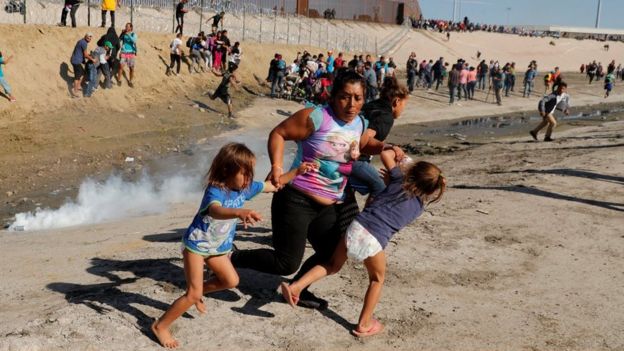
    A photograph of Maria Meza and two of her daughters escaping tear gas was widely circulated online, and used by several major newspapers.
    Ms Meza, from Honduras, said she had not attempted to cross the border, and was only looking across the fence when the tear gas was used.

    A migrant woman, Maria Meza, holds onto two of her daughters as she escapes the tear gasImage copyrightREUTERS
    Image captionThis photo of Maria Meza and her twin daughters escaping tear gas was widely circulated online
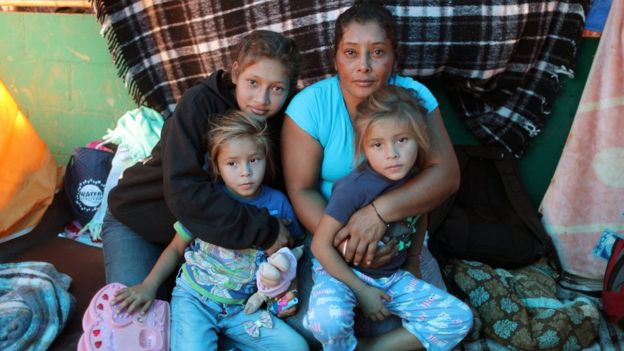
    Maria Meza with her three daughtersImage copyrightREUTERS
    Image captionMaria Meza described herself as a single mother who wanted to provide for her children

    "I was scared," she told BuzzFeed News. "I grabbed my daughters and ran... I thought my kids were going to die with me because of the gas we inhaled."
    Meanwhile, a Honduran migrant at the border told AFP the US authorities had started using tear gas as they neared the border.
    "The alarm went off and they began throwing tear gas at us. A person got hit and lots of kids fainted. So some people got rocks and threw them because many kids were fainting."

    Presentational white space
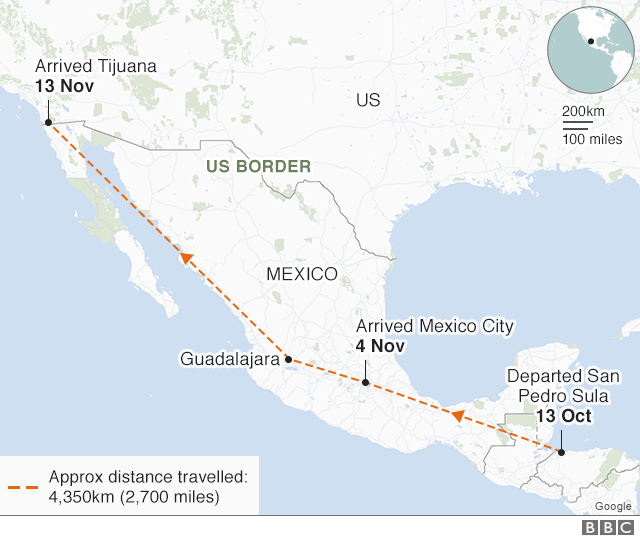
    Map of caravan route
    Presentational white space

    The migrants have travelled in large groups, dubbed "caravans", for more than 4,000km (2,500 miles) from Central America.
    President Trump has vowed to keep each migrant on the Mexican side of the border until courts have decided their cases, meaning some face a long wait.

    More on this story