Biodun Iginla, BBC News

Biodun Iginla, BBC News
Showing posts with label World Health Organisation. Show all posts

Thursday, March 12, 2020

ANALYSIS: Covid-19: The politics of pandemics

by Biodun Iginla, The Economist Intelligence Unit News Analyst


All governments will struggle. Some will struggle more than others
LeadersMar 12th 2020 edition

TO SEE WHAT is to come look to Lombardy, the affluent Italian region at the heart of the covid-19 outbreak in Europe. Its hospitals provide world-class health care. Until last week they thought they would cope with the disease—then waves of people began turning up with pneumonia. Having run out of ventilators and oxygen, exhausted staff at some hospitals are being forced to leave untreated patients to die.
The pandemic, as the World Health Organisation (WHO) officially declared it this week, is spreading fast, with almost 45,000 cases and nearly 1,500 deaths in 112 countries outside China. Epidemiologists reckon Italy is one or two weeks ahead of places like Spain, France, America and Britain. Less-connected countries, such as Egypt and India, are further behind, but not much. (For more coverage of covid-19 see our coronavirus hub.)
Few of today’s political leaders have ever faced anything like a pandemic and its economic fallout—though some are evoking the financial crisis of 2007-09 (see article). As they belatedly realise that health systems will buckle and deaths mount, leaders are at last coming to terms with the fact that they will have to weather the storm. Three factors will determine how they cope: their attitude to uncertainty; the structure and competence of their health systems; and, above all, whether they are trusted.
The uncertainty has many sources. One is that SARS-CoV-2 and the disease it causes, covid-19, are not fully understood (see article). Another is over the status of the pandemic. In each region or country it tends to proliferate rapidly undetected. By the time testing detects cases in one place it will be spreading in many others, as it was in Italy, Iran and South Korea. By the time governments shut schools and ban crowds they may be too late.
China’s solution, endorsed by the WHO, was to impose a brutal quarantine, bolstered by mass-testing and contact tracing. That came at a high human and economic cost, but new infections have dwindled. This week, in a victory lap, President Xi Jinping visited Wuhan, where the pandemic first emerged (see article). Yet uncertainty persists even in China, because nobody knows if a second wave of infections will rise up as the quarantine eases.
In democracies leaders have to judge if people will tolerate China’s harsh regime of isolation and surveillance. Italy’s lockdown is largely self-policed and does not heavily infringe people’s rights. But if it proves leakier than China’s, it may be almost as expensive and a lot less effective (see article).
Efficacy also depends on the structure and competence of health-care systems. There is immense scope for mixed messages and inconsistent instructions about testing and when to stay isolated at home. Every health system will be overwhelmed. Places where people receive very little health care, including refugee camps and slums, will be the most vulnerable. But even the best-resourced hospitals in rich countries will struggle.
Universal systems like Britain’s National Health Service should find it easier to mobilise resources and adapt rules and practices than fragmented, private ones that have to worry about who pays whom and who is liable for what (see article). The United States, despite its wealth and the excellence of its medical science, faces hurdles. Its private system is optimised for fee-paying treatments. America’s 28m uninsured people, 11m illegal immigrants and an unknown number without sick pay all have reasons to avoid testing or isolation. Red tape and cuts have fatally delayed adequate testing (see article).
Uncertainty will be a drag on the third factor—trust. Trust gives leaders licence to take difficult decisions about quarantines and social-distancing, including school closures. In Iran the government, which has long been unpopular, is widely suspected of covering up deaths and cases. That is one reason rebellious clerics could refuse to shut shrines, even though they spread infection (see article).
Nothing stokes rumour and fear more than the suspicion that politicians are hiding the truth. When they downplay the threat in a misguided attempt to avoid panic, they end up sowing confusion and costing lives. Yet leaders have struggled to come to terms with the pandemic and how to talk about it. President Donald Trump, in particular, has veered from unfounded optimism to attacking his foes. This week he announced a 30-day ban on most travel from Europe that will do little to slow a disease which is already circulating in America. As people witness the death of friends and relatives, he will find that the pandemic cannot be palmed off as a conspiracy by foreigners, Democrats and CNN.
What should politicians do? Each country must strike its own balance between the benefits of tracking the disease and the invasion of privacy, but South Korea and China show the power of big data and mass-testing as a way of identifying cases and limiting their spread. Governments also need to anticipate the pandemic, because actions to slow its spread, such as banning crowds, are more effective if they are early.
The best example of how to respond is Singapore, which has had many fewer cases than expected. Thanks to an efficient bureaucracy in a single small territory, world-class universal health care and the well-learned lesson of SARS, an epidemic of a related virus in 2003, Singapore acted early. It has been able to make difficult trade-offs with public consent because its message has been consistent, science-based and trusted.
In the West covid-19 is a challenge to the generation of politicians who have taken power since the financial crisis. Many of them decry globalisation and experts. They thrive on division and conflict. In some ways the pandemic will play to their agenda. Countries may follow America and turn inward and close their borders. In so far as shortages crimp the world economy, industries may pull back from globalisation—though they would gain more protection by diversifying their supply chains.
Yet the pandemic also puts doctors, scientists and policy experts once again at the heart of government. Pandemics are quintessentially global affairs. Countries need to work together on treatment protocols, therapeutics and, it is hoped, a vaccine. Worried voters may well have less of an appetite for the theatrical wrestling match of partisan politics. They need their governments to deal with the real problems they are facing—which is what politics should have been about all along.

Friday, February 28, 2020

ANALYSIS: The Coronavirus: is coming

The pandemic

Governments have an enormous amount of work to do
LeadersFeb 27th 2020 edition

IN PUBLIC HEALTH, honesty is worth a lot more than hope. It has become clear in the past week that the new viral disease, covid-19, which struck China at the start of December will spread around the world. Many governments have been signalling that they will stop the disease. Instead, they need to start preparing people for the onslaught (see article).
Officials will have to act when they do not have all the facts, because much about the virus is unknown. A broad guess is that 25-70% of the population of any infected country may catch the disease. China’s experience suggests that, of the cases that are detected, roughly 80% will be mild, 15% will need treatment in hospital and 5% will require intensive care. Experts say that the virus may be five to ten times as lethal as seasonal flu, which, with a fatality rate of 0.1%, kills 60,000 Americans in a bad year. Across the world, the death toll could be in the millions.
If the pandemic is like a very severe flu, models point to global economic growth being two percentage points lower over 12 months, at around 1%; if it is worse still, the world economy could shrink. As that prospect sank in during the week, the S&P 500 fell by 8% (see article).
Yet all those outcomes depend greatly on what governments choose to do, as China shows. Hubei province, the origin of the epidemic, has a population of 59m. It has seen more than 65,000 cases and a fatality rate of 2.9%. By contrast, the rest of China, which contains 1.3bn people, has suffered fewer than 13,000 cases with a fatality rate of just 0.4%. Chinese officials at first suppressed news of the disease, a grave error that allowed the virus to take hold. But even before it had spread much outside Hubei, they imposed the largest and most draconian quarantine in history. Factories shut, public transport stopped and people were ordered indoors. This raised awareness and changed behaviour. Without it, China would by now have registered many millions of cases and tens of thousands of deaths.
The World Health Organisation was this week full of praise for China’s approach. That does not, however, mean it is a model for the rest of the world. All quarantines carry a cost—not just in lost output, but also in the suffering of those locked away, some of whom forgo medical treatment for other conditions. It is still too soon to tell whether this price was worth the gains. As China seeks to revive its economy by relaxing the quarantine, it could well be hit by a second wave of infections. Given that uncertainty, few democracies would be willing to trample over individuals to the extent China has. And, as the chaotic epidemic in Iran shows, not all authoritarian governments are capable of it.
Yet even if many countries could not, or should not, exactly copy China, its experience holds three important lessons—to talk to the public, to slow the transmission of the disease and to prepare health systems for a spike in demand.
A good example of communication is America’s Center of Disease Control. World Health Organisation  which issued a clear, unambiguous warning on February 25th. A bad one is Iran’s deputy health minister, who succumbed to the virus during a press conference designed to show that the government is on top of the epidemic.
Even well-meaning attempts to sugarcoat the truth are self-defeating, because they spread mistrust, rumours and, ultimately, fear. The signal that the disease must be stopped at any cost, or that it is too terrifying to talk about, frustrates efforts to prepare for the virus’s inevitable arrival. As governments dither, conspiracy theories coming out of Russia are already sowing doubt, perhaps to hinder and discredit the response of democracies.
The best time to inform people about the disease is before the epidemic. One message is that fatality is correlated with age. If you are over 80 or you have an underlying condition you are at high risk; if you are under 50 you are not. Now is the moment to persuade the future 80% of mild cases to stay at home and not rush to a hospital. People need to learn to wash their hands often and to avoid touching their face. Businesses need continuity plans, to let staff work from home and to ensure a stand-in can replace a vital employee who is ill or caring for a child or parent. The model is Singapore, which learned from SARS, another coronavirus, that clear, early communication limits panic.
China’s second lesson is that governments can slow the spread of the disease. Flattening the spike of the epidemic means that health systems are less overwhelmed, which saves lives. If, like flu, the virus turns out to be seasonal, some cases could be delayed until next winter, by which time doctors will understand better how to cope with it. By then, new vaccines and antiviral drugs may be available.
When countries have few cases, they can follow each one, tracing contacts and isolating them. But when the disease is spreading in the community, that becomes futile. Governments need to prepare for the moment when they will switch to social distancing, which may include cancelling public events, closing schools, staggering work hours and so on. Given the uncertainties, governments will have to choose how draconian they want to be. They should be guided by science. International travel bans look decisive, but they offer little protection because people find ways to move. They also signal that the problem is “them” infecting “us”, rather than limiting infections among “us”. Likewise, if the disease has spread widely, as in Italy and South Korea, “Wuhan-lite” quarantines of whole towns offer scant protection at a high cost.

Scrub up

The third lesson is to prepare health systems for what is to come. That entails painstaking logistical planning. Hospitals need supplies of gowns, masks, gloves, oxygen and drugs. They should already be conserving them. They will run short of equipment, including ventilators. They need a scheme for how to set aside wards and floors for covid-19 patients, for how to cope if staff fall ill, and for how to choose between patients if they are overwhelmed. By now, this work should have been done.
This virus has already exposed the strengths and weaknesses of China’s authoritarianism. It will test all the political systems with which it comes into contact, in both rich and developing countries. China has bought governments time to prepare for a pandemic. They should use it.
Read more:Covid-19 is now in 50 countries, and things will get worse (February 27th)
To curb covid-19, China is using its high-tech surveillance tools (February 27th)
Covid-19 presents economic policymakers with a new sort of threat (February 20th)
How China’s coronavirus epidemic could hurt the world economy
(February 13th)
This article appeared in the Leaders section of the print edition under the headline "Going global"

Reuse this contentThe Trust Project

Wednesday, May 16, 2018

BREAKING: DR Congo Ebola outbreak spreads to Mbandaka city


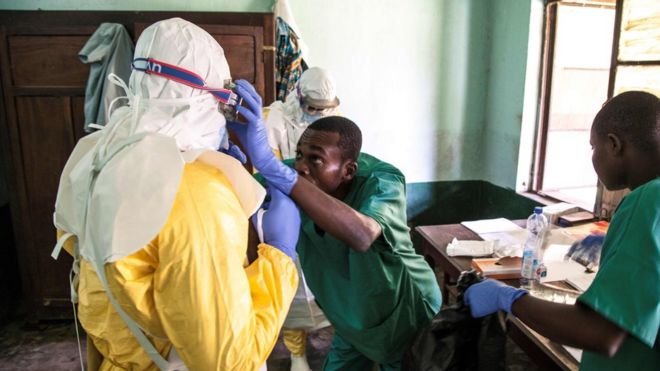
Health workers at Bikoro hospital in DR CongoImage copyrightAFP/GETTY
Image captionTwenty-three people are known to have died
by Rashida Adjani and Biodun Iginla, BBC News, Mbandaka, Congo
The Ebola outbreak in Congo has spread from the countryside into a city, prompting fears that the disease will be increasingly difficult to control.
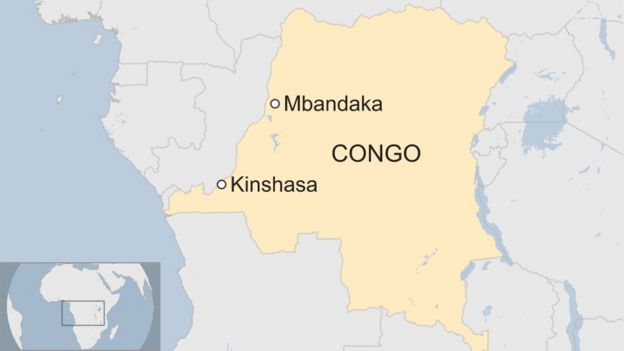
Health Minister Oly Ilunga Kalenga confirmed a case in Mbandaka, a city of a million people about 130km (80 miles) from the area where the first cases were confirmed earlier this month.
The city is a major transportation hub with routes to the capital Kinshasa.
Forty-two people have now been infected and 23 people are known to have died.
Confirmed, probable and suspected cases of Ebola have been recorded in three health zones of Congo's Equateur province, the World Health Organisation (WHO) said.
map
The WHO's Peter Salama said health workers had identified 430 people who may have had contact with the disease and were working to trace more than 4,000 contacts of Ebola patients, who had spread across northwest Congo.
On Wednesday more than 4,000 doses of an experimental vaccine sent by the World Health Organisation (WHO) arrived in the country with another batch expected soon.
The vaccine from pharmaceutical firm Merck is unlicensed but was effective in limited trials during the Ebola outbreak in West Africa.
It needs to be stored at a temperature of between -60 and -80 C. Electricity supplies in Congo are unreliable.

'Exploding outbreak'

Observers said the rapid response of international bodies - delivering personnel and medical supplies - showed they were taking this latest outbreak seriously.
"We've really seen a remarkable and very rapid mobilisation in this case," New York-based Ebola expert Dr Laurie Garrett told us at the BBC.
"The logistic issues getting to this very remote area are quite considerable, and it will also be considerable on the ground to identify who should be vaccinated and to get out in this vast and very difficult area and provide vaccination in an appropriate way.
"It's never been done before in the midst of an exploding outbreak so we'll watch it very closely."
Some 11,300 people died of Ebola in Guinea, Liberia and Sierra Leone between 2014 and 2016.
Media captionHow the virus attacks human cells