Biodun Iginla, BBC News

Biodun Iginla, BBC News
Showing posts with label air strikes. Show all posts

Thursday, September 6, 2018

BREAKING: Hundreds flee as Syria, Russia hit rebel stronghold Idlib


by Nasra Ismail and Biodun Iginla, France24, Beirut


    © AFP | Syrian rebel fighters of the Turkish-backed National Liberation Front rest in the northern countryside of Idlib province on September 5, 2018, as a threatened government offensive looms

    BEIRUT - 
    Hundreds of Syrian civilians fled Idlib province on Thursday as the presidents of Russia, Iran and Turkey readied for last-ditch talks on the fate of the last rebel bastion.
    Government forces and their allies have been massing around Idlib, where aid groups fear what could be the last major battle of Syria's seven-year civil war may also prove the deadliest.
    Western powers have warned against a bloodbath but Damascus and Moscow seem adamant that an offensive is needed to root out the jihadists who dominate the province.
    Sporadic bombardment has targeted armed groups on Idlib's fringes in recent days, with fresh Syrian artillery and Russian air bombardment of the southeast of the province on Thursday, the Syrian Observatory for Human Rights said.
    The attacks prompted terrified residents to flee before a fully-fledged assault gets under way, the monitor said.
    "Around 180 families, or some 1,000 people" have fled their homes since Wednesday night towards rebel territory further east, said Observatory head Rami Abdel Rahman.
    He said the displaced were mostly villagers from areas near government-held territory and most vulnerable to the early phase of an assault.
    Artillery fire also killed one civilian and wounded six more, Abdel Rahman said.
    In the city of Idlib, resident Mohamed al-Zir said the most terrifying threat was that of air strikes by the regime or its Russian allies.
    "These are criminal air forces that commit massacres against civilians," he told us at France24.  "The strikes are barbaric, they have no target, they are launched randomly."
    The number displaced so far is tiny compared to the 800,000 that the United Nations fears may be thrown onto the roads, more than a quarter of the rebel zone's population.
    A France24  correspondent in Idlib saw convoys of families heading north, towards areas closer to the border with Turkey and less exposed to the launch of a major offensive.
    Turkey, which sponsors some of the rebel groups competing with the jihadist Hayat Tahrir al-Sham (HTS) alliance in Idlib, is scrambling to avert an assault from which it has much to lose.
    Russia wants Turkey to exert its influence in Idlib to rein in jihadist and other fighters, but Ankara's progress has been slow and HTS remains the strongest force in the province.
    "We can work together to render those (radical groups) ineffective. The solution is not to bomb or attack all over Idlib, without any distinction," Turkish Foreign Minister Mevlut Cavusoglu said on Wednesday.
    Turkey already hosts three million Syrian refugees and fears a large scale military operation in Idlib will push more over its border.
    - 'World is watching' -
    The fate of the province, which has been used as a relief valve for tens of thousands of fighters and civilians evacuated from other parts of the country following surrender deals, could be decided in Tehran on Friday.
    The presidents of Russia, Iran and Turkey -- the three main power brokers in Syria -- are due to meet as part of the ongoing Astana process aimed at ending the conflict.
    Successive rounds of talks have failed to halt the war, which has killed 350,000 people and driven more than 11 million from their homes since it erupted in 2011.
    Observers have argued that another tragedy could be averted if Turkey gives Russia guarantees on the ground and Moscow understands that a major crisis in Idlib risks undermining its own political goals in Syria.
    Russia itself has suggested that the Idlib offensive could be conducted in several phases, giving negotiations a chance to continue in parallel.
    The next few days could see the launch of an assault restricted to peripheral areas.
    Initial targets would include securing Syria's main north-south M5 highway, eliminating groups responsible for drone attacks on Russia's Hmeimim air base and flushing out jihadists from areas close to the Mediterranean coastal heartland of Assad's Alawite minority.
    Humanitarian groups have warned against any escalation in violence, and Save the Children said on Thursday an assault would have "devastating consequences" for the young.
    "During seven years of war, these children have seen and experienced things that no child ever should," said its CEO Helle Thorning-Schmidt, calling on the warring parties in Idlib to "pull back from the brink."
    Turkish President Recep Tayyip Erdogan said before heading to Iran that an offensive could trigger "a serious massacre", while his US counterpart, Donald Trump, said the outcome of the Tehran summit would be crucial.
    "Because the world is watching. That cannot be a slaughter. If it's a slaughter, the world is going to be very, very angry. And the United States is going to be very angry, too," he told reporters on Wednesday.


    Friday, August 17, 2018

    BREAKING: China 'training for strikes' on US targets


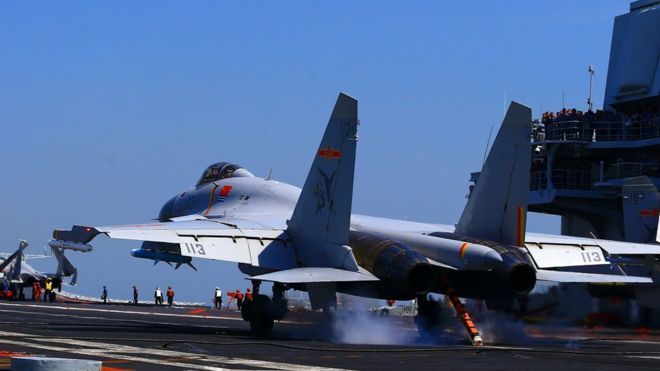
    A Chinese J15 fighter jet landing on an aircraft carrier, 24 April 2018Image copyrightGETTY IMAGES
    by Rachel Rubin and Biodun Iginla, BBC News, Washington DC
    China's military "is likely training for strikes" against US and allied targets in the Pacific, a Pentagon report warns.
    The annual report to Congress says China is increasing its ability to send bomber planes further afield.
    The report highlights its increasing military capability, including defence spending estimated at $190bn (£150bn) - a third that of the US.
    China has not yet commented on the report.

    What else does the report say?

    The warning about air strikes is one part of a comprehensive assessment of China's military and economic ambitions.
    "Over the last three years, the PLA [People's Liberation Army] has rapidly expanded its over-water bomber operating areas, gaining experience in critical maritime regions and likely training for strikes against US and allied targets," the report says.
    It goes on to say it is not clear what China is trying to prove by such flights.
    The PLA may demonstrate the "capability to strike US and allied forces and military bases in the western Pacific Ocean, including Guam," the report adds.
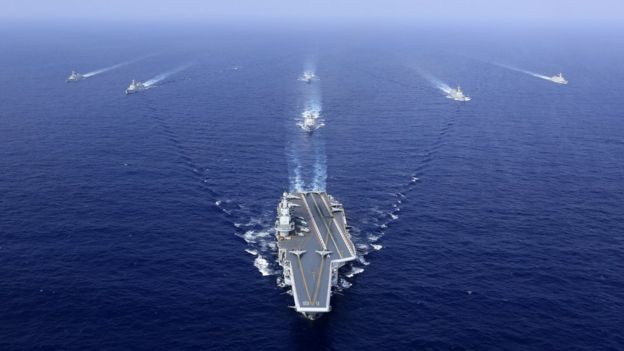
    Chinese aircraft carrierImage copyrightGETTY IMAGES
    Image captionA Chinese navy fleet including the aircraft carrier Liaoning
    China, it says, is restructuring its ground forces to "fight and win".
    ADVERTISEMENT
    "The purpose of these reforms is to create a more mobile, modular, lethal ground force capable of being the core of joint operations," the report says.
    China's military budget is expected to expand to $240bn over the next 10 years, according to the assessment.
    It also highlights China's growing space programme "despite its public stance against the militarization of space".
    In June, President Donald Trump announced his intentions to set up a sixth branch of the US armed forces - a "space force".

    Where are the areas of tension?

    The US is concerned about China's growing influence in the Pacific, where Washington still plays a major role.
    One of the most high-profile areas is the South China Sea, much of it claimed by China and other countries.
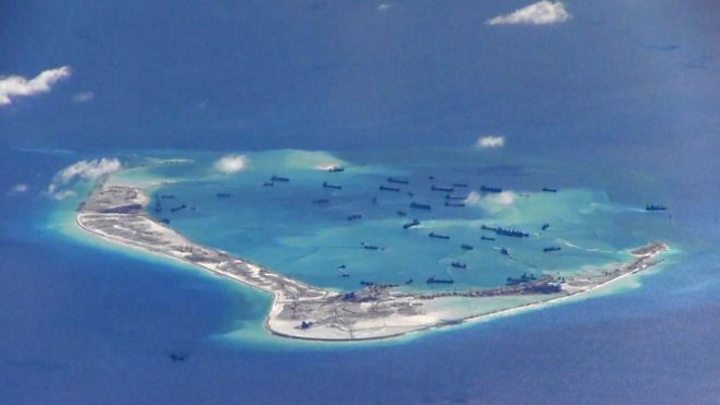
    Media captionA BBC team flew over the disputed South China Sea islands in a US military plane.
    The US military regularly seeks to demonstrate freedom of navigation by flying over the South China Sea.
    China has been expanding what appear to be military facilities on islands and reefs in the area, and it has landed bombers on the outposts during training exercises.
    Another flashpoint is Taiwan, which is seen by China as a breakaway province.
    The document warns that China "is likely preparing for a contingency to unify Taiwan with China by force".
    "Should the United States intervene, China would try to delay effective intervention and seek victory in a high-intensity, limited war of short duration," the report says.
    In a nod to China, the US cut formal ties with Taiwan in 1979 but continues to maintain close political and security ties, which irks Beijing.
    The US also continues to maintain a substantial military presence in Japan, which has its own territorial disputes with China and the Philippines.
    Tensions also continue in the non-military sphere. The US and China have announced tariffs on a range of each other's goods.

    China's maritime militia

    By Jonathan Marcus, Defence and Diplomatic Correspondent
    While the bulk of the Pentagon's annual China report focuses on Beijing's rapidly developing military capabilities, the study also looks in some depth at China's little known Maritime Militia.
    This is an armed civilian reserve force, organised and recruited locally, but according to the Pentagon, the Militia plays a vital role in the South China Sea, spreading Beijing's political goals through operations short of outright war.
    A large number of Militia vessels support the Chinese Navy and Coast Guard in safeguarding maritime claims, protecting fisheries and so on.
    The Pentagon study says that the Militia has played a significant role in a number of high-profile incidents, where Chinese vessels have sought to coerce ships from countries with competing maritime claims.
    This is all part of China's effort to promote so-called "grey operations", designed to frustrate the response of other parties involved and secure its interests across a wide swathe of reefs and island chains.

    What is being done to defuse tensions?

    The Pentagon report is at pains to stress that the US "seeks a constructive and results-oriented relationship with China".
    There is regular contact between US and Chinese military officials.
    Media captionHow US defence spending plan compares to allies and rivals.
    And in June, James Mattis became the first US defence secretary to visit China since 2014.