Biodun Iginla, BBC News

Biodun Iginla, BBC News
Showing posts with label chemical attack. Show all posts

Thursday, July 5, 2018

Japan sarin attack cult leader 'executed'


July 6, 2018  04H:54 GMT/UTC/ZULU TIME


© Jiji Press / AFP | In this picture taken on July 19, 1995, Shoko Asahara (C) is transferred from Tokyo police headquarters to Tokyo District Court for questioning.

Latest update : 2018-07-06

Shoko Asahara, the leader of the Aum Shinrikyo cult that carried out a deadly sarin attack on Tokyo's subway in 1995, was executed on Friday, local media reported.

The justice ministry would not immediately confirm that Asahara had been hanged, nor reports that several other cult members would also be put to death Friday.
Asahara and 12 of his followers have been on death row for over a decade for the shocking 1995 chemical attack that killed 13 people and injured thousands more.
His hanging was the first execution in connection with the March 20, 1995 attack which shocked the world and prompted a massive crackdown on the cult.
It paralysed the Japanese capital, turning it into a virtual warzone as injured people staggered out of the underground struggling for breath and with watering eyes.
Some keeled over, foaming at the mouth, with blood streaming from their noses, as the rush hour attack unfolded.
The sarin had been released in liquid form on five subway carriages at different points throughout the network.
The first sign of it was a smell similar to paint thinner, but soon commuters began cough uncontrollably, recalled Sakae Ito, who was on the crowded Hibiya line that day.
"Liquid was spread on the floor in the middle of the carriage, people were convulsing in their seats. One man was leaning against a pole, his shirt open, bodily fluids leaking out."
Police were first alerted just after 8:00am and panic soon set in, with subway workers screaming at people to evacuate and passengers convulsing on carriage floors.
The Japanese Self-Defense Force was called in and descended into the depths in hazmat suits and gas masks to assist the injured and deal with the poison.
Though concerns about the Aum had already been raised, the attack prompted a massive crackdown on the cult's headquarters and the arrest of Asahara and other group members.
He was sentenced to death after a lengthy prosecution during which he regularly delivered rambling and incoherent monologues in English and Japanese.
Born Chizuo Matsumoto in 1955 on the southwestern island of Kyushu, Asahara changed his name in the 1980s, when the Aum cult was being developed.
Virtually blind, he was seen as a charismatic speaker who cloaked himself in mysticism to draw recruits to the doomsday cult he developed in the 1980s.
The Aum cult, now renamed Aleph, officially disowned Asahara in 2000, but it has never been banned and experts say the former guru retained a strong influence, with some members using pictures of him and recordings of his voice for meditation.
Despite the horror that persists over the Aum's subway attack and other crimes, some experts had warned against the execution of Asahara and his acolytes.
They fear his death may trigger the naming of a new cult leader, possibly his second son.
And the execution of Asahara's followers risks elevating them to "martyrs" in the eyes of remaining cult adherents, warned Taro Takimoto, a lawyer for relatives of cultists, in an interview with us  at France24  earlier this year.
"We should have them talk until they die a natural death so that they help prevent a recurrence," he said.

Date created : 2018-07-06
  • JAPAN

    Several dead as quake strikes Japan's Osaka
  • USA

    Reluctant Abe says US, Japan to start talks on 'trade deals'
  • JAPAN

    Japan activates first marines since WWII to bolster defenses against China
Leave a comment

Monday, April 10, 2017

BREAKING: Syria war: Russian officers 'could face sanctions'


  • April 11, 2017  05H:22  GMT/UTC/ZULU TIME
  •  
  • From the sectionMiddle East
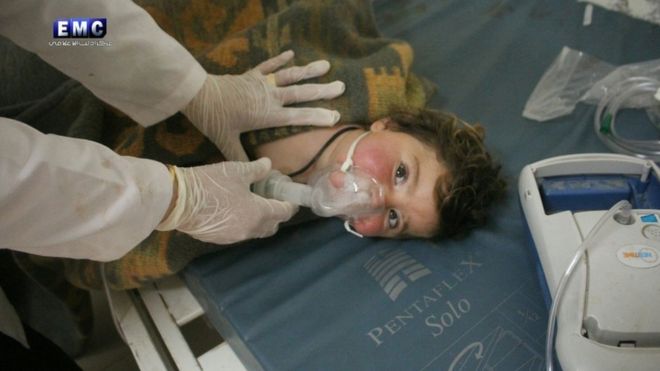
The suspected chemical attack in Khan Sheikhoun last week left 89 people deadImage copyrightEPA
Image captionThe suspected chemical attack in Khan Sheikhoun last week left 89 people dead and many hurt
by Isabelle Roussel and Biodun Iginla, BBC News, Lucca, Italy
G7 foreign ministers are to attempt to agree a common position on the Syrian conflict, before the US secretary of state flies to Russia to try to persuade it to abandon its Syrian ally.
Rex Tillerson will also meet officials from allied Middle Eastern countries before heading to Moscow.
The UK has suggested threatening tightly-focused sanctions on Russian and Syrian military officers.
The moves follow the latest apparent use of chemical weapons in Syria.
Syria has denied it carried out a chemical attack on the rebel-held town of Khan Sheikhoun last week that left 89 people dead.
Media captionMoscow newspaper: "We believed in you comrade Donald."
The Associated Press news agency quoted a senior US official as saying that the Russians knew of the chemical attack because a drone had been flying over a hospital in Khan Sheikhoun as victims sought help. Hours later a jet bombed the hospital in what the US believed was an attempt to cover up the attack, the agency said.
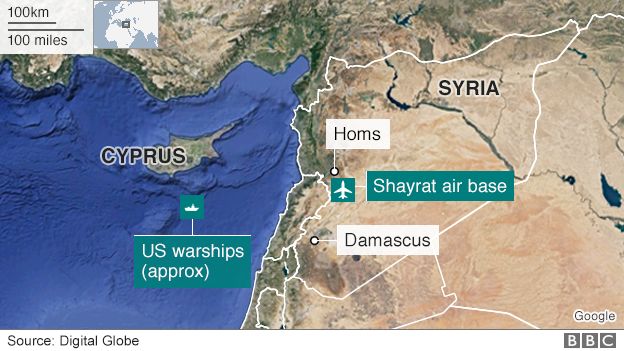
In response, the US says it destroyed a fifth of Syria's operational aircraft in an air strike on the Shayrat airbase last Thursday and said further strikes could take place.
President Trump and UK Prime Minister May said during a phone call that it was no longer in Russia's strategic interest to support President Assad.
German Chancellor Angela Merkel meanwhile agreed with President Trump that President Assad should be held accountable, the White House said.
Map showing location of Shayrat air base
However Washington's Syria policy remains unclear to many, with Mr Tillerson saying that there had been "no change to our military posture" in Syria following the US airbase strike and that Washington's "first priority" was to defeat so-called Islamic State (IS).
UK Foreign Secretary Boris Johnson said sanctions could target high-ranking Syrians and Russians who had been involved in coordinating Syrian military operations.
These would be the first sanctions against Russian figures over Syria if they were to be adopted.
The BBC's James Robbins in the Italian town of Lucca, where the G7 ministers are meeting, says British officials recognise that more general sanctions on Russia would probably be resisted by some G7 countries, including Germany and Italy.
Russia is already subject to a raft of sanctions imposed by the US and EU in response to the annexation of Crimea and the crisis in eastern Ukraine.
Media caption'There is no moderate opposition waiting to take over' - former UK ambassador Peter Ford
Russia says the US has failed to provide evidence that Syria has chemical weapons.
Russia and Iran, President Assad's key military backers, are also threatening retaliation if there are any further American air strikes.

Related Topics