Date created :

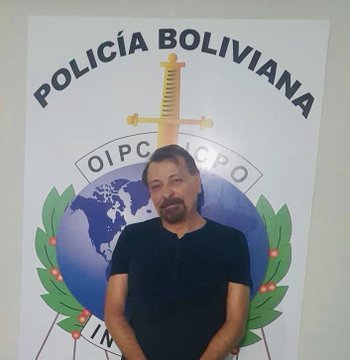
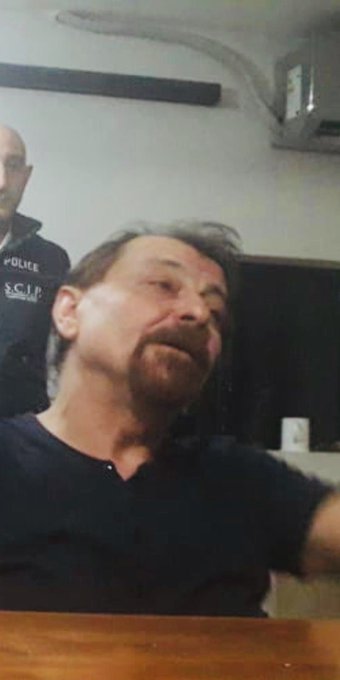
A former leftist militant sought by Rome for four murders in the 1970s was arrested in Bolivia on Saturday and will be extradited to Italy. Cesare Battisti managed to remain on the run for almost 40 years, in part due to left-wing leaders’ largesse.
ADVERTISING
After almost four decades on the run, Italian former leftist guerrilla Cesare Battisti was arrested in Bolivia on January 12. He had been living in neighbouring Brazil for years under the protection of former leftist president Luiz Inacio Lula da Silva, despite Italy’s repeated demands for his extradition.
Battisti is expected to be extradited to Brazil from La Paz, then to Italy, Italian authorities told Brazil’s CBN radio network. Italian Interior Minister Matteo Salvini said Sunday that Rome had dispatched a plane carrying Italian police and intelligence officers.
Ringrazio per il grande lavoro le Forze dell’Ordine italiane e straniere, la @poliziadistato, l’Interpol, l’AISE e tutti coloro che hanno lavorato per la cattura di #CesareBattisti, un delinquente che non merita una comoda vita in spiaggia, ma di finire i suoi giorni in galera.

2,965 people are talking about this
Brazil’s new far-right President Jair Bolsonaro “congratulated” those “responsible for the arrest of the terrorist Cesare Battisti” in a tweet on Sunday. During his 2017 presidential campaign, Bolsonaro vowed to “immediately” extradite Battisti if elected. Outgoing president Michel Temer signed his extradition order in mid-December but the former militant was nowhere to be found. Battisti’s whereabouts remained unknown until his arrest in the Bolivian city of Santa Cruz de la Sierra.
Parabéns aos responsáveis pela captura do terrorista Cesare Battisti! Finalmente a justiça será feita ao assassino italiano e companheiro de ideais de um dos governos mais corruptos que já existiram no mundo (PT).

12.7K people are talking about this
Life on the run
A son of Christian communists, Battisti joined leftist groups at an early age and remained loyal to them throughout Italy’s “dark years”, when the country was waging a battle against both far-left and far-right militants.
In June 1979, Battisti, already a member of the Armed Proletarians for Communism (PAC), was arrested in Milan as part of an investigation into the murder of a local jeweller.
Sentenced in May 1981 to 12 years and 10 months in prison for being a member of an armed group, he escaped from prison in 1981 before fleeing the country, first to France and then to Mexico in 1982.
Battisti returned to France in 1990, protected by the so-called Mitterand doctrine: Then president François Mitterand had granted freedom to former far-left Italian militants who had decided to lay down arms and renounce their violent pasts.
Meanwhile, in March 1993 a Milan court convicted him in absentia of killing two policemen – prison guard Antonio Santoro and officer Andrea Campagna – and taking part in the murder of butcher Lino Sabadin and Milanese jeweller Pierluigi Torregiani, who was shot and killed in front of his two children. Torregiani’s son, then age 15, was shot in the spine and left a paraplegic.
But Battisti, who has always denied involvement in the killings, remained free in France. He worked as the concierge of a residential building before becoming a successful author of highly autobiographical thrillers set in his home country.
Although he enjoyed the support of key left-wing figures in France – such as author Fred Vargas, philosopher Bernard-Henry Lévy and even Socialist ex-president François Hollande – then right-wing president Jacques Chirac brought an end to Mitterand’s policy in June 2004.
Paris finally said it would comply with the order for Battisti’s extradition after multiple requests by Rome.
‘A matter of national sovereignty’
Once again on the run, Battisti fled to Brazil in October 2004. In an interview with Brazilian magazine Istoe, he said he had been helped by French intelligence officers.
Battisti was arrested in Rio de Janeiro in March 2007 and jailed in Brasilia, prompting Italy to once again call for his extradition.
At the time, Brazil was led by leftist president Luiz Inacio Lula da Silva, a former union leader. A first Supreme Court ruling on Battisti’s extradition in 2009 left the ultimate decision to the president.
Bowing to pressure from his party’s heavyweights – and following several pro-Battisti public demonstrations – Lula declared that his refusal to extradite the former militant was “a matter of national sovereignty”.
Under Lula Brazil had become a major international actor and was trying to pursue a more independent foreign policy, having grown tired of falling under the influence of more developed countries.
Lula granted Battisti asylum on December 31, 2010, his last day in office.
One of Lula’s ‘biggest mistakes’
But many criticised Lula’s move. According to left-leaning Brazilian magazine Carta Capital, granting Battisti asylum was among the ex-president’s “biggest mistakes”. The Italian criminal “nourished the myth [that he was] a leftist activist, but he is nothing but a murderer”, the magazine wrote last December.
Turin’s chief prosecutor, Armando Spataro, agrees. In an interview with Italian newspaper La Repubblica in mid-December, Spataro said the failure to extradite Battisti “is an affront to Italian democracy and to the people he killed and got killed”. Spataro was in charge of the raids carried out on PAC’s Milanese headquarters in the late 1970s. “Battisti is a murderer of the worst kind,” he said.
Lula’s successor and protégée, Dilma Rousseff, a former far-left militant herself, did not revisit Lula’s decision and diplomatic relations between Brazil and Italy cooled. Rome even threatened to boycott the 2014 World Cup, which was hosted by Brazil.
‘You can always count on us’
Apart from political matters, Battisti’s former French lawyer Éric Turcon told FRANCE 24 the former militant could simply not be extradited, according to the country’s law. “In Brazil, he benefited from Article 5 of the Brazilian constitution, which says that every person who has been arrested or convicted of a political offence in his country and then seeks asylum in Brazil cannot be extradited” from the country.
When Lula’s Worker’s Party was ousted in 2016, official policy on Battisti’s case shifted. First he was placed in preventative detention for trying to cross the border into Bolivia with nearly $6,000 in cash. Later freed, he was placed under electronic surveillance in 2018.
“This all started when Battisti was aged 20,” argues Turcon. “He was convicted in absentia, during an exceptional period, by exceptional laws and by exceptional judges. He claims he never killed anyone.”
The arrival of far-right President Bolsonaro ended Battisti’s life as a “political refugee”. A political and ideological ally to Italy’s populist Matteo Salvini, who said on Sunday Battisti was “nothing but a criminal who should spend his last days in jail”, Bolsonaro tweeted in Italian after the former militant’s arrest.
“Congratulations, and you can always count on us, Minister Salvini!”