
Kim Jong Un presents a new face to the world, but not to his own citizens
“Things changing” has seemed like a tantalising possibility ever since Kim Jong Un, the North’s leader, embarked on a diplomatic charm offensive earlier this year. In Pyongyang, where most people can access accounts of the rapprochement with America and South Korea in the state media, some are allowing themselves to dream. One woman said she wanted to go to Britain and South-East Asia. Another asked your correspondent to help her practise her French because she hoped to travel to Paris if the diplomatic efforts paid off.
Yet hopes that Mr Kim will bring change, which were widespread when he took over from his father in 2011, have so far proved misplaced. Far from liberalising the country, Mr Kim has tightened the shackles, reinforcing the border with China to make it harder for people to escape and cracking down hard on offences such as possessing a flash drive loaded with South Korean soap operas, or owning a Chinese SIM card in order to make international calls near the border. (Ordinary citizens are not allowed to call foreigners within the country, much less anyone abroad.)
Pyongyang welcomes visitors with a relentless onslaught of murals, monuments and portraits of Mr Kim and his father and grandfather, who ran the country before him. Primary-school children decked out in traditional costumes sing songs about their glory. “Let us accomplish the programmatic task our dearest supreme leader Kim Jong Un proposed in his New Year address” runs one catchy slogan. Drivers have to slow down when they pass enormous bronze statues of the dead deities. Out-of-towners are compelled to wash their cars before crossing the city limits, lest they mar the capital’s aesthetic.
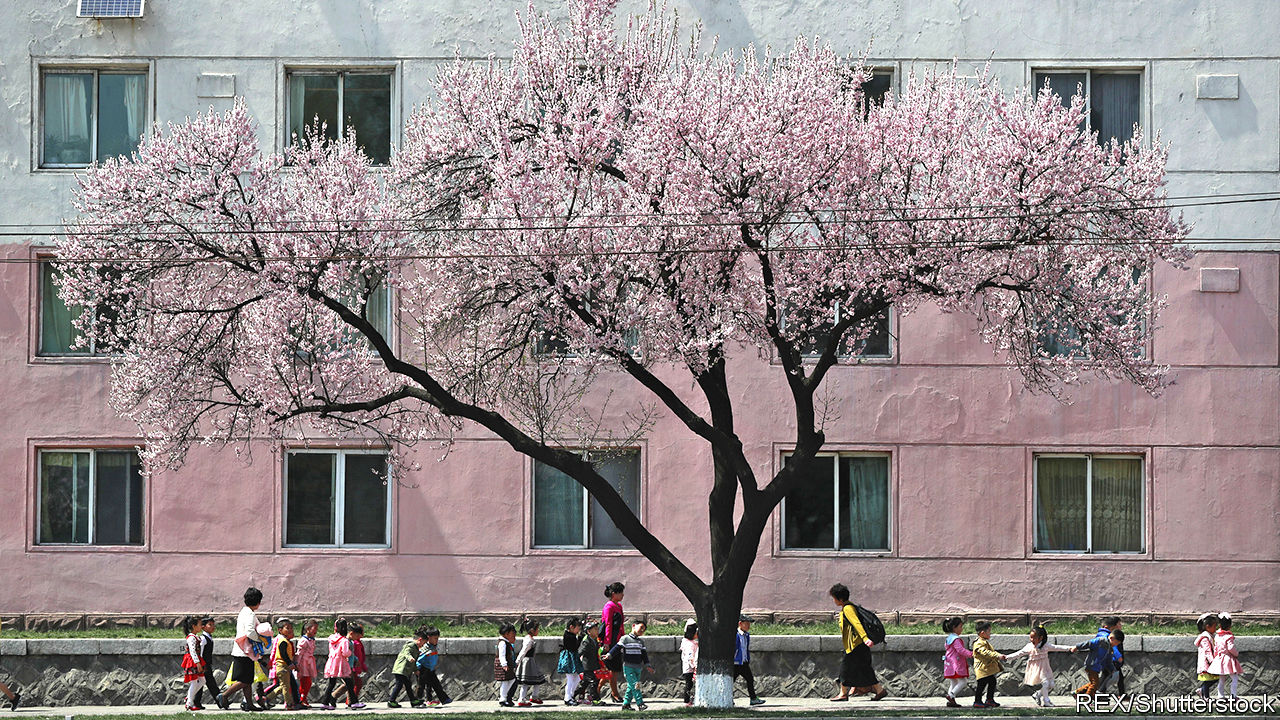
That aesthetic involves pastel-coloured apartment blocks, pretty flower-shaped streetlights and pleasant parks kept impeccably clean by residents. Work crews of middle-aged women dressed in bright orange can be seen at all hours planting flowers and ripping out weeds on the grassy verges around town. To those who can pay, the city affords a measure of material comfort, despite the recent tightening of sanctions. Restaurants offer pizza, pasta and sushi as well as semi-Western entertainment. At one restaurant the staff band performs stirring renditions of “Arirang”, a traditional Korean tune, and “Can you feel the love tonight?”, a schmaltzy duet from a Disney movie. Petrol and diesel prices have fallen by almost 20% after a spike in April, suggesting that China has relaxed its enforcement of the international sanctions that restrict North Korea’s oil imports.
Yet there are signs that even the showcase capital is struggling. Long-term foreign residents note that fancier restaurants and coffee shops look less busy than they did. (By contrast, grimy city-centre bars serving beer and cheap spirits are crammed even on weekday evenings.) Buses and trams, though gleaming, operate several times over capacity, with people hanging out of the windows and enormous queues at stops. In many buildings the lifts are mostly out of service and corridors remain dark, hinting at a less-than-perfect electricity supply (though some of the capital’s well-to-do get around the problem by installing solar panels on their balconies).
North Koreans are compelled to spend six days a week working for the state for meagre wages. Most get little choice in what they do, causing well-qualified people to complain of mind-numbing work with no prospects. “My job is just a dull waste of time,” says one woman in her 20s who works for a state-run firm. Asked about quitting, she demurs: “It’s not easy.”
The workers in factories on the outskirts of Pyongyang are also permitted to visit the city on Sundays, in the hope of finding a local husband. (North Korean women are encouraged to marry young, often to a husband selected by their family, and are derided as “rotten fish” if they remain single in their late 20s.) But on the whole, personal life is restricted. Beyond contact with one’s family and colleagues, socialising is discouraged.
Only those deemed loyal to the regime are allowed to live in the capital. Life outside is far worse. The WHO says that 40% of the population is malnourished. Electricity and proper plumbing are rarities. Unlike in Pyongyang, people have fewer ways of getting around sanctions, which are starting to cause shortages of fuel and fertiliser, according to NGOs that work in the country. Agricultural technology remains primitive. Visiting experts say they still encounter farming equipment from the 1950s. Just beyond the city limits of Pyongyang, farmers are still ploughing fields with oxen; women carry big bundles of firewood on their backs. On the hills, anti-aircraft guns tower over the squat one-storey villages. News of the outside world comes mainly in the form of a weekly briefing from a party official.
And even in Pyongyang, Western and South Korean pressure groups attest, the deadening totalitarian system is as intrusive as ever. People are encouraged to keep an eye on the political reliability of friends, family and co-workers, and are rewarded for reporting misdeeds. Even minor infringements, such as perusing smuggled religious pamphlets, can result in severe punishment. Unguarded remarks about the leader or one of his predecessors may lead to banishment from Pyongyang or, in more egregious cases, being carted off to a prison camp—sometimes with one’s family in tow. The UN estimated in 2014 that between 80,000 and 120,000 people were held in such camps, where torture, indiscriminate beatings and starvation are commonplace. The number seems to have stayed roughly constant since then. No wonder North Koreans are curious about different ways of doing things.
Latest stories
Pyongyang welcomes visitors with a relentless onslaught of murals, monuments and portraits of Mr Kim and his father and grandfather, who ran the country before him. Primary-school children decked out in traditional costumes sing songs about their glory. “Let us accomplish the programmatic task our dearest supreme leader Kim Jong Un proposed in his New Year address” runs one catchy slogan. Drivers have to slow down when they pass enormous bronze statues of the dead deities. Out-of-towners are compelled to wash their cars before crossing the city limits, lest they mar the capital’s aesthetic.
That aesthetic involves pastel-coloured apartment blocks, pretty flower-shaped streetlights and pleasant parks kept impeccably clean by residents. Work crews of middle-aged women dressed in bright orange can be seen at all hours planting flowers and ripping out weeds on the grassy verges around town. To those who can pay, the city affords a measure of material comfort, despite the recent tightening of sanctions. Restaurants offer pizza, pasta and sushi as well as semi-Western entertainment. At one restaurant the staff band performs stirring renditions of “Arirang”, a traditional Korean tune, and “Can you feel the love tonight?”, a schmaltzy duet from a Disney movie. Petrol and diesel prices have fallen by almost 20% after a spike in April, suggesting that China has relaxed its enforcement of the international sanctions that restrict North Korea’s oil imports.
Yet there are signs that even the showcase capital is struggling. Long-term foreign residents note that fancier restaurants and coffee shops look less busy than they did. (By contrast, grimy city-centre bars serving beer and cheap spirits are crammed even on weekday evenings.) Buses and trams, though gleaming, operate several times over capacity, with people hanging out of the windows and enormous queues at stops. In many buildings the lifts are mostly out of service and corridors remain dark, hinting at a less-than-perfect electricity supply (though some of the capital’s well-to-do get around the problem by installing solar panels on their balconies).
North Koreans are compelled to spend six days a week working for the state for meagre wages. Most get little choice in what they do, causing well-qualified people to complain of mind-numbing work with no prospects. “My job is just a dull waste of time,” says one woman in her 20s who works for a state-run firm. Asked about quitting, she demurs: “It’s not easy.”
Patriotic brick-laying
Young men have to spend years doing military service, which mostly amounts to hard labour on construction sites. Many young women work in factories far from home, where they live crammed into spartan dormitories. The only day off—Sunday—features group discussions about how output can be improved.The workers in factories on the outskirts of Pyongyang are also permitted to visit the city on Sundays, in the hope of finding a local husband. (North Korean women are encouraged to marry young, often to a husband selected by their family, and are derided as “rotten fish” if they remain single in their late 20s.) But on the whole, personal life is restricted. Beyond contact with one’s family and colleagues, socialising is discouraged.
Only those deemed loyal to the regime are allowed to live in the capital. Life outside is far worse. The WHO says that 40% of the population is malnourished. Electricity and proper plumbing are rarities. Unlike in Pyongyang, people have fewer ways of getting around sanctions, which are starting to cause shortages of fuel and fertiliser, according to NGOs that work in the country. Agricultural technology remains primitive. Visiting experts say they still encounter farming equipment from the 1950s. Just beyond the city limits of Pyongyang, farmers are still ploughing fields with oxen; women carry big bundles of firewood on their backs. On the hills, anti-aircraft guns tower over the squat one-storey villages. News of the outside world comes mainly in the form of a weekly briefing from a party official.
And even in Pyongyang, Western and South Korean pressure groups attest, the deadening totalitarian system is as intrusive as ever. People are encouraged to keep an eye on the political reliability of friends, family and co-workers, and are rewarded for reporting misdeeds. Even minor infringements, such as perusing smuggled religious pamphlets, can result in severe punishment. Unguarded remarks about the leader or one of his predecessors may lead to banishment from Pyongyang or, in more egregious cases, being carted off to a prison camp—sometimes with one’s family in tow. The UN estimated in 2014 that between 80,000 and 120,000 people were held in such camps, where torture, indiscriminate beatings and starvation are commonplace. The number seems to have stayed roughly constant since then. No wonder North Koreans are curious about different ways of doing things.

