Biodun Iginla, BBC News

Biodun Iginla, BBC News
Showing posts with label gender equality. Show all posts

Saturday, November 25, 2017

Emmanuel Macron: Domestic violence is 'France's shame'


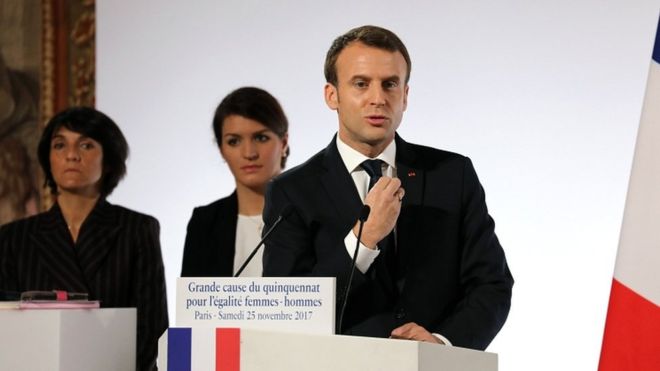
French President Emmanuel Macron (R) stands next to French Junior Minister for Gender Equality Marlene Schiappa (C) and French humorist and patron of association Women Safe Florence Foresti as he delivers a speech during the International Day for the Elimination of Violence Against Women, on 25 November 2017 at the Elysee Palace in ParisImage copyrightAFP
Image captionMr Macron held a minute's silence for the women who died of domestic violence last year
by Natalie de Vallieres and Biodun Iginla, BBC News, Paris
French President Emmanuel Macron has spoken out against domestic violence, saying it shames France that a woman is killed every three days.
In a speech marking International Day for the Elimination of Violence Against Women, he said the silence around the issue must be broken.
He has made gender equality one of the main themes of his five-year term in office.
A number of demonstrations are being held across France to mark the day.
A stock image of a young girl with folded armsImage copyrightGETTY IMAGES
Image captionOne woman was killed by a spouse on average every three days last year, Mr Macron said
During his election campaign last year, Mr Macron said that the issue of violence against women would be a priority for his presidency.
Polls conducted by his then movement, En Marche, suggested that it was the French public's top concern.
During his speech, Mr Macron observed a minute's silence for the 123 women killed by their partner or ex-partner in 2016.
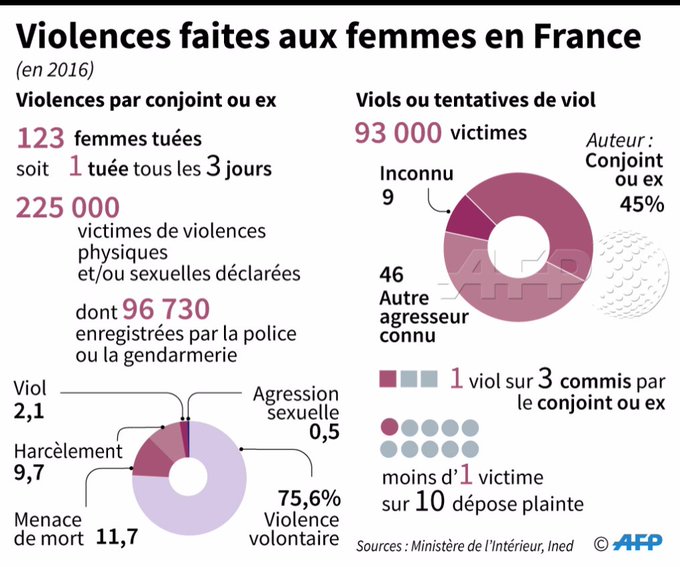
Nearly 225,000 women were physically or sexually abused by their spouses, but fewer than one in five filed a complaint about it.

On-demand bus stops

Among the measures Mr Macron announced are a 24-hour online service for victims of violence, harassment or discrimination.
Victims will be able to speak to trained policemen and women to talk about incidents of sexual violence and harassment and find out how to report them.
An awareness campaign on pornography will be launched in secondary schools and the government will introduce a bill against sexual and gender-based violence next year, he said.
Mr Macron's proposals include criminalising street harassment, extending the statute of limitation for the rape of children and setting the age of sexual consent at 15.
Earlier this month, France's minister for gender equality Marlene Schiappa said the government was considering setting a fixed age below which sex was automatically a serious offence.
Other measures will include an app for victims of online stalking and "on demand" bus stops in the evening, where women can stop a bus anywhere at night so they can get home safely. This service has already been tested in several towns, including Bordeaux.
International Day for the Elimination of Violence against Women kicks off 16 days of activism with sexual harassment as a focal point of this year.

More on this story

Europe

Wednesday, January 11, 2017

Asma Lamrabet: Morocco's Muslim feminist polymath--an analysis


by Rashida Adjani and  Biodun Iginla, France24, Rabat, Morocco


    © AFP/File | Moroccan author Asma Lamrabet has accumulated a body of work showing how feminism and Islam can co-exist despite centuries of male-centred dogma

    RABAT - 
    Moroccan author Asma Lamrabet is used to multi-tasking -- mixing her writing with a career in medicine -- but perhaps her most noteworthy balancing act is being both a faithful Muslim and a committed feminist.
    A tireless advocate for gender equality in a region where women's rights often lag far behind those of men, Lamrabet has accumulated a body of work showing how feminism and Islam can co-exist despite centuries of male-centred dogma.
    "There's a tendency to conflate models and ideals. But just as there are different models of democracy, there are different types of feminism," she tells us at France24 in her Rabat offices.
    "So if Moroccan feminists fight for true equality with men on the ground or against the marriage of minors, Saudi (women) claim the right to drive, vote and live in freedom."
    Although women in Morocco have far more freedom than their Saudi counterparts and gender equality is theoretically guaranteed by law, the north African kingdom has yet to adopt legislation criminalising violence against women, and child marriage is not uncommon.
    Lamrabet's key message is that gender inequality is less to do with the tenets of Islam and more down to its interpretation within male-dominated societies.
    Her latest work, "Faithful and Feminists", examines passages of the Koran and argues that there is nothing in the text itself to enshrine female subordination.
    "In all religious traditions, you find a certain stereotypical representation of women," she says.
    "The problem doesn't come from religious texts but instead from the interpretation of these texts by men."
    It is for this reason, argues the Rabat native, who writes award-winning texts in between a career as a pathologist, that "it's absolutely necessary to read the Koran in context.
    "When the Koran speaks of reason and justice, they need to be seen as universal concepts. But there are some verses that respond to given historical circumstances," says Lamrabet, her thick black hair draped in a bright blue veil.
    "We must keep this spirit, but not take it literally."
    - Western 'hegemony' -
    Although wholly committed to universal women's rights, Lamrabet says she took inspiration from renowned Indian feminist theorist Gayatri Chakravorty Spivak in her belief that the feminist cause has long been dominated by Western voices.
    She's quick to disparage this "hegemony", which she says seeks to "speak for all women in the world."
    Western feminists "continue to consider women of the (global) south as subordinate.
    "The priorities and demands of women may change depending on the context even though the principles remain the same," Lamrabet insists.
    One defining factor of Moroccan social discourse in recent years has been dogged disagreement over the role of religion in politics.
    The kingdom is facing an unprecedented political deadlock after a power struggle between the Islamist Justice and Development Party (PJD), which won October's general election, and the secular runners-up.
    Lamrabet is an unalloyed supporter of secular rule, which she says "is the only way of truly protecting individual freedoms while also protecting religion."
    She admits that secularism has a bad reputation in Muslim Arab nations, though, "as it's often associated with atheism."
    Morocco is keen to be viewed as a beacon of moderate Islam and has embarked on a vast imam training scheme that has seen some 50 women preachers oversee religious development at some mosques.
    While Lamrabet finds the idea of female preachers "interesting", she's at pains to point out that having women as messengers changes little if the message itself remains essentially "patriarchal".
    "These preachers don't advance women's cause," she says. "Judicial equality, dignity, liberty and emancipation. These are the keys to feminism."