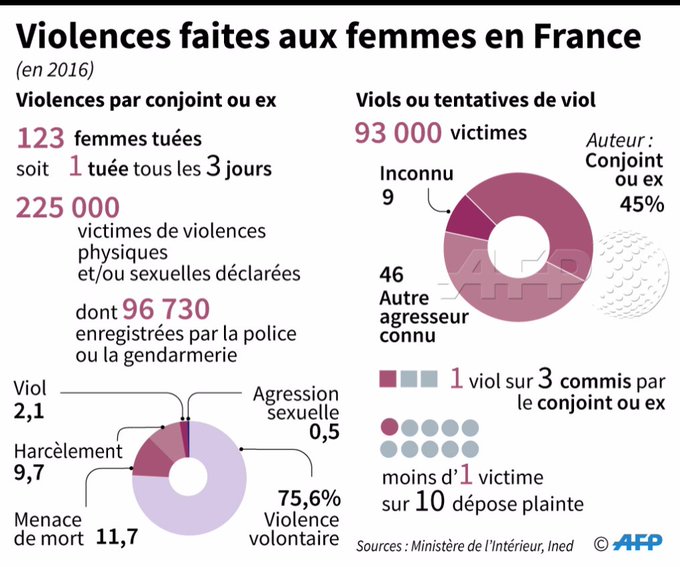
Nearly 225,000 women were physically or sexually abused by their spouses, but fewer than one in five filed a complaint about it.
On-demand bus stops
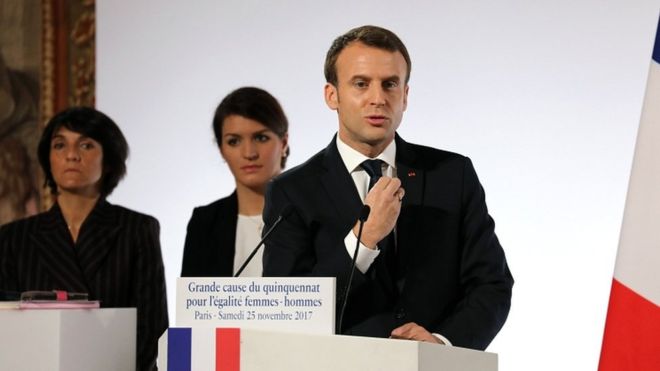
Among the measures Mr Macron announced are a 24-hour online service for victims of violence, harassment or discrimination.
Victims will be able to speak to trained policemen and women to talk about incidents of sexual violence and harassment and find out how to report them.
An awareness campaign on pornography will be launched in secondary schools and the government will introduce a bill against sexual and gender-based violence next year, he said.
Mr Macron's proposals include criminalising street harassment, extending the statute of limitation for the rape of children and setting the age of sexual consent at 15.
Other measures will include an app for victims of online stalking and "on demand" bus stops in the evening, where women can stop a bus anywhere at night so they can get home safely. This service has already been tested in several towns, including Bordeaux.
International Day for the Elimination of Violence against Women kicks off 16 days of activism with sexual harassment as a focal point of this year.
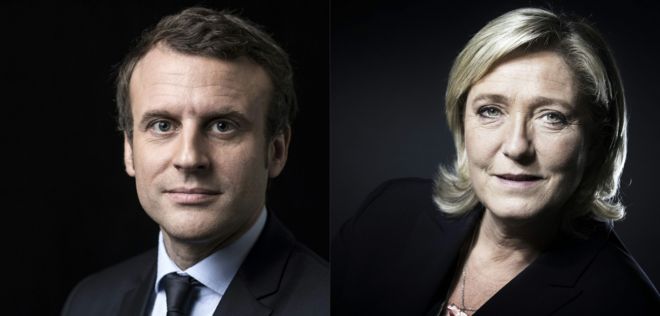
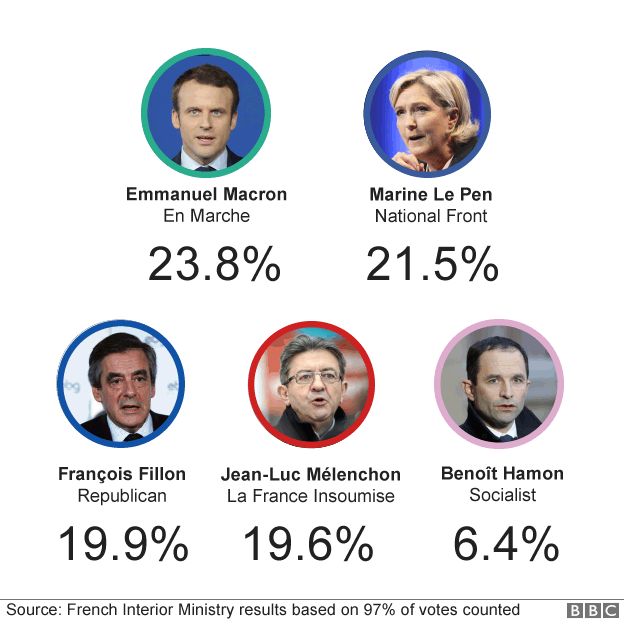
But several political rivals are now expected to unite behind Mr Macron in the run-off vote, in a bid to keep Ms Le Pen's Front National (FN) from power.
What does Mr Macron stand for?
At 39, Mr Macron could become the youngest president France has ever had - and the first president in the Fifth Republic who does not belong to a major party.
He secured 8.4 million votes - more than any other candidate - in the first round.
Mr Macron was current President Francois Hollande's economy minister but quit to create his own party, En Marche, which pushes a liberal, pro-EU agenda.
Media captionEmmanuel Macron: "I hope to become your president"
His campaign promises include:
A €50bn (£43bn; $53bn) public investment plan to cover job-training, exit from coal and shift to renewable energy, infrastructure and modernisation
Big cut in corporation tax and more leeway for companies to renegotiate 35-hour working week
Cut in jobless rate to 7% (now 9.7%)
Ban on mobile phone use in schools for under-15s and a €500 culture pass for 18 year olds
In a victory speech to supporters, Mr Macron borrowed language favoured by his rival to describe himself as the patriotic choice for France.
"I hope that in a fortnight I will become your president. I want to become the president of all the people of France - the president of the patriots in the face of the threat from the nationalists," he said.
Ms Le Pen took over the FN leadership from her father in January 2011 and helped her party secure big gains in regional elections.
She won 7.6 million votes on Sunday - the strongest ever result for a FN candidate, and 2.8 million more than her father, Jean-Marie Le Pen, won for the FN in 2002.
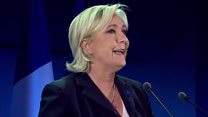
Media captionMarine Le Pen: "I am calling on sincere patriots... to join me"
Her party wants to slash immigration, clamp down on free trade, and overturn France's relationship with Europe.
Her campaign has called for:
Negotiation with Brussels on a new EU, followed by a referendum
"Automatic" expulsion of illegal immigrants and legal immigration cut to 10,000 per year following an immediate total moratorium
"Extremist" mosques closed and priority to French nationals in social housing
Retirement age fixed at 60 and 35-hour week assured
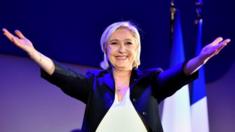
Following the first round results, Ms Le Pen made an "appeal to all patriots", saying a vote for her was the key to the "survival of France".
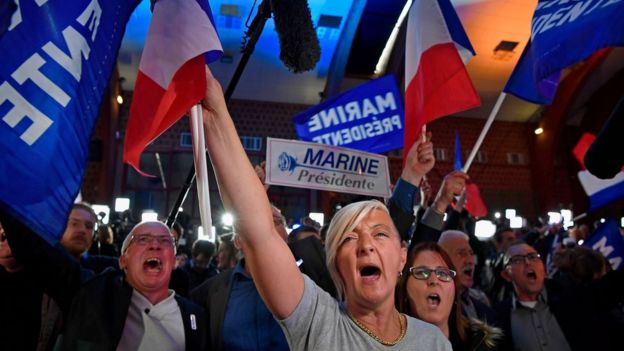
Image copyrightGETTY IMAGESImage captionLe Pen supporters celebrating her win
"Wherever they come from, whatever their origin, whatever they voted for in the first round, I invite them all to join us and to abandon ancient quarrels and to concentrate on what is essential for our country," she said.
But Mr Macron may struggle to get enough of his candidates elected to parliament - where more established parties, such as the Republicans and the Socialists, currently have the most seats.
Without a majority, Mr Macron would have to negotiate to have his policies approved through the assembly - which could be challenging.
What do the other candidates say?
Benoît Hamon, the candidate of President Hollande's Socialist Party who failed to make an impact in the first round, urged those who voted for him to support Mr Macron in the next stage. Mr Fillon has done the same.
However, Mr Mélenchon has not endorsed either candidate yet.
Some voters are unhappy with both candidates - hundreds took part in "anti-fascist, anti-capitalist" protests on Sunday night, opposing both Ms Le Pen and Mr Macron.
Some demonstrators set cars on fire and broke shop windows - police said 143 people were arrested.
What do the results mean for the EU?
Analysts and world leaders have been watching the election closely - after the Brexit vote in the UK and election of US President Donald Trump challenged liberal values and the political establishment.
Many European leaders are now congratulating Mr Macron on the first round results - as they are keen to strengthen the union after Brexit.
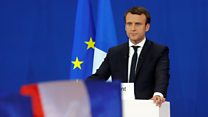
Mr Macron addressed the nation in front of an EU flag as the results came in - something noticed by both pro and anti-EU politicians.
German Chancellor Angela Merkel's spokesman, Steffan Seibert, tweeted: "It's good that Emmanuel Macron was successful with his course for a strong EU and social market economy. All the best for the next two weeks."
European Commission President Jean-Claude Juncker also congratulated him, as did EU foreign policy chief Federica Mogherini.
"The result is the hope and future of our generation," she tweeted.
Anti-EU politicians, on the other hand, have congratulated Ms Le Pen for making the second round.
Dutch MP Geert Wilders, who leads the anti-immigration Freedom Party, said the results were a "bright day for patriots in France and elsewhere who want more national sovereignty and less EU and immigration".
Are you a French citizen? What is your reaction to the result of the first round? You can share your comments by emailing haveyoursay@bbc.co.uk.
Please include a contact number if you are willing to speak to a BBC journalist. You can also contact us in the following ways:

 AFP
AFP GETTY IMAGES