Biodun Iginla, BBC News

Biodun Iginla, BBC News
Showing posts with label housing. Show all posts

Tuesday, February 18, 2020

ANALYSIS: Presidential hopeful Bloomberg proposes new taxes, protections to rein in Wall Street

February 19, 2020  02H:06  GMT/ZULU
NEW YORK  - U.S. Democratic presidential candidate Michael Bloomberg on Tuesday outlined a sweeping financial services policy proposal to rein in Wall Street trading, boost consumer protections, increase Americans’ access to banking services and crack down on financial crime.
FILE PHOTO: Democratic U.S. presidential candidate Michael Bloomberg addresses a news conference after launching his presidential bid in Norfolk, Virginia, U.S., November 25, 2019. REUTERS/Joshua Roberts/File Photo
The left-leaning platform marks a striking turnaround for the former Republican New York mayor and Wall Street investment banker who made his $60 billion fortune in financial services and in the past has criticized reforms introduced following the 2007-2009 financial crisis.
Trying to make a virtue of his Wall Street heritage, Bloomberg’s campaign argued on Tuesday that “as the founder of a successful global financial technology company, he understands the system well and is uniquely qualified to make it work better for all Americans.”
Among the most eye-catching proposals are a tax of 0.1% on transactions in stocks, bonds and payments on derivative contracts, bolstering the “Volcker Rule” ban on banks’ proprietary trading and setting a trading speed limit - all of which take aim at Wall Street clients of Bloomberg Inc’s trading terminal.
The proposal also pledges to reinforce protections eroded by the Trump administration by boosting bank capital levels, toughening banks’ annual health checks and restoring the Consumer Financial Protection Bureau’s rules curbing payday lending and its ban on imposing mandatory arbitration on consumers.
Bloomberg also waded into the long-running debate on the future of housing finance giants Fannie Mae and Freddie Mac, which were bailed out during the financial crisis. He proposed to merge them to ensure taxpayers are fully compensated for the risks of guaranteeing the firms’ securities.
While Bloomberg’s platform does not go as far as proposals backed by progressive rival presidential candidates Elizabeth Warren and Bernie Sanders, who have called for big banks to be broken up, it underscores how far the Democratic Party is moving to the left on financial and corporate policy issues.
Bloomberg, a latecomer to the race who has so far spent $188 million of his own money on the campaign, will step onto the Democratic debate stage for the first time on Wednesday after exceeding the double-digit polling threshold set by the Democratic Party, with 19% support.
“Our sense is that these proposals are primarily intended to blunt progressive attacks, especially with Bloomberg joining the debate stage for the first time on Wednesday evening,” Isaac Boltansky, director of policy research at Washington-based Compass Point Research & Trading, said in a note.
“But the overarching tone of the proposals underscores the populist shift in the Democratic party and the heightened potential for significant policy shifts.”
Bloomberg has previously proposed major tax hikes on the wealthy, including a higher capital gains rate and a 5% surtax on annual incomes that exceed $5 million.
His newest proposal would also address the student loan crisis by automatically enrolling undergraduate students in income-based repayment plans, installing caps on debt payments and making it easier to discharge student debt via bankruptcy. It would curb debt collection agencies and bank overdraft fees.
ADVERTISEMENT
Touching on a key theme of Warren and Sanders, Bloomberg also proposed measures to boost Americans’ access to the financial system by offering a range of banking services through the U.S. Postal Service, as well as launching a pilot program for free or nearly no-cost bank accounts.
Adopting another familiar Democratic idea, Bloomberg proposed a new “corporate crime” team at the U.S. Department of Justice that would be discouraged from using non-prosecution agreements, which impose fines without criminal charges.

LOBBYING PUSHBACK

The proposals, in particular a transaction tax, are likely to spark strong pushback from the financial lobby, which is already fighting aggressively to rebut the idea. Such a tax was rejected by the Obama administration, but it has gained traction in Democratic circles in recent years.
Under Bloomberg’s plan, the tax would be phased in gradually, starting at 0.02%, to “minimize any unintended consequences.”
Ken Bentsen, CEO of the Securities Industry and Financial Markets Association, said a transaction tax would hurt middle class savers and retirees.
“At a time when market development, efficiency and competition are driving the cost of investing toward zero, it makes little sense to increase the cost through what is essentially a sales tax. Further, the threat such a tax poses to the efficiency of the U.S. capital markets is real. It begs the question, ‘What’s the point?’”
ADVERTISEMENT
Bloomberg began his career at investment bank Salomon Brothers, where he became a partner before later being laid off amid a company merger. He subsequently founded Bloomberg, the financial information and media giant whose desktop terminal is synonymous with Wall Street trading.
Many Democratic-leading financiers had seen Bloomberg as a safe pair of hands and on Tuesday some analysts played down the risk his presidency would pose to the industry.
“To win, a Democrat needs a plan to focus on big banks,” said Cowen Washington Research Group analyst Jaret Seiberg in a note “Bloomberg understands markets, which makes it less likely that he would push policies that could hurt the economy.”

Thursday, January 16, 2020

ANALYSIS: The horrible housing blunder


The West’s biggest economic policy mistake

Its obsession with home ownership undermines growth, fairness and public faith in capitalism
LeadersJan 16th 2020 edition


by Rochelle van Amber and Biodun Iginla, The Economist Intelligence Unit News Analysts


Economies can suffer both sudden crashes and chronic diseases. Housing markets in the rich world have caused both types of problem. A trillion dollars of dud mortgages blew up the financial system in 2007-08. But just as pernicious is the creeping dysfunction that housing has created over decades: vibrant cities without space to grow; ageing homeowners sitting in half-empty homes who are keen to protect their view; and a generation of young people who cannot easily afford to rent or buy and think capitalism has let them down. As our special report this week explains, much of the blame lies with warped housing policies that date back to the second world war and which are intertwined with an infatuation with home ownership. They have caused one of the rich world’s most serious and longest-running economic failures. A fresh architecture is urgently needed.
At the root of that failure is a lack of building, especially near the thriving cities in which jobs are plentiful. From Sydney to Sydenham, fiddly regulations protect an elite of existing homeowners and prevent developers from building the skyscrapers and flats that the modern economy demands. The resulting high rents and house prices make it hard for workers to move to where the most productive jobs are, and have slowed growth. Overall housing costs in America absorb 11% of gdp, up from 8% in the 1970s. If just three big cities—New York, San Francisco and San Jose—relaxed planning rules, America’s gdp could be 4% higher. That is an enormous prize.
As well as being merely inefficient, housing markets are deeply unfair. Over a period of decades, falling interest rates have compounded inadequate supply and led to a surge in prices. In America the frenzy is concentrated in thriving cities; in other rich countries average national prices have soared, especially in English-speaking countries where punting on property is a national sport. The financial crisis did not kill off the trend. In Britain inflation-adjusted house prices are roughly equal to their pre-crisis peak, while real wages are no higher. In Australia, despite recent falls, prices remain 20% higher than in 2008. In Canada they are up by half.
The soaring cost of housing has created gaping inequalities and inflamed both generational and geographical divides. In 1990 a generation of baby-boomers, with a median age of 35, owned a third of America’s real estate by value. In 2019 a similarly sized cohort of millennials, aged 31, owned just 4%. Young people’s view that housing is out of reach—unless you have rich parents—helps explain their drift towards “millennial socialism”. And homeowners of all ages who are trapped in declining places resent the windfall housing gains enjoyed in and around successful cities. In Britain areas with stagnant housing markets were more likely to vote for Brexit in 2016, even after accounting for differences in income and demography.
You might think fear and envy about housing is part of the human condition. In fact, the property pathology has its roots in a shift in public policy in the 1950s towards promoting home ownership. Since then governments have used subsidies, tax breaks and sales of public housing to encourage owner-occupation over renting. Politicians on the right have seen home ownership as a way to win votes by encouraging responsible citizenship. Those on the left see housing as a conduit for redistribution and for nudging poorer households to build wealth.
These arguments are overstated. It is hard to show whether property ownership makes better citizens. If you ignore leverage, it is usually better to own shares than to own homes. And the cult of owner-occupation has huge costs. Those who own homes often become nimbys who resist development in an effort to protect their investments. Data-crunching by The Economist suggests that the number of new houses constructed per person in the rich world has fallen by half since the 1960s. Because supply is constrained and the system is skewed towards ownership, most people feel they risk being left behind if they rent. As a result politicians focus on subsidising marginal buyers, as Britain has done in recent years. That channels cash to the middle classes and further boosts prices. And it fuels the build-up of mortgage debt that makes crises more likely.
It does not have to be this way. Not everywhere is afflicted with every part of the housing curse. Tokyo has no property shortage; between 2013 and 2017 it put up 728,000 dwellings—more than England did—without destroying quality of life. The number of rough sleepers has dropped by 80% in the past 20 years. Switzerland gives local governments fiscal incentives to allow housing development—one reason why there is almost twice as much home-building per person as in America. New Zealand recoups some of homeowners’ windfall gains through land and property taxes based on valuations that are frequently updated.
Most important, in a few places the rate of home ownership is low and no one bats an eyelid. It is just 50% in Germany, which has a rental sector that encourages long-term tenancies and provides clear and enforceable rights for renters. With ample supply and few tax breaks or subsidies for owner-occupiers, home ownership is far less alluring and the political clout of nimbys is muted. Despite strong recent growth in some cities, Germany’s real house prices are, on average, no higher than they were in 1980.

A home run

Is it possible to escape the home-ownership fetish? Few governments today can ignore the anger over housing shortages and intergenerational unfairness. Some have responded with bad ideas like rent controls or even more mortgage subsidies. Yet there has been some progress. America has capped its tax break for mortgage-interest payments. Britain has banned murky upfront fees from rental contracts and curbed risky mortgage lending. A fledgling yimby—“yes in my backyard”—movement has sprung up in many successful cities to promote construction. Those, like this newspaper, who want popular support for free markets to endure should hope that such movements succeed. Far from shoring up capitalism, housing policies have made the system unsafe, inefficient and unfair. Time to tear down this rotten edifice and build a new housing market that works. 
This article appeared in the Leaders section of the print edition under the headline "The West’s biggest economic policy mistake"
Reuse this contentThe Trust Project

Thursday, January 3, 2019

Analysis: #ShutdownStories: The impact of the government shutdown


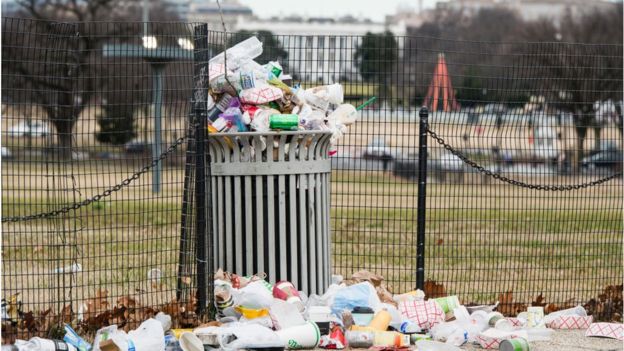
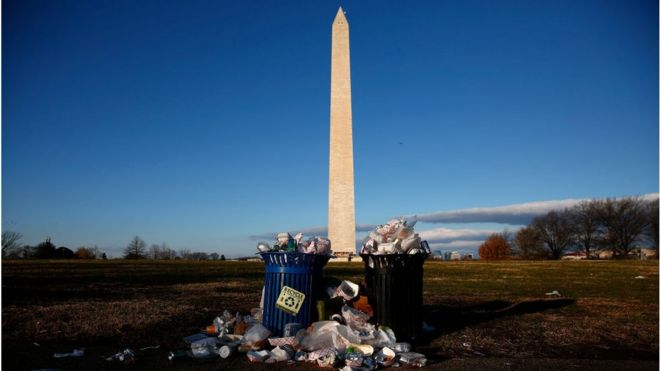
Trash begins to accumulate along the National Mall near the Washington Monument due to a partial shutdown of the federal governmentImage copyrightWIN MCNAMEE VIA GETTY IMAGES
Image captionRubbish has been piling up all along the National Mall monuments
by Suzanne Gould and Biodun Iginla, BBC News Analysts, Washington DC
The partial US government shutdown has entered the new year as President Donald Trump's border wall standoff with Congress remains unresolved. With federal closures now on day 12, around 800,000 employees are feeling the impacts of no funding and no pay.
On Wednesday, Mr Trump insisted he would keep the government closed for "as long as it takes" to fund the border wall as he met top Democrats and Republicans at the White House.
But the shutdown showed little signs of ending after lawmakers said they would return to the White House on Friday to continue negotiations.
And as agencies drop all non-essential work, the consequences are wider-reaching than just quiet Washington DC streets and shuttered museums.
Since 22 December, Americans nationwide have expressed their worry and anger over the situation, taking to social media to share how they cannot pay their bills or afford medication thanks to the shutdown.
Short presentational grey line

'We won't be able to pay our mortgage'

The partial shutdown means about 25% of the US federal government has no funding. Only essential employees will continue working, but they'll do so without pay.
ADVERTISEMENT
Nine departments have been affected by the shutdown, including Homeland Security, Justice, Housing, Agriculture, Commerce, Interior, and the Treasury.
Around 800,000 federal workers are now furloughed - that is, temporarily laid off due to a lack of funding - or working without pay.
Many hope they will receive back pay when the government resumes, but that remains uncertain. Some have resorted to second jobs or fundraising to get by in the meantime.
Employees have taken to Twitter to express their frustration over the shutdown, sharing financial difficulties with the hashtag #ShutdownStories.
Presentational white space
Julie Burr, a contracted worker, told the BBC's Newsday that she has lost two weeks worth of wages thus far - with no guarantee she will be repaid.
"I am a single mother so I am on my own with this," Ms Burr says.
"I've worked with my landlord and we're ok for the month of January probably, but if it continues...and I keep going without wages, then we get into February's rent and that's when it's going to be difficult."
One federal employee, who requested to be identified only as Stacey, told the BBC she feels like "disaster could strike at any time".
She said that one of her children is severely autistic and receives medical services from the government. With the shutdown, Stacey now has to worry about affording emergency hospital care or doctor visits.
"Obviously if it goes on too long then I'm going to have to look at other options. I love my job but I can't go too long without pay."
A worker's union representing some 400,000 essential personnel on Monday filed a lawsuit against the Trump administration for allegedly violating the Fair Labour Standards Act by not paying these employees since 22 December.
Short presentational grey line

No census in Indiana

And the impact stretches beyond the capital city.
In Indiana, the political standoff stopped US census work, with 40% of census bureau employees sent home without pay just after Christmas, according to the News and Tribune.
Short presentational grey line

Rubbish piles in national parks

The National Park Service has suspended all non-emergency services, including all visitor services like public toilets, waste pickup, road maintenance and support centres, with over 21,000 employees now furloughed.
The parks remain generally accessible to the public, but conditions have deteriorated due to a lack of staff.
Noticeably, rubbish quickly began to pile up outside national sites, including around the National Mall and the White House.
Washington Mayor Muriel Bowser has been using the district's local resources to keep the capital clean at a cost of $46,000 (£36,500) per week.
In New York, Governor Andrew Cuomo has committed to paying $65,000 a day to ensure the Statue of Liberty and Ellis Island stay rubbish-free and open for tourists.
Garbage overflows a trash can on the National Mall across from the White HouseImage copyrightBILL CLARK VIA GETTY IMAGES
Image captionGarbage overflows on the National Mall across from the White House
The Los Angeles Times reported human waste has created a health hazard in Yosemite after visitors began using the roadside as a replacement for public toilets.
And without snow ploughs or rangers to help handle wintry conditions, the Sequoia and Kings Canyon national parks in California have seen an increase in vehicle accidents due to dangerously icy roads.
In recent days, nonprofits and volunteers have pitched in to clean up parklands across the US. In Joshua Tree, volunteers nicknamed "toilet angels" have helped haul hundreds of pounds of rubbish out of the park and restock toiletries.
The lack of staff has also impacted visitor safety by way of rescues: One backpacker in Texas had to be carried for two hours by a single ranger after breaking his leg on a trail.
In addition, any park-operated monuments and homes are also closed, including the Frederick Douglass Historic Site, Ford's Theatre and Belmont-Paul Women's Equality National Monument.
Short presentational grey line

Science setbacks

As many federally employed scientists stop working at agencies like the National Science Foundation, labs across the country are facing repercussions.
Researchers are concerned about their ability to access federal data and getting in touch with grant officials about project funding.
Rush Holt, head of the American Association for the Advancement of Science, emphasised the impact in a statement.
"Any shutdown of the federal government can disrupt or delay research projects, lead to uncertainty over new research, and reduce researcher access to agency data and infrastructure," Mr Holt said.
Presentational white space
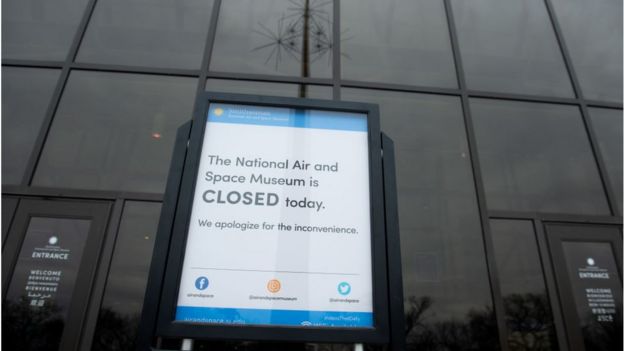
A sign outside the Smithsonian National Air and Space Museum states that the museum is closed because of a partial government shutdown in Washington, DC, January 2, 2019Image copyrightSAUL LOEB/GETTY IMAGES
Image captionAll Smithsonian museums, one of DC's tourist highlights, are closed
Short presentational grey line

Panda cam goes offline

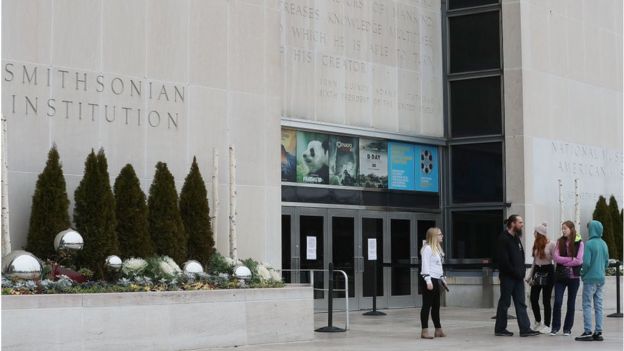
Tourists in DC will find all of the popular Smithsonian museums - like the Air and Space, African American History and Natural History museums - are now closed.
The National Zoo and all live-animal broadcasts - panda cam included - are also offline. The animals will still be cared for, the Smithsonian said.
Smithsonian spokeswoman Linda St Thomas told the BBC an estimated 1.2 million visitors will be turned away if the shutdown continues through January. She noted two thirds of Smithsonian employees are now furloughed.
The National Arboretum and National Archives have also shuttered.
The National Gallery of Art has managed to acquire enough funds to stay open until Thursday. Thanks to an earlier appropriations bill, the US Botanic Garden and Capitol Building are also open.
Meanwhile, nonfederal museums remain open with some, like the Woodrow Wilson House, offering free admission to federal workers.
Tourists turn around after realizing the Smithsonian National Museum of American History is closed due to the partial shutdownImage copyrightMARK WILSON VIA GETTY IMAGES
Image captionTourists turn around after realizing the Smithsonian National Museum of American History is closed due to the partial shutdown
Short presentational grey line

Native tribes struggling

Native American tribes receive substantial federal funding for essential services like healthcare and food as part of a deal negotiated decades ago in exchange for Native lands.
In Michigan, a Chippewa tribe has already been forced to use their own funds to pay some $100,000 (£79,400) to keep clinics and food pantries open, the New York Times reported.
Similar stories have cropped up across the country. Some Navajo tribes in New Mexico, Arizona and Utah are trapped in their homes without access to groceries and medicine due to unploughed roads.
In Minnesota, police officers on the Boise Forte Indian Reservation are already working without pay.
Short presentational grey line

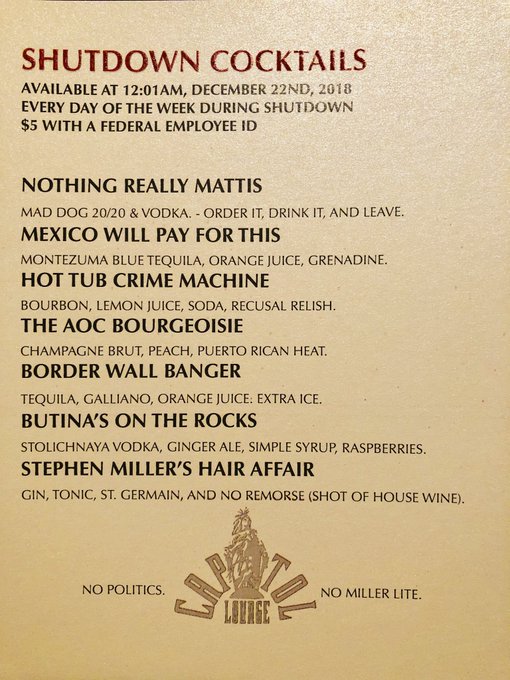
Discounted drinks in DC

Washington DC's local government is still operating, and has been reminding tourists that businesses and restaurants are also open for business.
And many local spots are offering discounts to government employees to help ease the strain of the shutdown.
Presentational white space
Celebrity chef José Andrés, who owns a number of restaurants in the Washington DC area, announced that federal employees and their families could get a free sandwich at any of his establishments throughout the shutdown.
Presentational white space
Italian restaurant Carmine's will also be offering free food to workers.
Presentational white space
As Washington locals band together to address food concerns, the shutdown has also sparked national concerns over benefit programmes like food stamps.
The Department of Agriculture confirmed eligible families would continue to receive food assistance in January, but some programmes will operate solely on state funding through the shutdown.
The National Women, Infants and Children (WIC) Association, which provides food and education to low-income pregnant mothers and children, issued a statementurging lawmakers to end the shutdown before state agencies run out of funds.
"Over seven million mothers, pregnant women, and children rely on WIC," association president Rev Douglas Greenaway said.
"The uncertainty and confusion that a shutdown causes is not only disruptive to people's lives, but could also lead to significant health consequences."
Short presentational grey line

'Unofficial' marriages only

The shutdown has also made its mark on some late December weddings in Washington DC.
One couple tweeted that their marriage remains unofficial since marriage bureau staff in the capital were furloughed during their wedding.
Presentational white space
But those hoping to file for divorce can still do so as the intake centre has stayed open, Buzzfeed News reported.
presentational grey line
Are you a federal employee or contractor affected by the government shutdown? Share your experiences by emailing haveyoursay@bbc.co.uk.
Please include a contact number if you are willing to speak to a BBC journalist. You can also contact us in the following ways:
Or use the form below
Your contact details
If you are happy to be contacted by a BBC journalist please leave a telephone number that we can contact you on. In some cases a selection of your comments will be published, displaying your name as you provide it and location, unless you state otherwise. Your contact details will never be published. When sending us pictures, video or eyewitness accounts at no time should you endanger yourself or others, take any unnecessary risks or infringe any laws. Please ensure you have read the terms and conditions.

More on this story