Biodun Iginla, BBC News

Biodun Iginla, BBC News
Showing posts with label journalism. Show all posts

Sunday, June 2, 2019

After podcasts, The New York Times hits television with 'The Weekly'


The New York Times has set a target of raising subscriptions in print and digital from 4.5 million today to 10 million in 2025
The New York Times has set a target of raising subscriptions in print and digital from 4.5 million today to 10 million in 2025 The New York Times has set a target of raising subscriptions in print and digital from 4.5 million today to 10 million in 2025 GETTY IMAGES NORTH AMERICA/AFP/File
ADVERTISING
New York 
After transforming the podcast essay format with "The Daily," The New York Times is set to take a stab at television with a new show premiering on Sunday that will follow its journalists as they report in the field.
"The Weekly" will be broadcast on FX and distributed online via Hulu, aiming to cover major stories but also to show viewers the behind-the-scenes struggles and calculations that go into producing its journalism.
ADVERTISING
The first show planned by The Times as part of its expansion into television, it also represents the outlet's latest bid to diversify amid declining revenues for American newspapers.
"Audiences want to know, who are these reporters telling me these stories? How do they know what they know? How do they confirm it?" Sam Dolnick, the assistant managing editor in charge of the newspaper's video and audio projects, told us at France24. 
"We think that a level of transparency makes the stories themselves more compelling," he said.
- Broadening the audience -
Since its launch in 2017, listenership of "The Daily" has risen to an average of two million per episode, making it one of the ten most popular podcasts in the United States.
While The Times employs video journalists, Dolnick said they weren't involved in the television show which was made jointly with production company Left/Right and which the Times has already sold overseas.
Each episode of "The Weekly" lasts about 30 minutes and follows journalists through their reporting process, showing the behind-the-scenes of a story that has typically already run in print.
The premier follows a reporter investigating the dubious methods of a school in Louisiana that sends disadvantaged students to some of the best universities in the country.
"The big motivation for this show was to help stories bring journalism to people who may not read the New York Times, to broaden our audience and help more and more people understand what we think are important issues that the public needs to grapple with," Dolnick said.
Online outlets Buzzfeed and Vice have produced similar television shows but "The Weekly" is the first by a major American newspaper.
While declining to discuss financial details of their arrangement with FX and Hulu, a spokesman for the newspaper called the show "a significant investment for The Times."
The newspaper has set a target of raising subscriptions in print and digital from 4.5 million today to 10 million in 2025.
The Times also plans to launch other television projects, among them a fictionalized adaptation for Amazon's streaming platform of the popular "Modern Love" column, in which readers relate stories about relationships.
Another documentary series in the works for Netflix is called "Diagnosis," based on the column of the same name where readers are enlisted to help solve undiagnosed medical cases.

Thursday, May 10, 2018

Analysis: Catalonia's leader, a dyed-in-the-wool partisan of independence


by Elodie Bagnol and Biodun Iginla, France24 News Analysts, Barcelona


    © AFP/File / by Daniel BOSQUE | The 54-year-old former journalist became president of Catalonia in January 2016, after an election in which separatists won a majority in the regional parliament for the first time.

    BARCELONA - 
    Carles Puigdemont, the ousted leader of Catalonia who on Thursday stepped back from efforts to reappoint him, has been a convinced secessionist since his youth, long before the issue moved to the centre of Catalan and Spanish politics.
    The 54-year-old former journalist became president of Catalonia in January 2016, after an election in which separatists won a majority in the regional parliament for the first time.
    Less than two years later, on October 1, 2017, Puigdemont staged an independence referendum even though the courts had ruled it unconstitutional.
    The Catalan government claimed that 90 percent of voters backed independence in the referendum, with Puigdemont declaring that his region had "won the right to an independent state".
    A virtual unknown when he became president of the northeastern Spanish region of 7.5 million people, Puigdemont, who combs his hair in a shaggy Beatles-style mop, become the main enemy of Prime Minister Mariano Rajoy's conservative government.
    In Amer, the small mountainous village of 2,200 people where he grew up, and in Girona, where Puigdemont served as mayor from 2011 to 2016, he is recalled as a convinced separatist.
    "In Catalonia many people became separatists in an allergic reaction to Madrid's policies. Not him, he always had these convictions," said Puigdemont's friend Antoni Puigverd, a poet and journalist.
    Puigdemont has never hidden his separatist tendencies, not even when he joined his predecessor Artur Mas's CDC party in 1980 at a time when it merely wanted to negotiate greater autonomy for Catalonia -- far from the idea of breaking away from Spain.
    His friend Salvador Clara, a leftwing secessionist councillor in Amer, added that Puigdemont had defended the independence of Catalonia "since he can remember".
    - Pro-independence family -
    In July 2015 Puigdemont became president of the Association of Municipalities for Independence, which brings together local entities to promote the right to self-determination.
    For 17 years he worked for Catalonia's nationalist daily El Punt, which now publishes under the name El Punt Avui after merging with another paper. He later created a regional news agency and an English-language newspaper about his region.
    "He always combined his political activism with journalism," said Ramon Iglesias, a journalist with news radio Cadena Ser in Girona.
    In 1991, while working at a local newspaper in Girona, Puigdemont launched a campaign to change the spelling of the name of the city from the Spanish version, Gerona, to Girona, the Catalan spelling, Iglesias recalled.
    Born on December 29, 1962, into a family of bakers, Puigdemont was the second of eight siblings.
    "We're a pro-independence family through and through," his sister Anna, who runs the family bakery in Amer, told us at France24.
    - 'Enormous freedom' -
    Puigdemont -- currently on bail in Germany, as Madrid tries to persuade the German courts to extradite him to faces charges of rebellion over the October 1 referendum -- speaks English and French as did his predecessor Artur Mas.
    He is also a Romanian speaker as his wife Marcela Topor comes from Romania, and they have two girls.
    But unlike Mas, who implemented unpopular austerity measures during Spain's economic crisis, Puigdemont is more of a social democrat who was better able to seduce the far-left members of Catalonia's separatist faction who were wary of Mas.
    Catalan journalist Enric Juliana said Puigdemont's long-standing separatist convictions had made him the "ideal candidate" to succeed Mas, who never managed to convince some separatists of his dedication to a cause he embraced only a few years ago.
    In June 2016, when far-left separatists withdrew their support, he took a risk and called a motion of no confidence in the Catalan regional parliament, which he survived.
    "He arrived where he is by chance. He did not aspire to a political career, and that has given him enormous freedom," Puigverd said.

    Wednesday, April 25, 2018

    Politician-fuelled 'hatred of journalism threatens democracies', says Reporters Without Borders


    © Ted Aljibe, AFP | An activist displays a placard showing President Rodrigo Duterte as a clown during a protest in favour of the freedom of press in Manila on January 19, 2018.

    Latest update : 2018-04-25

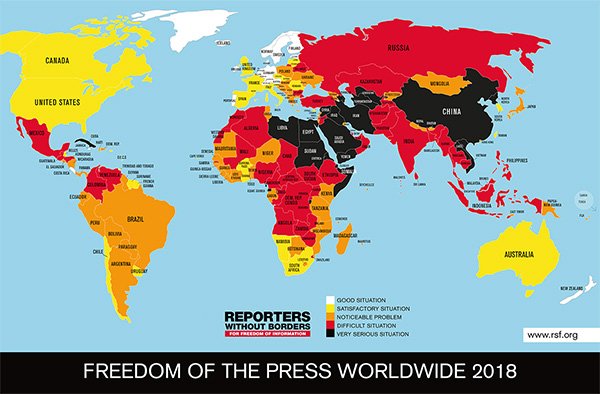
    Press freedom around the world is under threat from a triple whammy of US President Donald Trump, Russia and China's bid to crush all dissent, a watchdog said Wednesday.

    Reporters Without Borders (RSF) warned that a "climate of hatred and animosity" towards journalists combined with growing attempts to control the media pose a "threat to democracies".
    Its annual report said that reporters were the target of a growing wave of authoritarianism with leaders whipping up hostility against them.
    The group accused the world's three superpowers -- the USChina and Russia -- of leading the charge against press freedom, with Trump regularly launching personal attacks on reporters and Beijing exporting its "media control model" to strangle dissent elsewhere in Asia.
    The slide towards "strongman" and populist politics in Europe, stoked by Moscow, was threatening freedoms in the region where they were once safest, it added, with Hungary, Slovakia and Poland setting off alarm bells.
    Czech President Milos Zeman turned up at a press conference with a fake Kalashnikov inscribed with the words "for journalists" while Slovakia's former leader Robert Fico called journalists "filthy anti-Slovak prostitutes" and "idiotic hyenas".
    "The unleashing of hatred towards journalists is dangerous and a threat to democracy," RSF chief Christophe Deloire told us at France24. 
    "Political leaders who fuel loathing for reporters... undermine the concept of public debate based on facts instead of propaganda. To dispute the legitimacy of journalism today is to play with extremely dangerous political fire," he added.
    China's 'oppressive' order
    RSF said that hostility towards the media is "no longer confined to authoritarian countries such as Turkey and Egypt", but was poisoning the political atmosphere in some of the great democracies.
    "More and more democratically elected leaders no longer see the media as part of democracy's essential underpinning, but as an adversary to which they openly display their aversion," the report said, picking out Trump, India's Narendra Modi and Philippine leader Rodrigo Duterte for particular criticism.
    The US president had referred to reporters as "enemies of the people", a term once used by Stalin, it said.
    RSF accused Vladimir Putin's Russia of "stifling independent voices at home... and extending its propaganda network by means of media outlets such as RT (Russia Today) and Sputnik."
    It had even harsher words for Beijing, saying "Xi Jinping's China is getting closer and closer to a contemporary version of totalitarianism.
    "Censorship and surveillance reached unprecedented levels thanks to the massive use of new technology" in his first term in office, the report said.
    Now the Chinese government "is trying to establish a 'new world media order' under its influence, by exporting its oppressive methods, information censorship system and Internet surveillance tools," it added.
    "Its unabashed desire to crush all pockets of public resistance unfortunately has imitators in Asia," the RSF said, condemning Cambodian Prime Minister Hun Sen's "ruthless offensive" against the media.
    It said Beijing's influence and tactics were also being felt in Thailand, Malaysia and Singapore.
    Turkey falls further
    Turkey -- the world's biggest jailer of journalists -- has fallen into the most repressive 25 countries in the world.
    The watchdog said that "media-phobia" there is now so pronounced that journalists are routinely accused of terrorism and "those who don't offer loyalty are arbitrarily imprisoned."
    North Korea remains the most repressive country on Earth closely followed by Eritrea, Turkmenistan, Syria and then China.
    Saudi Arabia, Bahrein, Vietnam, Sudan and Cuba also remain among the worst offenders, according to the RSF ranking of 180 countries.
    Malta tumbled 18 places to 65 after the assassination of investigative journalist Daphne Caruana Galizia.
    But not all the news was bad. Ecuador jumped 13 places after tensions eased between the government and privately-owned media, while Justin Trudeau's Canada entered the European-dominated top 20.
    Jamaica climbed to eighth overall, above Belgium and New Zealand, and Gambia jumped 21 places -- the biggest rise in Africa -- just ahead of Angola and Zimbabwe.
    The departure of the three African countries' "predatory presidents" was the main reason for their improved performance, the RSF said.
    As usual, Scandinavian countries topped the list with Norway deemed as having the world's freest press for the second year in a row.

    Date created : 2018-04-25
    • RUSSIA

      Russian reporter who investigated Syria mercenaries dies in 'balcony fall'
    • TURKEY

      Turkey sentences 25 journalists to prison terms, most on terror charges
    • USA

      Trump rebuked as he unveils 'Fake News Awards'
    Leave a comment