Biodun Iginla, BBC News

Biodun Iginla, BBC News
Showing posts with label migrant families. Show all posts

Saturday, February 9, 2019

U.S. Border Patrol overwhelmed by large groups of migrant families

February 9, 2019  14H:26  GMT/ZULU
U.S. Border Patrol said on Friday its resources were being stretched thin by larger and larger groups of Central American families left by smugglers in remote locations along the U.S. Mexico border.
So far in fiscal year 2019, which began last October, the Border Patrol has apprehended 60 groups of 100 or more migrants, compared with 13 during the entire 2018 fiscal year and just two large groups caught in the 2017 fiscal year, a U.S. Customs and Border Protection (CBP) official said on a call with reporters.
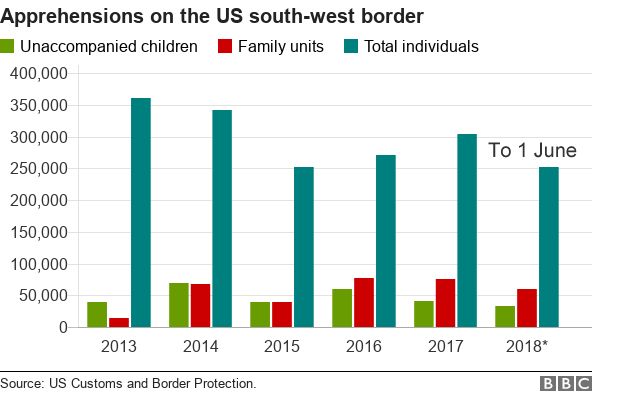
Until recently, most people caught crossing the border illegally were men from Mexico, but now Central American families and unaccompanied minors make up some 60 percent of those apprehended, data from the agency show.
Facilities built decades ago are struggling to cope with the influx of migrant families, many with young children, who are often in need of medical care.
SPONSORED
“Large bus loads of individuals are being bussed up to the border and we don’t have any infrastructure in that area,” the official said on the call with reporters.
Many of the migrants who may seek passage with smugglers in their journey through Mexico cross the border and turn themselves into U.S. authorities to seek asylum in the United States, a drawn-out court process that can take months or years to resolve.
The border patrol official said smugglers drop off large groups as a diversion tactic to tie up law enforcement resources in order to move drugs across other parts of the border.
The Trump administration has tried to curb access to asylum, including by starting a program that would require applicants to wait out their legal proceedings in Mexico.
Human rights advocates say increased border security and daily quotas put on asylum requests at ports of entry are among factors pushing large groups of migrants to cross the border in risky, remote areas.
U.S. lawmakers see 'progress' in border talks
Just how dangerous these crossings can be was highlighted in December when a 7-year-old girl from Guatemala died in U.S. custody after she and her father crossed in a large group in a remote area of New Mexico. Weeks later, an 8-year-old Guatemalan boy died after crossing the border with his father near El Paso, Texas.
Overall, illegal crossings at the southern border have dropped dramatically compared to previous decades but in recent years the number of families and unaccompanied children heading to the United States has increased.
(For an interactive graphic titled 'Crisis on the Border?', see: here)

Saturday, June 30, 2018

BREAKING AND UPDATE: #Familiesbelongtogether: Thousands protest over migrant separations


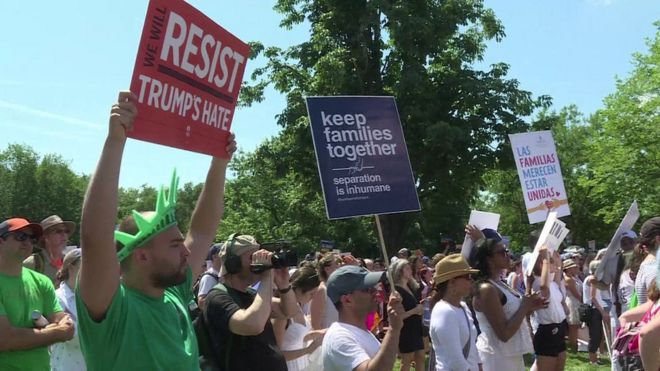
Protesters in Washington DCImage copyrightAFP
Image captionThe main gathering was in Washington DC with some 50 events were taking place nationwide
by Suzanne Gould and Biodun Iginla, BBC News, New York
Tens of thousands of people have joined nationwide protests across the US over the Trump administration's hardline immigration policies.
More than 630 events were planned, with protesters calling for migrant families split at the US border to be reunited.
Some 2,000 children remain separated from their parents, despite President Donald Trump bowing to public outrage and curtailing the policy.
Concerns remain that records were not kept linking parents and children.
Major protests took place in Washington DC, New York, and many other cities, using the hashtag #familiesbelongtogether. Marchers held placards calling for no more family separations and for the controversial immigration agency ICE to be abolished.
"It goes against everything we stand for as a country," one protester, Paula Flores-Marques, 27, told Reuters in front of the White House in Washington DC. President Trump was out of town.
In New York they chanted, "Say it loud, say it clear, refugees are welcome here". In Chicago, protesters marched to the local offices of federal immigration authorities.
The original Trump administration "zero tolerance" policy required authorities to arrest and detain anyone crossing the Mexico-US border illegally. That meant separating children from their parents and holding them separately.
Media captionWhat do Trump supporters make of the family separations?
Faced with a massive public outcry after recordings were published of distressed, crying children in detention centres, President Trump promised to "keep families together" in migrant detention centres.
But critics say the order did not address the issue of families already separated, leaving uncertainty over the fate of 2,342 children taken away from their parents between 5 May and 9 June alone. Earlier this week, a judge in California ordered the families to be reunited within 30 days.
It also still requires authorities to detain immigrant families, rather than release them with a court date to return.

What do the protesters want?

Organisers said they wanted to send a message to President Trump, prompted by concerns that he would renege on his executive order.
"We cannot slow down now since the court ruling alone isn't enough and could be overturned," said a statement on the movement's website.
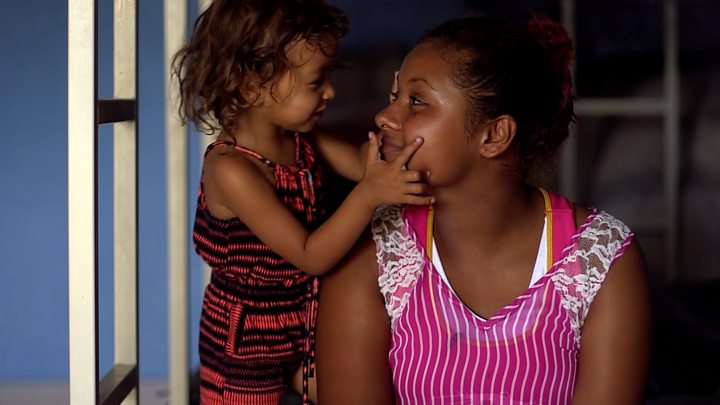
Media captionVeronica is terrified she'll be separated from her daughter when she seeks asylum at the US border
As well as the reunification of parents and children, organisers called for an end to immigrant detention - even when families are kept together - and also planned to voice opposition to President Trump's travel ban targeting five majority-Muslim nations, which was upheld by the US Supreme Court earlier this week.
Demonstrations were also likely to focus on the shake-up of the Supreme Court after Anthony Kennedy announced his retirement last week, giving President Trump the opportunity to solidify a conservative majority on the country's top court.
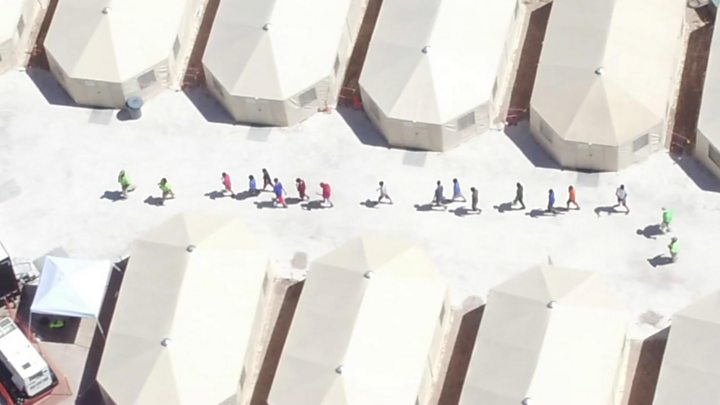
Media captionDrone footage shows a "tent city" immigration centre
Much of the uproar over the separation policy came after news organisations reported on children being held in cells, converted warehouses and desert tents around the country.
President Trump on Saturday defended the agency that played a central role in carrying out the separations - the Immigration and Customs Enforcement (ICE). He told its employees: "You are doing a fantastic job of keeping us safe by eradicating the worst criminal elements. So brave!"

Who is taking part?

Organisers issued instructions for people to dress in white, to represent peace and unity. The main march is taking place in Washington DC, but one of the people behind the movement, Anna Galland, said separate events were planned in 50 states.
Lead organisers of the march include the American Civil Liberties Union, the Leadership Conference on Civil Rights and the National Domestic Workers Alliance.
A number of celebrities expressed their support, including actresses Julianne Moore, America Ferrara and Natalie Portman, and Lin-Manuel Miranda, creator of the hit musical Hamilton.
The protests are not the first against Mr Trump's immigration policy. Nearly 600 women were arrested on Thursday during a sit-in at a US Senate building against the government's migration policy. Actress Susan Sarandon was among those detained.
Many were draped in foil sheets to highlight the flimsy bedding given to migrant children held in border detention facilities.

What is the policy?

President Trump's "zero tolerance" policy has strong support among his key Republican support base. He has repeatedly defended the policy, saying it is simply enforcing the law.
Under a crackdown rolled out in May, all border crossers - including first-time offenders - are criminally charged and jailed.
Media caption"I have no information on my son" - one woman's story of being separated from her son
Migrant children are not permitted to be incarcerated with their parents and are kept in separate facilities maintained by the Department of Health and Human Services.
Under previous US administrations, undocumented immigrants caught crossing the border for the first time tended to be issued with court summonses.
Chart showing US arrests at Mexico border

More on this story