Biodun Iginla, BBC News

Biodun Iginla, BBC News
Showing posts with label mosul. Show all posts

Friday, December 22, 2017

Yazidi sisters reunited after three years in Islamic State captivity

DECEMBER 22, 2017 11H:23  GMT/UTC/ZULU TIME
SHARYA, Iraq - When Rosa, now 14, asked her Islamic State captors about her younger sisters Bushra, 12, and Suhayla, seven, she was told they had been killed for misbehaving.
“At that point, I didn’t care about anything anymore. Even if I died,” she said. “I never thought I’d see them again.”
The sisters were finally reunited on Sunday, more than three years after being taken by the militants in an assault on Sinjar, the Yazidi heartland on August 3, 2014.
SPONSORED
Just last week, Iraq declared “final victory” over Islamic State, with parades through the streets of Baghdad in celebration after three years of bloody war.
But the damage done by the militants is not easily remedied: they brutalized Iraqis, exposing fault lines in the country’s already fragile social fabric and ripping families apart.
For Rosa and her family, though overjoyed at reuniting, the last three years will not be easily erased.
The militants shot, beheaded, burned alive or kidnapped more than 9,000 members of the minority religion, in what the United Nations has called a genocidal campaign against them. According to community leaders, more than 3,000 Yazidis remain unaccounted for.
Among them, are Rosa’s parents, thought murdered by the militants who rolled their victims into mass graves scattered across the sides of Sinjar mountain, where thousands of Yazidis still live in tents.
The girls’ nine-year-old brother, Zinal, is also still missing. Captured and held with them in the nearby city of Tal Afar, he was later driven away to Mosul in a car full of young Yazidi boys. They haven’t heard from him since.

SEPARATED AND SOLD

Reuters could not verify all of the details given by Rosa, Bushra and some of the five older brothers they now live with in a group of tents in the tiny village of Sharya in Iraq’s Kurdistan region.
But Amin Khalat, spokesperson for Kurdish government office which helps return missing Yazidis, said Rosa and Suhayla had been taken to Syria and Turkey respectively after being held in Tal Afar and that his office had helped reunite them with their family.
He said Rosa was returned from Syria by fighters from the Kurdistan Workers Party (PKK) and Suhayla by the Iraqi government which was alerted to her existence by Turkish officials who found her at a refugee camp in Turkey. Her family then recognized her photograph.

Yazidi girls Bushra, 12, Suhayla, 7, and Rosa, 13, who were reunited with their family after being enslaved by Islamic State militants, pose for a photo at Sharya Camp in Duhuk, Iraq December 18, 2017. REUTERS/Ari Jalal
Rosa said she and her younger siblings were sold, by the Islamic State militants who attacked Sinjar, to a fighter and his family in Tal Afar, a city of predominantly ethnic Turkmen which produced some of the group’s most senior commanders.
She said she did all the household chores and cared for her siblings and other young Yazidi captives, who lived together in a tiny room.
After a year together, Zinal was taken to Mosul, while Suhayla and Bushra were sold off to separate Islamic State families, close to one another, but not allowed to meet. After Bushra’s captors took her to Rosa’s house for a visit, she said she memorized the route so she could return.
“I would wait till everyone fell asleep in the afternoon, I’d pretend to fall asleep and then sneak out to see Rosa,” said Bushra. “They once caught me and threatened to sell me off if I didn’t stop seeing my sister but I didn’t care.”


Slideshow (8 Images)
Bushra said she was eventually sold again, but about a year ago, she and six older Yazidi girls ran away and reached Sinjar, where Kurdish fighters helped them find their families.
Rosa was taken to Deir Ezzor, Syria and sold twice more. She said she was originally bought for $4 in Tal Afar and last sold in Syria for $60. “Those dogs made quite a good profit out of me,” she said with a wry smile. PKK fighters came across her in Idlib and brought her back to Iraq and her family, she said.
Suhayla was taken by her Turkmen captors to a refugee camp in Turkey, where authorities discovered her situation and repatriated her. She was reunited with her sisters and other relatives on Sunday, a day after Rosa returned.
Beaten, forced to convert and forget their native Kurdish, the girls even had their names changed.
Rosa was known as Noor – hers was an infidel’s name, her captors told her. Suhayla, captured when she was three, barely recognizes her sisters and speaks in broken Turkman dialect and Arabic.
“She has to learn to remember us again,” said Rosa. “She got used to calling some strangers mum and grandpa while she was held captive.”
Her sisters say Suhayla has barely spoken since returning to her family, but wearing a pink sweater and plastic jewelry, she relaxed under a flood of kisses from her sisters.
Bushra, nine when she was captured, is only at ease with her closest relatives. Because she returned to the family first, her brothers have asked her to help her sisters, but she warned them that it would not be easy.
“It’s true we are strong, we’ve been through so much. But our hearts are weak – they’re broken.”

Friday, July 7, 2017

Islamic State nears its end--analysis

Last days of the caliphate
by Leila Mohamed and Biodun Iginla, News Analysts, The Economist Intelligence Unit, Beirut/New York

Even before the battle is won, hopes of a fresh dawn for Iraq are fading
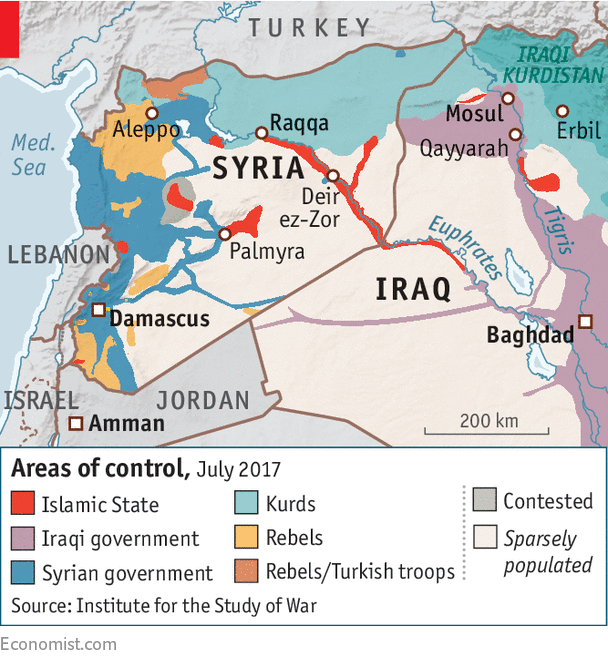
THE fireworks have been ordered. Street parties are planned. The Iraqi government has prepared a week of festivities to mark the fall of Abu Bakr al-Baghdadi’s self-proclaimed caliphate. Three years after seizing control of the great alluvial plains of the Tigris and the Euphrates, Islamic State, which has claimed so many victims in north-western Iraq, Syria and beyond, is finally dying. American-led forces in Syria breached the old city walls of IS’s capital, Raqqa, on July 4th. In Mosul, in Iraq, all but the last alleyways of the Old City were back in government hands as The Economist went to press on July 6th.
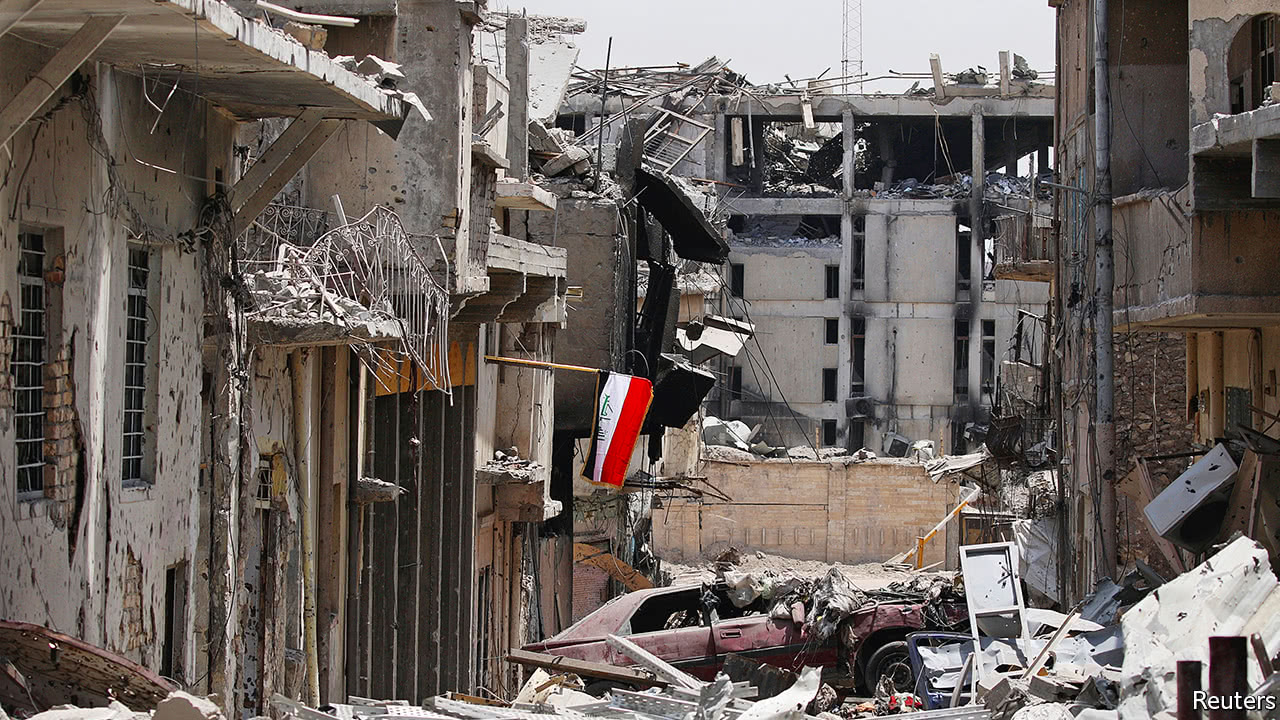
Finding a backdrop from which to celebrate the liberation of Mosul will be difficult, though. Between them, IS and the coalition have destroyed too many shrines and mosques to leave much of historic value, including the al-Nuri mosque dating back to Crusader times from where Mr Baghdadi proclaimed himself caliph. Gone is the Jewish quarter, the markets with their monasteries, and the lattice balconies and sculptured masonry of another Sunni silk road city. “Overlooking the Tigris, there could be no nobler or more beautiful place to sit in,” waxed Ibn Jubayr, a Spanish travel writer who visited in the 12th century. What one side booby-trapped, the other side shelled. Almost half the neighbourhoods of west Mosul have been destroyed, including much of the Old City, estimates a foreign observer, perhaps some 20,000 houses in all. “Like Dresden,” an American general was heard muttering, touring the ruins.

Latest updates

See all updates
The odour of putrefaction hangs in the hot air. Cameramen entering the honeycomb of the Old City return with footage of bodies, old and young, lying under blankets in front rooms for days. Many more are buried under the rubble. Thousands trapped in the alleys IS still holds are without water or food. Iraqi soldiers maintaining a siege prevent aid workers from getting food to those inside.
Previous battles for the city have been short-lived. In 1918 and 2003, opposition melted away when British and American forces respectively marched in. Even in the earlier battle for east Mosul, IS fighters ceded one neighbourhood after another, and retreated west over the Tigris and into Syria. But besieged in their western redoubt, they have nowhere else to go. Unlike during the fall of Aleppo to the Assad regime earlier this year, no one has negotiated safe passage in the final stages of battle. The fighting goes on alley by alley.
The clear-up operation will do much to determine whether Iraq’s government wins the war as well as the battle. Mosul’s exodus has realised the UN’s worst-case predictions. About 900,000 of the city’s 2m people have been displaced; 700,000 are still homeless. The prime minister, Haider al-Abadi, wants to get people home quickly, but the UN says 200,000 have none to return to. Most of the latter come from poor neighbourhoods, like the Old City, where IS found many recruits. Strewn across Iraq, they may now spread their anger countrywide. Other reconstruction operations are proceeding slowly, too. Six months after its liberation the east side remains cut off from the electricity grid. For want of water, the UN is carting in 6m litres a day. Schools quickly reopened, but initial jubilation has turned to despondency among teachers who, six months on, remain unpaid. Mosul’s university, once home to the region’s best engineering college, lies destroyed and abandoned.
The coalition should know better. In 2003 America’s forces rested on their laurels after their race to Baghdad, letting insurgents fill the vacuum. They did the same after beating back al-Qaeda in 2007. But once again, reconstruction is a distant prospect. Iraqi ministers estimate that rehabilitating areas liberated from IS will cost $100bn, roughly the sum they and the Americans spent on the war. But the government is broke. Sunni Gulf states are said to be considering involvement, but have contributed next to nothing. The World Bank has reportedly committed $300m. Germany is offering €500m ($570m). Coalition talks on a ten-year reconstruction plan, set to begin in Washington on July 10th, might drum up a bit more. But, runs an Arabic proverb, commitments are clouds, implementation the rain.
Even if money is found, procurement and contracts will take time. “It will take a year before you see anything happening,” says Ammar Shubbar, an Iraqi economist. “And that will be patchwork—some sewage repair here and there.” Almost a year after taking Qayyarah to the south of Mosul, Iraq’s government has yet to reconnect it to the grid. General Electric, an American company that won the contract, says it is still trying to negotiate financing. Danger and corruption, says a GE employee, are further hampering the company’s hopes of re-entering Mosul. And material reconstruction is only part of the task. More perturbing than the children who shriek at the bombardment around them are those who barely flinch.
In Mosul, the initial relief at liberation from IS’s reign of terror is already turning to grumbling. IS ran services and rubbish collection better, say residents. They repaired the potholes in the road faster and kept electricity going. “Why did the Iraqi government abandon us to IS in 2014, only to destroy our city when they returned?” asks a Mosul University graduate. Locals still report lurking fighters and suspicious packages to the plethora of security forces in the city. After a lull of several months, sleeper cells are reawakening in the east of the city. Suicide bombing has begun again. In the space of a week last month, three mukhtars, or neighbourhood elders, were killed. Some predict the return of a low-level insurgency much as before IS swept control in June 2014. After all, though Iran and Russia say that Mr Baghdadi is dead, his organisation still occupies swathes of (thinly-populated) territory either side of the Iraqi-Syrian border.
IS’s vestiges, though, may anyway be one of the lesser problems facing Iraq. Exultant armies and militias now occupy the ground once held by the caliphate. A generation of young Iraqis currently earn a living from fighting IS; they may now develop ambitions of their own. Having avoided confrontation while they were assaulting IS, America and its allies are now coming to blows with Iran and its allies across the border in south-eastern Syria. A similar struggle looms in Iraq. Meanwhile, Iraq’s politicians squabble, largely confined to the Green Zone, the walled city within a city occupying the core of Baghdad. So far there is not much sign of the fresh dawn that IS’s downfall should bring.
This article appeared in the Middle East and Africa section of the print edition under the headline "Last days of the caliphate"
View comments
Reuse this content

Friday, April 21, 2017

Iraq forces free 11-year-old Yazidi girl in Mosul


by Sunita Kureishi and Biodun Iginla, France24, Baghdad. Sunita Kureishi is working undercover in Baghdad.


    © AFP/File | Iraqi soldiers pose next to a cross on January 22, 2017 at St. George's Monastery (Mar Gurguis), a historical Chaldean Catholic church on the northern outskirt of Mosul

    BAGHDAD - 
    Iraqi forces in Mosul have freed an 11-year-old Yazidi girl who was kidnapped and sold as a slave by the Islamic State group in 2014, the federal police said Friday.
    The girl was taken by the jihadists from the village of Kosho, south of the Yazidi hub of Sinjar in northern Iraq, together with her mother and sisters.
    She was freed during an operation by the security forces on Thursday in the west Mosul neighbourhood of Tanek, federal police chief Lieutenant General Raed Shakir Jawdat said in a statement to us at France24.
    The elite Counter-Terrorism Service has been operating in the area and secured more than half of the neighbourhood on Thursday.
    "They who kidnap these children are monsters," Major General Jaafar al-Baatat, Jawdat's top aide, said in a statement which was released with a video showing the girl at a police base south of Mosul.
    Vian Dakhil, a prominent Yazidi lawmaker who helped bring her minority's plight to the world's attention when IS jihadists swept through the region in 2014, said the girl's release had been carefully planned.
    "When Daesh (IS) took her village on August 15, 2014, she was eight years old and she was kidnapped with her mother and her sisters," she told us at France24. She was initially taken to Tal Afar and was sold on to Mosul."
    Yazidis are neither Arab nor Muslim and when IS swept across northern Iraq almost three years ago, it carried out massacres against the minority which the United Nations said qualified as genocide.
    Most of the several hundred thousand members of the minority live in northern Iraq, mainly around Sinjar, a large town which anti-IS forces have now retaken but was extensively destroyed.
    IS jihadists captured Yazidi women and turned them into sex slaves to be sold and exchanged across their self-proclaimed "caliphate". Around 3,000 of them are believed to remain in captiv