Biodun Iginla, BBC News

Biodun Iginla, BBC News
Showing posts with label the Ottoman empire. Show all posts

Friday, August 9, 2019

ANALYSIS: 500 years ago, Europeans set off to explore the world


A New York statue of Christopher Columbus, one of the major European explorers of the 15th and 16th centuries, who is credited with discovering the Americas
GETTY IMAGES NORTH AMERICA/AFP/File
ADVERTISING
Paris 
The expedition that circumnavigated the globe via the oceans for the first time 500 years ago is among the major journeys of discovery by European explorers in the 15th and 16th centuries.
- 1488: Dias rounds Africa -
With the mighty Ottoman Empire holding a monopoly on trade with the Indian subcontinent in the 15th century, Portugal's Prince Henry the Navigator launches a quest to conquer the seas via Africa.
At the time the length of the continent's coastline was unknown.
Less than 30 years after Henry's death, Portuguese explorer Bartolomeu Dias leads the expedition that rounds the southern tip of Africa for the first time in 1488, opening a new sea route from Europe to Asia.
He calls it the Cape of Storms but Portugal's King John II renames it the Cape of Good Hope.
Dias continues his eastward journey but his exhausted crew eventually forces him to turn back.
- 1492: Columbus discovers Americas -
Italian Christopher Columbus, determined to reach the East via a western route, makes four voyages across the Atlantic between 1492 and 1504, sailing for the Spanish crown.
During the first, he disembarks from his flagship, the Santa Maria, in the Bahamas in October 1492 and then moves on to today's Haiti, which he names Hispaniola.
In another expedition he sets foot on the American mainland for the first time in present-day Venezuela, but is convinced he is in the East Indies.
It is only later that Italian explorer Amerigo Vespucci realises that the landmass that Colombus discovered is a new continent. It is named America in his honour in 1507.
- 1498: Da Gama reaches India -
Vasco da Gama from Portugal becomes the first European to reach India via Africa, rounding the Cape of Good Hope discovered by Dias just a decade before.
He leaves Lisbon in 1497 and sails around the tip of the continent to reach the coasts of India in 1498.
During his second expedition, Da Gama establishes the first Portuguese trading post in Asia at Cochin in eastern India.
- 1500: Cabral discovers Brazil -
Portuguese navigator Pedro Alvares Cabral and his fleet of 13 caravels depart from Lisbon in 1500, on a southwest course to benefit from the trade winds, to discover what he calls "Island of the True Cross" and later becomes Brazil.
He then reaches the Indian subcontinent via the Cape of Good Hope, returning to Portugal laden with spices but having lost half of his fleet.
It is believed that Spaniard Vicente Yanez Pinzon may have arrived in Brazil shortly before Cabral but had not claimed the discovery.
- 1522: Globe circumnavigated -
In 1519 Ferdinand Magellan launches the sea journey that will become the first to round the world, leaving Seville with five ships and 237 men.
They cross the South American strait that will later take Magellan's name and reach calmer waters in an ocean that he names the Pacific.
The fleet pushes on to the Philippines, where Magellan is killed by a local's arrow in 1521.
Spaniard Juan Sebastian de Elcano takes over command and completes the circumnavigation. He returns to Spain in 1522 with the last ship, the Victoria, and around 20 survivors.
- 1534: French reach Canada -
In 1534 Frenchman Jacques Cartier sets off on a mission under King Francis I to find a western passage to Asia.
Just weeks later he reaches the Gulf of Saint Lawrence and explores the surrounding territory that he calls Canada, after "kanata", which means village in the local language.
Cartier claims Canada for France and makes two more journeys there, the last in 1542.

Wednesday, April 5, 2017

BREAKING: Australia warns of Gallipoli terror threat


by Louise Healy and Biodun Iginla, France24, Sydney

    © POOL/AFP/File | Dignitaries lay wreathes during a service of commemoration and thanksgiving to mark Anzac Day in London on April 25, 2016, the anniversary of the first major military action fought by Australian and New Zealand forces during the First World War

    SYDNEY - 
    Australia Thursday warned terrorists could target Anzac Day commemorations on the Gallipoli peninsula in Turkey this month, and urged travellers to avoid Ankara and Istanbul.
    The emotive event on April 25 remembers the heroism and sacrifice of Australians and New Zealanders during World War I and their campaign against the Ottoman Empire in 1915.
    Canberra said intelligence suggested it could be a target this year by extremists.
    "There is information to suggest that terrorists may seek to target Anzac Day commemorations on the Gallipoli peninsula," said Veterans' Affairs Minister Dan Tehan, adding that Turkey was aware and stepping up security.
    "The Turkish authorities are taking this extremely seriously. The celebrations on Gallipoli are as important to the Turkish authorities and Turkish people as they are to the Australians.
    "They are taking it seriously, in terms of the security envelope for the sake of everybody on the peninsula."
    While Canberra's advice to travellers had not changed from "exercise a high degree of caution" in Gallipoli and Turkey overall, it said they should "reconsider their need to travel to Ankara and Istanbul".
    "We are conscious of the effect of this on the many Australians planning to attend this year's Anzac Day commemorations at Gallipoli," added Tehan.
    "In the current global environment, major events attract threats of varying degrees of credibility. Regrettably Anzac Day is not immune."
    Hundreds of Australians and New Zealanders annually make the trip to Gallipoli to mark the amphibious assaults on the peninsula in what is now western Turkey.
    Many were killed in the initial assault and the overall Allied campaign ended in failure and evacuation.
    But the spirit shown by the Anzac (Australian and New Zealand Army Corps) troops has long been seen as critical in forging a national identity in New Zealand and Australia. Both commemorate April 25 as Anzac Day.

    Sunday, February 12, 2017

    Turkey referendum on boosting presidential powers set for April 16


    Subscribe to our videos for free!
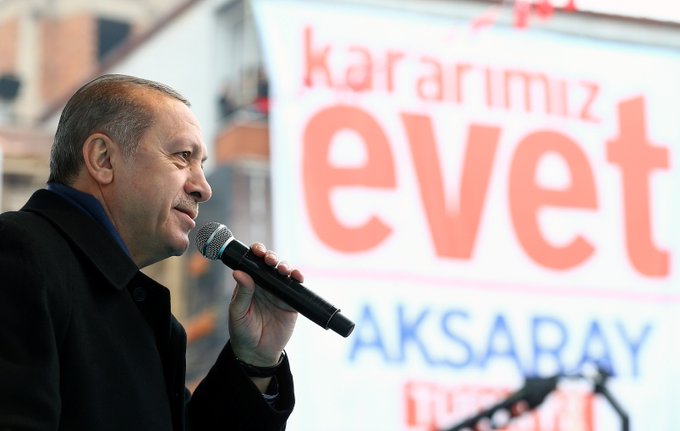
    © Adem Altan, AFP | President of Turkey Recep Tayyip Erdogan gestures as he delivers a speech during the Turkish Union of Chambers and Commodity Exchanges (TOBB) Economic Council in Ankara, February 7, 2017.

    Latest update : 2017-02-13  03H:14  GMT/UTC/ZULU TIME  


    Turkey will hold a referendum on April 16 on replacing its parliamentary system with the stronger presidency long sought by incumbent Tayyip Erdogan, electoral authorities announced on Saturday.

    The proposed constitutional reform would mark one of the biggest changes in the European Union candidate country’s system of governance since the modern republic was founded on the ashes of the Ottoman empire almost a century ago.
    It would enable the president to issue decrees, declare emergency rule, and appoint ministers and top state officials. It could also see Erdogan remain in power in the NATO member state until 2029.
    Erdogan’s supporters see the plans as a guarantee of stability at a time of turmoil, with Turkey’s security threatened by the wars in neighbouring Syria and Iraq, and by a spate of Islamic State and Kurdish militant attacks.
    Opponents fear a lurch towards authoritarianism in a nation which has seen tens of thousands of people, from teachers and journalists to soldiers and police, detained since a failed coup attempt last July.
    Seeking the support of nationalist voters, Erdogan has warned those who vote against the changes will strengthen Turkey’s enemies, including the Kurdistan Workers Party (PKK) militant group, which has fought the state for more than three decades from camps in the Qandil mountains of northern Iraq.
    "Who says no? The PKK says no. Who says No? Qandil says no. Who says no? Those who want to divide this country say no. Those who are against our flag say no," Erdogan told members of a pro-government think-tank in Istanbul, his speech frequently interrupted by chants of his name from the conference hall.
    The executive presidency was needed, Erdogan said, to avoid the fragile parliamentary coalitions of the past. He said the 65 governments in the 93 years of the modern republic had each lasted an average of just 16 months.
    The two main opposition parties - the secularist CHP and the pro-Kurdish HDP - say the change would strip away balances to Erdogan’s already considerable influence over government.
    Like almost all of his speeches, Erdogan’s comments on Saturday were broadcast live on multiple television channels and, as campaigning gets under way, opposition politicians say they will be crowded out.
    "This is definitely not going to be a fair referendum. We know that the pro-Erdogan media will have a broadcasting policy that completely ignores the opposition," CHP leader Kemal Kilicdaroglu told a roundtable with journalists in Ankara.
    "It will be presented as if we are running against the state," he said, adding that 90 percent of Turkey’s media outlets were under government influence.
    Supporters of the nationalist MHP, the fourth party in parliament, are divided over the proposed changes. Its veteran leader Devlet Bahceli and many of its MPs support the plans, but prominent party member Meral Aksener, who mounted a failed leadership challenge last year, is against them.
    The electricity was cut in a hotel whose owners are seen as close to Erdogan where Aksener was addressing a rally on Saturday, the Cumhuriyet newspaper said, silencing the audio system and forcing her to continue using a megaphone.

    Date created : 2017-02-13
    • SYRIA

      Turkey-backed rebels push into Syrian IS group stronghold of al-Bab
    • TURKEY

      Turkey detains hundreds of IS group suspects in nationwide raids
    • TURKEY

      Turkey's parliament approve bill to expand President Erdogan's powers
    Leave a comment