Biodun Iginla, BBC News

Biodun Iginla, BBC News
Showing posts with label tourism. Show all posts

Wednesday, January 15, 2020

ANALYSIS: In Seychelles, nature is prized above mass tourism


ADVERTISING
Anse Bazarca (Seychelles) 
In a shady patch along a pristine white beach on Mahe Island, a radio spits out reggae and snapper sizzles on the barbecue, as Seychelloise Nareen tops up her rum and coke on time off from her job aboard a luxury yacht.
Her family is spending the weekend at the beach where a couple dipping their feet into the turquoise waters off in the distance are the only foreign tourists in sight.
"We don't have mass tourism in Seychelles, and that's great. That is how we want it," says Nareen, 32, who asked for her full name not to be published.
ADVERTISING
Nevertheless, like most citizens, she earns her living from tourism, which makes up more than 60 percent of GDP in the Seychelles, the only country in Africa considered "high income" by the World Bank.
The Indian Ocean archipelago, a chain of 115 islands, is a byword for luxury holidays, Instagram-perfect beaches and has gained a reputation as a honeymoon idyll.
But it is confronting a tug-of-war over how to keep the economy growing, while protecting its fragile ecosystem.
"More tourists means it's better for the economy, but it's not the only thing that comes into play," Nareen says.
- One island, one resort -
High-end tourism, from Europe mainly, helped pull the Seychelles from the brink of financial ruin after the 2008 economic crisis.
Visitor numbers almost doubled in the decade that followed, to around 360,000 in 2018, nearly four times the country's population.
But now the Seychelles is grappling with how many visitors it can realistically accommodate. An official study commissioned into the matter is due to begin soon.
In the meantime, the government placed a moratorium in 2015 on the construction of large resorts on the three main islands of Mahe, Praslin and La Digue.
It wanted both to protect the environment and encourage the growth of smaller, locally-run hotels.
On further-flung islands, the Seychelles practises a "one island, one resort" policy.
"It's about controlling the number of tourists that come here, through controlling the number of rooms in the hotels that exist," Tourism Minister Didier Dogley told AFP.
The Seychelles has 6,000 hotel rooms, but another 3,000 are in the pipeline, having been approved before the moratorium took effect, Dogley said.
"We believe that we can go up to 500,000 tourists, that is just an estimate for the time being," he said.
- World heritage -
Nearly half of the Seychelles 455 square kilometres (176 square miles) are classed as protected areas.
By later this year, 30 percent of its 1.3 million square km of marine territory will have protected status too, under a special arrangement in which conservation groups agree in return to pay a small portion of Seychelles' national debt.
The country has two UNESCO world heritage sites: the Mai Valley and its indigenous coco de mer palm trees, and the Aldabra Atoll, home to the Seychelles' famed giant tortoises.
With a few exceptions such as the popular Beau Vallon Beach on Mahe or Anse Source d'Argent on La Digue, regularly named one of the world's most beautiful beaches, tranquility reigns on the islands.
Most beachside resorts keep a low profile, blending into the jungle backdrop that reaches into the island's interior from the white sands bordering the azure shores.
"It all depends on the standards that you want to maintain," said Nirmal Shah, executive director of environmental NGO Nature Seychelles.
He believes that some of the more popular sites have already reached their full capacity.
The Seychelles, he said, "really do not want to become" an eyesore like some beaches in Europe, crowded by umbrellas and edged by concrete.
- Room to improve -
On Grand Police, in the south of Mahe island, locals have been angered by a Gulf company's plans to build a new resort, approved before the 2015 ban.
The project is unpopular over concerns about the health of a local marshland but also because most large resorts are owned by foreign groups.
The government has promised to talk to those behind the new resort to explore how the proposal could be dropped.
Despite environmental pledges and efforts, Dogley said that much still had to be done in Seychelles to ensure a sustainable tourism industry.
Large hotel groups have put measures in place to limit their impact on the environment, such as having their own vegetable gardens and reducing plastic and energy use.
Smaller, Seychellois-owned establishments, though not leaving the same ecological footprint, sometimes lack the resources to match these efforts, despite government incentives.
"Given our small population, the number of tourists is huge, and it is difficult to absorb the footprint of so many visitors," said Shah.
More than a quarter of the workforce is foreign, he pointed out, especially in the tourism and construction industries -- unemployment is only around 3.5 percent.
The tourism industry faces other constraints, too.
The small, hilly country is forced to import more than 90 percent of its goods, and most of the energy needed to keep the islands running is derived from oil-powered generators.
Still, the pursuit of eco-friendly growth over profit alone has struck a chord with some visitors.
"We didn't know much about the ecological side of tourism in the Seychelles... but once here, it really hit us," says Romain Tonda, a 28-year-old French tourist on his honeymoon on Cousin Island, fringed by coral reef.
"It's not perfect, but we can see that it's something that is important for the Seychellois."
Sunday, July 8, 2018

At least six Tunisian police killed in ambush

July 9, 2018  03H:32  GMT/UTC/ZULU TIME
TUNIS  - At least six members of Tunisia’s security forces were killed on Sunday in an ambush in the northwest of the country close to the border with Algeria.
Hospital workers transport the body of member of Tunisian security forces, who was killed in an ambush in the northwest of the country close to the border with Algeria, at a hospital morgue in Tunis, Tunisia, July 8, 2018. REUTERS/Zoubeir Souissi
State news agency TAP said nine had died, while the interior ministry put the initial death toll at six. Officials could not immediately be reached for comment, but both tolls were the highest in any attack since 2015.
The police unit from Gar Dimaou in the region of Jendouba was ambushed during a regular patrol, TAP reported.
Hospital workers transport the body of member of Tunisian security forces, who was killed in an ambush in the northwest of the country close to the border with Algeria, at a hospital morgue in Tunis, Tunisia, July 8, 2018. REUTERS/Zoubeir Souissi
“The terrorist attackers threw a grenade at the first security car and there were confrontations with firearms,” its report cited a security source as saying.
One of the Arab world’s most secular nations, Tunisia became a target for militants after being hailed as a beacon of democratic change with an uprising against autocrat Zine Abidine Ben Ali in 2011.
Some militants operate in remote areas near the border with Algeria, which has been fighting the remnants of a major Islamist insurgency in the 1990s.
Tunisia suffered three major attacks in 2015, including two against tourists, one at a museum in Tunis and the second on a beach in Sousse. The third targeted presidential guards in the capital, killing 12. All three attacks were claimed by Islamic State.
Slideshow (3 Images)
Tourism, after collapsing, has since gradually recovered.
The government has maintained a state of emergency, allowing it greater powers in its attempts to dismantle militant networks.

Friday, August 18, 2017

Islamist terrorism in Catalonia--analysis

Senseless slaughter
by Elodie Bagnol and Biodun Iginla, News Analysts, The Economist Intelligence Unit, Barcelona
Islamist terrorism in Catalonia leaves the Spanish wondering why

Two attacks kill 14 and wound over 100, but the reasons are murky
THE jihadists of Islamic State (IS) may boast of their ambition to recover the lost Islamic lands of “al-Andalus”. But until this week Spain seemed relatively safe, and tourists have been flocking to its cities and beaches in growing numbers—nowhere more so than to Barcelona.
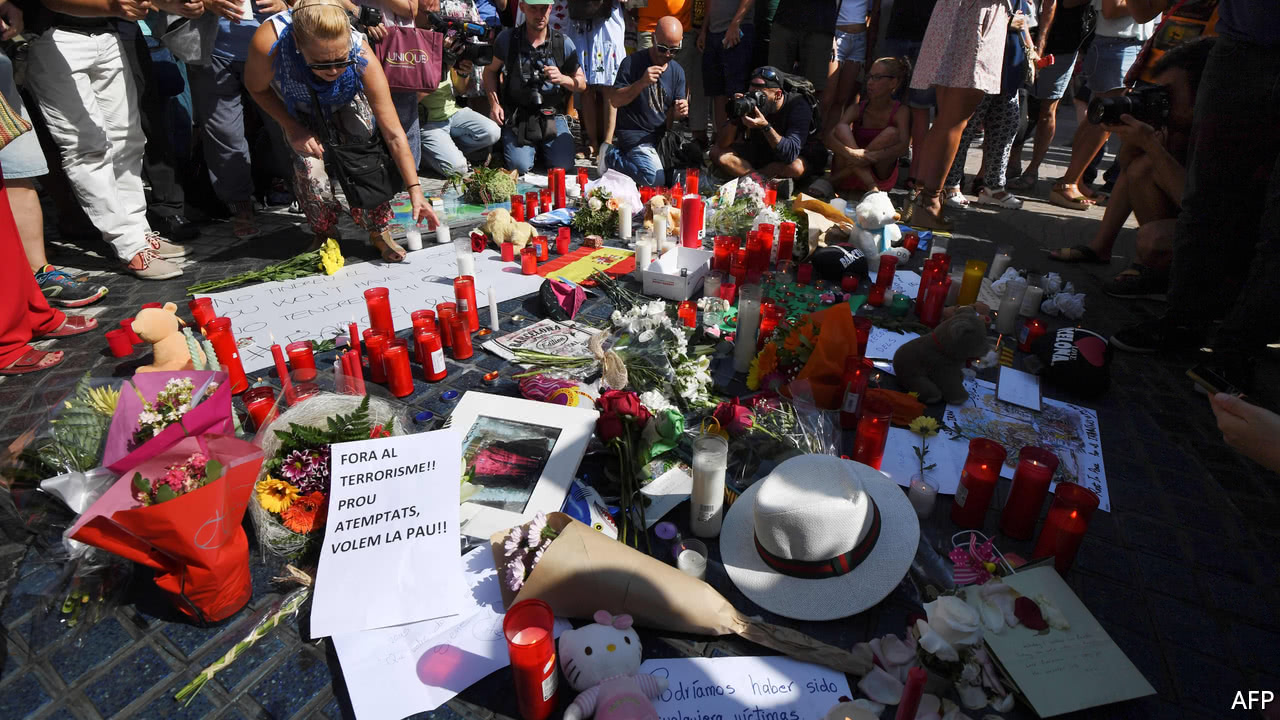
That illusion of security was cruelly shattered around 5pm on August 17th, when a white van veered onto Las Ramblas, a tree-lined avenue that represents the city’s easy-going spirit. The vehicle zigzagged down the avenue for about 500 metres, mowing down panicked pedestrians before crashing; the driver fled on foot. At least 13 people were killed, and more than 100 injured.

Latest updates

See all updates
What at first seemed like a lone-wolf attack quickly turned into something more organised and sinister. A few hours after the carnage in Las Ramblas, in the early hours of August 18th, Catalan police shot dead five suspected terrorists in Cambrils, a seaside resort. Their vehicle had jumped a police checkpoint and sped towards the main beachfront promenade, where it overturned, according to local media reports. They were wearing what appeared to be explosive vests but these proved to be fake, the police said. Four of the attackers were killed by police after the vehicle flipped, while the fifth was shot after being spotted by a police helicopter, according to El País, a Spanish newspaper. Video footage by bystanders shows him being repeatedly shot, standing up, and being shot again as he jumped over a partition in the road and rushed towards policemen. A woman who was stabbed by one of the assailants was killed in Cambrils; five civilians and one policeman were injured.
Adding to the alarm is the evidence from an explosion that destroyed a house on Wednesday night in another Catalan town, Alcanar. The blast, which left one person dead, was initially attributed by firemen to a gas leak. But the house now appears to have been a bomb factory, part of a plot to use gas as an explosive. One of the men injured in the house explosion in Alcanar is in police custody.
Investigations into the suspected cell are still at an early stage, but are focusing on men of Moroccan descent, including some with links to the Spanish enclaves in north Africa. The man in whose name the Barcelona attack van had been rented was arrested in another Catalan town, Ripoll, after he walked into a police station to report that his documents had been stolen. Media reports identify him as Driss Oukabir, a Moroccan. Unconfirmed reports claim his brother, Moussa, was the driver of the van in Barcelona. Police are trying to determine whether he was among those killed in Cambrils.
Catalonia, which hosts Spain’s largest Muslim population, has been a focus of radicalism. Since 2012 police have conducted some 30 separate anti-terrorism investigations in the region, arresting 62 suspects. In April police arrested nine people in and around Barcelona, reportedly in connection to the terrorist attacks in Brussels in March 2016. El Periódico, a newspaper, says the CIA had warned Spain about an impending attack in Barcelona, but it appeared to lack specific details.
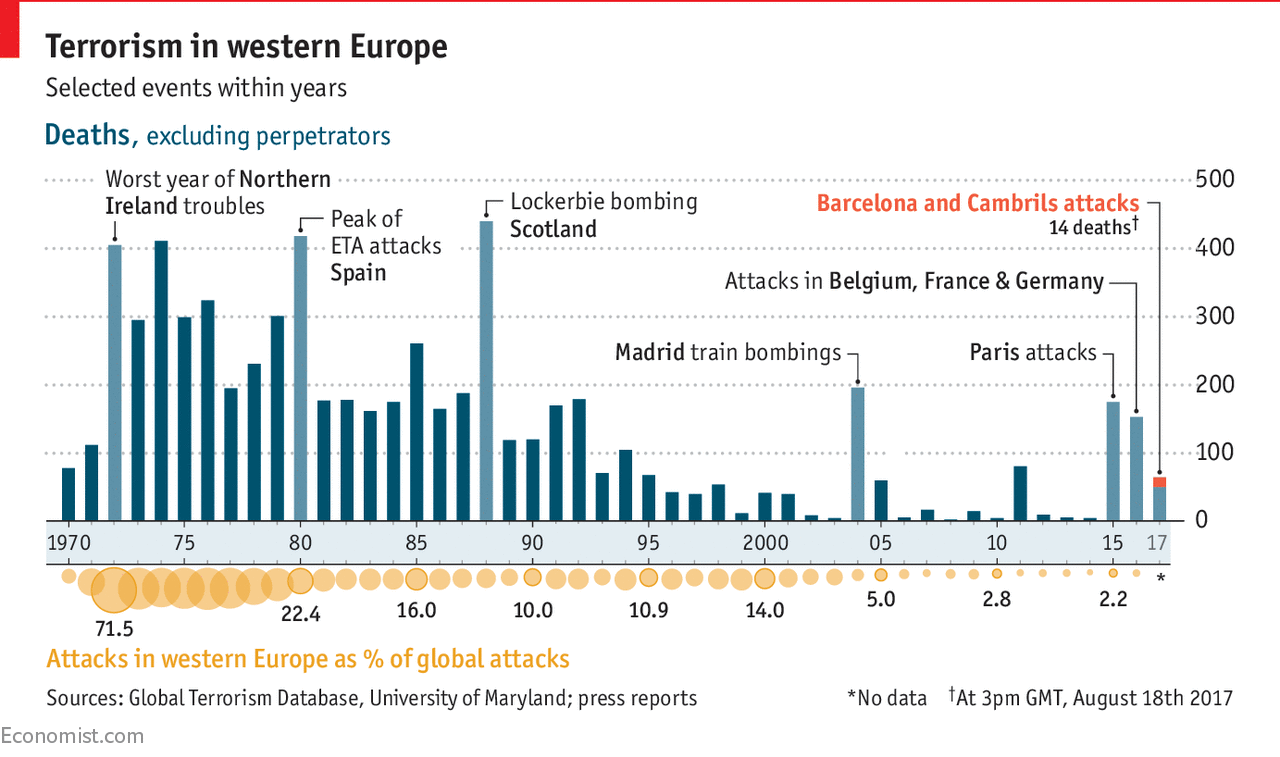
IS later claimed responsibility for the attack in Las Ramblas, saying it was a “response to calls for targeting coalition states”—a reference to the American-led coalition against the group. It was the worst act of jihadist terrorism in Spain since the bombing of commuter trains in Madrid killed 192 people in 2004 (see chart below). If the Madrid bombings were supposedly a reprisal for the country’s participation in the invasion of Iraq, the motivation for the latest attacks seem less obvious. These days Spain is a minor player in the campaign against IS and other groups, a fact that some thought might reduce the risk of attack. In 2015 Spain withdrew nearly all its troops from Afghanistan. It is not taking part in the air campaign against IS in Iraq and Syria. Spain has about 400 soldiers helping to train the Iraqi army and police. In Africa, Spain has also provided transport aircraft to help French-led missions in Gabon and Senegal, and has had a small contingent of 150 soldiers in Mali.
Yet pretexts for an attack are easy to find in the tangle of historical, religious and contemporary grudges that jihadists hold against the West. In the end, the targets and timing of jihadist attacks in Europe may have less to do with deliberate planning by IS leaders, increasingly embattled in their self-declared caliphate, and more with the availability of extremists, sometimes self-radicalised, willing to carry out attacks. An important question for counter-terrorism experts is whether the attacks in Spain involved fighters who have returned to Europe from Syria. Unlike those of al-Qaeda, IS’s claims of responsibility tend not to include “martyrdom” videos made by the attackers.
Whether or not IS was mounting a concerted plot against Spain, the attacks were an assault on all of Europe, and the world: the dead and injured include German, French, Italian, Belgian and Greek citizens. Australian, Pakistani, Philippine, Venezuelan and Chinese nationals were also among the casualties, officials said.
Tourism has been the engine of Spain’s economic recovery since the financial crisis, accounting for 11% of GDP last year. Spain welcomed a record 75m tourists in 2016 and is expecting another surge this year; the number of tourists rose almost 12% in the first half of 2017, compared with the same period last year. In part Spain benefited from terrorist attacks elsewhere, including Tunisia, Egypt and Turkey.
Barcelona is Spain’s main tourism hub, welcoming sine 9m overnight visitors a year. In recent online propaganda linked to IS, the city’s emblematic Sagrada Família basilica was featured as a possible target.
The Madrid attacks of 2004 had an immediate political impact, ruining the prospect of re-election for the centre-right Popular Party a few days later, not least because it had wrongly blamed the attack on the Basque-separatist ETA movement. One question is whether the attacks in Barcelona and Cambrils might dampen support for Catalan independence in a controversial referendum by the regional government, scheduled for October 1st. For now, though, the city’s citizens will be mourning their dead. As the strollers returned to Las Ramblas the day after the murders, they spontaneously broke out in chants of “we have no fear”.
Reuse this content