IT WAS 11.15pm at the Cummins Unit, the facility on the Arkansas plains where death sentences are supposed to be carried out, and the clock was ticking. Not in the usual way, however: rather than the condemned man, Don Davis, seeking an emergency stay, on April 17th the state was asking the Supreme Court in Washington, DC, to lift one. The death warrant would expire at midnight; if it did, Arkansas might be unable to dispatch Mr Davis for the foreseeable future. That is because its supply of a drug it intended to use in a run of eight back-to-back lethal injections—a glut of executions unprecedented in the modern era—will soon expire, too.
The journalists who had been ushered through the electric fences, then past the watch towers and the incongruous rose garden, drew lots to decide who would serve as witnesses. It was unclear whether there was still time for a legal kill. Finally, at a quarter to midnight, the justices declined to lift the stay. Increasingly and chaotically, a gruesome plan that, had it been realised, might have suggested a revival of America’s death penalty, has come instead to seem further evidence of its anachronism.
Arkansas has an unhappy history of multiple executions: in 1923 a man was taken from his coffin and put back in the electric chair after he was found still to be breathing. Nonetheless, in February Asa Hutchinson, the state’s governor, scheduled eight executions in an 11-day period, two each on four nights, beginning with Mr Davis and Bruce Ward, another convicted murderer. That would have been more than the rest of the country has performed so far this year, and almost half of last year’s national total of 20, which was the lowest since 1991 (see chart). No state has executed two people on the same day since 2000. Arkansas has not executed anyone at all since 2005. Mr Hutchinson’s haste avowedly stemmed from the trouble that his state, like others, has faced in carrying out legal injections, which had seemed a reassuringly hygienic method, just as the electric chair once did. Because of European export bans and the reluctance of domestic pharmaceutical firms to be involved, states have struggled to obtain the drugs they need. Arkansas is among those to have resorted to unusual shifts, such as importing a batch from a pharmacy run from the back of a driving school in London. Like other states, it has passed rules to cloak its procurement, which, as elsewhere, led to more litigation and delays. The supply it finally secured of midazolam, a sedative, is supposed to be administered by the end of April. When a legal opening arose, Mr Hutchinson issued his warrants.
Quite apart from the oddity of arranging deaths on the basis of a use-by date, midazolam is controversial. Critics say it does not always numb the pain caused by the other drugs, which prevent breathing and stop the heart; it came into fashion only after preferable anaesthetics were withdrawn. It has been implicated in a series of excruciatingly botched procedures, including one in Arizona in which Dale Baich, a public defender, saw his client take nearly two hours to die. It was “by far the most difficult to watch” of the 12 lethal injections Mr Baich has attended. Several states have renounced midazolam; a federal court in Ohio recently blocked its use (though the Supreme Court has permitted it). On April 15th a federal court stayed all the Arkansas executions on the grounds that midazolam might indeed lead to unconstitutional “cruel and unusual” punishment.
That order was reversed on appeal on the afternoon before Mr Davis and Mr Ward were meant to die—the judges ruling, in effect, that their colleague was too squeamish about the risk of pain. Still, this bout of litigation over lethal-injection cocktails was important because of the role of drug companies, two of which filed objections to the use of products apparently procured through middlemen. In separate actions in a county court, McKesson, a distributor, accused Arkansas of obtaining a drug through deception. The original judge in that case granted a restraining order, then lay down on a mock gurney at a protest outside the governor’s mansion; he now faces disciplinary action.
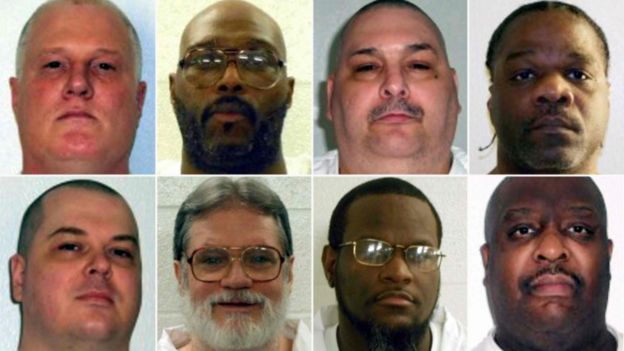
In the end Mr Davis—pictured, top left—was saved by different considerations. The Arkansas Supreme Court issued a stay until the federal one hears a forthcoming case concerning the right of defendants to enlist independent mental-health experts. Mr Ward was covered both by that and a separate ruling regarding his competence to be executed (he hallucinates about dogs at the end of his bed). A third man, Jason McGehee, slated to die on April 27th, won a stay after the parole board recommended clemency.
So many ways to live
“Our country does not participate in mass executions,” lawyers for the men maintained. They may be right. The Arkansas eight are dwindling. Those remaining have likewise been convicted of heinous crimes. On the other hand, say their lawyers, they too can muster mitigating factors: childhood abuse, mental disability, lousy representation at their trials. As The Economist went to press, Stacey Johnson, whose execution was to be on April 20th, had earned a stay to allow him to pursue DNA testing. After yet another ruling, McKesson’s complaint offered hope to Ledell Lee, who shared Mr Johnson’s death date and, like him, protests his innocence.
Arkansas’s officials harrumph about justice being thwarted. But even if, in some cases, they prevail, the rigmarole has shown that there are many sound reasons not to execute someone. Along with the myriad legal objections, it has highlighted the costs to those charged with overseeing the process. A group of former prison officials warned the governor that his eight-kill scheme would impose “unnecessary stress and trauma” on staff at the Cummins Unit and increase the risk of a botch. The state reportedly struggled to find enough citizen witnesses; the prisons chief is said to have solicited volunteers at a Rotary Club event. The waning enthusiasm for the death penalty of another group of laymen—juries—is a big factor in its decline.
Mr Davis spent April 17th in a cell opposite the death chamber. He had been there before, in fact, on another occasion when his demise was forestalled at the 11th hour. In the gathering execution-night mood—part hospital vigil, part crime scene—he was served a last meal, that ghoulish ritual. The state gave up its bid to do away with Mr Ward earlier in the evening, but relatives of both men’s victims were at the prison. They were put “through hell”, said Mr Hutchinson’s spokesman, after the Supreme Court ruled and the clock ticked down. No doubt.
A judge has blocked Arkansas from using one of three lethal injection drugs ahead of a series of executions in the US state.
The Supreme Court of Arkansas has also granted an emergency stay of execution for one of two inmates scheduled to die on Monday.
In an unprecedented move, the state had planned to put seven prisoners to death over an 11-day period.
Lawyers said the state was acting unconstitutionally and recklessly.
Pulaski County Circuit Judge Wendell Griffen issued a temporary restraining order on Friday barring the state from administering one of the drugs.
Separately, a stay of execution was granted in the case of Bruce Ward, who was convicted of strangling to death Rebecca Doss, a teenage shop clerk who worked in Little Rock.
The executions in Arkansas had been arranged to take place before a batch of one of the drugs used by the state expires later this month.
The move has drawn international attention and has been condemned by rights groups as an "assembly line" and a violation of the US legal process.
On Thursday, two pharmaceutical manufacturers asked a federal judge to bar the state from using their drugs.
Midazolam - one part of the three-drug lethal injection "cocktail" - is set to expire at the end of April, and has been criticised as contributing to several botched executions in other states.
Drug companies Fresenius Kabi USA and West-Ward Pharmaceuticals filed a motion as part of the federal lawsuit by the condemned inmates on Thursday, claiming that the drugs were secured in an improper manner, and could affect their ability to sell in Europe.
Image copyrightGETTY IMAGESImage captionJason McGehee (bottom left) and Bruce Ward (bottom, second left) have been temporarily spared lethal injection
The companies said that it appears the drugs were procured through a third party, since the companies say they only sell to medical providers.
They also argue that the executions could limit their ability to trade in the European Union, which has prohibited the buying or selling of products used for capital punishment.
Governor Hutchinson earlier said he was confident that the drugs would work, and that he was satisfied that the prison staff could handle the executions.
A group of former prison officials had written to the governor in late March to say that the quick pace would place undue physical and emotional burden on prison staff.
But he dismissed that, saying that he had met them and "they don't take it lightly".
"I have a responsibility to the voters, I have a responsibility to my oath of office, but I also have responsibility to a higher power, God and eternity, and I understand that," he said.
"I feel comfortable in my understanding of my responsibilities both in terms of faith and scripture and in terms of as governor," he added.