Many of the demonstrators were Flemish nationalists opposed to a UN global compact on migration, which has seen Belgian Prime Minister Charles Michel lose his government majority after nationalists quit his teamMany of the demonstrators were Flemish nationalists opposed to a UN global compact on migration, which has seen Belgian Prime Minister Charles Michel lose his government majority after nationalists quit his teamBelga/AFP
Police deployed teargas and water cannon after scuffles broke out Sunday as thousands of people answered a call by far-right groups to reject a UN migration pact.
Police said some 5,500 people rallied in Brussels' European quarter housing a number of EU institutions. Some held aloft banners bearing slogans including "Our people first" and "We have had enough, close the borders."
Police stepped in to disperse the crowd after projectiles and firecrackers were thrown, a France24 journalist on the scene reported.
Many marchers were supporters of the Vlaams Belang party, which opposes last week's signing of the UN accord in the Moroccan city of Marrakesh.
The agreement is designed to frame an effective international approach to migration -- a deeply divisive issue across Europe and beyond.
A counter-demonstration drew around 1,000 people to another Brussels district, according to police.
Belgian authorities initially banned both rallies fearing unrest but the country's supreme administrative court the Council of State overturned the decision.
More than 150 states last Monday approved the pact, a Global Compact for Safe, Orderly and Regular Migration.
But NGOs have voiced doubts about its implementation both on the ground and the high seas.
Pope Francis on Sunday voiced his support for the agreement and urged the international community to show "responsibility, solidarity and compassion" in dealing with migrants.
The pontiff stressed the pact was designed to secure "safe, ordered and regular migration."
But its provisions are not legally binding and detractors warn it could might encourage uncontrolled people flows.
In Belgium the issue has become a political hot potato.
Belgian Prime Minister Charles Michel was left leading a minority administration after the biggest party in his coalition -- the Flemish nationalist N-VA, which held four ministries -- quit over the accord.
Some marchers called for Michel to resign at Sunday's rally and a number of opposition parties have called for a vote of confidence in the government.
The 'yellow vests' protests in France have forced concessions from President Emmanuel MacronThe 'yellow vests' protests in France have forced concessions from President Emmanuel MacronAFP
The "yellow vest" revolt in France over the high cost of living has sparked copycat protests abroad -- as well a swarm of fake reports.
AFP's fact-checking service sorts the real from the imagined:
- Copycat protests -
The month-long French demonstrations, which have led to repeated rioting in Paris, have inspired protesters in a number of mostly European countries.
On December 8, some 400 people were detained in Brussels after protesters wearing high-visibility fluorescent vests briefly clashed with police.
Others reportedly blocked a highway linking Brussels to the town of Rekkem in Flanders, near the French border to protest high taxes.
On the same day in the Netherlands, "yellow vests" turned out in Amsterdam, Rotterdam and the Hague to protest the high cost of living, but they were few in number and the demonstrations were peaceful.
In Hungary, some of those protesting a new law, which increases the amount of overtime employers can require of workers, also dressed up in yellow vests on December 12 outside parliament.
And in Poland, farmers wearing the distinctive jackets on Wednesday blocked a motorway to demand government compensation for a swine flu outbreak.
In Germany, both Alice Weidel, one of the founders of the right-wing Alternative for Germany party, and the radical left-wing Die Linke party have expressed support for the French movement.
And some yellow vests were seen among a 1,000-strong crowd of right-wing demonstrators when the Pegida anti-migrant movement when it held a rally on December 1 in Berlin.
In Belgrade, a handful of opposition members of parliament also donned yellow on December 4 to protest petrol price increases.
In South Africa, where some protesters have been spotted wearing yellow vests during demonstrations against the low quality of public services, the Federation of Trade Unions (SAFTU) spoke out in favour of the French movement, saying it was a model for future protests.
The French movement kicked off on November 17 over higher fuel taxes, but quickly morphed into a nationwide grassroot protest against the high cost of living and the government.
President Emmanuel Macron has since offered tax and wage concessions in a bid to end the protest.
- Worried governments -
In Egypt, authorities fearing possible protests on the anniversary of the uprising that toppled Egypt's longtime president Hosni Mubarak in February 2011, have sought to restrict the sale of yellow vests.
"We received instructions from the police around a week ago to sell yellow vests to companies only, and not to individuals," one importer said.
And a human rights lawyer, Mohamed Ramadan, was remanded in custody earlier this month over charges including the distribution and possession of leaflets and yellow vests.
On Tuesday, Russian President Vladimir Putin, for his part, defended the jailing of an elderly rights activist over calls to protest, stressing he wanted to prevent events like France's "yellow vest" revolt.
- Fake yellow news -
But not every sighting of a high-visibility jacket should be seen as political.
Many social media accounts wrongly reported on Monday that German rail workers, who held a one-day strike for higher pay, wore yellow vests in solidarity with the French.
The vests are mandatory to ensure they are visible when on the railway tracks.
Other reports were pure fakes.
An internet platform, 24jours.com, published a photograph showing 300 motorcyclists in yellow vests purportedly demonstrating in the capital of the Central African Republic against "the French neo-colonial system" and against the local French-linked currency.
The picture was in fact taken in May when motorcyclists in Bangui attended a first aid training clinic.
A key European Union summit may end without a deal to resolve a row over ways to tackle irregular migration.
Italy - the entry point of thousands of migrants, mainly from Africa - says it will veto a joint statement over the entire agenda if no solution is found.
Leaders are discussing the sticking point over dinner.
Italy wants other countries to share the burden. German Chancellor Angela Merkel has said the issue could be a defining moment for the EU.
Mrs Merkel is under pressure to come up with a deal to prevent new arrivals.
Interior Minister Horst Seehofer, from her Bavarian coalition partner the CSU, has given her until this weekend. Otherwise he has said he will start turning away migrants from the border in his home state.
The migrant flows also include refugees fleeing the Syrian war and other conflicts, urgently seeking asylum.
It is not a crisis on the scale of 2015, when thousands were coming ashore daily on the Greek islands. The European Council - the EU's strategic leadership - says the numbers illegally entering the EU have dropped 96% since their peak in October 2015.
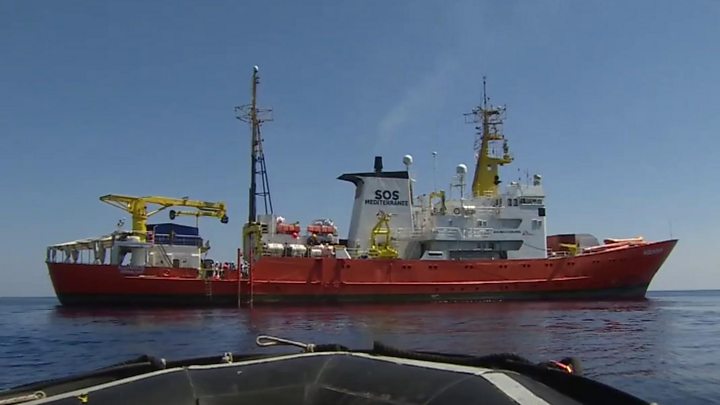
But this month's tensions over migrant rescue ships barred from entry to Italian ports - most recently the German charity ship Lifeline - have put the issue firmly back in the EU spotlight.
The Dublin principle - that asylum seekers should stay in the country where they enter the EU - has broken down. Italy and Greece, who receive the most, are demanding that their neighbours share the burden.
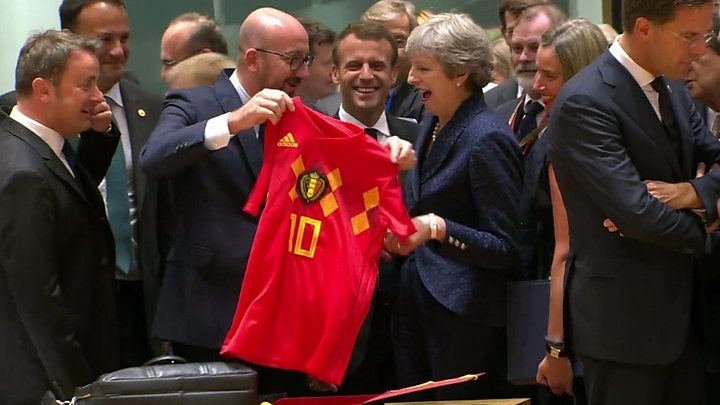
Media captionBelgian PM gives UK PM his team's shirt ahead of World Cup clash on Thursday evening
There was a lighter note, as the summit got under way in Brussels. Belgium's Prime Minister Charles Michel presented UK Prime Minister Theresa May with a Belgian football shirt ahead of the two countries' World Cup clash.
It bore the number of Belgian star Eden Hazard.
EU fissures go deeper
By Katya Adler, BBC Europe editor
Hardened Eurosceptics might love to think the EU's in trouble, but as leaders gather in Brussels for their summer summit on Thursday, dedicated Europhiles are also sounding the alarm.
"The fragility of the EU is increasing," warns EU Commission chief Jean-Claude Juncker. "The cracks are growing in size."
It's been easy to get distracted this last couple of weeks by the new Italian government and its headline-grabbing rejection of NGO migrant rescue boats.
But Mr Juncker is right: EU fissures go deeper and are more widespread.
Migration pits southern Europe against the north.
Italy and Greece smoulder with resentment at having been left alone to deal with migrant arrivals. Meanwhile, northern countries blame the south for not patrolling their Mediterranean borders better and for having, at least in the past, enabled migrants to "slip away" northwards towards richer Germany, Austria and Sweden.
Italy's new populist government has made getting an EU-wide deal on immigration and asylum a priority.
The issue played a major role in the Italian election, catapulting nationalist League leader Matteo Salvini into power. But it is a powerful election issue EU-wide.
Austria's right-wing government takes over the EU's rotating presidency next month and it has a hardline stance on irregular migrants. So do its Visegrad Group neighbours: the Czech Republic, Slovakia, Hungary and Poland. That group rejected an EU scheme to relocate 160,000 refugees from overcrowded camps in Greece and Italy.
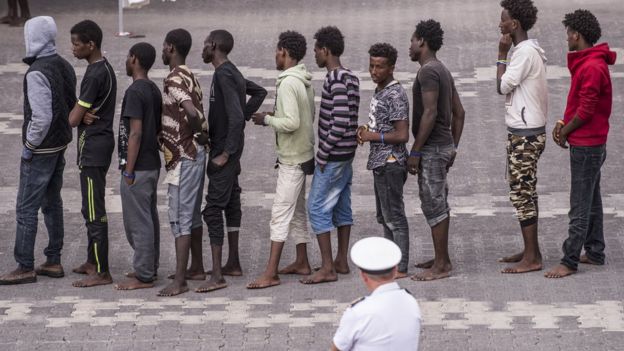
Image copyrightGETTY IMAGESImage captionItaly is the main destination for migrants rescued from overloaded boats off Libya
Much of the attention is on the German chancellor, because her interior minister has threatened to start blocking migrants at the border if they have already registered in another EU country. Without his party, the CSU, she would lose her parliamentary majority.
He warned that the EU's problems with migration policy were giving ammunition to populists, who "offer simple answers to the most complicated questions".
What solutions are on offer?
1. 'Regional disembarkation platforms'
This is an Austrian-Danish proposal, aimed at breaking the business model of the people-smuggling gangs. In the draft summit conclusions, it is seen as a way to speed up the processing of asylum claims and stopping illegal economic migrants.
Pros?
They could deter migrants from putting to sea in overloaded boats.
Gangs might then be less able to profit from migrants' desperation.
Cons?
Getting North African countries to host such centres could be very difficult. Morocco again on Thursday rejected the idea.
Close co-ordination with UN agencies will be needed, to prevent them becoming crowded, dangerous camps.
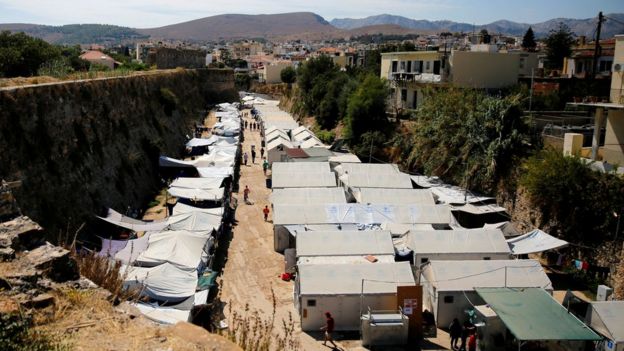
Image copyrightREUTERSImage captionGreece says emergency action is necessary to "decongest" some of its islands
The force could intervene more rapidly, nipping migrant emergencies in the bud, preventing any repetition of the 2015 chaos.
Cons?
Solidarity has been lacking among the 28 member states.
Frontex still lacks some important resources that were pledged.
EU police risk usurping the role of national border guards - a sensitive issue.
Media captionMigrant crisis: EU border force Frontex explained
3. More co-operation with transit and migrants' home countries
This would allow more failed asylum seekers to be sent back; the "return" rate currently is just 36.6%, the Commission says.
Pros?
There has been effective EU co-operation with Turkey: a 2016 deal led to a drastic drop in migrants taking the Balkan route.
The EU naval mission off Libya works closely with the Libyan coastguard to stop people-smuggling.
Cons?
Conditions are dire in Libyan migrant holding centres.
Turkey is still short of €3bn (£2.6bn; $3.5bn), pledged by the EU for Syrian refugees.
Tackling poverty in Africa, from which many migrants are fleeing, requires generous EU funding. There is an EU Trust Fund for Africa, but it is short of €1.2bn in pledged funds.