Biodun Iginla, BBC News

Biodun Iginla, BBC News
Showing posts with label eu Migrant crisis. Show all posts

Saturday, September 1, 2018

Analysis: Migrant crisis haunts EU three years after Merkel's fateful call


by Isabelle Roussel and Biodun Iginla, France24 News Analysts, Berlin


    © AFP/File | German Chancellor Angela Merkel won praise, then opprobrium with her decision to welcome in hundreds of thousands of asylum seekers, amid rising nationalist sentiment despite falling numbers and some headway made on integration

    BERLIN - 
    German Chancellor Angela Merkel won accolades for her stunning call on September 4, 2015 to keep open Germany's doors to hundreds of thousands of asylum seekers, many fleeing war-torn Syria or Iraq.
    Three years on, scenes of far-right protesters chasing down foreigners in a German city have shocked the world.
    All of Europe has seen a sea-change since the migration crisis erupted.
    Britain is now just months away from quitting the European Union, the far-right is sharing power in both Italy and Austria, while right-wing extremist group AfD has become the biggest opposition party in Germany's parliament.
    If there is a common denominator for these upheavals in European politics, it is the migration crisis seized upon by pro-Brexiters and far-right forces across Europe as the public enemy in their campaigns.
    Despite her "we can do it" rally cry, Merkel has since agreed to toughening restrictions to curb new arrivals, while the EU as a bloc is seeking to stop migrants landing on its soil.
    As a result, the influx has slowed considerably.
    In Germany, which recorded 745,545 asylum applications in 2016, just 93,316 were registered for the first half of this year.
    Some headway also appears to have been made on integration.
    One in four asylum seekers who arrived in Germany since 2015 have since found work, according to data released in May by the employment ministry's think-tank IAB.
    Nevertheless, "migration remains the biggest challenge" for the bloc, noted Stefan Lehne, visiting professor at Carnegie Europe.
    "While the numbers of arrivals are down, the hysteria is up, as populist movements and a growing number of mainstream politicians are building their business model on anti-migration sentiments."
    In the most recent illustration of the deep-seated resentment against newcomers, hundreds of mostly white men gathered swiftly in the eastern German city of Chemnitz, some attacking foreign-looking people, after news circulated that a German man was stabbed to death last Sunday, allegedly by an Iraqi and a Syrian.
    Across the Atlantic, US President Donald Trump in June also poured fuel on the burning topic: "Big mistake made all over Europe in allowing millions of people in who have so strongly and violently changed their culture!"
    - 'Fatal solvent of the EU?' -
    Some analysts warn that not only was Europe's migration crisis not over, it could yet be the undoing of the EU itself.
    Offering a pessimistic reading of the situation, British historian Niall Ferguson wrote: "Far from leading to a fusion, Europe's migration crisis is leading to fission."
    "Increasingly I believe that the issue of migration will be seen by future historians as the fatal solvent of the EU," the professor at Harvard predicted.
    "In their accounts Brexit will appear as merely an early symptom of the crisis."
    EU member states' reaction to the refugee influx has been dramatically different to that of the financial crisis, which was marked by countries sacrificing controls over the banking system to save the euro, Lehne noted.
    "The response to the recent refugee crisis was just the opposite," with countries turning instead to national measures.
    "This logic of re-nationalisation, combined with the rise of xenophobia and identity politics in many EU countries, now hampers the development of robust collective instruments to deal with migration challenges," he said.
    - 'Nationalist international' -
    The migration crisis has also unearthed a key fault-line between western European nations and the former communist bloc, with Hungarian Prime Minister Viktor Orban leading the east in flatly refusing to take in refugees.
    "Ten years ago, the biggest problem in Europe was that western Europeans were unhappy about EU expansion as they fear job losses," said Bulgarian political scientist Ivan Krastev in an interview with Die Welt daily.
    "Today, eastern Europeans feel they are the biggest losers."
    But he nevertheless voiced support for Merkel's fateful decision because leaving frontline nations Italy and Greece alone to deal with the crisis in 2015 "would have been the end of the EU".
    Italy's far-right interior minister Matteo Salvini has repeatedly accused Europe of abandoning his country.
    Ahead of next year's European parliament elections, the hardline minister has also aligned himself with the right-wing "Visegrad" countries of the Czech Republic, Poland, Austria and Hungary to form an anti-migration camp.
    "The appearance of a 'nationalist international' will hopefully trigger a counter-mobilisation of pro-European political forces," said Lehne, noting that this could in turn spark a necessary healthy debate on the future of the EU.
    "Such a debate involves risks, as major parts of the public remain alienated from the EU, but it also could turn into a catalyst for positive change. Some storms are necessary to clear the air and provide a better view on what the future holds."

    Thursday, June 28, 2018

    ANALYSIS AND BREAKING: Migrant crisis: EU summit divided amid migration row


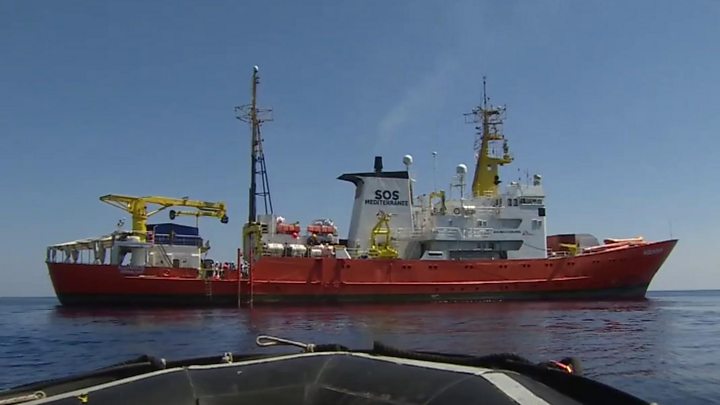
    Media captionWhy is the Aquarius migrant rescue ship empty?
    by Isabelle Roussel and Biodun Iginla, BBC News Analysts,  Brussels
    A key European Union summit may end without a deal to resolve a row over ways to tackle irregular migration.
    Italy - the entry point of thousands of migrants, mainly from Africa - says it will veto a joint statement over the entire agenda if no solution is found.
    Leaders are discussing the sticking point over dinner.
    Italy wants other countries to share the burden. German Chancellor Angela Merkel has said the issue could be a defining moment for the EU.
    Mrs Merkel is under pressure to come up with a deal to prevent new arrivals.
    Interior Minister Horst Seehofer, from her Bavarian coalition partner the CSU, has given her until this weekend. Otherwise he has said he will start turning away migrants from the border in his home state.
    The migrant flows also include refugees fleeing the Syrian war and other conflicts, urgently seeking asylum.
    It is not a crisis on the scale of 2015, when thousands were coming ashore daily on the Greek islands. The European Council - the EU's strategic leadership - says the numbers illegally entering the EU have dropped 96% since their peak in October 2015.
    But this month's tensions over migrant rescue ships barred from entry to Italian ports - most recently the German charity ship Lifeline - have put the issue firmly back in the EU spotlight.
    The Lifeline was only allowed to dock in Malta after intense diplomacy among several EU states, who each agreed to take a share of the migrants on board. Malta said that Norway had now also agreed to take some migrants from the Lifeline.
    The Dublin principle - that asylum seekers should stay in the country where they enter the EU - has broken down. Italy and Greece, who receive the most, are demanding that their neighbours share the burden.
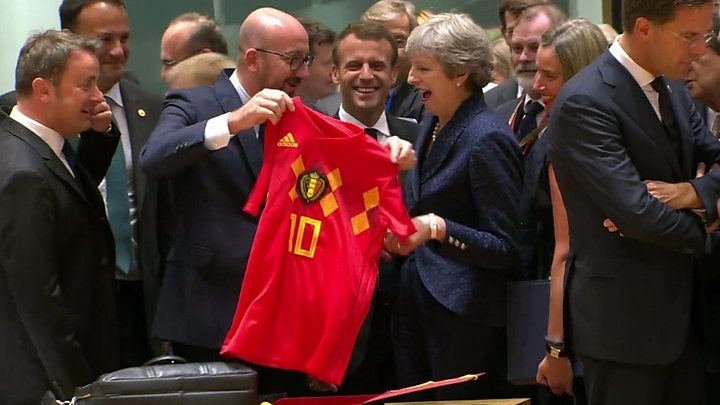
    Media captionBelgian PM gives UK PM his team's shirt ahead of World Cup clash on Thursday evening
    There was a lighter note, as the summit got under way in Brussels. Belgium's Prime Minister Charles Michel presented UK Prime Minister Theresa May with a Belgian football shirt ahead of the two countries' World Cup clash.
    It bore the number of Belgian star Eden Hazard.
    Presentational grey line

    EU fissures go deeper

    By Katya Adler, BBC Europe editor
    Hardened Eurosceptics might love to think the EU's in trouble, but as leaders gather in Brussels for their summer summit on Thursday, dedicated Europhiles are also sounding the alarm.
    "The fragility of the EU is increasing," warns EU Commission chief Jean-Claude Juncker. "The cracks are growing in size."
    It's been easy to get distracted this last couple of weeks by the new Italian government and its headline-grabbing rejection of NGO migrant rescue boats.
    But Mr Juncker is right: EU fissures go deeper and are more widespread.
    Migration pits southern Europe against the north.
    Italy and Greece smoulder with resentment at having been left alone to deal with migrant arrivals. Meanwhile, northern countries blame the south for not patrolling their Mediterranean borders better and for having, at least in the past, enabled migrants to "slip away" northwards towards richer Germany, Austria and Sweden.
    Presentational grey line

    What are the new pressures on EU leaders?

    Italy's new populist government has made getting an EU-wide deal on immigration and asylum a priority.
    The issue played a major role in the Italian election, catapulting nationalist League leader Matteo Salvini into power. But it is a powerful election issue EU-wide.
    Austria's right-wing government takes over the EU's rotating presidency next month and it has a hardline stance on irregular migrants. So do its Visegrad Group neighbours: the Czech Republic, Slovakia, Hungary and Poland. That group rejected an EU scheme to relocate 160,000 refugees from overcrowded camps in Greece and Italy.
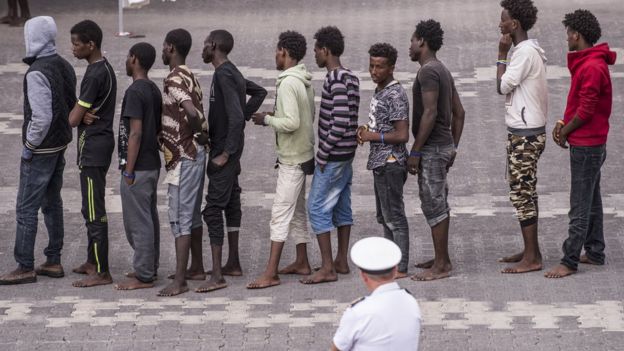
    Migrants brought ashore in Catania, Italy, 13 Jun 18Image copyrightGETTY IMAGES
    Image captionItaly is the main destination for migrants rescued from overloaded boats off Libya
    Much of the attention is on the German chancellor, because her interior minister has threatened to start blocking migrants at the border if they have already registered in another EU country. Without his party, the CSU, she would lose her parliamentary majority.
    European Council President Donald Tusk told the leaders in his pre-summit letter "the stakes are very high and time is short".
    He warned that the EU's problems with migration policy were giving ammunition to populists, who "offer simple answers to the most complicated questions".

    What solutions are on offer?

    1. 'Regional disembarkation platforms'
    This is an Austrian-Danish proposal, aimed at breaking the business model of the people-smuggling gangs. In the draft summit conclusions, it is seen as a way to speed up the processing of asylum claims and stopping illegal economic migrants.
    Pros?
    • They could deter migrants from putting to sea in overloaded boats.
    • Gangs might then be less able to profit from migrants' desperation.
    Cons?
    • Getting North African countries to host such centres could be very difficult. Morocco again on Thursday rejected the idea.
    • Close co-ordination with UN agencies will be needed, to prevent them becoming crowded, dangerous camps.
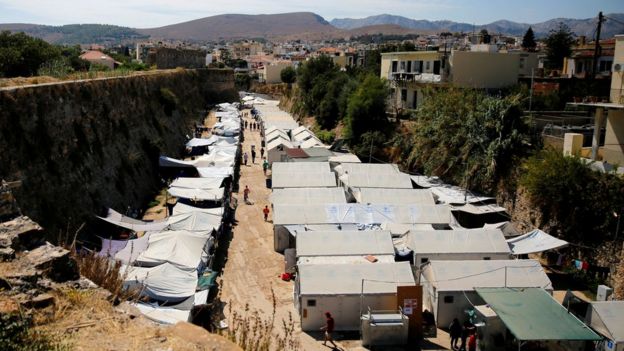
    Souda tented camp, Chios - file picImage copyrightREUTERS
    Image captionGreece says emergency action is necessary to "decongest" some of its islands
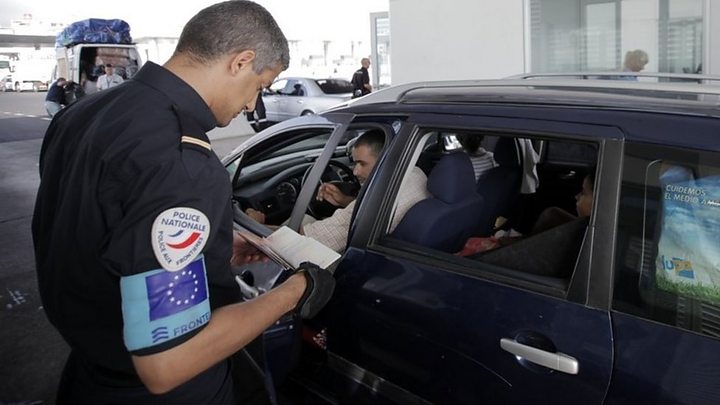
    2. Beefing up EU border agency Frontex
    The European Commission says this would make it a genuine border police force. The force is to be boosted from the current 1,300 (with 1,500 in reserve) to 10,000 by 2027.
    Pros?
    • The force could intervene more rapidly, nipping migrant emergencies in the bud, preventing any repetition of the 2015 chaos.
    Cons?
    • Solidarity has been lacking among the 28 member states.
    • Frontex still lacks some important resources that were pledged.
    • EU police risk usurping the role of national border guards - a sensitive issue.
    Media captionMigrant crisis: EU border force Frontex explained
    3. More co-operation with transit and migrants' home countries
    This would allow more failed asylum seekers to be sent back; the "return" rate currently is just 36.6%, the Commission says.
    Pros?
    • There has been effective EU co-operation with Turkey: a 2016 deal led to a drastic drop in migrants taking the Balkan route.
    • The EU naval mission off Libya works closely with the Libyan coastguard to stop people-smuggling.
    Cons?
    • Conditions are dire in Libyan migrant holding centres.
    • Turkey is still short of €3bn (£2.6bn; $3.5bn), pledged by the EU for Syrian refugees.
    • Tackling poverty in Africa, from which many migrants are fleeing, requires generous EU funding. There is an EU Trust Fund for Africa, but it is short of €1.2bn in pledged funds.

    More on this story