Biodun Iginla, BBC News

Biodun Iginla, BBC News
Showing posts with label Catalan referendum. Show all posts

Friday, October 6, 2017

Splits emerge among Catalan separatists


by Elodie Bagnol and Biodun Iginla, France24, Barcelona

    © AFP / by Daniel BOSQUE | Catalan President Carles Puigdemont has threatened to declare independence but has put off appearing at Catalonia's parliament until Tuesday.

    BARCELONA -  Splits have emerged among Catalan separatist leaders over their plans to unilaterally declare independence following a secession referendum deemed illegal by Madrid.
    Catalonia's leader Carles Puigdemont has threatened to declare independence "within days", but the region's business minister Santi Vila proposed a "ceasefire" in the row with Spain's central government.
    In an opinion article published in Catalan daily Ara he urged the pro-secession camp to "reflect on the usefulness and consequences" of a declaration of independence.

    Puigdemont put off until Tuesday an appearance in the regional Catalan parliament at which time some leaders have called for the declaration to be made.
    The session of parliament to analyse the results of last Sunday's referendum was initially scheduled for Monday but Spain's Constitutional Court ordered that it be suspended.
    The Catalan government has also not yet officially ratified the results of the vote, a move which would open a two-day period in which the parliament can declare independence.
    Participants in the referendum opted overwhelmingly for secession, but turnout was only 43 percent as Catalans who favour remaining part of Spain mainly boycotted the ballot.
    While Vila urged caution, Puigdemont is under strong pressure from the far-left CUP party -- whose support his government needs to pass legislation -- to move quickly.
    "The inescapable, inevitable moment of exercising self-determination has arrived," said CUP lawmaker Carles Riera.
    - 'Real alarm' -
    Puigdemont's predecessor Artur Mas also weighed in, telling Britain's Financial Times that Catalan leaders should focus not on "how to proclaim independence, but instead on how to make it effective."
    Analysts said the Catalan government risks losing international sympathy and giving Madrid an excuse for a hardline response if it makes a declaration of independence based on an unconstitutional vote.
    But if it waits too long to act on the results of the plebiscite it could see the momentum behind the independence movement fizzle.
    The debate is not just limited to politicians -- supporters of the separatist cause are also divided over what strategy to follow.
    "I have an inner conflict. I do not want a unilateral declaration of independence to happen that will last five minutes," said Olga Jubany, an anthropology professor in Barcelona.
    "The strategy (of independence) was never 'we are going to impose it'. It is not the strategy I would like to follow."
    Joan Botella, dean of political science at the Autonomous University of Barcelona, said "there is a sense of real alarm, not just uneasiness" in Catalan society.
    Spanish Prime Minister Mariano Rajoy, who is under pressure to show a harder line towards the separatists, has urged Puigdemont not to go ahead with the independence declaration to avoid "bigger problems".
    His comment was seen as a reference to a never before used article of the Spanish constitution which allows the central government to suspend the authority of a regional government.
    "There are few hours left to avoid a head-on collision... these are critical hours," said Botella.
    - Urging no immediate decisions -
    Since the referendum Puigdemont has called for international mediation.
    Switzerland has been in contact with both sides in the dispute "but the conditions for facilitation do no exist at the moment," the country's foreign ministry said.
    Without foreign mediation, the other option is for mediation within Spain.
    Puigdemont has met with a commission set up by Barcelona's law society made up of academics and representatives of unions and the business world.
    It has recommended that both sides not take any "immediate decisions," the withdrawal of the thousands of extra police sent to Catalonia ahead of the referendum, and for a "dialogue commission" to be set up.
    "These are crucial hours, we cannot expect a mediator to suddenly emerge or that both governments accept a proposal for dialogue," said Xavier Arbos, a professor of constitutional law at the University of Barcelona.
    "Although the situation remains worrying, now I see that there is a margin of time," he added.


    Thursday, October 5, 2017

    Separatism in Catalonia--analysis

    by Elodie Bagnol and Biodun Iginla, News Analysts, The Economist Intelligence Unit, Barcelona
    It is not too late to stop the break-up of Spain

    To avoid calamity, ask Catalans what they really want
    WHEN a democracy sends riot police to beat old ladies over the head with batons and stop them voting, something has gone badly wrong. Catalans say that almost 900 people were hurt by police in the referendum for independence on October 1st. Whatever the provocation from Catalan leaders in staging an unconstitutional poll, the reaction of Mariano Rajoy, the prime minister, has thrown Spain into its worst constitutional crisis since an attempted coup in 1981.
    If Mr Rajoy thought that cracking heads would put a stop to secessionism, he could not have been more wrong. He has only created a stand-off that has energised his enemies and shocked his friends (see article). On October 3rd Catalonia, one of Spain’s richest regions, was paralysed by a protest strike. Hundreds of thousands of demonstrators have marched to express their outrage.

    Latest updates

    See all updates
    Secession would be a disaster for Spain. The country would lose its second city and risk the further loss of the Basque region. Secession would also hurt Catalans, which is why a majority of them probably oppose it. And Catalan independence might stir up separatism elsewhere in Europe—in Scotland again, no doubt, but also in northern Italy, in Corsica, perhaps even in Bavaria. To prevent the crisis deepening, both sides need to seek a new constitutional settlement. Instead, they are digging in and Catalonia is on the brink of unilaterally—and illegally—declaring independence.
    After Franco
    Spain has a historical fear of dismemberment. Catalan secessionism was one of the factors that brought about the Spanish civil war of the 1930s. Many Spaniards no doubt share the anger of King Felipe who, in a rare televised speech, denounced Catalonia’s leaders for irresponsibly and disloyally tearing up the constitution of 1978. After all, Catalans overwhelmingly endorsed that settlement, which entrenched democracy, brought prosperity and granted a large dose of autonomy to Spanish regions, including Catalonia.
    A well-run democracy must abide by the rule of law. That is what protects democratic liberties, not least the freedom of minorities to express discontent. Until referendum day, nobody who experienced the vibrancy of Barcelona could seriously claim that Catalonia was oppressed. With few exceptions, notably when empires collapse, the world generally favours national unity over self-determination by subnational groups. Many of the states liberated by the break-up of the Soviet empire joined the European Union, but these days the EU is wary, warning would-be secessionists that new states have no automatic right to join. Without Spain’s support, Catalonia would find itself on the wrong side of a new customs wall.
    For all these reasons the Catalan leader, Carles Puigdemont, does not have a strong case for independence. Nor can he claim a real mandate. He rammed the laws authorising the referendum through the Catalan parliament with a narrow majority and without proper debate. Those laws have no formal legal standing. Before his referendum, opinion polls suggested that only 40-45% of Catalans wanted to break away. The 90% vote to leave was 90% of an unregistered turnout of well under half, because Catalonia’s Remainers mostly declined to take part. As with populists elsewhere, Mr Puigdemont has offered a simplistic vision, without explaining the costs of independence or how it might come about.
    But that is not the end of the story. Democracy rests on the consent of the governed. Even some who disagree with Mr Puigdemont’s methods believe Catalonia has a case for nationhood. It could survive economically. A lot of its people think it constitutes a nation. Under autonomy, Catalan leaders have promoted their language and their nationalist creed.
    The pain in Spain
    Whatever the legality of separatism, once the desire for independence reaches a critical point, governments must deal with it in three ways: crush it, bow to it, or negotiate in good faith, knowing that separation may still be the outcome.
    Mr Rajoy has failed to grasp the nature of this choice. First he blocked the nationalists in the courts and, last weekend, he resorted to force. His deployment of policemen to suppress the Catalan vote was not only a propaganda gift to them but, more important, crossed a line. Aggression against crowds of peaceful citizens may work in Tibet but cannot be sustained in a Western democracy. In the contest between formal justice and natural justice, natural justice wins eventually every time. Constitutions exist to serve citizens, not the other way around. Rather than uphold the rule of law as he intended, Mr Rajoy ended up tarnishing the legitimacy of the Spanish state.
    Will Mr Puigdemont declare independence? That would be reckless and irresponsible but, if he does, Mr Rajoy should resist the temptation to arrest Catalan leaders and, for the time being, avoid using his power to suspend regional rule. Just now, either measure would only compound his mistakes.
    Only a negotiation can restore calm and it should start immediately. Even now most Catalans can probably still be won over with the offer of greater autonomy, including the power to raise and keep more of their own taxes, more protection for the Catalan language and some kind of recognition of the Catalans as a “nation”. Mr Rajoy might even take up the opposition Socialists’ idea of turning Spain into a federal state.
    Any settlement, though, must include the option of a referendum on independence. Separation would be a wrenching change for Catalonia and the rest of Spain, so should not be done lightly. A majority of Catalans eligible to vote should be the minimum threshold for independence. A follow-up vote on the terms of a separation might be wise, too.
    For all his deficiencies, David Cameron, the former British prime minister, was right about allowing a referendum on Scottish independence in 2014. He made the case for Scotland to stay, and won the vote convincingly. Mr Rajoy should do the same. The case for the unity of Spain is strong. But it must be won by force of argument. By using force alone, Mr Rajoy is not preventing the break-up of Spain, but hastening it.
    This article appeared in the Leaders section of the print edition under the headline "How to save Spain"
    Reuse this content

    Sunday, October 1, 2017

    BREAKING: Catalan referendum: Voting begins amid police crackdown


    • October 1, 2017  09H:11  GMT/UTC/ZULU TIME 
    • From the sectionEurope
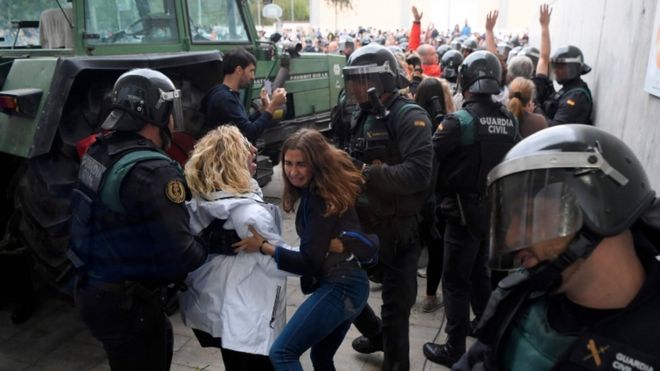
    Women clash with Spanish Guardia Civil guards outside a polling station in Sarria de Ter, where Catalan president is supposed to vote, on 1 October 2017.Image copyrightAFP
    Image captionWomen clash with Spanish Guardia Civil guards outside a polling station in Sarria de Ter, where the Catalan president is supposed to vote
    by Elodie Bagnol and Biodun Iginla, BBC News, Barcelona
    Catalonia's independence referendum has begun in chaotic fashion, with police attempting to prevent the vote from taking place.
    The Spanish government has pledged to stop a vote that was declared illegal by the country's constitutional court.
    The interior ministry says police officers began seizing ballot papers and boxes as the polls opened.
    Riot police blocked potential voters from entering a polling station in the regional capital Barcelona.

    How is the day unfolding?

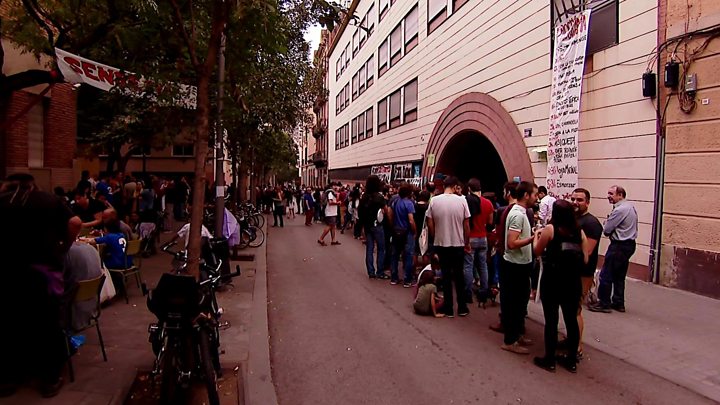
    Thousands of separatist supporters occupied schools and other buildings that have been designated as voting centres ahead of the polls opening.
    Many of those inside are parents and their children, who remained in the buildings after the end of lessons on Friday and bedded down in sleeping bags on gym mats.
    In some areas, farmers positioned tractors on roads and in front of polling station doors, and school gates were taken away to make it harder for the authorities to seal buildings off.
    Police insisted polling stations would not be allowed to open, and that those inside would be evicted.
    In the early hours of Sunday morning, dozens of national police vehicles left their base in the port of Barcelona as officers were deployed.
    Referendum organisers have called for peaceful resistance to any police action.
    Catalan government officials have predicted a big turnout.
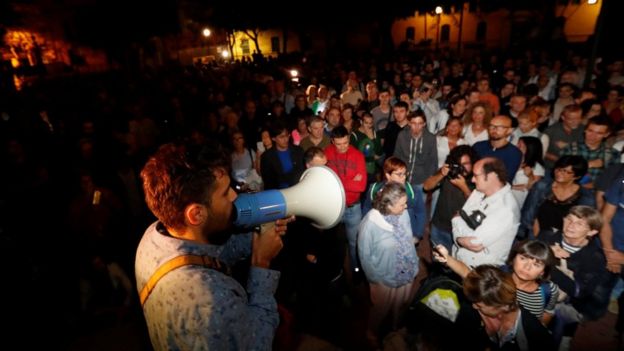
    A man uses a megaphone as people gather outside a school that is a polling station for the banned independence referendum in Barcelona, Spain, October 1, 2017Image copyrightREUTERS
    Image captionVoters gathered outside polling stations before dawn, defying Spanish authorities
    The ballot papers contain just one question: "Do you want Catalonia to become an independent state in the form of a republic?" There are two boxes: Yes or No.
    Ahead of the polls opening, the Catalan government said voters could use any polling station if their designated voting place was shut.
    Sunday would be an "important date for democracy", regional Vice-President Oriol Junqueras told TV3, the main Catalan public channel.

    Will the vote be credible?

    The referendum has been declared illegal by Spain's constitutional court, and thousands of extra police officers have been sent to the region.
    Media captionTom Burridge reports from one of the designated polling stations for the banned independence referendum
    The Madrid government has put policing in Catalonia under central control and ordered the regional force, the Mossos d'Esquadra, to help enforce the ban.
    In a show of force ahead of the poll, Spanish authorities have seized voting materials, imposed fines on top Catalan officials and temporarily detained dozens of politicians.
    Police have also occupied the regional government's telecommunications centre.
    The head of the Catalan police has urged officers to avoid using force.

    Why is a vote being held?

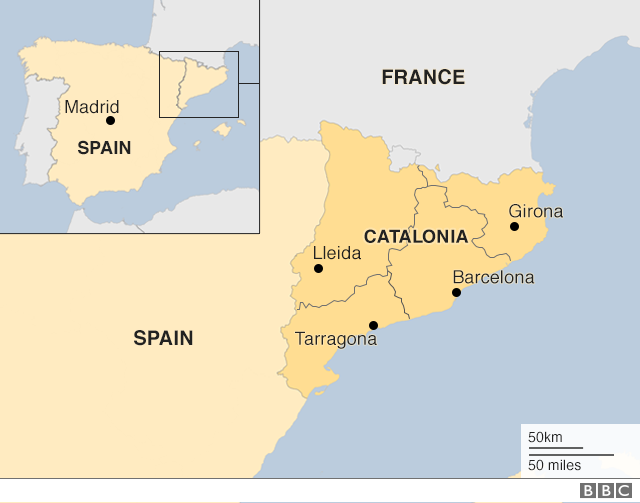
    Catalonia, a wealthy region of 7.5 million people in north-eastern Spain, has its own language and culture.
    It also has a high degree of autonomy, but is not recognised as a separate nation under the Spanish constitution.
    Media captionWhy some Catalans want independence - and others don't
    Pressure for a vote on self-determination has grown over the past five years.
    But Spanish unionists argue Catalonia already enjoys broad autonomy within Spain, along with other regions like the Basque Country and Galicia.

    Why is Madrid so opposed?

    Spanish Prime Minister Mariano Rajoy says the vote goes against the constitution, which refers to "the indissoluble unity of the Spanish nation, the common and indivisible homeland of all Spaniards".
    Central government spokesman Iñigo Mendez de Vigo accused the Catalan government of being inflexible and one-sided, but it is a charge that Catalan nationalists throw back at Madrid itself.

    Catalonia in numbers

    • 16% of Spain's population live in Catalonia
    • 25.6% of Spain's exports come from Catalonia
    • 19% of Spain's GDP is produced in Catalonia
    • 20.7% of foreign investment in Spain goes to Catalonia
    • 35.3% of Catalonia's GDP is debt
    Getty
    Demonstrations by independence campaigners have been largely peaceful.
    "I don't believe there will be anyone who will use violence or who will want to provoke violence that will tarnish the irreproachable image of the Catalan independence movement as pacifist," Catalan leader Carles Puigdemont said.
    On the eve of the vote, thousands of demonstrators calling for Spanish unity held rallies in cities across Spain, including in the Catalan capital Barcelona.
    They waved Spanish flags and carried banners reading "Catalonia is Spain".
    BBC map

    Related Topics

    More on this story