Biodun Iginla, BBC News

Biodun Iginla, BBC News
Showing posts with label Dmitry Medvedev. Show all posts

Saturday, May 5, 2018

Analysis: Putin: Russia's post-Soviet tsar


by Maria Ogryzlo and Biodun Iginla, France24 News Analysts, Moscow


    © AFP | Vladimir Putin, seen here on a billboard in south Lebanon, has stamped his total authority in Russia, silencing opposition and reasserting Moscow's lost might abroad 

    MOSCOW - 
    A KGB officer turned world leader, Vladimir Putin has stamped his total authority on Russia, silencing opposition and reasserting Moscow's lost might abroad while building a strongman image through macho stunts.
    Putin, 65, who will be inaugurated as president for the fourth time on Monday, has reimposed the Kremlin's grip on society since taking power 18 years ago after a lawless but relatively free decade following the demise of the USSR.
    On the international stage, he has dealt with three US presidents, thrust Moscow into a new rivalry with the West by snatching Crimea from Ukraine and launched a pivotal intervention in Syria.
    Named the world's most powerful person by Forbes for the past four years running, the judo black belt has carefully nurtured his image as a powerful leader with photo opportunities showing him riding topless on horseback in the Siberian wilderness and darting an endangered tiger.
    Supporters laud him as a saviour who restored pride and traditional values to a humiliated nation.
    To foes, however, Putin has dragged his homeland further from democracy, presided over a seizure of the state by a new elite of former secret police cronies and stoked nationalism in a bid to restore Moscow's lost empire.
    - 'Hit first' -
    Putin was born into a working-class family in Leningrad -- now Saint Petersburg -- on October 7, 1952 and cut his teeth in the city's rough-and-tumble neighbourhoods.
    "The Leningrad streets taught me one thing: if a fight is unavoidable, you have to hit first," Putin said in 2015.
    He fulfilled a childhood dream by joining the KGB intelligence service, with a posting in 1985-1990 in Dresden -- then East Germany -- just as Soviet power was crumbling.
    His political rise began after he returned to work at Saint Petersburg city hall under his mentor, liberal mayor Anatoly Sobchak.
    By 1996, he was called to Moscow to work in the Kremlin under Russia's first democratically elected president Boris Yeltsin, who in 1998 made little-known Putin head of the KGB's successor, the FSB.
    Battling health and drinking problems, frail Yeltsin in August 1999 named Putin prime minister and his popularity shot up as he oversaw the launch of a second war to crush rebels in the Chechnya region.
    When Yeltsin sensationally resigned on New Year's Eve 1999, Putin took over as president of the biggest country on Earth.
    - A tsar is born -
    Buoyed by an influx of petrodollars that saw living standards soar, the Kremlin under Putin forged its own "sovereign democracy" in which the trappings of pluralism -- such as political opposition and civil society -- were subverted.
    He has guarded his private life jealously and once famously told journalists to keep their "snotty noses" out of his business.
    After three decades of marriage, he divorced his wife Lyudmila in 2013 but rumours of new romance -- including with a former Olympic gymnast -- have not been confirmed.
    In line with the constitution, when Putin ended his second term in 2008, he handed power to protege Dmitry Medvedev and moved to become prime minister -- but few doubted who was really in charge.
    In 2012, he returned as president in the face of huge street protests.
    While the demonstrations petered out after a police crackdown, the spectre of unrest spurred tough new measures to eradicate dissent.
    - Crimea, Ukraine, Syria -
    Putin, who once decried the collapse of the USSR as the "greatest geopolitical catastrophe" of the 20th century, has ferociously defended Moscow's sphere of influence and also challenged perceived US hegemony.
    When crowds in Ukraine ousted Russia-backed leader Viktor Yanukovych in February 2014, the Kremlin faced losing its dominance over a key neighbour.
    Within days, Putin ordered special forces to seize the strategic Crimea peninsula and -- after a hasty referendum rejected internationally -- in March 2014 signed off on the region's annexation.
    The redrawing of Russia's border sparked the worst standoff with the West since the Cold War and unleashed a wave of nationalism at home that saw Putin's popularity soar.
    Soon the Kremlin was accused of masterminding a rebellion in east Ukraine that turned into a festering conflict that has cost more than 10,000 lives.
    Despite sanctions pushing the economy into recession, Putin also launched a bombing campaign in Syria to support leader Bashar al-Assad in 2015. It is widely seen as the key factor that tipped the war in Assad's favour.
    Putin was then accused of spreading his tentacles much further and Moscow's old foe -- the United States -- found itself in the crosshairs.
    After Donald Trump's shock election win, US intelligence accused Putin of ordering a hacking and influence campaign to get Trump to the White House.
    "Those that lose always look to blame someone else," Putin retorted.

    Monday, April 3, 2017

    St Petersburg metro bomb blast suspect 'from Central Asia'


    • April 4, 2017  05H:24  GMT/UTC/ZULU TIME
    •  
    • From the sectionEurope
    Media captionFootage shows passengers leaping from the wreckage in the minutes after the blast
    by Maria Ogryzlo and Biodun Iginla, BBC News, Moscow
    The man suspected of killing 11 people in a St Petersburg train is in his early 20s and from Central Asia, Russian media report.
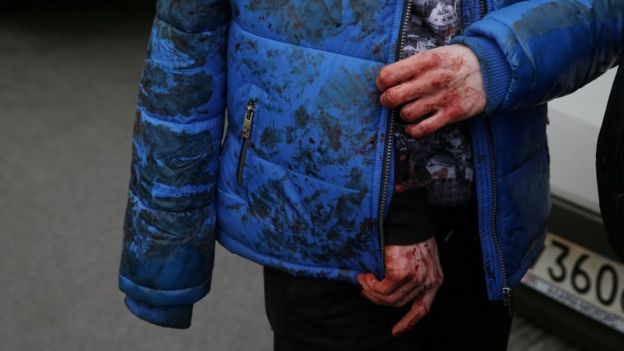
    At least 45 people were injured in the explosion between two underground stations on Monday afternoon.
    The Interfax and Tass news agencies said the suspect had been identified, but there are conflicting reports as to whether he was a suicide bomber.
    Authorities in Saint Petersburg have declared three days of mourning.
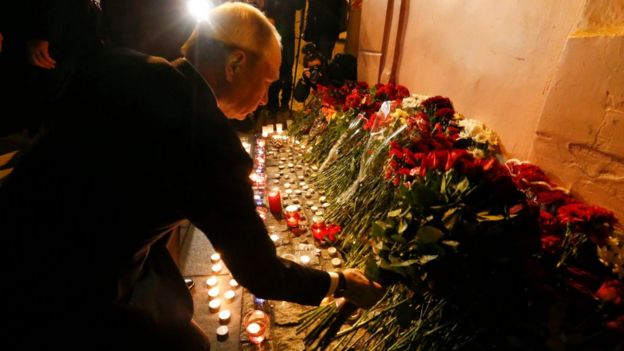
    President Vladimir Putin, who was in the city when the blast occurred, visited the scene on Monday evening and laid flowers at a makeshift shrine.
    Russian investigators have described it as a suspected "act of terror" but they have given few details. No group has said it was responsible.
    Prime Minister Dmitry Medvedev said in a Facebook post that the explosion was a "terrorist attack".
    Russian president Vladimir Putin puts flowers down outside Tekhnologicheskiy Institut metro station in St. Petersburg, Russia, April 3, 2017Image copyrightREUTERS
    Image captionPresident Putin laid flowers near the scene of the blast
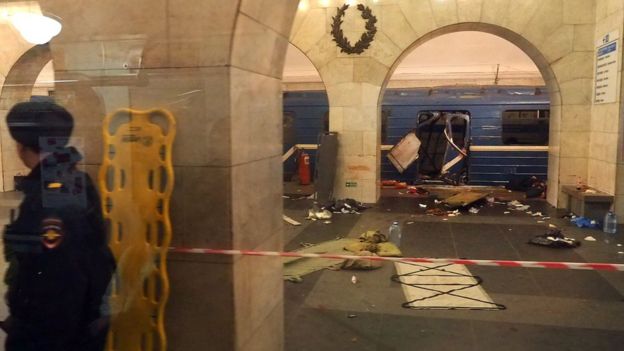
    A picture shows the damaged train carriage at Technological Institute metro station in Saint Petersburg on April 3, 2017Image copyrightAFP/GETTY IMAGES
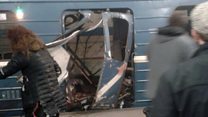
    Image captionThe badly-damaged train came to a stop at the Tekhnologichesky Institut station
    World leaders rallied behind Russia in condemning the blast.
    The White House said President Donald Trump had spoken to Mr Putin by phone and offered "full support" in bringing those responsible to justice.
    "Both President Trump and President Putin agreed that terrorism must be decisively and quickly defeated," a statement said.
    German Chancellor Angela Merkel described the blast as a "barbaric act" and EU foreign policy chief Federica Mogherini said Europe's thoughts were with the Russian people.
    First images from the scene showed a train at Tekhnologichesky Institut station with a hole blown in its side and wounded passengers on the platform.
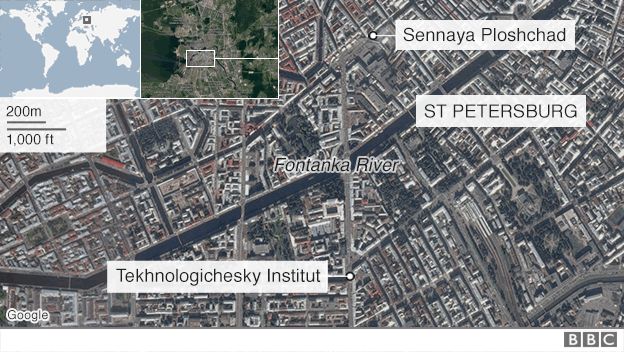
    Initial reports suggested there had been two explosions, one each at Sennaya Ploshchad and Tekhnologichesky Institut stations.
    But the Russian National Anti-Terrorist Committee later confirmed there had been only one explosion, between the two stations, at about 14:30 local time (11:30 GMT).
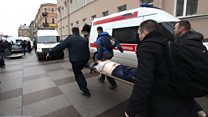
    Media captionEmergency services tend to the wounded outside a St Petersburg metro station
    Senior investigator Svetlana Petrenko told Russian media the train driver's decision to continue to the next station almost certainly helped save lives, as it allowed people to be rescued quickly.
    Health Minister Veronika Skvortsova said 10 people had died - seven at the scene, one in an ambulance and two in hospital. The death toll was later raised to 11.
    Map showing scene of explosion in St Petersburg - 3 April 2017
    Andrei Przhezdomsky, the head of the National Anti-Terrorist Committee, said the explosion was caused by "an unidentified explosive device".
    President Putin said all causes, especially terrorism, were being investigated.
    The discovery of an explosive device at another station, Ploshchad Vosstaniya, also suggested a co-ordinated attack.
    Interfax said the focus was now on a 23-year-old man from Central Asia known to have links to radical Islam.
    The news agency said the man died in a suicide blast and was identified through his remains. But the president's spokesman Dmitry Peskov would not comment on reports a suicide bomber was to blame.
    Another agency, Tass, reported that a woman may also have been involved in the explosion.
    Grey line

    Who might be behind the blast? Analysis by Frank Gardner, BBC Security Correspondent

    An injured person walks outside Sennaya Ploshchad metro station, following explosions in two train carriages at metro stations in St Petersburg, Russia April 3, 2017Image copyrightREUTERS
    Image captionThe entire metro network was shut down
    The Russian authorities are sensibly being cautious before apportioning blame for Monday's metro blast. An earlier quote by the prosecutor-general that it was an act of terrorism was quickly retracted.
    The FSB security service, the successors to the Soviet-era KGB, have skilled investigators, including forensic explosive experts. They will have been examining security camera footage and the explosive residue for clues, as well as the second device that was found intact and defused.
    Their suspicions are likely to focus on two possible suspects, neither yet confirmed. First, an IS-inspired group enraged by recent Russian airstrikes in Syria. And second, Chechen nationalists (or even a combination of both).
    Chechen militants and international jihadists do have a track record of plotting to attack Russia's transport hubs, notably in Moscow. An estimated 7,000 Russians have travelled to Syria to join extremist groups - and some have returned.
    Grey line
    St Petersburg's metro system, which is used by more than two million passengers every day, has not suffered previous attacks.
    Several transport hubs in Russia have, however, been attacked. In 2010, 38 people died in a double suicide bombing on the Moscow metro.
    And a year later, a bomb exploded on a high-speed train travelling between Moscow and St Petersburg, killing 27 and injuring another 130.
    Both attacks were claimed by Islamist groups.

    Related Topics

    More on this story