Biodun Iginla, BBC News

Biodun Iginla, BBC News
Showing posts with label St Petersburg metro bomb blast. Show all posts

Tuesday, April 4, 2017

St Petersburg metro bomb blast victims identified


  • April 4, 2017  23H:48 GMT/UTC/ZULU TIME
  •  
  • From the sectionEurope
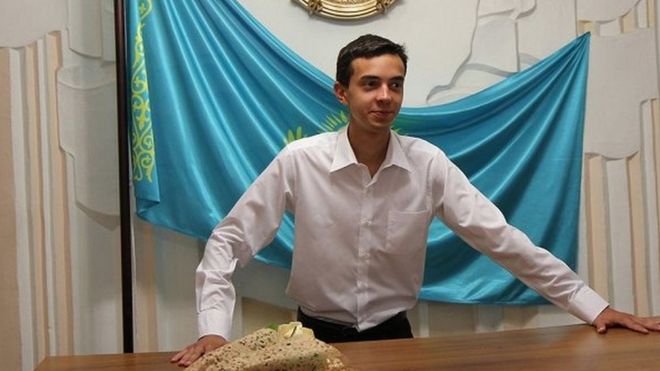
Picture of Maksim AryshevImage copyrightEMBASSY OF KAZAKHSTAN
Image captionMaksim Aryshev was a student at St Petersburg State University
by Maria Ogryzlo and Biodun Iginla, BBC News, St Petersburg, Russia
The first victims of the St Petersburg metro explosion have been named, as investigators continue to piece together the identity of the attacker.
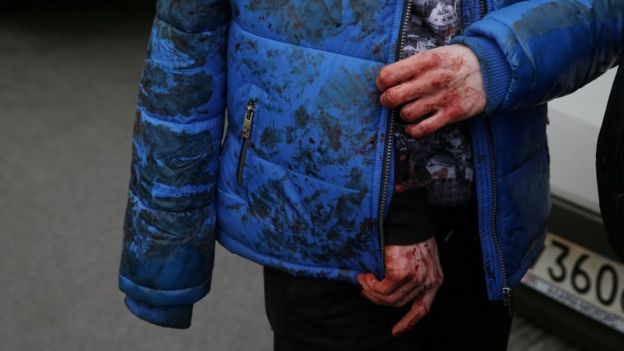
Monday's blast between two stations killed 14 people and injured almost 50.
Investigators say it may have been a suicide bomb set off by a Kyrgyzstan-born man, Akbarzhon Jalilov.
Reports in Russia say one of the victims, Irina Medyantseva, died as she tried to shield her daughter from the explosion.
Ms Medyantseva, a 50-year-old doll-maker, reportedly died in an ambulance.
Her daughter Yelena, 29, was treated for her injuries in hospital and her condition is said to be stable.
Others victims include Dilbara Alieva, 20, from Azerbaijan, who was taken to hospital but later died from her injuries.
The oldest victim was Yuri Nalimov, 71, and one of the youngest was Ksenia Malyukova, 18, Russia's investigative committee reports (in Russian).
Kazakhstan's foreign ministry said one of its nationals, Maksim Aryshev, a 20-year-old student, had died. He was wrongly named as the bomber on social media on Monday.

Media captionFootage shows passengers leaping from the wreckage in the minutes after the blast
Kyrgyzstan's security service named the suspect as Akbarzhon Jalilov, who was born in the Kyrgyz city of Osh in 1995 and had obtained Russian citizenship.
His name was later confirmed by Russian investigators, who said he also planted a second bomb that did not explode.
No group has said it was behind the bombing.

A city on edge: By Sarah Rainsford, BBC News, St Petersburg
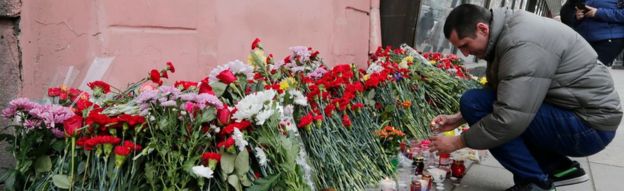
A man lays flowers outside Tekhnologichesky Institute metro station to pay tribute to the victims of an explosion in the metro stationImage copyrightEPA
The metro here is open again, but passengers heading into the stations at the heart of the attack pass a huge pile of flowers. People here at Sennaya Ploshchad have been adding to the shrine all morning, leaving notes and stuffed toys and lighting candles.
This is a city trying to get back to normal, but there is deep shock at what's happened.
I spoke to women in tears. One told me she felt she had to bring flowers because this attack was so awful, and her mother was horrified at how random the killing was. "Everyone I know is fine," Irina said. "But it could have been any one of us."
There were bomb scares on the metro system again this morning, and several stations were closed and cordoned off as security teams moved in. It is another sign that this is a city on edge now.

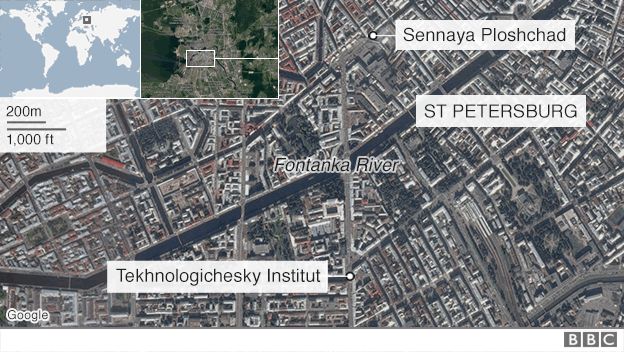
The blast occurred on Monday afternoon after the train had left Sennaya Ploshchad station.
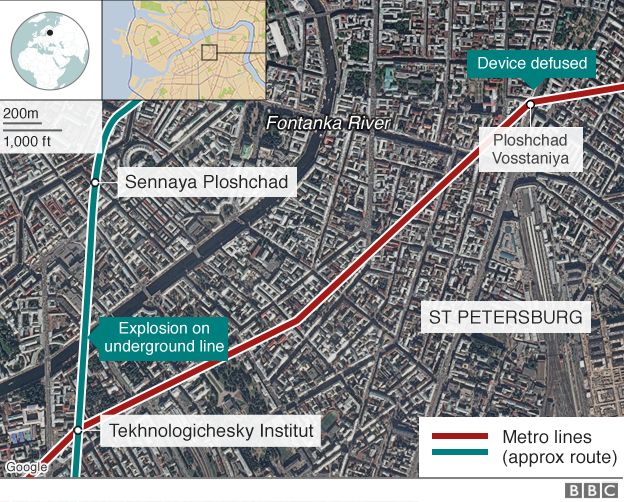
Map showing St Petersburg bombs - 4 April 2017
Senior investigator Svetlana Petrenko told Russian media the train driver's decision to continue to the next station, Tekhnologichesky Institut, had almost certainly helped save lives, as it allowed people to be rescued quickly.
Train driver Alexander Kaverin told reporters: "I just followed the procedure. You will know that this isn't the first terrorist act that we've had, there've been explosions before, so smart people came up with smart procedures.
"And these procedures say that in this situation I had to take the train to the nearest station. This is what I did. The train kept moving. There was a bang and lots of dust, but the train kept on moving."
The discovery of an explosive device at another station, Ploshchad Vosstaniya, on Monday also suggested a co-ordinated attack.
Both Mr Kaverin and another employee who found the unexploded bomb would be rewarded for their actions, metro officials said.

Related Topics

More on this story

Monday, April 3, 2017

St Petersburg metro bomb blast suspect 'from Central Asia'


  • April 4, 2017  05H:24  GMT/UTC/ZULU TIME
  •  
  • From the sectionEurope
Media captionFootage shows passengers leaping from the wreckage in the minutes after the blast
by Maria Ogryzlo and Biodun Iginla, BBC News, Moscow
The man suspected of killing 11 people in a St Petersburg train is in his early 20s and from Central Asia, Russian media report.
At least 45 people were injured in the explosion between two underground stations on Monday afternoon.
The Interfax and Tass news agencies said the suspect had been identified, but there are conflicting reports as to whether he was a suicide bomber.
Authorities in Saint Petersburg have declared three days of mourning.
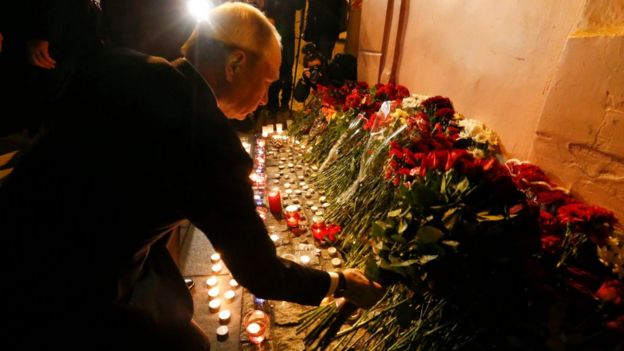
President Vladimir Putin, who was in the city when the blast occurred, visited the scene on Monday evening and laid flowers at a makeshift shrine.
Russian investigators have described it as a suspected "act of terror" but they have given few details. No group has said it was responsible.
Prime Minister Dmitry Medvedev said in a Facebook post that the explosion was a "terrorist attack".
Russian president Vladimir Putin puts flowers down outside Tekhnologicheskiy Institut metro station in St. Petersburg, Russia, April 3, 2017Image copyrightREUTERS
Image captionPresident Putin laid flowers near the scene of the blast
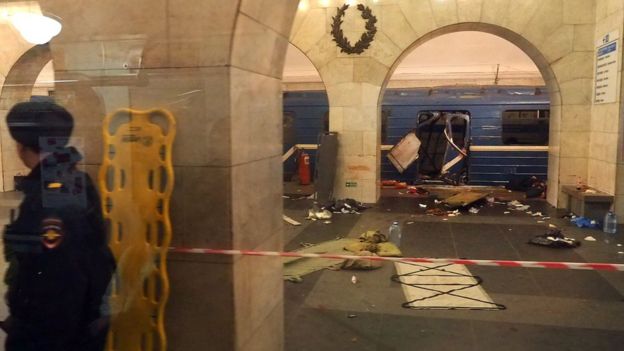
A picture shows the damaged train carriage at Technological Institute metro station in Saint Petersburg on April 3, 2017Image copyrightAFP/GETTY IMAGES
Image captionThe badly-damaged train came to a stop at the Tekhnologichesky Institut station
World leaders rallied behind Russia in condemning the blast.
The White House said President Donald Trump had spoken to Mr Putin by phone and offered "full support" in bringing those responsible to justice.
"Both President Trump and President Putin agreed that terrorism must be decisively and quickly defeated," a statement said.
German Chancellor Angela Merkel described the blast as a "barbaric act" and EU foreign policy chief Federica Mogherini said Europe's thoughts were with the Russian people.
First images from the scene showed a train at Tekhnologichesky Institut station with a hole blown in its side and wounded passengers on the platform.
Initial reports suggested there had been two explosions, one each at Sennaya Ploshchad and Tekhnologichesky Institut stations.
But the Russian National Anti-Terrorist Committee later confirmed there had been only one explosion, between the two stations, at about 14:30 local time (11:30 GMT).
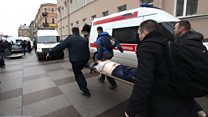
Media captionEmergency services tend to the wounded outside a St Petersburg metro station
Senior investigator Svetlana Petrenko told Russian media the train driver's decision to continue to the next station almost certainly helped save lives, as it allowed people to be rescued quickly.
Health Minister Veronika Skvortsova said 10 people had died - seven at the scene, one in an ambulance and two in hospital. The death toll was later raised to 11.
Map showing scene of explosion in St Petersburg - 3 April 2017
Andrei Przhezdomsky, the head of the National Anti-Terrorist Committee, said the explosion was caused by "an unidentified explosive device".
President Putin said all causes, especially terrorism, were being investigated.
The discovery of an explosive device at another station, Ploshchad Vosstaniya, also suggested a co-ordinated attack.
Interfax said the focus was now on a 23-year-old man from Central Asia known to have links to radical Islam.
The news agency said the man died in a suicide blast and was identified through his remains. But the president's spokesman Dmitry Peskov would not comment on reports a suicide bomber was to blame.
Another agency, Tass, reported that a woman may also have been involved in the explosion.
Grey line

Who might be behind the blast? Analysis by Frank Gardner, BBC Security Correspondent

An injured person walks outside Sennaya Ploshchad metro station, following explosions in two train carriages at metro stations in St Petersburg, Russia April 3, 2017Image copyrightREUTERS
Image captionThe entire metro network was shut down
The Russian authorities are sensibly being cautious before apportioning blame for Monday's metro blast. An earlier quote by the prosecutor-general that it was an act of terrorism was quickly retracted.
The FSB security service, the successors to the Soviet-era KGB, have skilled investigators, including forensic explosive experts. They will have been examining security camera footage and the explosive residue for clues, as well as the second device that was found intact and defused.
Their suspicions are likely to focus on two possible suspects, neither yet confirmed. First, an IS-inspired group enraged by recent Russian airstrikes in Syria. And second, Chechen nationalists (or even a combination of both).
Chechen militants and international jihadists do have a track record of plotting to attack Russia's transport hubs, notably in Moscow. An estimated 7,000 Russians have travelled to Syria to join extremist groups - and some have returned.
Grey line
St Petersburg's metro system, which is used by more than two million passengers every day, has not suffered previous attacks.
Several transport hubs in Russia have, however, been attacked. In 2010, 38 people died in a double suicide bombing on the Moscow metro.
And a year later, a bomb exploded on a high-speed train travelling between Moscow and St Petersburg, killing 27 and injuring another 130.
Both attacks were claimed by Islamist groups.

Related Topics

More on this story