Biodun Iginla, BBC News

Biodun Iginla, BBC News
Showing posts with label EU citizens. Show all posts

Friday, February 22, 2019

ANALYSIS: Good-bye Brexit: Why a German actress is moving from London back to Germany

February 22, 2019  21H:36  GMT/ZULU

by Emily Straton and Biodun Iginla, BBC News and Reuters News  Analysts, London

LONDON  - Actor Sonja Morgenstern, a German national who has lived in London since 1996, packed up and moved back to Nuremberg this week in hopes of rediscovering the peace and certainty she lost when Britain voted for Brexit in 2016.

The 41-year-old, an active anti-Brexit campaigner who dresses up at pro-EU events, is one of 3.7 million EU citizens living in Britain, many of whom fear chaos when it leaves the European Union on March 29.
If Prime Minister Theresa May fails to reach a trade deal with the EU as a bridge to Britain’s biggest political change in four decades, many fear border backlogs and supermarket shortages in the aftermath.
“It feels like some major values that we all share in Europe have been undermined for whatever shady reasons,” she told us at Reuters, surrounded by boxes and bubblewrap.
ADVERTISEMENT
“So to just, you know, blindly keep going in the direction of a cliff like lemmings, I don’t get it. All I know is I’m not going to be a winner out of this situation.”
Despite getting British citizenship earlier this year, Sonja says she feels an “impending doom” that Britain, once an open-minded place, has lost its way and that the government has no plan.
Britain has said that EU citizens and their families who have been living in the UK for at least five years by the end of 2020 will be able to apply for so-called settled status, giving them the right to remain and work in the country.
ADVERTISEMENT
But Sonja said that by deciding to leave, she has regained a sense of power.
A single parent to 4-year-old Mio, her decision came while stacking tins of tomatoes and spaghetti in case of “no deal”.
“I started to prepare for Brexit by stockpiling some food” she said. “But then I thought, actually this is crazy! I might as well spend my energy and my money moving and being closer to family and not having that constant worry.”

Slideshow (4 Images)
The task brought echoes of family emergencies in the past - a period of drinking only powdered milk in Germany in the 1980s because of fears of contamination from the Chernobyl nuclear disaster, or food shortages during World War Two described by her father and grandmother.
“Being German, we’ve grown up with a very keen sense of our history and the idea that these things shouldn’t repeat and certain things are just, you know when they feel sort of slightly worrying - when is the right time to leave?” she said, speaking in London-accented English.
“Something is brewing that I feel very uncomfortable with.”

Thursday, June 22, 2017

BREAKING: Brexit: UK offer on EU citizens a good start, says Merkel


  • June 23, 2017  05H:45   GMT/UTC/ZULU TIME
  •  
  • From the sectionEurope
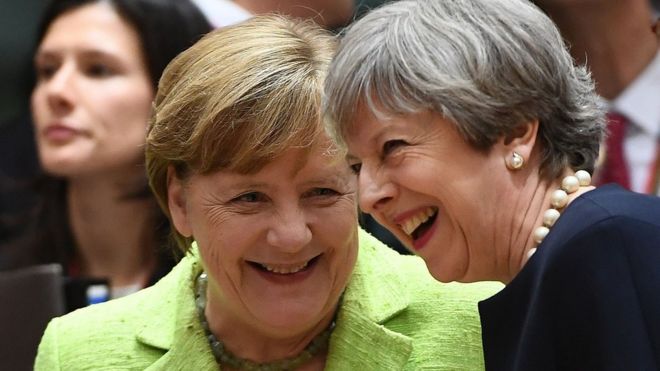
German Chancellor Angela Merkel (L) and UK Prime Minister Theresa May (R) at EU leaders summit in Brussels, on 22 June 2017Image copyrightAFP
Image captionAngela Merkel says Brexit is not the focus of the two-day EU summit on Brussels
by Isabelle Roussel and Biodun Iginla, BBC News, Berlin
German Chancellor Angela Merkel has described UK plans to ensure the rights of EU citizens in Britain after Brexit as "a good start".
However, she said there were "many, many other questions" about Brexit and there was "still a lot to do".
The UK proposal was unveiled by Prime Minister Theresa May at an EU summit in Brussels on Thursday.
It would grant EU migrants who had lived in the UK for five years a new "UK settled status".
That would allow them to stay in the country and access health, education and other benefits.
The plan would affect 3.2 million EU citizens now living in the UK.
Their rights - and the rights of UK citizens living in the rest of the EU - are among the thorny issues that have to be resolved early on in Brexit talks, along with the UK's divorce bill and the Northern Ireland border.
"Theresa May made clear today that EU citizens who have been in Great Britain for five years can keep their full rights. That's a good start," said Mrs Merkel at the end of Thursday's talks.
"But of course there are many, many other questions about Brexit - about finances, about the relationship with Ireland - which means we still have a lot to do until October."
She insisted that Brexit was not the focus of the summit - the UK's split from the EU is being negotiated separately.
Media captionLeaders of the 28 member states have plenty to discuss during the two-day summit, Elaine Jung explains
"For me the shaping of the future of the 27 is a priority coming before the issue of the negotiations with Britain on the exit," she added.
Before Mrs May's offer, the EU proposed that EU citizens in the UK and the estimated 1.2 million Britons living in EU countries should continue enjoying the same rights, enforceable by the European Court of Justice (ECJ).
At the summit, the PM sought to reassure the 27 other EU states, saying the UK "does not want anyone here to have to leave, nor does it want families to be split up".
"No-one will face a cliff edge," she said.
Media captionDonald Tusk: Dreaming of a Brexit 'miracle'
The UK stunned the EU when it voted to end its membership in a referendum a year ago on Friday. The exit deadline is 30 March 2019.
The summit's final day is to focus on migration, security and economic issues.
Counter-terrorism has been a key issue at the summit which comes in the wake of an attack in Brussels on Tuesday.
Several EU states have been attacked in recent weeks, including the UK, France and Sweden, and Mrs May said that an attack against any member state was an attack on all.
Grey line

Questions remain: Chris Morris, BBC News, Brussels

Both sides would like to get the issue of citizens' rights wrapped up as soon as possible - it would be good for morale to get an early win, and they have more difficult issues to tackle.
But while there is a sense that progress can be made, there are still some tricky technical questions to deal with.
Which rights will be extended to immediate family members living elsewhere - to children in particular? And who will guarantee citizens' rights in the event of any legal dispute? The EU has already insisted that the European Court of Justice should be involved; the UK insists that British courts should uphold the deal.
It is also not clear what the cut-off date should be for citizens to qualify for any offer that is agreed. The UK proposal suggests a date between March 2017 and March 2019 - although it is highly unlikely that the EU would be willing to accept a date that has already passed.
From an EU perspective, what we've heard so far from the UK side remains rather vague. EU negotiators will want to see the details of this proposal which are only due to be made public next Monday.

More on this story