
The death of the internal combustion engine
It had a good run. But the end is in sight for the machine that changed the world
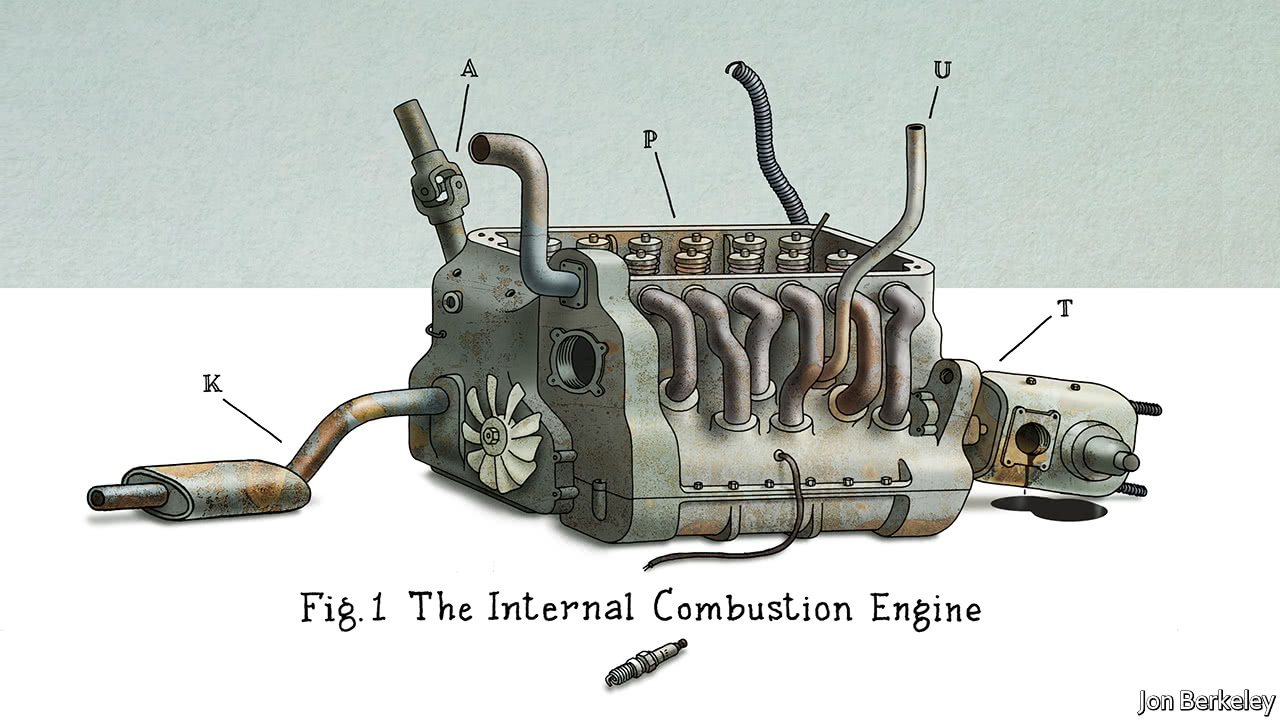
“HUMAN inventiveness…has still not found a mechanical process to replace horses as the propulsion for vehicles,” lamented Le Petit Journal, a French newspaper, in December 1893. Its answer was to organise the Paris-Rouen race for horseless carriages, held the following July. The 102 entrants included vehicles powered by steam, petrol, electricity, compressed air and hydraulics. Only 21 qualified for the 126km (78-mile) race, which attracted huge crowds. The clear winner was the internal combustion engine. Over the next century it would go on to power industry and change the world.
But its days are numbered. Rapid gains in battery technology favour electric motors instead (see Briefing). In Paris in 1894 not a single electric car made it to the starting line, partly because they needed battery-replacement stations every 30km or so. Today’s electric cars, powered by lithium-ion batteries, can do much better. The Chevy Bolt has a range of 383km; Tesla fans recently drove a Model S more than 1,000km on a single charge. UBS, a bank, reckons the “total cost of ownership” of an electric car will reach parity with a petrol one next year—albeit at a loss to its manufacturer. It optimistically predicts electric vehicles will make up 14% of global car sales by 2025, up from 1% today. Others have more modest forecasts, but are hurriedly revising them upwards as batteries get cheaper and better—the cost per kilowatt-hour has fallen from $1,000 in 2010 to $130-200 today. Regulations are tightening, too. Last month Britain joined a lengthening list of electric-only countries, saying that all new cars must be zero-emission by 2050.
The shift from fuel and pistons to batteries and electric motors is unlikely to take that long. The first death rattles of the internal combustion engine are already reverberating around the world—and many of the consequences will be welcome.
To gauge what lies ahead, think how the internal combustion engine has shaped modern life. The rich world was rebuilt for motor vehicles, with huge investments in road networks and the invention of suburbia, along with shopping malls and drive-through restaurants. Roughly 85% of American workers commute by car. Carmaking was also a generator of economic development and the expansion of the middle class, in post-war America and elsewhere. There are now about 1bn cars on the road, almost all powered by fossil fuels. Though most of them sit idle, America’s car and lorry engines can produce ten times as much energy as its power stations. The internal combustion engine is the mightiest motor in history.
But electrification has thrown the car industry into turmoil. Its best brands are founded on their engineering heritage—especially in Germany. Compared with existing vehicles, electric cars are much simpler and have fewer parts; they are more like computers on wheels. That means they need fewer people to assemble them and fewer subsidiary systems from specialist suppliers. Carworkers at factories that do not make electric cars are worried that they could be for the chop. With less to go wrong, the market for maintenance and spare parts will shrink. While today’s carmakers grapple with their costly legacy of old factories and swollen workforces, new entrants will be unencumbered. Premium brands may be able to stand out through styling and handling, but low-margin, mass-market carmakers will have to compete chiefly on cost.
Assuming, of course, that people want to own cars at all. Electric propulsion, along with ride-hailing and self-driving technology, could mean that ownership is largely replaced by “transport as a service”, in which fleets of cars offer rides on demand. On the most extreme estimates, that could shrink the industry by as much as 90%. Lots of shared, self-driving electric cars would let cities replace car parks (up to 24% of the area in some places) with new housing, and let people commute from far away as they sleep—suburbanisation in reverse.
Even without a shift to safe, self-driving vehicles, electric propulsion will offer enormous environmental and health benefits. Charging car batteries from central power stations is more efficient than burning fuel in separate engines. Existing electric cars reduce carbon emissions by 54% compared with petrol-powered ones, according to America’s National Resources Defence Council. That figure will rise as electric cars become more efficient and grid-generation becomes greener. Local air pollution will fall, too. The World Health Organisation says that it is the single largest environmental health risk, with outdoor air pollution contributing to 3.7m deaths a year. One study found that car emissions kill 53,000 Americans each year, against 34,000 who die in traffic accidents.
Meanwhile, a scramble for lithium is under way. The price of lithium carbonate has risen from $4,000 a tonne in 2011 to more than $14,000. Demand for cobalt and rare-earth elements for electric motors is also soaring. Lithium is used not just to power cars: utilities want giant batteries to store energy when demand is slack and release it as it peaks. Will all this make lithium-rich Chile the new Saudi Arabia? Not exactly, because electric cars do not consume it; old lithium-ion batteries from cars can be reused in power grids, and then recycled.
The internal combustion engine has had a good run—and could still dominate shipping and aviation for decades to come. But on land electric motors will soon offer freedom and convenience more cheaply and cleanly. As the switch to electric cars reverses the trend in the rich world towards falling electricity consumption, policymakers will need to help, by ensuring that there is enough generating capacity—in spite of many countries’ broken system of regulation. They may need to be the midwives to new rules and standards for public recharging stations, and the recycling of batteries, rare-earth motors and other components in “urban mines”. And they will have to cope with the turmoil as old factory jobs disappear.
Driverless electric cars in the 21st century are likely to improve the world in profound and unexpected ways, just as vehicles powered by internal combustion engines did in the 20th. But it will be a bumpy road. Buckle up.
The big end
Latest updates
The shift from fuel and pistons to batteries and electric motors is unlikely to take that long. The first death rattles of the internal combustion engine are already reverberating around the world—and many of the consequences will be welcome.
To gauge what lies ahead, think how the internal combustion engine has shaped modern life. The rich world was rebuilt for motor vehicles, with huge investments in road networks and the invention of suburbia, along with shopping malls and drive-through restaurants. Roughly 85% of American workers commute by car. Carmaking was also a generator of economic development and the expansion of the middle class, in post-war America and elsewhere. There are now about 1bn cars on the road, almost all powered by fossil fuels. Though most of them sit idle, America’s car and lorry engines can produce ten times as much energy as its power stations. The internal combustion engine is the mightiest motor in history.
But electrification has thrown the car industry into turmoil. Its best brands are founded on their engineering heritage—especially in Germany. Compared with existing vehicles, electric cars are much simpler and have fewer parts; they are more like computers on wheels. That means they need fewer people to assemble them and fewer subsidiary systems from specialist suppliers. Carworkers at factories that do not make electric cars are worried that they could be for the chop. With less to go wrong, the market for maintenance and spare parts will shrink. While today’s carmakers grapple with their costly legacy of old factories and swollen workforces, new entrants will be unencumbered. Premium brands may be able to stand out through styling and handling, but low-margin, mass-market carmakers will have to compete chiefly on cost.
Assuming, of course, that people want to own cars at all. Electric propulsion, along with ride-hailing and self-driving technology, could mean that ownership is largely replaced by “transport as a service”, in which fleets of cars offer rides on demand. On the most extreme estimates, that could shrink the industry by as much as 90%. Lots of shared, self-driving electric cars would let cities replace car parks (up to 24% of the area in some places) with new housing, and let people commute from far away as they sleep—suburbanisation in reverse.
Even without a shift to safe, self-driving vehicles, electric propulsion will offer enormous environmental and health benefits. Charging car batteries from central power stations is more efficient than burning fuel in separate engines. Existing electric cars reduce carbon emissions by 54% compared with petrol-powered ones, according to America’s National Resources Defence Council. That figure will rise as electric cars become more efficient and grid-generation becomes greener. Local air pollution will fall, too. The World Health Organisation says that it is the single largest environmental health risk, with outdoor air pollution contributing to 3.7m deaths a year. One study found that car emissions kill 53,000 Americans each year, against 34,000 who die in traffic accidents.
Autos and autocracies
And then there is oil. Roughly two-thirds of oil consumption in America is on the roads, and a fair amount of the rest uses up the by-products of refining crude oil to make petrol and diesel. The oil industry is divided about when to expect peak demand; Royal Dutch Shell says that it could be little more than a decade away. The prospect will weigh on prices long before then. Because nobody wants to be left with useless oil in the ground, there will be a dearth of new investment, especially in new, high-cost areas such as the Arctic. By contrast, producers such as Saudi Arabia, with vast reserves that can be tapped cheaply, will be under pressure to get pumping before it is too late: the Middle East will still matter, but a lot less than it did. Although there will still be a market for natural gas, which will help generate power for all those electric cars, volatile oil prices will strain countries that depend on hydrocarbon revenues to fill the national coffers. When volumes fall, the adjustment will be fraught, particularly where the struggle for power has long been about controlling oil wealth. In countries such as Angola and Nigeria where oil has often been a curse, the diffusion of economic clout may bring immense benefits.Meanwhile, a scramble for lithium is under way. The price of lithium carbonate has risen from $4,000 a tonne in 2011 to more than $14,000. Demand for cobalt and rare-earth elements for electric motors is also soaring. Lithium is used not just to power cars: utilities want giant batteries to store energy when demand is slack and release it as it peaks. Will all this make lithium-rich Chile the new Saudi Arabia? Not exactly, because electric cars do not consume it; old lithium-ion batteries from cars can be reused in power grids, and then recycled.
The internal combustion engine has had a good run—and could still dominate shipping and aviation for decades to come. But on land electric motors will soon offer freedom and convenience more cheaply and cleanly. As the switch to electric cars reverses the trend in the rich world towards falling electricity consumption, policymakers will need to help, by ensuring that there is enough generating capacity—in spite of many countries’ broken system of regulation. They may need to be the midwives to new rules and standards for public recharging stations, and the recycling of batteries, rare-earth motors and other components in “urban mines”. And they will have to cope with the turmoil as old factory jobs disappear.
Driverless electric cars in the 21st century are likely to improve the world in profound and unexpected ways, just as vehicles powered by internal combustion engines did in the 20th. But it will be a bumpy road. Buckle up.


