Biodun Iginla, BBC News

Biodun Iginla, BBC News
Showing posts with label Europol. Show all posts

Sunday, May 14, 2017

BREAKING: global cyber-attack a wake-up call, Microsoft warns


  • May 14, 2017 23H:55 GMT/UTC/ZULU TIME
  •  
  • From the sectionTechnology


Media captionHow to protect yourself online

by Tamara Kachelmeier and Biodun Iginla, BBC News Technology reporters, New York
Cyber-attacks that have hit 150 countries since Friday should be treated by governments around the world as a "wake-up call", Microsoft says.
The computing giant said software vulnerabilities hoarded by governments have caused "widespread damage".
The latest virus exploits a flaw in Microsoft Windows first identified by US intelligence.
There are fears of further "ransomware" attacks as people return to work on Monday.
Many firms have had experts work over the weekend to prevent new infections. The virus took control of users' files, demanding payments to restore access.
The spread of the virus slowed over the weekend but the respite might only be brief, experts have warned. More than 200,000 computers have been affected so far.
A statement released by Microsoft on Sunday criticised the way governments store up information about security flaws in computer systems.
"We have seen vulnerabilities stored by the CIA show up on WikiLeaks, and now this vulnerability stolen from the NSA has affected customers around the world.
"An equivalent scenario with conventional weapons would be the US military having some of its Tomahawk missiles stolen."
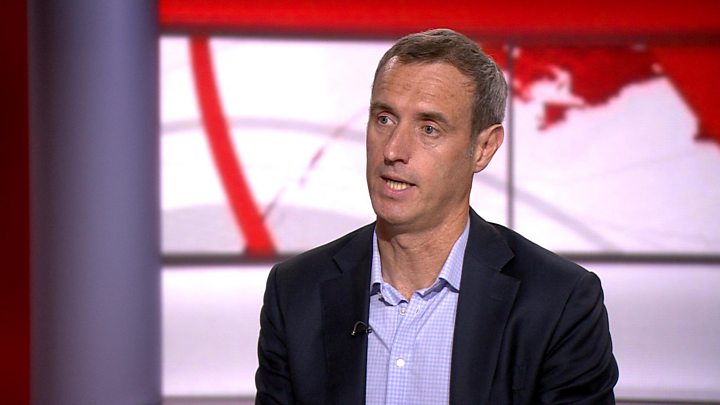


Media captionFirms must patch their systems before Monday morning, Europol chief warns

It added: "The governments of the world should treat this attack as a wake-up call."
Microsoft said it had released a Windows security update in March to tackle the problem involved in the latest attack, but many users were yet to run it.
"As cybercriminals become more sophisticated, there is simply no way for customers to protect themselves against threats unless they update their systems," the company said.

Temporary fix

Meanwhile Europol's chief told us at the BBC that that the ransomware was designed to allow "infection of one computer to quickly spread across the networks", adding: "That's why we're seeing these numbers increasing all the time."
Although a temporary fix earlier slowed the infection rate, the attackers had now released a new version of the virus, he said.
A UK security researcher known as "MalwareTech", who helped to limit the ransomware attack, predicted "another one coming... quite likely on Monday".
MalwareTech, who wants to remain anonymous, was hailed as an "accidental hero" after registering a domain name to track the spread of the virus, which actually ended up halting it.
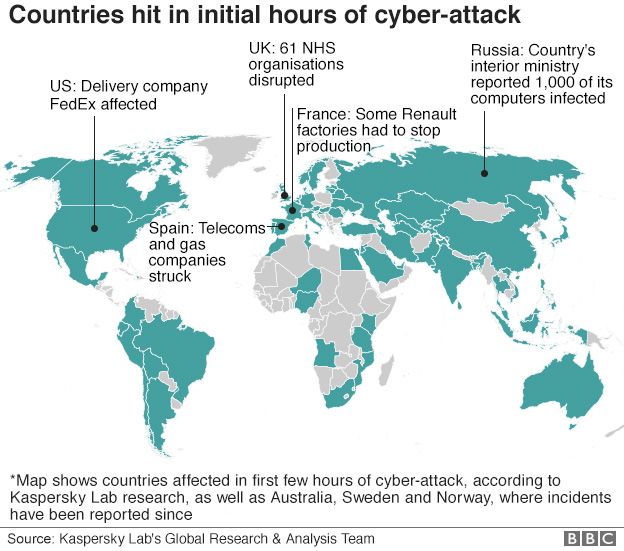
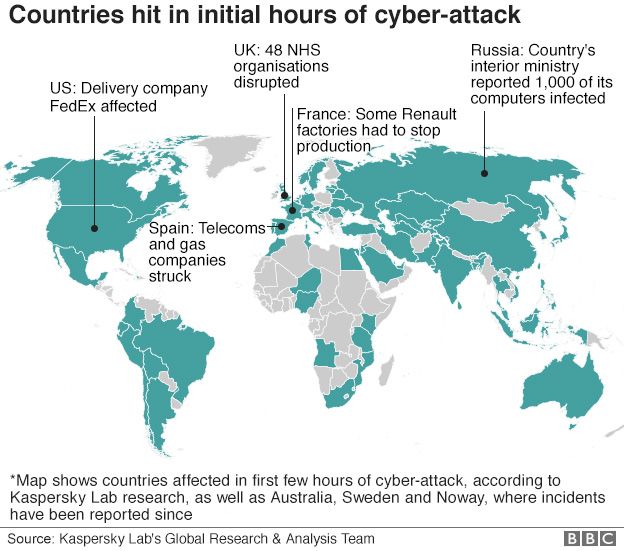
Map of areas hit by the cyber attack

Becky Pinkard, from Digital Shadows, a UK-based cyber-security firm, told AFP news agency that it would be easy for the initial attackers or "copy-cat authors" to change the virus code so it is difficult to guard against.
"Even if a fresh attack does not materialise on Monday, we should expect it soon afterwards," she said.
In England, 48 National Health Service (NHS) trusts reported problems at hospitals, doctor surgeries or pharmacies, and 13 NHS organisations in Scotland were also affected.
Other organisations targeted worldwide included Germany's rail network Deutsche Bahn, Spanish telecommunications operator Telefonica, French carmaker Renault, US logistics giant FedEx and Russia's Interior Ministry.

Related Topics

More on this story

Saturday, May 13, 2017

BREAKING: Europol says cyber-attack was unprecedented in scale

May 13, 2017  19H:42  GMT/UTC/ZULU TIME

  • 2 hours ago
  •  
  • From the sectionEurope
WannaCryImage copyrightWEBROOT
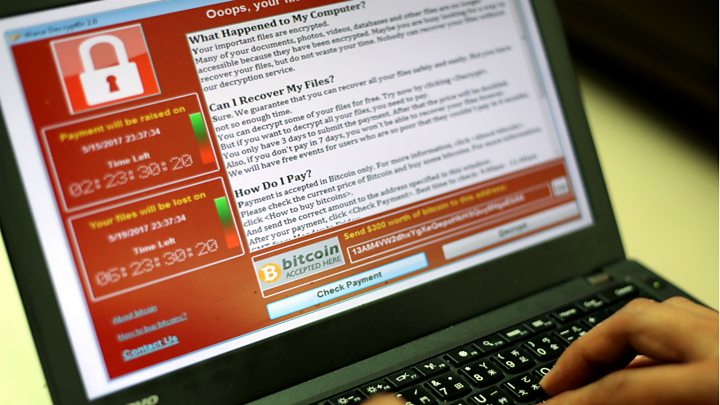
Image captionThe ransomware has been identified as WannaCry - here shown in a safe environment on a security researcher's computer
by Elodie Bagnol, Tamara Kachelmeier, and Biodun Iginla, Technology reporters, BBC News, London
A cyber-attack that hit organisations worldwide including the UK's National Health Service was "unprecedented", Europe's police agency says.
Europol also warned a "complex international investigation" was required "to identify the culprits".
Ransomware encrypted data on at least 75,000 computers in 99 countries on Friday. Payments were demanded for access to be restored.
European countries, including Russia, were among the worst hit.
Although the spread of the malware - known as WannaCry and variants of that name - appears to have slowed, the threat is not yet over.
Europol said its cyber-crime team, EC3, was working closely with affected countries to "mitigate the threat and assist victims".
Media captionNHS cyber attack: "My heart surgery was cancelled"
In the UK, a total of 48 National Health trusts were hit by Friday's cyber-attack, of which all but six are now back to normal, according to the Home Secretary Amber Rudd.
The attack left hospitals and doctors unable to access patient data, and led to the cancellation of operations and medical appointments.
Map

Who else has been affected by the attack?

Some reports say Russia has seen more infections than any other country. Banks, the state-owned railways and a mobile phone network were hit.
Russia's interior ministry said 1,000 of its computers had been infected but the virus was swiftly dealt with and no sensitive data was compromised.
In Germany, the federal railway operator said electronic boards had been disrupted; people tweeted photos of a ticket machine.
France's carmaker Renault was forced to stop production at a number of sites.
Other targets have included:
  • Large Spanish firms - such as telecoms giant Telefonica, and utilities Iberdrola and Gas Natural
  • Portugal Telecom, a university computer lab in Italy, a local authority in Sweden
  • The US delivery company FedEx
  • Schools in China, and hospitals in Indonesia and South Korea
Coincidentally, finance ministers from the G7 group of leading industrial countries had been meeting on Friday to discuss the threat of cyber-attacks.
They pledged to work more closely on spotting vulnerabilities and assessing security measures.

Read more:

How did it happen and who is behind it?

The malware spread quickly on Friday, with medical staff in the UK reportedly seeing computers go down "one by one".
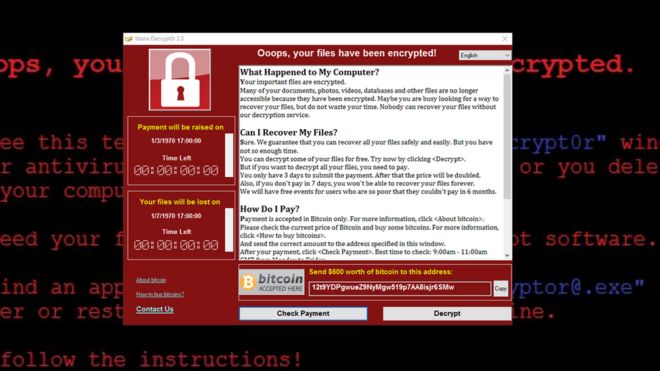
NHS staff shared screenshots of the WannaCry programme, which demanded a payment of $300 (£230) in virtual currency Bitcoin to unlock the files for each computer.
The infections seem to be deployed via a worm - a program that spreads by itself between computers.
Most other malicious programs rely on humans to spread by tricking them into clicking on an attachment harbouring the attack code.
By contrast, once WannaCry is inside an organisation it will hunt down vulnerable machines and infect them too.
Media captionThe BBC's Rory Cellan Jones explains how Bitcoin works
It is not clear who is behind the attack, but the tools used to carry it out are believed to have been developed by the US National Security Agency (NSA) to exploit a weakness found in Microsoft's Windows system.
This exploit - known as EternalBlue - was stolen by a group of hackers known as The Shadow Brokers, who made it freely available in April, saying it was a "protest" about US President Donald Trump.
A patch for the vulnerability was released by Microsoft in March, which would have automatically protected those computers with Windows Update enabled.
Media captionWhat is ransomware?
Microsoft said on Friday it would roll out the update to users of older operating systems "that no longer receive mainstream support", such Windows XP (which the NHS still largely uses), Windows 8 and Windows Server 2003.
The number of infections seems to be slowing after a "kill switch" appears to have been accidentally triggered by a UK-based cyber-security researcher tweeting as @MalwareTechBlog.
But in a BBC interview, he warned that it was only a temporary fix. "It is very important that people patch their systems now because there will be another one coming and it will not be stoppable by us," he said.
Media captionHow a computer expert managed to slow the spread of WannaCryptor

'Accidental hero' - by Chris Foxx, technology reporter
The security researcher known online as MalwareTech was analysing the code behind the malware on Friday night when he made his discovery.
He first noticed that the malware was trying to contact an unusual web address but this address was not connected to a website, because nobody had registered it.
So, every time the malware tried to contact the mysterious website, it failed - and then set about doing its damage.
MalwareTech decided to spend £8.50 ($11) and claim the web address. By owning the web address, he could also access analytical data. But he later realised that registering the web address had also stopped the malware trying to spread itself.
"It was actually partly accidental," he told us at the BBC.

Have you or your company been affected by the cyber-attack? Email us at haveyoursay@bbc.co.uk
You can also contact us in the following ways:
  • Tweet: @BBC_HaveYourSay
  • WhatsApp: +447555 173285
  • Text an SMS or MMS to 61124 (UK) or +44 7624 800 100 (international)
Or use the form below
Your contact details
If you are happy to be contacted by a BBC journalist please leave a telephone number that we can contact you on. In some cases a selection of your comments will be published, displaying your name as you provide it and location, unless you state otherwise. Your contact details will never be published. When sending us pictures, video or eyewitness accounts at no time should you endanger yourself or others, take any unnecessary risks or infringe any laws. Please ensure you have read the terms and conditions.

More on this story

Europe