Biodun Iginla, BBC News

Biodun Iginla, BBC News
Showing posts with label global cyber-attack. Show all posts

Sunday, May 14, 2017

BREAKING: global cyber-attack a wake-up call, Microsoft warns


  • May 14, 2017 23H:55 GMT/UTC/ZULU TIME
  •  
  • From the sectionTechnology


Media captionHow to protect yourself online

by Tamara Kachelmeier and Biodun Iginla, BBC News Technology reporters, New York
Cyber-attacks that have hit 150 countries since Friday should be treated by governments around the world as a "wake-up call", Microsoft says.
The computing giant said software vulnerabilities hoarded by governments have caused "widespread damage".
The latest virus exploits a flaw in Microsoft Windows first identified by US intelligence.
There are fears of further "ransomware" attacks as people return to work on Monday.
Many firms have had experts work over the weekend to prevent new infections. The virus took control of users' files, demanding payments to restore access.
The spread of the virus slowed over the weekend but the respite might only be brief, experts have warned. More than 200,000 computers have been affected so far.
A statement released by Microsoft on Sunday criticised the way governments store up information about security flaws in computer systems.
"We have seen vulnerabilities stored by the CIA show up on WikiLeaks, and now this vulnerability stolen from the NSA has affected customers around the world.
"An equivalent scenario with conventional weapons would be the US military having some of its Tomahawk missiles stolen."
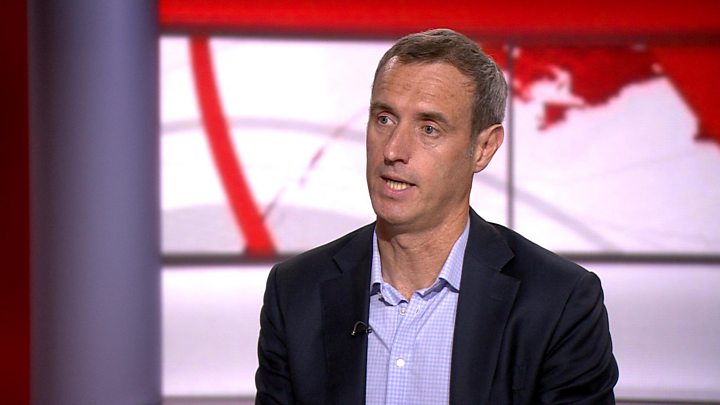


Media captionFirms must patch their systems before Monday morning, Europol chief warns

It added: "The governments of the world should treat this attack as a wake-up call."
Microsoft said it had released a Windows security update in March to tackle the problem involved in the latest attack, but many users were yet to run it.
"As cybercriminals become more sophisticated, there is simply no way for customers to protect themselves against threats unless they update their systems," the company said.

Temporary fix

Meanwhile Europol's chief told us at the BBC that that the ransomware was designed to allow "infection of one computer to quickly spread across the networks", adding: "That's why we're seeing these numbers increasing all the time."
Although a temporary fix earlier slowed the infection rate, the attackers had now released a new version of the virus, he said.
A UK security researcher known as "MalwareTech", who helped to limit the ransomware attack, predicted "another one coming... quite likely on Monday".
MalwareTech, who wants to remain anonymous, was hailed as an "accidental hero" after registering a domain name to track the spread of the virus, which actually ended up halting it.
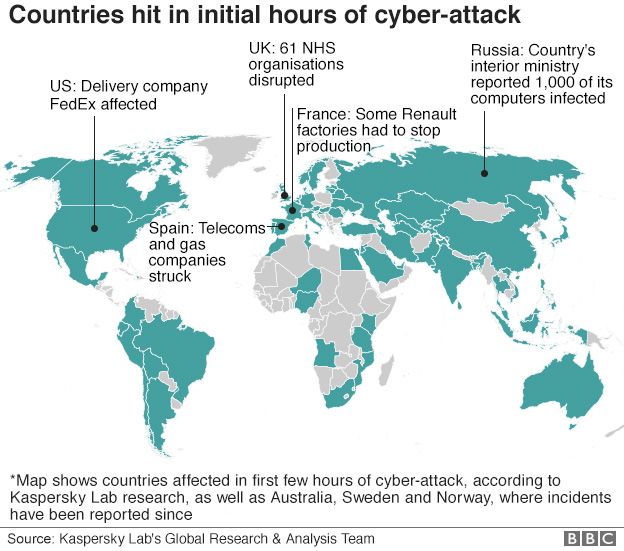
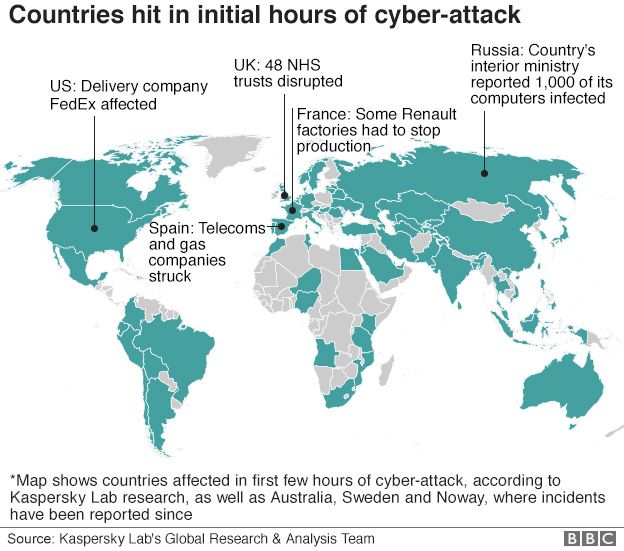
Map of areas hit by the cyber attack

Becky Pinkard, from Digital Shadows, a UK-based cyber-security firm, told AFP news agency that it would be easy for the initial attackers or "copy-cat authors" to change the virus code so it is difficult to guard against.
"Even if a fresh attack does not materialise on Monday, we should expect it soon afterwards," she said.
In England, 48 National Health Service (NHS) trusts reported problems at hospitals, doctor surgeries or pharmacies, and 13 NHS organisations in Scotland were also affected.
Other organisations targeted worldwide included Germany's rail network Deutsche Bahn, Spanish telecommunications operator Telefonica, French carmaker Renault, US logistics giant FedEx and Russia's Interior Ministry.

Related Topics

More on this story

Saturday, May 13, 2017

Experts warn that next global cyber-attack could be imminent


  •  May 14, 2017 06H:47   GMT/UTC/ZULU TIME  
  • From the sectionUK


Media captionHow to protect yourself online

by Tamara Kachelmeier and Biodun Iginla, BBC News Technology reporters, London/New York
Another major cyber-attack could be imminent after Friday's global hit that infected more than 125,000 computer systems, security experts have warned.
UK security researcher "MalwareTech", who helped to limit the ransomware attack, predicted "another one coming... quite likely on Monday".
The virus, which took control of users' files, spread to 100 countries, including Spain, France and Russia.
In England, 48 NHS trusts fell victim, as did 13 NHS bodies in Scotland.
Some hospitals were forced to cancel procedures and appointments, as ambulances were directed to neighbouring hospitals free from the computer virus.
UK Home Secretary Amber Rudd said on Saturday that all but six NHS trusts' systems had been restored, but that "there's always more" that could be done to protect against computer viruses.

'No reason to stop'

After taking computers over, the virus displayed messages demanding a payment of $300 (£230) in virtual currency Bitcoin to unlock files and return them to the user.
BBC analysis of three accounts linked with the global attack suggests the hackers have already been paid the equivalent of £22,080.
MalwareTech, who wants to remain anonymous, was hailed as an "accidental hero" after registering a domain name to track the spread of the virus, which actually ended up halting it.
The 22-year-old told us at the BBC: "It's very important that people patch their systems now.
"We have stopped this one, but there will be another one coming and it will not be stoppable by us.
"There's a lot of money in this. There's no reason for them to stop. It's not really much effort for them to change the code and then start over.
"So there's a good chance they are going to do it... maybe not this weekend, but quite likely on Monday morning."

Countries hit in initial hours of cyber-attack

Fellow security researcher Darien Huss, from tech firm Proofpoint, echoed MalwareTech's view.
"I highly suspect that, with the amount of coverage that this incident is getting, there are probably already people that are working to incorporate the exploit that was used for spreading," he said.
Investigators are working to track down those responsible for the ransomware used on Friday, known as Wanna Decryptor or WannaCry.

'Bring them to justice'

The virus exploits a vulnerability in Microsoft Windows software, first identified by the US National Security Agency, experts have said.
Europol described the cyber-attack as "unprecedented" and said its cyber-crime team was working with affected countries to "mitigate the threat and assist victims".
Oliver Gower, of the UK's National Crime Agency, added: "Cyber criminals may believe they are anonymous, but we will use all the tools at our disposal to bring them to justice."

Update not applied

In the UK, critics said the government had known about the threat of a cyber-attack for some time, but hospitals had not made the right upgrades to protect themselves.
A security update - or patch - was released by Microsoft in March to protect against the virus, but it appears many NHS organisations had not applied it or were using an older version of the operating system no longer supported - namely Windows XP.
Kingsley Manning, a former chairman of NHS Digital, claimed that several hundred thousand computers were still running the out-of-date operating system.


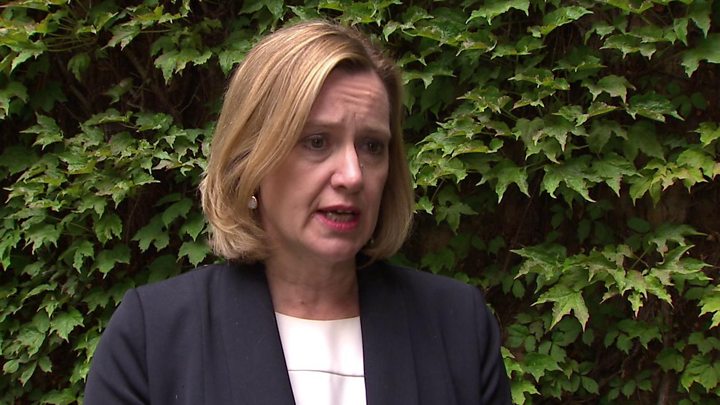
Media captionHome Secretary Amber Rudd said most of the NHS was now "working normally"

Mr Manning told BBC Radio 4's PM programme: "Some trusts took the advice that was offered to them very seriously and acted on it and some of them may not have done.
"If you're sitting in a hard-pressed hospital in the middle of England, it is difficult to see that as a greater priority than dealing with outpatients or A&E."
NHS Digital said that 4.7% of devices within the NHS use Windows XP, with the figure continuing to decrease.
The Liberal Democrats and Labour have both demanded an inquiry into the cyber-attack.

BBC News Daily


Blue line

Related Topics

UK