Biodun Iginla, BBC News

Biodun Iginla, BBC News
Showing posts with label Microsoft Windows. Show all posts

Tuesday, May 28, 2019

BREAKING: Baltimore says it will not pay ransom after cyberattack


Baltimore city hall was targeted in a cyberattack
Baltimore city hall was targeted in a cyberattack Baltimore city hall was targeted in a cyberattack GETTY IMAGES NORTH AMERICA/AFP/File
ADVERTISING
Washington 
The US city of Baltimore, a victim this month of a cyberattack that paralyzed part of its computer network, will not pay a ransom to undo the damage, Mayor Bernard Young said Tuesday.
Hackers reportedly had demanded $100,000 in bitcoin, but Young told a news conference "I'm not considering" paying it.
ADVERTISING
"As a matter of fact, we are going to work with other cities, encouraging them not to pay either," he said.
Baltimore was the latest big US city, after Atlanta, Georgia and San Antonio, Texas, to be hit with a ransomware attack.
Smaller cities like Greenville, North Carolina and Allentown, Pennsylvania also have been targeted.
The Baltimore attack targeted the Microsoft Windows operating system, blocking city hall's computer system, online sales and real estate sales.
They used a malware known as "EternalBlue," developed by the Maryland-headquartered National Security Agency, The New York Times reported Saturday.
Leaked from the NSA, the hacking tool was posted on the internet in April 2017 by "Shadow Brokers," a hacking group that first surfaced in mid-2016.
- 'Smart virus' -
"This was a smart virus," said Young. "Anytime NSA do something they do it well, I just hope that they had the key so we can all get out of this."
Since the attack was discovered on May 7, the mayor's IT team has worked to restore the network with the help of state, federal and private sector experts, Young said.
"We're making progress on some of the programming piece. We are not there yet," he said, adding he could not say how long it would take.
He said since NSA was the origin of the malware, the city is seeking federal financial assistance to cover the cost of repairs.
But some experts say other malware known as "Robin Hood" was used in the attack, not "EternalBlue."
Robert Graham, of the cyber security firm Errata Security, said Microsoft provided its clients with a patch for "EternalBlue" in 2017.
"Going two years without a patch is gross malfeasance that's hard to lay at the NSA's feet," Graham said in a blog post.

Monday, May 15, 2017

Global cyber attack: who is to blame?--analysis


by Tamara Kachelmeier and Biodun Iginla, France24 Technology reporters, New York


    NEW YORK - 
    Questions are swirling over who is responsible for the security flaws exploited by hackers in the world's biggest ransomware attack to date, which crippled thousands of businesses and public organizations around the world. Here are some answers:
    - Who bears the blame? -
    Because hackers exploited a security hole in some Windows versions discovered by the National Security Agency, Microsoft says the intelligence agency bears some responsibility.
    "This attack provides yet another example of why the stockpiling of vulnerabilities by governments is such a problem," Microsoft president and general counsel Brad Smith said in a weekend blog post.
    Steven Weber, faculty director at the Center for Long-Term Cybersecurity at the University of California, said "the fault is pretty distributed -- there are plenty of people to blame."
    Weber said the NSA's primary mission is intelligence: "If I were sitting at the NSA I would push that argument right back to Microsoft," he argued. "They would say, 'It's our job to stockpile those weapons and use them against our adversaries.'"
    Other factors were the large number of old, outdated software programs in use and often ineffective security systems.
    Cornell University computer scientist Stephen Wicker blamed "profound ethical lapses" both on the part of the US government and the computing public.
    The flaws "were known to the NSA and CIA, but were kept secret by those organizations to be exploited for their own data collection purposes," Wicker said.
    But he added that a large number of businesses and other users failed to install a patch issued by Microsoft in March.
    "This 'free-rider' problem -- some manufacturers and users choosing to enjoy the benefits of the internet without taking the time and effort to maintain secure computing systems -- is also unethical, and is a problem that will get much worse as the Internet of Things (IoT) continues to grow," Wicker said.
    - How did hackers get this tool? -
    Microsoft effectively confirmed what many analysts have stated, that the ransomware known as "WannaCry" was designed to exploit NSA software that was leaked earlier this year by a group calling itself Shadow Brokers.
    President Vladimir Putin has said Russia -- which has been accused of cyber meddling in several countries -- had nothing to do with the massive cyberattack, and criticized the US intelligence community for creating the original software.
    But Bruce Schneier, chief technology officer for IBM Resilient Systems, has suggested that a state-sponsored actor, most likely Russia, was probably responsible for the initial hack of the NSA.
    "Whoever got this information years before and is leaking it now has to be capable of hacking the NSA and/or the CIA, and willing to publish it all," Schneier said in a recent blog post.
    "The list of countries who fit both criteria is small: Russia, China, and... and... and I'm out of ideas."
    James Lewis, a cybersecurity specialist with the Center for Strategic and International Studies, said he believes the exposure of the flaw likely "leads back to Moscow" -- but that the hackers who designed the malware are probably not Russian.
    "One of the rules in Russia is that Russian criminals are not allowed to hack Russian targets," Lewis said. "This does not fit the pattern of Russian-sponsored activity."
    "The cybercrime market is really innovative," he added, "and they are quick to take advantage of vulnerabilities."
    - What about computer security at large? -
    The attacks came a day after US President Donald Trump signed an executive order calling for improved cybersecurity in the federal government and better cooperation with the private sector.
    But few see this or any single initiative as a silver bullet.
    Weber said the attacks show the risks of an overreliance on computerized systems that are not fully secure.
    "We have built an increasingly digital society on a very insecure foundation and we are starting to see the consequences of that," he said.
    Weber warned there is no single entity capable of fixing this problem in the near future, since security depends on so many factors.
    "If you want to look for an upside, it would be this would be a wakeup call," to improve computer security, he said.
    At the same time, Weber noted that the attack could prompt more people to shun digital technology and turn back to analog systems that can't be hacked.
    Weber said there are already some signs that the public is losing confidence in the digital world as a result of security problems.
    "For Silicon Valley and technology companies, their future depends on these underlying systems working," he said.


    Sunday, May 14, 2017

    BREAKING: global cyber-attack a wake-up call, Microsoft warns


    • May 14, 2017 23H:55 GMT/UTC/ZULU TIME
    •  
    • From the sectionTechnology


    Media captionHow to protect yourself online

    by Tamara Kachelmeier and Biodun Iginla, BBC News Technology reporters, New York
    Cyber-attacks that have hit 150 countries since Friday should be treated by governments around the world as a "wake-up call", Microsoft says.
    The computing giant said software vulnerabilities hoarded by governments have caused "widespread damage".
    The latest virus exploits a flaw in Microsoft Windows first identified by US intelligence.
    There are fears of further "ransomware" attacks as people return to work on Monday.
    Many firms have had experts work over the weekend to prevent new infections. The virus took control of users' files, demanding payments to restore access.
    The spread of the virus slowed over the weekend but the respite might only be brief, experts have warned. More than 200,000 computers have been affected so far.
    A statement released by Microsoft on Sunday criticised the way governments store up information about security flaws in computer systems.
    "We have seen vulnerabilities stored by the CIA show up on WikiLeaks, and now this vulnerability stolen from the NSA has affected customers around the world.
    "An equivalent scenario with conventional weapons would be the US military having some of its Tomahawk missiles stolen."


    Media captionFirms must patch their systems before Monday morning, Europol chief warns

    It added: "The governments of the world should treat this attack as a wake-up call."
    Microsoft said it had released a Windows security update in March to tackle the problem involved in the latest attack, but many users were yet to run it.
    "As cybercriminals become more sophisticated, there is simply no way for customers to protect themselves against threats unless they update their systems," the company said.

    Temporary fix

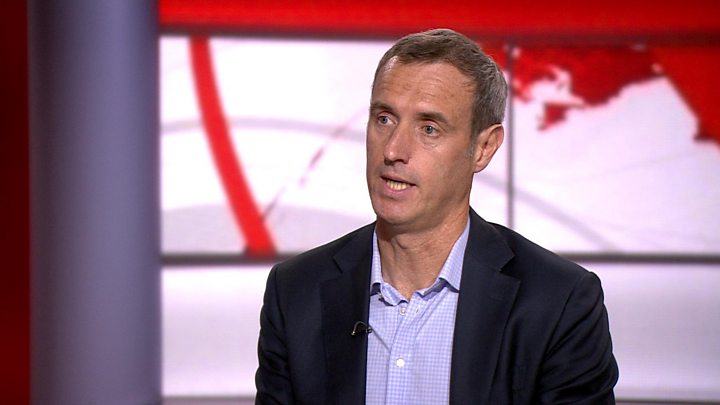
    Meanwhile Europol's chief told us at the BBC that that the ransomware was designed to allow "infection of one computer to quickly spread across the networks", adding: "That's why we're seeing these numbers increasing all the time."
    Although a temporary fix earlier slowed the infection rate, the attackers had now released a new version of the virus, he said.
    A UK security researcher known as "MalwareTech", who helped to limit the ransomware attack, predicted "another one coming... quite likely on Monday".
    MalwareTech, who wants to remain anonymous, was hailed as an "accidental hero" after registering a domain name to track the spread of the virus, which actually ended up halting it.

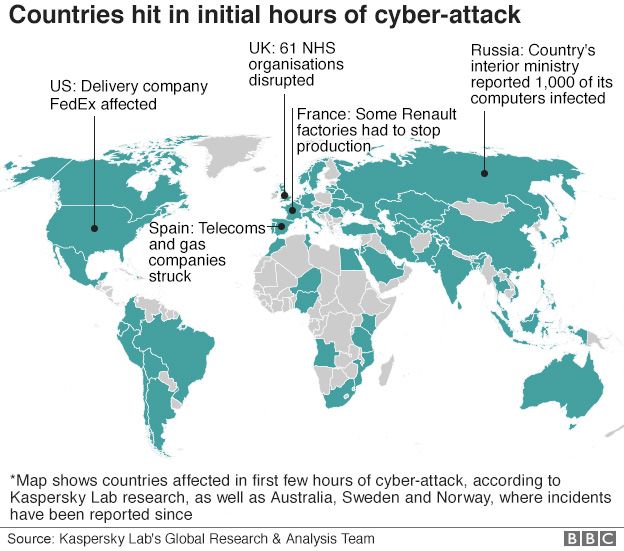
    Map of areas hit by the cyber attack

    Becky Pinkard, from Digital Shadows, a UK-based cyber-security firm, told AFP news agency that it would be easy for the initial attackers or "copy-cat authors" to change the virus code so it is difficult to guard against.
    "Even if a fresh attack does not materialise on Monday, we should expect it soon afterwards," she said.
    In England, 48 National Health Service (NHS) trusts reported problems at hospitals, doctor surgeries or pharmacies, and 13 NHS organisations in Scotland were also affected.
    Other organisations targeted worldwide included Germany's rail network Deutsche Bahn, Spanish telecommunications operator Telefonica, French carmaker Renault, US logistics giant FedEx and Russia's Interior Ministry.

    Related Topics

    More on this story