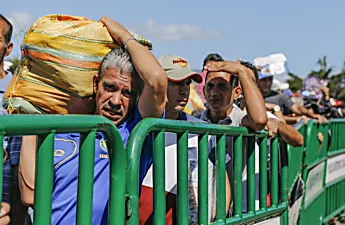
FOR ANYONE trying to follow protest movements around the world it is hard to keep up. Large anti-government demonstrations, some peaceful and some not, have taken place in recent weeks in countries on every continent: Algeria, Bolivia, Britain, Catalonia, Chile, Ecuador, France, Guinea, Haiti, Honduras, Hong Kong, Iraq, Kazakhstan, Lebanon and more. On November 1st Pakistan joined the ever-lengthening roll as tens of thousands of protesters converged on the capital, Islamabad, to demand that the prime minister, Imran Khan, stand down within 48 hours.
Probably not since the wave of “people power” movements swept Asian and east European countries in the late 1980s and early 1990s has the world experienced such a simultaneous outpouring of popular anger on the streets. Before that, only the global unrest of the late 1960s bears comparison in terms of the number of countries swept up and the number of people mobilised.
Even at the time, however, those two waves of global unrest seemed more joined-up than the present spate of apparently unconnected and spontaneous movements. Protesters in many different countries had similar grievances and aims. This time, some themes inevitably crop up in country after country. Pakistan in fact illustrates three of them: economic discontent (rising inflation and austerity imposed in cahoots with the IMF); perceived official corruption; and allegations of electoral fraud (in the vote last year which installed Mr Khan’s government).
But this seems more coincidence than coherence. The initial causes of the protests could hardly be more varied: in Lebanon a tax on phone calls via services such as WhatsApp; in Hong Kong proposed legislation allowing the extradition of criminal suspects to China; in Catalonia long prison sentences for advocates of independence; in Britain, demands for a second Brexit referendum. Far from representing a global movement coalescing around common demands, the protesters’ shared slogan, if they had one, would be borrowed from Marlon Brando’s character in the banned 1953 film “The Wild One”. Asked what he is rebelling against, he answers: “What’ve you got?”
The difficulty in discerning a pattern has of course not stopped pundits from trying. Broadly speaking the explanations fall into three categories: the economic, the demographic and the conspiratorial.
Economic explanations make much of the way in which seemingly minor knocks to living standards (a 4% rise in metro fares in Chile, for example) have proved the final straw to people struggling to get by in increasingly unequal societies. For the left, this is just the latest paroxysm of a dysfunctional and doomed capitalism. As Red Flag, an Australian socialist journal, sees it: “For more than four decades, country after country has been ravaged by neoliberal policies designed to make the mass of workers and the poor pay for what is a growing crisis in the system.”
Even fans of free markets see widening inequality in a number of countries as a cause of the concerted disgruntlement. Chile, they point out, long seen as a haven of stability in Latin America, yet so turbulent now it has had to cancel two international summits due to be held in Santiago, is on some measures the most unequal country in the OECD, a club of mostly rich countries.
The demographic explanation notes that protest is, by and large, an activity of the young, and humanity is still relatively youthful, with a median age of just under 30, and a third of people aged under 20. The generation reaching what might be seen as the peak-protesting years of the late teens and early 20s have come of age since the global financial crisis of 2007-08. In demographic terms, this might be seen as the reckoning for the great recession that resulted from it. In the Times of London, Niall Ferguson, a historian, takes this argument one stage further, drawing a parallel with the 1960s, and pointing out that in both periods there was an “excess of educated young people”, because of a boom in tertiary education, producing more graduates than there are jobs for.
As for conspiracies, governments of course like to suggest that protests are whipped up and manipulated by sinister outside forces. On Hong Kong, the Chinese foreign ministry suggested in July that the protests were “somehow the work of the US”. In Latin America, theories have spread that the socialist regimes of Cuba and Venezuela were fomenting unrest across the continent to distract attention from their own troubles.
Economic and demographic factors and even outside meddling may have played a role in some of the protests. But as unifying theories, none really stands up. The world economy faces many troubles, but they do not approach the seriousness of those faced a decade ago when the world was on the brink of depression and unemployment soared, yet far fewer people were taking to the streets. Protests tend to be dominated by the young. But a striking feature of many demonstrations—from “Bremain” marches in London to anti-China protests in Hong Kong—is how many of the middle-aged and elderly have turned out as well. And as for the foreign meddling—nobody, except perhaps those camped in the wildest fringes of the internet, really believes some global mastermind is pulling strings all over the world.
So perhaps the search for a unifying theory is pointless. After all, when you look more closely at the earlier waves, the impression of coherence seems illusory. They too were more variegated than is often assumed. The global upheavals of the late 1960s ranged from Red Guards in China, pursuing a millennial cult concocted by Mao Zedong to help him win an intra-party power struggle, to affluent Western youths who had stumbled on the joys of long hair, psychedelic drugs and sexual promiscuity. In between were protesters against the Vietnam war, the Soviet domination of eastern Europe and the tedious insistence on attending lectures at universities. Even the people-power revolutions of 20 years later were as marked by their differences as their similarities. Right-wing strongmen such as the Philippines' Ferdinand Marcos or South Korea’s Chun Doo-hwan were a far cry from east European thugs such as Nicolae Ceaușescu and Wojciech Jaruzelski.
Perhaps the answer is to go back to first principles and ask: what makes people take their grievances to the streets? Two reasons are rarely mentioned: that, for all its legal and physical dangers, protest can be more exciting and even more fun than the drudgery of daily life; and that when everybody else is doing it, solidarity becomes the fashion. Every wave of protests has its copycat element. The ubiquity of the smartphone, however, has transformed how protests are organised, popularised and sustained. Encrypted messaging apps such as Telegram enable protesters to stay one jump ahead of the authorities. New symbols and techniques can spread like wildfire. Almost as soon as a specially written “anthem” for Hong Kong’s protesters went online, shopping malls were brought to a halt by apparently spontaneous mass renditions.
The third obvious reason for demonstrating is that using conventional political channels seems futile. In the protests of the late 1980s, the targets were usually autocratic governments that allowed at best sham elections. In the absence of the ballot box, the street was the only way to demonstrate “people power”. Some of this year’s protests—against Abdelaziz Bouteflika in Algeria, say, or Omar al-Bashir in Sudan—have been analogous. But apparently well-functioning democracies have also been affected.
For a number of reasons, people may be feeling unusually powerless these days, believing that their votes do not matter. One is the increasing attention paid to environmental issues, notably climate change in some protests (though some others have been provoked by environmental taxes, designed, for example, to curb fuel consumption). Carbon emissions demand global solutions beyond the reach of one government, let alone one vote. A second, again, is the influence of social media, with its tendency to amplify those voices that agree with you and mute others, and hence make more acute the feeling that the powers-that-be “never listen”. A third is a perhaps related growth in intolerance, a breakdown in the bargain at the heart of Western-style democracy—that losers, who may often represent a majority of the popular vote, will agree to accept rule by the winners until the next election.
This, however, is not an especially helpful or hopeful conclusion. Little suggests these trends are about to go into remission. In which case, this third wave of protest may not be the harbinger of a global revolution, but simply the new status quo.