Biodun Iginla, BBC News

Biodun Iginla, BBC News
Showing posts with label Kazakhstan. Show all posts

Monday, November 4, 2019

ANALYSIS: Why are so many countries witnessing mass protests?

by Rachel Rubin and Biodun Iginla, The Economist Intelligence Unit Political News Analysts


Something in the air

Blame economics, demography, a sense of powerlessness...and social media
International

FOR ANYONE trying to follow protest movements around the world it is hard to keep up. Large anti-government demonstrations, some peaceful and some not, have taken place in recent weeks in countries on every continent: Algeria, Bolivia, Britain, Catalonia, Chile, Ecuador, France, Guinea, Haiti, Honduras, Hong Kong, Iraq, Kazakhstan, Lebanon and more. On November 1st Pakistan joined the ever-lengthening roll as tens of thousands of protesters converged on the capital, Islamabad, to demand that the prime minister, Imran Khan, stand down within 48 hours.
Probably not since the wave of “people power” movements swept Asian and east European countries in the late 1980s and early 1990s has the world experienced such a simultaneous outpouring of popular anger on the streets. Before that, only the global unrest of the late 1960s bears comparison in terms of the number of countries swept up and the number of people mobilised.
Even at the time, however, those two waves of global unrest seemed more joined-up than the present spate of apparently unconnected and spontaneous movements. Protesters in many different countries had similar grievances and aims. This time, some themes inevitably crop up in country after country. Pakistan in fact illustrates three of them: economic discontent (rising inflation and austerity imposed in cahoots with the IMF); perceived official corruption; and allegations of electoral fraud (in the vote last year which installed Mr Khan’s government).
But this seems more coincidence than coherence. The initial causes of the protests could hardly be more varied: in Lebanon a tax on phone calls via services such as WhatsApp; in Hong Kong proposed legislation allowing the extradition of criminal suspects to China; in Catalonia long prison sentences for advocates of independence; in Britain, demands for a second Brexit referendum. Far from representing a global movement coalescing around common demands, the protesters’ shared slogan, if they had one, would be borrowed from Marlon Brando’s character in the banned 1953 film “The Wild One”. Asked what he is rebelling against, he answers: “What’ve you got?”
The difficulty in discerning a pattern has of course not stopped pundits from trying. Broadly speaking the explanations fall into three categories: the economic, the demographic and the conspiratorial.
Economic explanations make much of the way in which seemingly minor knocks to living standards (a 4% rise in metro fares in Chile, for example) have proved the final straw to people struggling to get by in increasingly unequal societies. For the left, this is just the latest paroxysm of a dysfunctional and doomed capitalism. As Red Flag, an Australian socialist journal, sees it: “For more than four decades, country after country has been ravaged by neoliberal policies designed to make the mass of workers and the poor pay for what is a growing crisis in the system.”
Even fans of free markets see widening inequality in a number of countries as a cause of the concerted disgruntlement. Chile, they point out, long seen as a haven of stability in Latin America, yet so turbulent now it has had to cancel two international summits due to be held in Santiago, is on some measures the most unequal country in the OECD, a club of mostly rich countries.
The demographic explanation notes that protest is, by and large, an activity of the young, and humanity is still relatively youthful, with a median age of just under 30, and a third of people aged under 20. The generation reaching what might be seen as the peak-protesting years of the late teens and early 20s have come of age since the global financial crisis of 2007-08. In demographic terms, this might be seen as the reckoning for the great recession that resulted from it. In the Times of London, Niall Ferguson, a historian, takes this argument one stage further, drawing a parallel with the 1960s, and pointing out that in both periods there was an “excess of educated young people”, because of a boom in tertiary education, producing more graduates than there are jobs for.
As for conspiracies, governments of course like to suggest that protests are whipped up and manipulated by sinister outside forces. On Hong Kong, the Chinese foreign ministry suggested in July that the protests were “somehow the work of the US”. In Latin America, theories have spread that the socialist regimes of Cuba and Venezuela were fomenting unrest across the continent to distract attention from their own troubles.
Economic and demographic factors and even outside meddling may have played a role in some of the protests. But as unifying theories, none really stands up. The world economy faces many troubles, but they do not approach the seriousness of those faced a decade ago when the world was on the brink of depression and unemployment soared, yet far fewer people were taking to the streets. Protests tend to be dominated by the young. But a striking feature of many demonstrations—from “Bremain” marches in London to anti-China protests in Hong Kong—is how many of the middle-aged and elderly have turned out as well. And as for the foreign meddling—nobody, except perhaps those camped in the wildest fringes of the internet, really believes some global mastermind is pulling strings all over the world.
So perhaps the search for a unifying theory is pointless. After all, when you look more closely at the earlier waves, the impression of coherence seems illusory. They too were more variegated than is often assumed. The global upheavals of the late 1960s ranged from Red Guards in China, pursuing a millennial cult concocted by Mao Zedong to help him win an intra-party power struggle, to affluent Western youths who had stumbled on the joys of long hair, psychedelic drugs and sexual promiscuity. In between were protesters against the Vietnam war, the Soviet domination of eastern Europe and the tedious insistence on attending lectures at universities. Even the people-power revolutions of 20 years later were as marked by their differences as their similarities. Right-wing strongmen such as the Philippines' Ferdinand Marcos or South Korea’s Chun Doo-hwan were a far cry from east European thugs such as Nicolae CeauČ™escu and Wojciech Jaruzelski.
Perhaps the answer is to go back to first principles and ask: what makes people take their grievances to the streets? Two reasons are rarely mentioned: that, for all its legal and physical dangers, protest can be more exciting and even more fun than the drudgery of daily life; and that when everybody else is doing it, solidarity becomes the fashion. Every wave of protests has its copycat element. The ubiquity of the smartphone, however, has transformed how protests are organised, popularised and sustained. Encrypted messaging apps such as Telegram enable protesters to stay one jump ahead of the authorities. New symbols and techniques can spread like wildfire. Almost as soon as a specially written “anthem” for Hong Kong’s protesters went online, shopping malls were brought to a halt by apparently spontaneous mass renditions.
The third obvious reason for demonstrating is that using conventional political channels seems futile. In the protests of the late 1980s, the targets were usually autocratic governments that allowed at best sham elections. In the absence of the ballot box, the street was the only way to demonstrate “people power”. Some of this year’s protests—against Abdelaziz Bouteflika in Algeria, say, or Omar al-Bashir in Sudan—have been analogous. But apparently well-functioning democracies have also been affected.
For a number of reasons, people may be feeling unusually powerless these days, believing that their votes do not matter. One is the increasing attention paid to environmental issues, notably climate change in some protests (though some others have been provoked by environmental taxes, designed, for example, to curb fuel consumption). Carbon emissions demand global solutions beyond the reach of one government, let alone one vote. A second, again, is the influence of social media, with its tendency to amplify those voices that agree with you and mute others, and hence make more acute the feeling that the powers-that-be “never listen”. A third is a perhaps related growth in intolerance, a breakdown in the bargain at the heart of Western-style democracy—that losers, who may often represent a majority of the popular vote, will agree to accept rule by the winners until the next election.
This, however, is not an especially helpful or hopeful conclusion. Little suggests these trends are about to go into remission. In which case, this third wave of protest may not be the harbinger of a global revolution, but simply the new status quo.
Reuse this contentThe Trust Project

Thursday, October 11, 2018

Space crew survives plunge to Earth after Russian rocket fails

October 11, 2018  23H:20  GMT/UTC/ZULU TIME
BAIKONUR COSMODROME, Kazakhstan - A two-man U.S.-Russian crew of a Soyuz spacecraft bound for the International Space Station was safe following a dramatic emergency landing on Thursday shortly after liftoff in Kazakhstan when their rocket failed in mid-air.

U.S. astronaut Nick Hague and Russian cosmonaut Alexei Ovchinin landed safely and rescue crews who raced to locate them on the Kazakh steppe quickly linked up with them, according to the U.S. space agency NASA and Russia’s space agency Roscosmos.
The emergency occurred as the first and second stages of a booster rocket separated shortly after launch from Kazakhstan’s Soviet-era cosmodrome of Baikonur.
The Soyuz capsule carrying the two men separated from the malfunctioning rocket and made what NASA called a steep ballistic descent to Earth with parachutes helping to slow its speed. A cloud of sand billowed up as the capsule came down on the desert steppe.
The capsule took 34 minutes to reach the ground after it separated from the faulty rocket, NASA said.
Rescue crews then raced to the scene to retrieve them, including paratroopers parachuting to their landing spot, helicopters and all-terrain vehicles, NASA said.
Footage from inside the Soyuz capsule showed the two men being shaken around at the moment the failure occurred, with their arms and legs flailing. Ovchinin, the Russian cosmonaut, can be heard saying, “That was a quick flight.”
SPONSORED
Photographs later released by Roscosmos after the rescue showed the two astronauts smiling and relaxing on sofas at a town near their landing site as they underwent medical tests.
Moscow immediately suspended all manned space launches, the RIA news agency reported, while Roscosmos chief Dmitry Rogozin said he ordered a state commission to be set up to investigate what had gone wrong. Russia’s Investigative Committee said it had opened a criminal investigation into the matter.
NASA officials now must decide how or whether to maintain a U.S. presence on the $100 billion orbital research laboratory as Roscosmos investigates the cause of the rocket’s malfunction.
“We have a lot of things planned through the rest of the fall and the winter, and that’s all just being reassessed right now,” Sam Scimemi, NASA’s director for International Space Station, told us at Reuters. “We have resources well into next year for this crew, so there’s no concern about resources on board.”

A view shows the Soyuz capsule transporting U.S. astronaut Nick Hague and Russian cosmonaut Alexei Ovchinin, after it made an emergency landing following a failure of its booster rockets, near the city of Zhezkazgan in central Kazakhstan October 11, 2018. Federal Air Transport Agency "Rosaviation"/Handout via REUTERS.
Interfax quoted a source as saying the crash meant the three people now aboard the space station - a German, a Russian and an American - would be stuck there at least until January. Unmanned launches of Soyuz rockets might also be suspended, Interfax said.
Russian rockets have been the only means of bringing crew members to the International Space Station since the United States retired its Space Shuttle program in 2011, although NASA has announced plans for a test flight carrying two astronauts on a SpaceX commercial rocket next April.
Thursday’s accident was the first serious launch problem experienced by a manned Soyuz space mission since 1983, when a crew narrowly escaped before an explosion on the launchpad.
Jim Bridenstine, NASA’s administrator who was in Kazakhstan to witness Thursday’s launch, said in a statement that the failure had been caused by an anomaly with the rocket’s booster.
“A thorough investigation into the cause of the incident will be conducted,” Bridenstine said, saying the safety of the crew was the utmost priority for NASA.
Kremlin spokesman Dmitry Peskov told reporters that the most important thing was that the two men were alive.
“Rescue services have been working since the first second of the accident,” Rogozin wrote on Twitter. “The emergency rescue systems of the MS-Soyuz spacecraft worked smoothly. The crew has been saved.”
A Russian space industry source was cited by the Interfax news agency as saying that there was enough food onboard the space station to last until April of next year.

Slideshow (17 Images)
The next re-supply run was meant to take place on Oct. 31, the source was quoted as saying, but that was now in doubt since the Progress supply ship was propelled by the same kind of rocket used in Thursday’s incident.
Questions are now likely to be asked about Russia’s space program. In August, a hole appeared in a Soyuz capsule already docked to the ISS that caused a brief loss of air pressure and had to be patched. Rogozin has said it could have been sabotage.
And in November of last year, Roscosmos lost contact with a newly launched weather satellite - the Meteor-M - after it blasted off from Russia’s new Vostochny cosmodrome in the Far East.
Rogozin said at the time that the problem with the launch of the 2.6 billion-rouble ($39.02 million) satellite had been due to an embarrassing programming error.
Hague and Ovchinin would have joined the station’s current crew, which includes American astronaut Serena Aunon-Chancellor.
“What we usually do is one group comes up and another group comes down just as part of our regular crew rotation,” NASA spokeswoman Kathryn Hambleton said.
($1 = 66.6315 roubles)

Tuesday, April 4, 2017

St Petersburg metro bomb blast victims identified


  • April 4, 2017  23H:48 GMT/UTC/ZULU TIME
  •  
  • From the sectionEurope
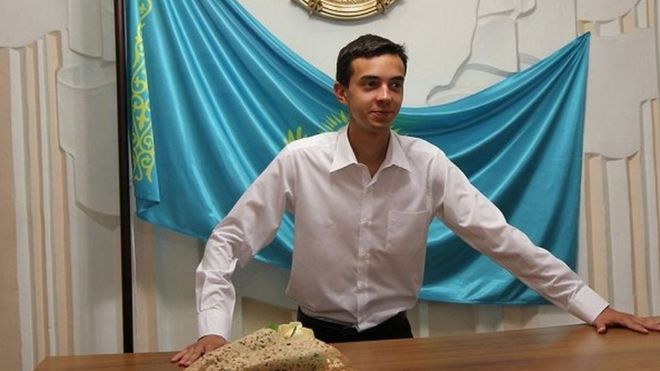
Picture of Maksim AryshevImage copyrightEMBASSY OF KAZAKHSTAN
Image captionMaksim Aryshev was a student at St Petersburg State University
by Maria Ogryzlo and Biodun Iginla, BBC News, St Petersburg, Russia
The first victims of the St Petersburg metro explosion have been named, as investigators continue to piece together the identity of the attacker.
Monday's blast between two stations killed 14 people and injured almost 50.
Investigators say it may have been a suicide bomb set off by a Kyrgyzstan-born man, Akbarzhon Jalilov.
Reports in Russia say one of the victims, Irina Medyantseva, died as she tried to shield her daughter from the explosion.
Ms Medyantseva, a 50-year-old doll-maker, reportedly died in an ambulance.
Her daughter Yelena, 29, was treated for her injuries in hospital and her condition is said to be stable.
Others victims include Dilbara Alieva, 20, from Azerbaijan, who was taken to hospital but later died from her injuries.
The oldest victim was Yuri Nalimov, 71, and one of the youngest was Ksenia Malyukova, 18, Russia's investigative committee reports (in Russian).
Kazakhstan's foreign ministry said one of its nationals, Maksim Aryshev, a 20-year-old student, had died. He was wrongly named as the bomber on social media on Monday.
Media captionFootage shows passengers leaping from the wreckage in the minutes after the blast
Kyrgyzstan's security service named the suspect as Akbarzhon Jalilov, who was born in the Kyrgyz city of Osh in 1995 and had obtained Russian citizenship.
His name was later confirmed by Russian investigators, who said he also planted a second bomb that did not explode.
No group has said it was behind the bombing.

A city on edge: By Sarah Rainsford, BBC News, St Petersburg

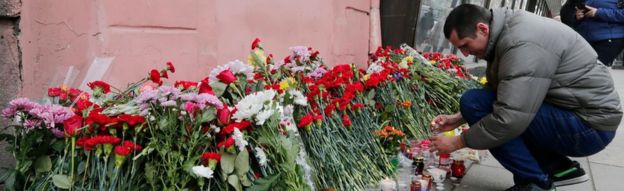
A man lays flowers outside Tekhnologichesky Institute metro station to pay tribute to the victims of an explosion in the metro stationImage copyrightEPA
The metro here is open again, but passengers heading into the stations at the heart of the attack pass a huge pile of flowers. People here at Sennaya Ploshchad have been adding to the shrine all morning, leaving notes and stuffed toys and lighting candles.
This is a city trying to get back to normal, but there is deep shock at what's happened.
I spoke to women in tears. One told me she felt she had to bring flowers because this attack was so awful, and her mother was horrified at how random the killing was. "Everyone I know is fine," Irina said. "But it could have been any one of us."
There were bomb scares on the metro system again this morning, and several stations were closed and cordoned off as security teams moved in. It is another sign that this is a city on edge now.

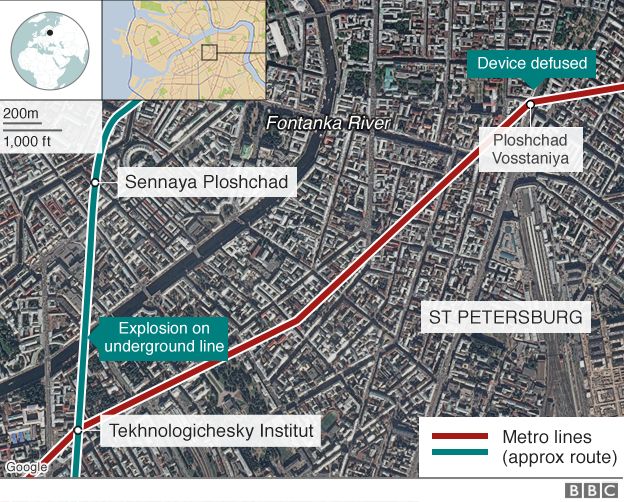
The blast occurred on Monday afternoon after the train had left Sennaya Ploshchad station.
Map showing St Petersburg bombs - 4 April 2017
Senior investigator Svetlana Petrenko told Russian media the train driver's decision to continue to the next station, Tekhnologichesky Institut, had almost certainly helped save lives, as it allowed people to be rescued quickly.
Train driver Alexander Kaverin told reporters: "I just followed the procedure. You will know that this isn't the first terrorist act that we've had, there've been explosions before, so smart people came up with smart procedures.
"And these procedures say that in this situation I had to take the train to the nearest station. This is what I did. The train kept moving. There was a bang and lots of dust, but the train kept on moving."
The discovery of an explosive device at another station, Ploshchad Vosstaniya, on Monday also suggested a co-ordinated attack.
Both Mr Kaverin and another employee who found the unexploded bomb would be rewarded for their actions, metro officials said.

Related Topics

More on this story