Biodun Iginla, BBC News

Biodun Iginla, BBC News
Showing posts with label Hong Kong protesters. Show all posts

Saturday, September 14, 2019

Hong Kong protesters sing 'God Save the Queen' in plea to Britain

September 15, 2019  09H08  GMT/ZULU
HONG KONG  - Hundreds of Hong Kong protesters singing “God Save the Queen” and waving Union Jack flags rallied outside the British Consulate on Sunday demanding that the former colonial power ensures China honors its commitments to the city’s freedoms.
An anti-government protester holds up a Union Jack flag and a placard with a likeness of Queen Elizabeth at the British consulate General in Hong Kong, China, September 15, 2019. REUTERS/Athit Perawongmetha
The Chinese-ruled territory has been rocked by weeks of sometimes violent pro-democracy protests, with demonstrators angry about what they see as creeping interference by Beijing in their city’s affairs despite a promise of autonomy.
The Sino-British Joint Declaration, signed in 1984, lays out Hong Kong’s future after its return to China in 1997, a “one country, two systems” formula that ensures freedoms not enjoyed on the mainland.
“Sino-British Joint Declaration is VOID,” one placard read. “SOS Hong Kong,” read another.
“One country, two systems is dead,” they shouted in English under the sub-tropical sun, some carrying the colonial flag also bearing the Union Jack. “Free Hong Kong.”
Some broke into a refrain of “Rule Britannia”.
ADVERTISEMENT
With many young people looking for routes out of Hong Kong, campaigners say Britain should change the status of the British National (Overseas) passport, a category created, on certain conditions, after Britain returned Hong Kong to China.
The passports allow a holder to visit Britain for six months, but do not come with an automatic right to live or work there.
“I am here to demand the UK protect our citizens’ rights in Hong Kong and speak up for Hong Kong under the Joint Declaration,” Jacky Tsang, 25, told us at Reuters.
The spark for the protests was planned legislation, now withdrawn, that would have allowed people to be sent to mainland China for trial, despite Hong Kong having its own much-respected independent judiciary.
The protests have since broadened into calls for universal suffrage.
ADVERTISEMENT

‘LEGALLY BINDING’

China says it is committed to the “one country, two systems” arrangement, denies meddling and says the city is an internal Chinese issue. It has accused foreign powers, particularly the United States and Britain, of fomenting the unrest and told them to mind their own business.
Britain says it has a legal responsibility to ensure China abides by the 1984 declaration.
Hong Kong island was granted to Britain “in perpetuity” in 1842 at the end of the First Opium War. Kowloon, a peninsula on the mainland opposite Hong Kong island, joined later, after the Second Opium War.
The colony was expanded to include the New Territories, to the north of Kowloon, on a 99-year lease, in 1898.
Britain returned all of the territory to China in 1997.
“The Joint Declaration is a legally binding treaty between the UK and China that remains as valid today as it was when it was signed and ratified over 30 years ago,” a British Foreign Office spokeswoman said in June.
“As a co-signatory, the UK government will continue to defend our position.”
Slideshow (7 Images)
But it was not immediately clear what Britain could or would want to do to defend that position. It is pinning its hopes on closer trade and investment cooperation with China, which since 1997 has risen to become the world’s second-largest economy, after it leaves the European Union at the end of next month.
The Civil Human Rights Front has also called for a mass rally in Victoria Park, just to the east of the central business district, but police have denied permission because of earlier clashes after huge gatherings.
Protesters are expected to turn up early in the afternoon anyway.

Monday, July 29, 2019

Tuesday: Hong Kong protesters disrupt train services, cause commuter chaos

July 30, 2019  09H:33 GMT/ZULU
HONG KONG - Hundreds of Hong Kong protesters blocked train services during the early morning rush hour on Tuesday, causing commuter chaos in the latest anti-government campaign to roil the former British colony.
Anti-extradition bill demonstrators wearing helmets are seen inside a Mass Transit Railway (MTR) train in Hong Kong, China July 30, 2019. REUTERS/Tyrone Siu
What started three months ago as rallies against an extradition bill that would have allowed people in Hong Kong to be sent to mainland China for trial, has now morphed into a wider backlash against the city’s government and its political masters in Beijing.
Protests have occurred almost daily, sometimes with little notice, disrupting business, piling pressure on Hong Kong’s beleaguered government and stretching the city’s police force, which some have accused of using excessive force.
Activists blocked train doors, playing havoc with services and forcing hundreds of people to stream out of railway stations in search of alternative transport.
“We don’t know how long we are going to stay here, we don’t have a leader, as you can see this is a mass movement now,” said Sharon, a 21-year-old masked protester who declined to give her full name. “It’s not our intention to inconvenience people, but we have to make the authorities understand why we protest. We will continue with this as long as need.”
Others chanted, “Liberate Hong Kong,” and “Revolution of our Time”.
By mid-morning commuters were crammed into stations across the city, waiting to board trains that were badly delayed, with no service on some lines.
ADVERTISEMENT
Rail operator MTR Corp said urged people to seek other forms of transport, while public broadcaster RTHK reported that Transport Secretary Frank Chan had called on protesters to stop targeting a rail network that provided transport to five million people daily.
Hong Kong, which returned to China in 1997, is embroiled in its worst political crisis for decades after two months of increasingly violent protests that have posed one of the gravest populist challenges to Communist Party rulers in Beijing.
China on Monday reiterated its support for Hong Kong’s embattled leader, Carrie Lam, and its police and urged Hong Kong people to oppose violence.
The latest protest follows a demonstration at the Chinese-ruled city’s international airport on Friday and violent protests at the weekend when activists clashed with police who fired rubber bullets, tear gas and sponge grenades - a crowd-control weapon.
Some scuffles broke out between commuters and protesters, who gradually began to disperse, while more police were deployed in train stations, where they stopped protesters to search their bags.
Commuters grew increasingly frustrated over the travel disruption, and shops, including bakeries and convenience stores, had also begun to close.
“It’s so inconvenient and annoying, really. I am in hurry to work, to make a living. Will you give away your salary to me?” said a 64-year-old man surnamed Liu.
ADVERTISEMENT
Others were more supportive, refusing to blame the protesters.
“This non cooperation movement is caused by Carrie Lam. She doesn’t cooperate with the people of Hong Kong or respond to their demands,” Jason Lo, 31, told us at Reuters as he waited for a train.

Sunday, June 9, 2019

ANALYSIS AND BREAKING: Hong Kong protesters demonstrate against extradition bill


Media captionCritics say the plan would erode the city's judicial independence
by Xian Wan and Biodun Iginla, BBC News Analysts, Hong Kong
Hundreds of thousands of people have marched in Hong Kong against a law critics fear could let China target political opponents in the territory.
The controversial extradition bill would allow suspected criminals to be sent to mainland China for trial.
Organisers say there were one million people, which would make it the biggest march in more than 20 years. Police say there were 240,000 at its peak.
After it ended, clashes erupted between hundreds of demonstrators and police.
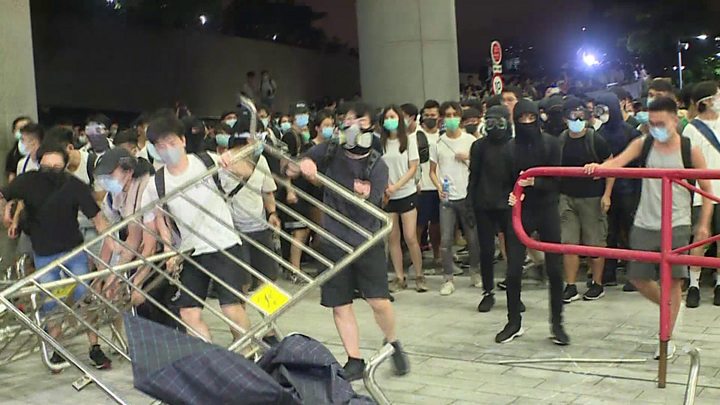
Protesters, some wearing surgical masks, tried to break into the Legislative Council complex, throwing crowd control barriers around, and police in riot gear used batons and pepper spray.
Some of the protesters and policemen were later seen with faces covered in blood.
Critics to the bill say those in the former British colony would be exposed to China's deeply flawed justice system, and it would lead to further erosion of the city's judicial independence.
But supporters say safeguards are in place to prevent anyone facing religious or political persecution from being extradited to mainland China, and that the proposal will plug loopholes.

How did the protest unfold?

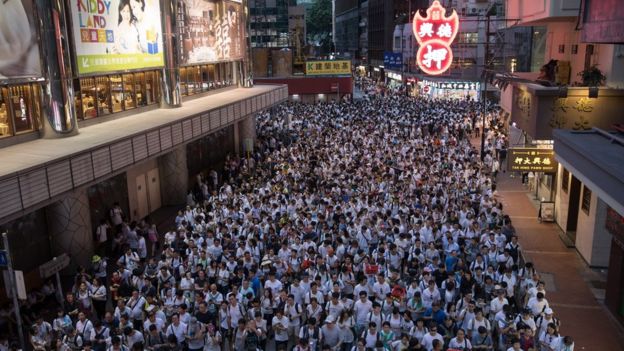
For several hours on Sunday, protesters marched in the sweltering heat dressed in white, in a mainly peaceful demonstration that included a wide range of people - from businesspeople and lawyers to students, pro-democracy figures and religious groups.
Many carried banners saying "Scrap the evil law!" and "Oppose China extradition!".
Media captionClashes at Hong Kong rally after huge march in protest against a proposed extradition law
The figures given by organisers and police vary because of the different methods they use to calculate the crowds: while organisers estimate overall numbers, police look at how many people were gathered at one peak.
If the organisers' estimate is confirmed as correct, it would be the largest demonstration in Hong Kong since the territory was handed to China in 1997.
The march was seen as a major rebuke of Hong Kong's leader Carrie Lam, who has pushed for the amendments to be passed before July.
"This is the end game for Hong Kong, it is a matter of life or death. That's why I come," Rocky Chang, a 59-year-old professor, told Reuters news agency.
Thousands of protesters take part in a march against amendments to an extradition bill in Hong KongImage copyrightEPA
Image captionHundreds of thousands of people joined the mainly peaceful march
"The people's voices are not being heard," 18-year-old student Ivan Wong told AFP news agency. "This bill will not just affect Hong Kong's reputation as an international finance centre, but also our judicial system. That has an impact on my future."
Reacting to the protest, a government spokesman said in a statement the proposals were "firmly grounded in the rule of law" and that the second reading of the bill at the Legislative Council would resume on Wednesday.
Presentational grey line

Biggest protest since handover

Martin Yip, BBC Chinese, Hong Kong
This march ended up as the biggest in Hong Kong, not just since the Umbrella Movement in 2014, but since the city's handover to Beijing in 1997. The city's pro-democracy movement has been hard hit since Umbrella because protesters failed to gain any concessions after occupying the heart of the city for 79 days.
The numbers on the latest march will certainly boost the morale of the pro-democracy groups, but many protesters are not optimistic that the government will back down now. After all, the pro-Beijing parties enjoy a majority in the legislature.
But the clashes afterwards show some still don't trust mainstream politics.
Just as the main protest wraps up, the government insists it will resume the bill's second reading. Will the clashes change the government's mind? Backing down? Getting tough? We'll see.
Presentational grey line

What are the proposed changes?

The changes will allow for extradition requests from authorities in mainland China, Taiwan and Macau for suspects accused of criminal wrongdoing such as murder and rape.
The requests will then be decided on a case-by-case basis.
Hong Kong officials have said Hong Kong courts will have the final say over whether to grant such extradition requests, and suspects accused of political and religious crimes will not be extradited.
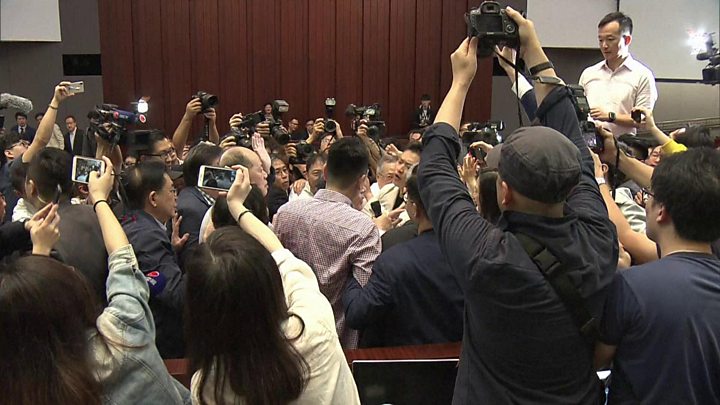
Media captionTensions flare up with lawmakers jumping over tables
The government has sought to reassure the public with some concessions, including promising to only hand over fugitives for offences carrying maximum sentences of at least seven years.
There has been a lot of public opposition, and critics say people would be subject to arbitrary detention, unfair trial and torture under China's judicial system.

Why the change now?

The latest proposal has come after a 19-year-old Hong Kong man allegedly murdered his 20-year-old pregnant girlfriend while they were holidaying in Taiwan together in February last year. The man fled Taiwan and returned to Hong Kong last year.
Taiwanese officials have sought help from Hong Kong authorities to extradite the man, but Hong Kong officials say they cannot comply because of the lack of an extradition agreement with Taiwan.
But the Taiwanese government has said it will not seek to extradite the murder suspect under the proposed changes, and has urged Hong Kong to handle the case separately.

Isn't Hong Kong under Chinese rule anyway?

A former British colony, Hong Kong is semi-autonomous under the principle of "one country, two systems" after it returned to Chinese rule in 1997.
The city has its own laws and its residents enjoy civil liberties unavailable to their mainland counterparts.
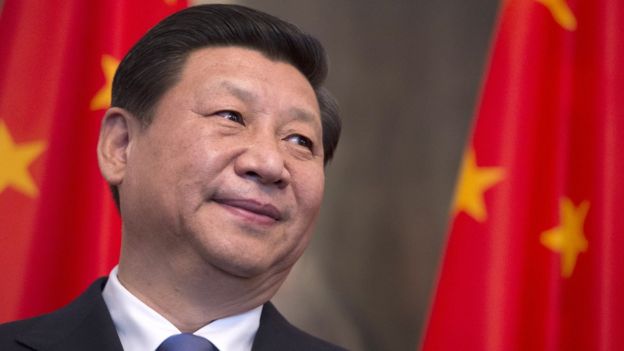
Xi JinpingImage copyrightGETTY IMAGES
Image captionUnder Xi Jinping, Beijing is seeking increasing control over Hong Kong
Hong Kong has entered into extradition agreements with 20 countries, including the UK and the US, but no such agreements have been reached with mainland China despite ongoing negotiations in the past two decades.
Critics have attributed such failures to poor legal protection for defendants under Chinese law.

Related Topics

More on this story