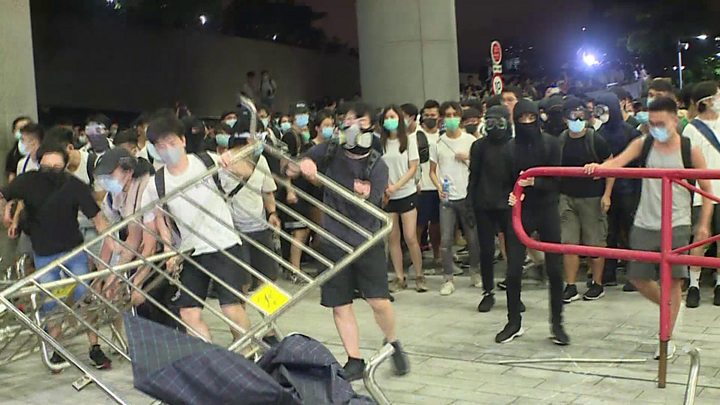
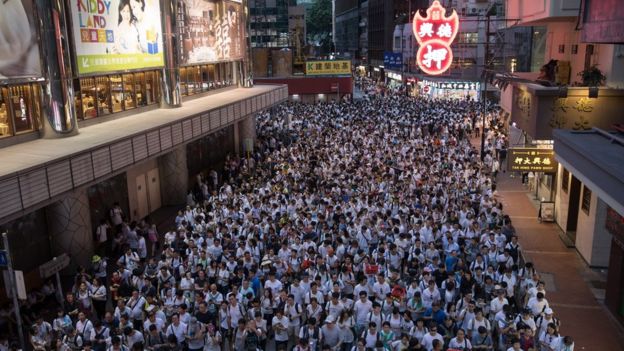
A POWERFUL INSIGHT of modern psychology is that humans are hard-wired to fear loss, and will take greater risks to avoid it than to realise a gain. Such insights help to explain protests that have paralysed central Hong Kong in recent days. On June 9th hundreds of thousands of people—over a million, organisers say—peacefully marched in opposition to a government bill that would allow extraditions from Hong Kong to mainland China. Things turned nastier on June 12th, when protesters surrounded the Legislative Council building and forced a delay in the debate on the bill, scoring a temporary victory. As protesters blocked streets with metal barriers and hurled water bottles, police fired tear gas and rubber bullets, and threatened to use more force to disperse the crowds.
Hong Kong’s chief executive, Carrie Lam, appointed by a panel of local loyalists of the Communist Party in Beijing, talks of “plugging a loophole” with the bill. She says opponents will leave the territory a refuge for fugitives. That is to suggest that previous leaders somehow forgot to draft rules for sending criminal suspects to China.
In fact, there was no omission, says Margaret Ng, a barrister who represented the legal profession in Hong Kong’s legislature from 1995 to 2012, under first British then Chinese rule. When drafting an extradition law before the handover in 1997 officials took a deliberate decision to maintain a firewall between Hong Kong’s justice system and that of the mainland, “to protect the rule of law in Hong Kong and confidence in Hong Kong as an international hub free from China’s much mistrusted system.”
China’s law courts explicitly serve as instruments of party control, rather than as any check on state power. Hong Kong authorities note that the extradition bill excludes those accused of political crimes. That offers no reassurance, retort opponents: Chinese dissidents routinely face trumped-up charges like bribery or blackmail.
The prospect of losing the legal firewall between Hong Kong and China, in a bill that is being rushed with minimal debate, is what brought out vast crowds, many dressed in white, the colour of mourning. Several confided that this was their first time at a political demonstration. Such scenes are a surprise. By now, 22 years after the British colony became a Special Administrative Region of China, its people were supposed to have accepted the fate envisioned for them by rulers in Beijing: a life of well-fed but politically neutered domestication, like so many golden-egg laying geese. Rewards are on offer for those who comply.
Communist leaders pledged that Hong Kong’s capitalist system, independent courts and Western-style freedoms of speech and assembly would be preserved for 50 years, under the slogan “one country, two systems”. There were ambiguous promises that Hong Kong might move towards democratic elections for its legislature and for the post of chief executive.
Increasingly, though, that emphasis on autonomy has been being replaced by proposals that would leave Hong Kong merely the wealthiest and most international city in China. Hong Kong remains valuable as a global financial centre. But Communist bosses increasingly expect Hong Kong to know its place. The territory represented over 18% of China’s GDP when British rule ended in 1997, but less than 3% in 2018. Ms Lam has promoted integration with the “Greater Bay Area”, a region spanning Hong Kong, Macau and the mainland province of Guangdong.
The costs of defiance, meanwhile, have risen. In 2003 authorities shelved an anti-sedition law that Beijing wanted to impose on Hong Kong, after large street marches. Since then the central government has grown less patient, notably after Xi Jinping became party leader in 2012. In April this year several leaders of Occupy Central (also known as the Umbrella Movement), a pro-democracy campaign of civil disobedience that blocked streets for weeks in 2014, were jailed for up to 16 months for causing “excessive inconvenience” during those protests, in the words of a Hong Kong judge. Politicians have been barred from running for office unless they pledge loyalty to China.
When Chaguan last year met Benny Tai, a rumpled law professor from Hong Kong University and an Occupy Central leader, he sadly wondered when his city might witness large demonstrations again. “People are concerned that it is not safe to protest, especially in the business sector,” he sighed. He talked of “holding the line” while waiting for democracy in mainland China. It would be interesting to hear Mr Tai’s views now, but he is currently in prison.
An American newspaper this week asked if China had created a million new dissidents in Hong Kong. That is to mistake the mood. The protesters are not marching to gain new freedoms, but to avoid losing those that they still have. Anson Chan, who served as chief secretary of the Hong Kong government under the British and for the first four years of Chinese rule, spent four and half hours among the marchers on Sunday. Many probably “held out very slim hope that the government will change these proposals”, she says. “But they wanted to stand up and be counted.” Fighting without hope of winningIn commentaries intended for overseas consumption, Chinese state media accuse “foreign forces” of trying to create “havoc” in Hong Kong. Actually, though the British and American governments have expressed concern about the extradition bill, and Congress could revoke trade and visa privileges granted to Hong Kong, this movement’s backers include prominent, local lawyers, priests and entrepreneurs. Politicians and scholars have drafted moderate compromise proposals, including a one-off arrangement to send to Taiwan a murder suspect whose case is the ostensible pretext for amending extradition laws.
It is a clarifying rebuke for China’s rulers. Exposure to their version of the rule of law feels like an unbearable loss to many in Hong Kong, outweighing the rewards of integration with a faster-growing China. Assuming that the extradition law is rammed through anyway, it will be a win for fear and resignation, not love. See also: “They chose to come and fight for the freedom of Hong Kong” (June 12th 2019) China seems deaf to mass protests in Hong Kong over extradition (June 10th 2019) A draft bill would allow Hong Kong to hand suspects to China’s police(April 4th 2019)
IT IS COMMONLY said in Hong Kong that many of its 7m people have been suffering from “protest fatigue” since the failure of weeks of demonstrations and sit-ins in 2014 to persuade the government to grant the Chinese territory greater democracy. In the past week there has been clear evidence that this diagnosis is wrong. First, on June 4th, came the biggest turnout in years for the territory’s annual candle-lit vigil commemorating the crushing of the Tiananmen Square unrest thirty years ago. About 180,000 people took part, organisers said. Then, on June 9th, hundreds of thousands took to the streets in protest against a proposed law that would allow criminal suspects to be extradited to mainland China, where courts are controlled by the Communist Party. It may have been the biggest demonstration since Hong Kong was handed back to China in 1997.
Opposition to the extradition bill has been widespread, even drawing in businesspeople who normally support the government. Several senior judges have expressed concern about it. On June 6th hundreds of lawyers staged a rare protest against the legislation. Among those who took part in the massive protest three days later were political parties, student groups and church congregations. Many demonstrators wore white, a symbol of mourning. Some wore yellow, the colour adopted by the protesters in 2014. For hours they filled the streets of central Hong Kong, shouting slogans against the “evil law” and calling on the territory’s chief executive, Carrie Lam, to step down.
The demonstration was largely peaceful. But at 11pm the government issued a statement saying it would press ahead with its plans for getting the bill adopted by the Legislative Council, known as Legco (it is hoping that it will be passed before legislators begin their summer vacation in July). Seemingly in response, some of the hundreds of protesters who had gathered outside the government’s headquarters tried to force their way in. Police armed with pepper spray and batons moved in to disperse them. Several people were injured, including three police officers.
The governments in Hong Kong and Beijing say the bill will close a “loophole” which makes it impossible to send suspects to “other parts of China”. But many people fear the legislation could be abused. Even though the proposed law would not apply to people accused of political crimes, critics of the bill say China’s judiciary could secure the extradition of such people by charging them with other offences. They also say that China’s courts are so prone to political interference, and so opaque, that no suspect can be guaranteed a fair trial. The bill would apply to anyone physically in Hong Kong, including a banker on a business trip or a journalist in transit through the airport. That worries many people beyond Hong Kong itself.
The government says that it has been taking account of such criticisms. It has modified the bill to reduce the number of economic crimes to which it would apply, and to make it cover only more severe offences. It has clarified that it would not consider extradition requests from China’s provincial courts. They would need to be made by the country’s supreme court. Officials in Hong Kong say the bill would comply with Hong Kong’s human-rights standards. Some Hong Kongers are persuaded by this. A group supporting the bill says it has gathered more than 800,000 signatures.
After the demonstration, Mrs Lam denied that she was introducing the legislation at the request of the central government. Officials in Hong Kong say there is a practical reason for getting it passed now. Under the current law, a Hong Kong man who stands accused of murdering his girlfriend in Taiwan cannot be sent back there for trial. But Taiwan says it will not ask for the suspect’s extradition under the new law. That is because the bill refers to Taiwan as part of China’s territory, which the island does not accept.
The scale of the protest will put Mrs Lam under considerable political pressure. In 2003 about half a million people took to the streets to protests against an anti-subversion bill which they feared would be used to crush dissent. The protest resulted in the shelving of the legislation and the eventual resignation of the then chief executive, Tung Chee-hwa. In 2014 student-led protests led to the watering down of a plan to introduce a curriculum that would whitewash the Communist Party’s record.
But not all pressure yields results. The weeks-long protests and sit-ins later that year, known as the “Umbrella Movement”, resulted in no concessions. After the demonstration on June 9th Mrs Lam repeated her support for the bill. She is also likely to take her cue from officials in Beijing, who have expressed strong support for the legislation. In response to the demonstration, a Chinese foreign ministry spokesman said the central government would continue to “firmly support” the administration in Hong Kong, and warned against “outside interference”. China Daily, a state-owned newspaper, accused “foreign forces” of aiming to “hurt China by trying to create havoc in Hong Kong.” Such statements do not suggest that the mood in Beijing is conciliatory.
Hundreds of thousands of people have marched in Hong Kong against a law critics fear could let China target political opponents in the territory.
The controversial extradition bill would allow suspected criminals to be sent to mainland China for trial.
Organisers say there were one million people, which would make it the biggest march in more than 20 years. Police say there were 240,000 at its peak.
After it ended, clashes erupted between hundreds of demonstrators and police.
Protesters, some wearing surgical masks, tried to break into the Legislative Council complex, throwing crowd control barriers around, and police in riot gear used batons and pepper spray.
Some of the protesters and policemen were later seen with faces covered in blood.
Critics to the bill say those in the former British colony would be exposed to China's deeply flawed justice system, and it would lead to further erosion of the city's judicial independence.
But supporters say safeguards are in place to prevent anyone facing religious or political persecution from being extradited to mainland China, and that the proposal will plug loopholes.
How did the protest unfold?
For several hours on Sunday, protesters marched in the sweltering heat dressed in white, in a mainly peaceful demonstration that included a wide range of people - from businesspeople and lawyers to students, pro-democracy figures and religious groups.
Many carried banners saying "Scrap the evil law!" and "Oppose China extradition!".
Media captionClashes at Hong Kong rally after huge march in protest against a proposed extradition law
The figures given by organisers and police vary because of the different methods they use to calculate the crowds: while organisers estimate overall numbers, police look at how many people were gathered at one peak.
If the organisers' estimate is confirmed as correct, it would be the largest demonstration in Hong Kong since the territory was handed to China in 1997.
The march was seen as a major rebuke of Hong Kong's leader Carrie Lam, who has pushed for the amendments to be passed before July.
"This is the end game for Hong Kong, it is a matter of life or death. That's why I come," Rocky Chang, a 59-year-old professor, told Reuters news agency.
Image copyrightEPAImage captionHundreds of thousands of people joined the mainly peaceful march
"The people's voices are not being heard," 18-year-old student Ivan Wong told AFP news agency. "This bill will not just affect Hong Kong's reputation as an international finance centre, but also our judicial system. That has an impact on my future."
Reacting to the protest, a government spokesman said in a statement the proposals were "firmly grounded in the rule of law" and that the second reading of the bill at the Legislative Council would resume on Wednesday.
Biggest protest since handover
Martin Yip, BBC Chinese, Hong Kong
This march ended up as the biggest in Hong Kong, not just since the Umbrella Movement in 2014, but since the city's handover to Beijing in 1997. The city's pro-democracy movement has been hard hit since Umbrella because protesters failed to gain any concessions after occupying the heart of the city for 79 days.
The numbers on the latest march will certainly boost the morale of the pro-democracy groups, but many protesters are not optimistic that the government will back down now. After all, the pro-Beijing parties enjoy a majority in the legislature.
But the clashes afterwards show some still don't trust mainstream politics.
Just as the main protest wraps up, the government insists it will resume the bill's second reading. Will the clashes change the government's mind? Backing down? Getting tough? We'll see.
What are the proposed changes?
The changes will allow for extradition requests from authorities in mainland China, Taiwan and Macau for suspects accused of criminal wrongdoing such as murder and rape.
The requests will then be decided on a case-by-case basis.
Hong Kong officials have said Hong Kong courts will have the final say over whether to grant such extradition requests, and suspects accused of political and religious crimes will not be extradited.
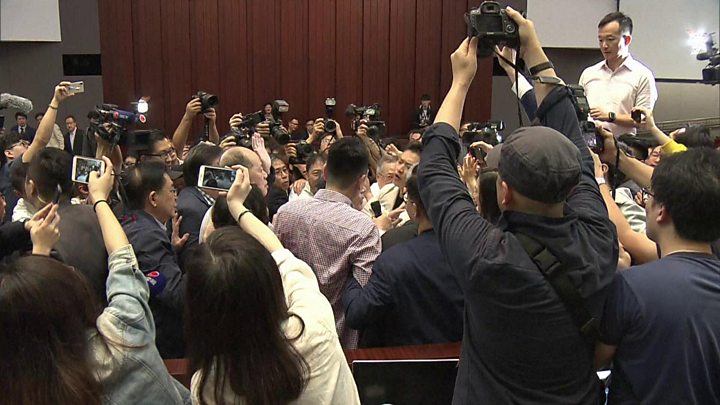
Media captionTensions flare up with lawmakers jumping over tables
The government has sought to reassure the public with some concessions, including promising to only hand over fugitives for offences carrying maximum sentences of at least seven years.
There has been a lot of public opposition, and critics say people would be subject to arbitrary detention, unfair trial and torture under China's judicial system.
Why the change now?
The latest proposal has come after a 19-year-old Hong Kong man allegedly murdered his 20-year-old pregnant girlfriend while they were holidaying in Taiwan together in February last year. The man fled Taiwan and returned to Hong Kong last year.
Taiwanese officials have sought help from Hong Kong authorities to extradite the man, but Hong Kong officials say they cannot comply because of the lack of an extradition agreement with Taiwan.
But the Taiwanese government has said it will not seek to extradite the murder suspect under the proposed changes, and has urged Hong Kong to handle the case separately.
Isn't Hong Kong under Chinese rule anyway?
A former British colony, Hong Kong is semi-autonomous under the principle of "one country, two systems" after it returned to Chinese rule in 1997.
The city has its own laws and its residents enjoy civil liberties unavailable to their mainland counterparts.
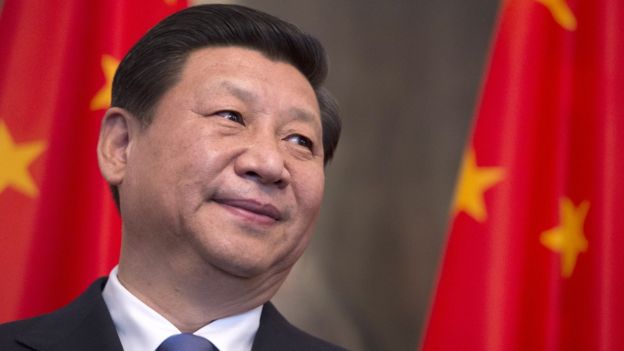
Image copyrightGETTY IMAGESImage captionUnder Xi Jinping, Beijing is seeking increasing control over Hong Kong
Hong Kong has entered into extradition agreements with 20 countries, including the UK and the US, but no such agreements have been reached with mainland China despite ongoing negotiations in the past two decades.
Critics have attributed such failures to poor legal protection for defendants under Chinese law.












![[Photos] The U.S. Navy Just Built Something No One Thought Was Possible](https://images.outbrainimg.com/transform/v3/eyJpdSI6IjgzMWQ3YTY0Yjc0ZDg0Y2M2ZTQ3YzAwNDkxYzA4N2NiMjhiNTEzZTk0NjBmZjNiNmJmN2Q1MDg4MTJhNDk1NzAiLCJ3IjoxNjAsImgiOjkwLCJkIjoxLjUsImNzIjowLCJmIjo0fQ.webp "[Photos] The U.S. Navy Just Built Something No One Thought Was Possible")

![[Photos] Mama Bear Pleaded To Him To Save Her Drowning Cubs, Then This Happened](https://images.outbrainimg.com/transform/v3/eyJpdSI6IjUwZWQ4N2EzY2MyMmIzMjhkNmMzNjUwYmE4OGExOTU4NDBiOGMwODFkODRjNDBiNzE3MGQwZDM1Y2RmOWUwOWYiLCJ3IjoxNjAsImgiOjkwLCJkIjoxLjUsImNzIjowLCJmIjo0fQ.webp "[Photos] Mama Bear Pleaded To Him To Save Her Drowning Cubs, Then This Happened")
![[Gallery] Check Out Fox News Anchor Ainsley Earhardt's Annual Salary](https://images.outbrainimg.com/transform/v3/eyJpdSI6ImM3MTcwOGZlNTM0M2M2NzM1NTNkZjJmNjAxYTQ4N2M4M2RiODc5YzA2NzA2ZDQ5ZWMyMjgxNTE5YTFlZjAyYTgiLCJ3IjoxNjAsImgiOjkwLCJkIjoxLjUsImNzIjowLCJmIjo0fQ.webp "[Gallery] Check Out Fox News Anchor Ainsley Earhardt's Annual Salary")