WASHINGTON - U.S. senators and Trump administration officials have reached an agreement on a massive economic stimulus bill to alleviate the economic impact of the coronavirus outbreak, White House official Eric Ueland said early on Wednesday.
“We have a deal,” Ueland told reporters after days of negotiations on the package, expected to be worth $2 trillion.
ADVERTISEMENT
The Senate’s Republican majority leader, Mitch McConnell, was expected to speak on the Senate floor shortly about the agreement.
The text of the pact was not expected to be available until later on Wednesday.
ADVERTISEMENT
The package had been expected to include a $500 billion fund to help hard-hit industries and a comparable amount for direct payments of up to $3,000 to millions of U.S. families, as well as $350 billion for small-business loans, $250 billion for expanded unemployment aid and $75 billion for hospitals.
It aims to cushion the economic blow from a pandemic that has killed more than 660 people in the United States and sickened more than 50,000, shuttered thousands of businesses, thrown millions out of work and led states to order 100 million people - nearly a third of the population - to stay at home.
The money at stake in the stimulus legislation exceeds what the U.S. government spends on national defense, scientific research, highway construction and other discretionary programs.
WASHINGTON - The U.S. Congress on Thursday aimed to end a dispute over border security with bipartisan legislation that would avert another partial government shutdown but does not give President Donald Trump the money he sought for a wall on the U.S.-Mexico border.
The measure faces votes in the Republican-led Senate and Democratic-controlled House of Representatives before going to the Republican president, who has not yet announced whether he will sign it. Trump triggered a 35-day-long shutdown of about a quarter of the federal government with his December demand for $5.7 billion to help build a wall, but did not get the money in a deal that ended that shutdown and does not get it in the legislation now before lawmakers.
Late on Wednesday, negotiators put the finishing touches on legislation that would provide more than $300 billion to fund the Department of Homeland Security and a range of other federal agencies through Sept. 30, the end of the current fiscal year. Funding is due to expire for those agencies on Friday.
Senate Majority Leader Mitch McConnell, speaking on the Senate floor, described the legislation as “a compromise that no side will view as a perfect deal,” but labeled it “a success for our bipartisan process” and reiterated his call for Trump to sign it.
SPONSORED
Trump was due to be briefed on the package on Thursday, a White House official said.
The legislation would provide $1.37 billion in new money to help build 55 miles (88.5 km) of new physical barriers on the border. It is the same level of funding Congress appropriated for border security measures last year, including barriers but not concrete walls.
“When the Senate votes on the agreement, we’ll be voting to avoid a second partial shutdown and provide the certainty of a fully functioning federal government,” Senate Majority Leader Mitch McConnell said. “Later today, I hope each of my colleagues will join me in moving forward with the agreement produced by this hard work, and the president will sign it into law.”
Top Senate Democrat Chuck Schumer called the agreement a “reasonable compromise.”
“It does not fund the president’s wall, but it does support smart border security initiatives that both parties have always supported, including increased security at our ports of entry and humanitarian assistance at the border. Most importantly, it will keep our government open,” Schumer said on the Senate floor.
The legislation would also fund the Justice Department, Commerce Department, State Department, Department of Agriculture, Internal Revenue Service and others, covering roughly 800,000 federal workers.
U.S. President Donald Trump listens next to Commerce Secretary Wilbur Ross during a Cabinet meeting at the White House in Washington, U.S., February 12, 2019. REUTERS/Carlos Barria
Four liberal, first-term House Democrats, including Representative Alexandria Ocasio-Cortez, said in a statement they would oppose the bill, citing their opposition to the administration’s immigration policies and declaring that the Department of Homeland Security “does not deserve an increase in funding.”
Failure to enact the bill would shutter many government programs, from national parks maintenance and air traffic controller training programs to the collection and publication of important data for financial markets, for the second time this year.
Trump 'not happy' with deal to avert shutdown
‘LET’S ALL PRAY’
Republican Senator Chuck Grassley, who was presiding over the opening of the Senate, added his own prayer at the end of a prayer by the guest chaplain. “Let’s all pray that the president will have the wisdom to sign the bill so the government doesn’t shut down,” Grassley said.
Trump was widely blamed for the previous shutdown.
A border wall was a central 2016 campaign promise by Trump. As president, he has called the border a national security crisis that requires a wall to curb illegal immigration and drug trafficking. He originally said Mexico would pay for the wall along the 2,000-mile (3,200-km) border, an idea Mexico dismissed.
Republican Senator Lindsey Graham, who is in regular contact with the White House, said Trump was “inclined to take the deal and move on.” Graham also told reporters Trump would then look elsewhere to find more money to build the wall and was “very inclined” to declare a national emergency to secure the funds.
Such a move, bypassing Congress and redirecting funds previously approved by lawmakers for other purposes in order to construct the wall, likely would spark a court battle, as it is Congress and not the president that mainly decides how federal funds get spent under the U.S. Constitution. Several Republicans have cautioned Trump against taking the unilateral action.
Vice President Mike Pence, speaking to reporters at a conference in Poland, said Trump is “evaluating what’s in the bill. He’s also evaluating the authority that he has, and I know he’ll be making a decision before the deadline this Friday.”
US President Donald Trump has said he has "no problem doing a shutdown" to pry funding from Congress for his planned border wall.
Hosting Italy's prime minister, he also told reporters he would "leave room for negotiation" on border security.
Congress must agree on spending to fund the government by 30 September, but a shutdown would be politically risky as mid-term elections loom in November.
The Republican president has repeatedly threatened a shutdown.
I would be willing to “shut down” government if the Democrats do not give us the votes for Border Security, which includes the Wall! Must get rid of Lottery, Catch & Release etc. and finally go to system of Immigration based on MERIT! We need great people coming into our Country!
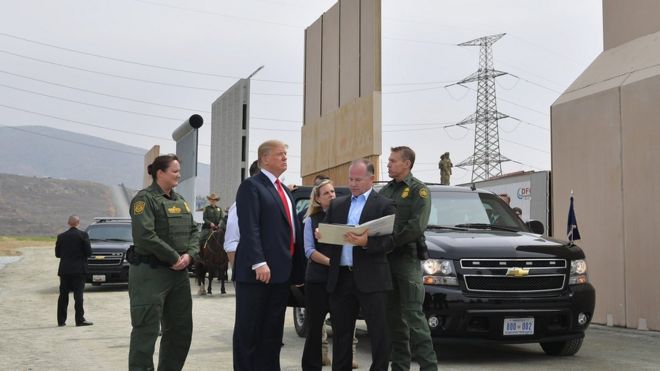
He wants lawmakers to approve $25bn (£19bn) to fund the construction of a "big, beautiful wall" on the US-Mexico border, a signature promise of his election campaign.
Deadlocks over spending and immigration caused a three-day government shutdown in January this year and again a month later, though that one lasted just a few hours.
The president's party controls both chambers of Congress, but in June moderate Republicans in the US House of Representatives helped sink an immigration bill that was proposed by their conservative colleagues and backed by Mr Trump.
ADVERTISEMENT
Media captionGovernment workers on what happens during a shutdown
In March, Congress passed a bill with $1.6bn in border security funding, but most of it was to repair existing sections of a barrier along the US-Mexico border.
Mr Trump briefly threatened to veto that spending bill before ultimately signing it, though he said he would never approve such a budget again.
Some of his supporters were disappointed, believing he had passed up on his best opportunity to wring full wall funding from Congress, and House Democratic leader Nancy Pelosi openly taunted the president.
Republican Senate leader Mitch McConnell said in a radio interview on Friday that he did not think there would be another fiscal showdown.
"No, that's not going to happen," the Kentucky senator told WHAS radio station in Louisville on Friday.