Biodun Iginla, BBC News

Biodun Iginla, BBC News
Showing posts with label Pierre Nkurunziza. Show all posts

Friday, August 4, 2017

Why so many African presidents are ditching term limits---analysis

The Economist explains
by Natalie Duval and Biodun Iginla, News Analysts, The Economist Intelligence Unit, Addis Ababa

They calculate that the costs of doing so are low
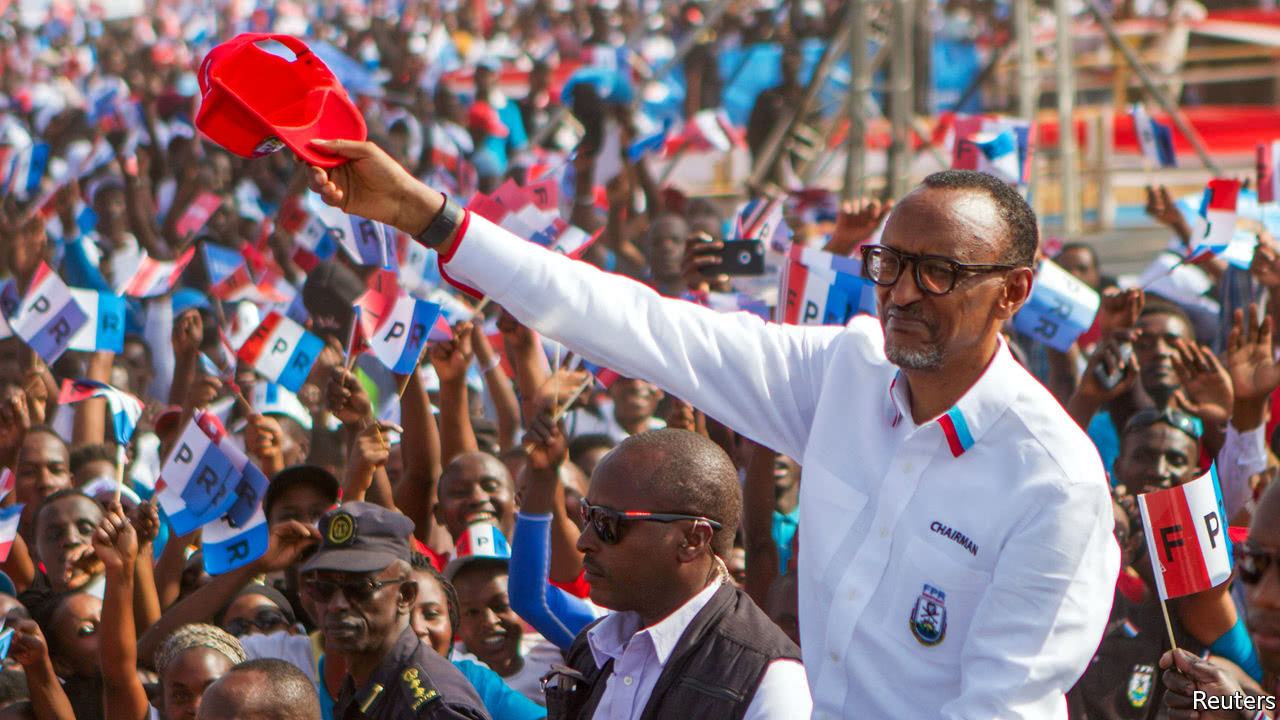
YESTERDAY, August 4th, Rwanda’s president of 17 years, Paul Kagame (pictured), will be re-elected for a third term (the result is not in question). This concludes a process that began in 2015 when his party, the ruling Rwandan Patriotic Front, proposed a constitutional amendment to allow Mr Kagame to outstay the two-term limit. In neighbouring Democratic Republic of Congo the president, Joseph Kabila, has long been mulling a similar ruse. He should have left office last December. In nearby Burundi, Pierre Nkurunziza announced in 2015 that he would stand for a controversial third term as president. A plan to amend or ditch term limits entirely is expected to be announced this autumn. And tomorrow, August 5th, Mauritanians will vote in a constitutional referendum that critics see as paving the way for a third term, too. If they succeed, these presidents will join the ranks of the 13 African heads of state who have successfully rolled back term limits. Why are they doing this?
Term limits became common in Africa with the wave of democratisation that swept the continent in the 1990s. Most countries included them in their constitutions after pressure from America and African democracy activists. Today there is widespread support for them. Afrobarometer, a polling firm, found that about three-quarters of people in 34 African countries said that presidential mandates should be restricted to two terms. Rwanda is an exception: nearly 4m Rwandans signed a “spontaneous” petition to let Mr Kagame stay on, and only ten people openly opposed it. But Mr Kagame rules his country through fear. In other countries, such as Burkina Faso in 2014, street protests forced the then president, Blaise Compaoré, to backtrack and flee the country. In 2015 Mr Kabila’s neighbour across the river in Congo-Brazzaville, Denis Sassou-Nguesso, successfully won a referendum allowing a third term—but provoked violent unrest in the process. Burundi has been in bloody turmoil ever since Mr Nkurunziza’s declared his third-term intentions.

Latest updates

See all updates
Presidents go ahead because they know the costs of doing so are low. Mr Kagame, still feted by foreign donors and prominent world leaders despite his growing authoritarianism, knew he could change the constitution without provoking a backlash from the international community. Mr Sassou-Nguesso made the same calculation. The Congolese president is seen by many, including France, the former colonial power, as a reliable partner, and the country is regarded as an island of stability in an otherwise troubled region. Moreover the rising influence of China means that African presidents know the West’s leverage is weaker than it once was. They also know that its priorities have shifted: combating jihadism is today more important than promoting democracy.
Term limits tend to be respected where democracy is already well established. Weak institutions make it easier for presidents to do away with them. Mr Nkurunziza was helped by a pliant constitutional court. Mr Kagame could count on his rubber-stamp parliament. And in many African countries where presidents have rolled back term limits the strongest institution is the army. Mr Kagame, Mr Nkurunziza and Mr Kabila are former rebel leaders who came to power through military victory; so too is the president of neighbouring Uganda, Yoweri Museveni, who successfully abolished term limits in 2005. The presidents of these central African countries where respect for term limits today is weakest are not by their nature democrats. Elsewhere on the continent, however, the picture is different: in Benin, Burkina Faso, Senegal and Nigeria recent attempts to sidestep term limits have failed.
View comments
Reuse this content

Sunday, February 7, 2016

Burundi grenade attack kills four, including boy


  • 2 hours ago

Soldiers patrol in Bujumbura. Photo: 3 February 2016Image copyright Reuters
Image caption Burundi's soldiers have been patrolling the streets of Bujumbura after a series of recent grenade attacks
Four people have been killed in Burundi in a grenade attack on a bar in the capital Bujumbura, officials say.
Among the victims was a child selling boiled eggs. Ten other people were injured in Saturday's attack.
Unknown attackers also threw grenades at an army patrol and at police in Bujumbura, hurting several people.
Since April, more than 400 people have died in clashes triggered by President Pierre Nkurunziza's bid for a third term. He won a disputed poll in July.
The African Union is trying to persuade the president to agree to the deployment of AU peacekeepers.
He is opposed to the plan, saying this would amount to an invasion.
map
Bujumbura has recently witnessed a string of deadly grenade attacks.
The government and opposition groups have accused each other of carrying out the attacks.
Last month, human rights group Amnesty International published satellite images it said were believed to be five mass graves near Burundi's capital, where security forces were accused of killing scores of people in December.
A fact-finding mission by the AU has reported arbitrary killings, torture and the "closure of some civil society organisations and the media".
Burundi on the brink
Tit-for-tat killings spread fear
Burundi's football-playing president
Presidents who cling to power

Burundi: Key facts

The country is facing its worst turmoil since the 12-year civil war ended in 2005

  • 10.4m population
  • 50 years - life expectancy for a man
  • 2nd poorest country in the world
  • 85% are Hutu, 14% Tutsi
  • 300,000 died in civil war

Burundi's deepening crisis

  • April 2015: Protests erupt after President Pierre Nkurunziza announces he will seek a third term in office.
  • May 2015: Constitutional court rules in favour of Mr Nkurunziza, amid reports of judges being intimidated. Tens of thousands flee violence amid protests.
  • May 2015: Army officers launch a coup attempt, which fails.
  • July 2015: Elections are held, with Mr Nkurunziza re-elected. The polls are disputed, with opposition leader Agathon Rwasa describing them as "a joke"
  • November 2015: Burundi government gives those opposing President Nkurunziza's third term five days to surrender their weapons ahead of a promised crackdown.
  • November 2015: UN warns it is less equipped to deal with violence in Burundi than it was for the Rwandan genocide.
  • December 2015: 87 people killed on one day as soldiers respond to an attack on military sites in Bujumbura.
  • January 2016: Amnesty International publishes satellite images it says are believed to be mass graves close to where December's killings took place
Find out more about Burundi

More on this story

Saturday, November 7, 2015

Burundi violence: Scores flee homes before crackdown starts

by Susan Peterson and Biodun Iginla, BBC News, Bujumbura, Burundi

23 minutes ago


Scores of people are leaving their homes in Burundi's capital ahead of a promised government crackdown.
A cycle of violence began in April with protests against President Pierre Nkurunziza's third-term bid.
Mr Nkurunziza gave a deadline of midnight on Saturday for Burundians to hand in illegal firearms or face being "dealt with as enemies of the nation".
Earlier this week, the UN secretary-general condemned the "inflammatory rhetoric" in Burundi.
And the Brussels-based International Crisis Group said the language was "chillingly similar" to that used in Rwanda before the genocide of 1994.
Agencies reported that many people were leaving Cibitoke and Mutakura, two neighbourhoods of the capital, Bujumbura, that have seen anti-government protests.
"Now I decide to leave as everyone is leaving," one elderly Mutakura resident, Marguerite Bigira, told the Associated Press news agency.
"There is fear everywhere. But I still believe in God and all this will end."
Another fleeing resident, Marie, told Agence France-Presse: "I was terrified, I understood that this time they would kill every last one of us."
The violence, in which close to 200 people have been killed, began in April when the president said he would stand again.
He argued that his first term as president did not count towards the constitutional two-term limit as he was chosen by MPs.
Mr Nkurunziza was duly re-elected to a third term with 70% of the vote in July.

Burundi: Key facts

The country is facing its worst turmoil since the 12-year civil war ended in 2005

  • 10.4m population
  • 50 years - life expectancy for a man
  • 2nd poorest country in the world
  • 85% are Hutu, 14% Tutsi
  • 300,000 died in civil war
graphic with details about Burundi -7 November 2015
The weapons ultimatum has led to a spike in killings.
On Friday, the body of Welly Nzitonda, the son of a leading human rights activist, was discovered.
UN Human Rights Commissioner Zeid Ra'ad al Hussein said the killing, which he called an assassination, "reinforces fears that there is a systematic policy of targeting members of the opposition, journalists, human rights defenders and ordinary citizens perceived to be opposing the government".
UN Secretary-General Ban Ki-moon said the discovery of bodies in Bujumbura was now a regular occurrence - and many victims showed evidence of summary execution.
Mr Ban said Burundian authorities had a responsibility to protect civilians.
The International Crisis Group and others were commenting on remarks by Burundi's Senate President Reverien Ndikuriyo - who threatened to "pulverise" opponents who did not lay down arms.
Uganda is leading regional efforts to broker peace talks and the UN Security Council is expected to discuss the violence at a meeting on Monday.
Map showing location of Burundi

More on this story


Thursday, June 25, 2015

Burundi Vice-President Gervais Rufyikiri flees

by Susan Peterson and Biodun Iginla, BBC News, Bujumbura, Burundi

20 minutes ago


One of Burundi's vice-presidents has fled the country, saying he felt threatened after opposing President Pierre Nkurunziza's third-term bid.
Burundi has seen months of turmoil since Mr Nkurunziza announced that he would be running for office again in July's election.
Gervais Rufyikiri told France24 TV that a third term for the president would be unconstitutional.
A government spokesman denied that Mr Rufyikiri had been threatened.
There are also reports that Burundi's National Assembly Speaker Pie Ntavyohanyuma has left for Belgium, citing medical reasons. He had also criticised the president's bid for a third term.
Both men hold Belgian nationality.
Violent protests in the capital Bujumbura followed the 25 April announcement that Mr Nkurunziza would seek re-election.

Rights groups say at least 70 people have been killed and 500 wounded as demonstrators clashed with police over the past two months.
More than 100,000 people have fled Burundi since the start of the crisis, the UN says.
In a sign of continuing tension, four people have been injured in a grenade attack in Bujumbura.
Also, more than 100 students have climbed into the compound of the US embassy to escape from the police, who were threatening to dismantle a camp that they had set up outside the building.


Friday, May 22, 2015

Twin grenade attack hits Burundi capital as protesters defy police crackdown


Latest update : 2015-05-22

Attackers hurled twin grenades into a crowd in Burundi's capital late Friday, killing three people, the latest in almost month of deadly violence triggered by the president's bid for a third term.

Thousands of anti-government protesters earlier battled police in the capital Bujumbura, defying one of the heaviest pushes by security forces to end weeks of demonstrations against President Pierre Nkurunziza.
But the grenade blasts -- the first such attacks to apparently deliberately target a civilian crowd -- mark a deadly twist in the unrest that has sent 110,000 Burundians fleeing as refugees into neighbouring nations.
Deputy police chief, General Godefroid Bizimana, said the unknown attackers aimed to kill, with three dead but also about a dozen maimed or wounded.
"Those who did this had the intention to kill, because the grenades were thrown among women selling fruits, in a big crowd," Bizimana said, adding the attackers escaped.
Meanwhile, protesters torched election materials in two separate attacks south of the capital, electoral commission spokesman Prosper Ntahorwmiye said, destroying voting booths and ballot boxes. "Everything was burned," Ntahorwmiye said.
Two-day truce and talks
More than 20 people have died since the crisis erupted in late April after the ruling party nominated Nkurunziza to stand again in the June 26 presidential election. The crisis deepened last week when a top general staged a failed coup attempt.
Parliamentary polls, initially set for May 26, have been postponed to June 5.
Nkurunziza said in an address to the nation late Wednesday that most of the central African country was secure and that upcoming parliamentary and presidential votes would be peaceful.
But on Friday morning, protesters shouted and blew whistles to try to encourage others to come out onto the streets. By late afternoon, thousands had answered the call. Some looted a beer truck as they celebrated, despite gunfire from police.
"And the government says there is no demonstration in Bujumbura!" said Adolphe, 46, a civil engineer and local resident.
But protesters also announced a two-day weekend truce "to allow the people to bury with dignity those who died for democracy," civil society leader Pacifique Nininahazwe said, but adding a warning that "protests will resume on Monday with even more force."
Nininahazwe said that talks between the protesters, opposition parties and government had been taking place this week.
"We ask the government to show good faith by refraining to shoot protesters," Nininahazwe added. "On our part, we promise a completely peaceful demonstration. If they continue to shoot, we will end the dialogue process."
Cholera deaths rising

Opposition and rights groups say that Nkurunziza's bid for a third five-year term violates the constitution and the terms of a peace deal that ended a 13-year civil war in 2006.
Nkurunziza, a former rebel leader and born-again Christian who believes he has divine backing to lead the country, argues that his first term did not count as he was elected by parliament, not directly by the people.
Refugees continue to flee the violence, the majority to neighbouring Tanzania, where over 50,000 refugees are struggling in dire conditions on the shores of Lake Tanganyika.
Cholera has broken out in squalid refugee camps there, with at least 31 people having died and over 3,000 cases in total, with numbers growing by up to 400 cases a day, according to the UN refugee agency.

Thursday, May 14, 2015

Burundi coup bid: President returns to Bujumbura

by Susan Peterson and Biodun Iginla, Reuters contributors and BBC News, Dar es Salaam, Tanzania

1 hour ago


Burundi's President Pierre Nkurunziza has returned to the country and his troops say they are in control of key locations, a day after a coup attempt.
Mr Nkurunziza announced his return on the Burundi presidency Twitter site.
There were earlier fierce clashes in the capital, Bujumbura, particularly at the state radio office, but they are now said to have subsided. Five soldiers are reported killed.
Mr Nkurunziza had been in Tanzania when the coup began on Wednesday.
Protests began in Burundi on 26 April when Mr Nkurunziza announced he was seeking a third term, a move his opponents said was unconstitutional.
The coup was launched by Maj Gen Godefroid Niyombare, a former ally of the president, on Wednesday after Mr Nkurunziza travelled to Dar es Salaam, Tanzania's largest city, to attend a summit on the crisis.
There were no new statements from Gen Niyombare on Thursday.
Thursday's events as they unfolded
What's behind the coup bid?
Timeline of events
Reports late on Wednesday said the president had tried to fly back to Burundi but was forced to return to Tanzania as he could not land.

However, Burundian presidential spokesman Willy Nyamitwe told the BBC on Thursday that the president had left Tanzania and was "safe and sound".

He later confirmed that Mr Nkurunziza was in Burundi but would give no more details due to "security reasons".
He had earlier told Radio France Internationale: "The loyalist army is present, his advisers are present and the government is present. The country, then, continues to function."
In his Twitter posting, Mr Nkurunziza said: "I thank the army and police for their patriotism. Above all I thank Burundians for their patience."

'Fighting has stopped'

Army chief of staff Gen Prime Niyongabo told the BBC's Maud Jullien the number of soldiers backing the coup had fallen.
"On Wednesday evening we gave them the chance to rejoin the army to avoid a bloodbath. But they tried to attack the radio station today - the army repelled the attack.
"We are in control of all strategic points in the country. Burundi is a democratic nation. The army does not interfere in politics. We are obliged to follow the constitution."

BBC correspondents say the streets seem to be mainly in the control of loyalist police, and the airport has reopened, which would appear to confirm reports it too is in loyalist hands.
However, coup spokesman Venon Ndabaneze earlier insisted insurgent troops were in control of "virtually the entire city".
Fighting erupted at the state radio building after the RTBN station had broadcast a message from Mr Nkurunziza condemning the coup.
"I thank soldiers who are putting things in order, and I forgive any soldier who decides to surrender," he said.

At the scene: Ruth Nesoba in Bujumbura
It is quiet in the streets in the centre of Bujumbura at the moment and I can see that some people have ventured out.
In the morning we woke to the news that the loyalists had launched an attack on private radio stations, which were taken off air, and then there was a struggle between rival factions in the army over control of the national broadcaster. The TV is not on air, but radio is playing Kirundi music. The broadcasts have been on and off.
There is no confirmation about the whereabouts of Gen Niyombare and we have not heard from him since his announcement of the coup on private radio on Wednesday.
The station briefly stopped broadcasting during the attack.
But station director Jerome Nzokirantevye was soon back on air, saying: "Now the fighting has stopped we can resume. It is still loyalist soldiers who are in control."
Control of the national broadcaster is key because it is the only outlet still broadcasting outside the capital.

The two private radio stations have been shut down. The most popular - Radio Publique Africaine - was burnt down overnight after broadcasting the coup announcement.
Thousands of people had taken to the streets on Wednesday to celebrate the announcement of the coup, marching on the centre of Bujumbura alongside soldiers.

Tens of thousands flee

The unrest began after the 51-year-old president said he would run for re-election in June.
Opponents said this contravened the constitution, which states a president can only be elected to two terms.

Mr Nkurunziza argued he was entitled to a third term because he was first appointed to the role by parliament in 2005, rather than elected.
Earlier this month, the country's constitutional court upheld his interpretation.
More than 20 people have died and tens of thousands of Burundians have fled to neighbouring states since the unrest began.

Coup bid leader: Gen Godefroid Niyombare, 46
  • Former rebel CNDD-FDD commander and ally of President Nkurunziza
  • First ethnic Hutu army chief - a significant step in reconciliation efforts
  • A negotiator in peace talks with last rebel group FNL
  • Oversaw Burundi's deployment to Somalia as part of African force
  • Served as ambassador to Kenya
  • Dismissed as intelligence chief in February three months after his appointment
  • Dismissal came days after he recommended against the third-term bid