
by Coco Jiang and Biodun Iginla, News Analysts, The Economist Intelligence Unit, Seoul
South Korea’s president is permanently stripped of her powers
Park Geun-hye is the first leader in the country’s democratic history to be forced by parliament from office
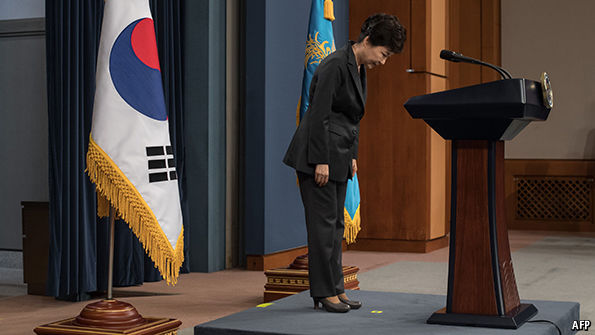
SHE had refused to be questioned, and attended none of the 20 hearings since a trial on her impeachment began on January 3rd. She had blocked investigators from entering the Blue House, the presidential residence, and a fortnight ago she demanded the ejection of one of the justices hearing her case. It was all for nothing. On March 10th Park Geun-hye, South Korea’s first female president as well as its first to have an impeachment upheld by a court, was permanently removed from office. It cut short her five-year term by 11 months.
All eight justices currently serving on the country’s constitutional court voted to uphold a parliamentary motion, on December 9th, to impeach her. That motion followed weeks of huge but peaceful crowds gathering in downtown Seoul, the capital, to call for her resignation. MPs had listed 13 constitutional violations, including dereliction of duty, abuse of power and infringing the freedom of the press. The court said it could not find conclusive evidence for most of these charges. But it was able to rule that Ms Park had divulged state secrets to Choi Soon-sil, an allegedly corrupt confidante (whose personal wealth, a special prosecution found, stands at $20m), and colluded to help her extort funds from conglomerates and profit from two cultural organisations that Ms Choi controlled.
After the crime, the cover-up. The court also found that throughout the investigation Ms Park’s actions had been aimed at concealing the truth; the justices said she had consistently obstructed the ability of the National Assembly to hold her to account. It all amounted to “an undermining of the rule of law and representative democracy”; she had lost the trust of the public and “let down” her citizens.
It will be much more difficult to find such unanimity within South Korean society. Over three-quarters of South Koreans felt she deserved to be impeached, according to a poll conducted shortly before the decision. But that still leaves a vocal, mostly older minority feeling that Ms Park is the victim of a left-wing witch hunt. Conservative protest groups opposing Ms Park’s removal have grown larger and shriller in recent weeks. They threatened a “bloody civil resistance” should the court uphold her impeachment (two from their camp, in their 60s and 70s, died during the protest following the verdict this morning). Over 21,000 riot police were today deployed in central Seoul. In recent weeks police buses have been set up as barricades at large demonstrations to keep Ms Park’s friends and foes from clashing.
Outside the constitutional court, where police had once again divided them, the anti-impeachment camp blared out the national anthem in defiance and promised to blast the constitutional court to pieces. Cheers meanwhile rose from a jubilant anti-Park camp, striking gongs and dancing to chants of “We won”. One anxious protester who has been to every one of 19 anti-Park weekly rallies said he had not been able to eat for 24 hours. A father had taken his child out of school for the day, for a historic moment that he said was “a truer education”.
Many remember the last time a court ruled on a leader’s impeachment, to citizens’ overwhelming approval: in 2004 Roh Moo-hyun, a liberal president, returned to office after 63 days when the constitutional court ruled that the reasons for his impeachment were feeble. Chon Jong-ik, part of the legal team that ruled on Roh’s case, says that set a precedent for the court’s decision today, by establishing that if public trust in a president’s ability to protect liberal democracy had been lost, he—or she—ought to be removed.
An investigation into allegations of Ms Park’s influence-peddling, which first surfaced in October, has already led to more than two dozen indictments. Those include Lee Jae-yong, heir to the Samsung empire, whose trial on charges of bribery linked to the presidential office began this week; as well as Ms Park’s former chief of staff, Kim Ki-choon; and Ms Choi, who will stand trial for her Samsung entanglements on March 13th. South Koreans will expect to see progress on these, and due punishment. But an early presidential election must also be held within 60 days; many expect the National Election Commission will set it for May 9th, to give candidates as much time as possible to win over South Korea’s mass of disenchanted voters in what will be a lightning-speed campaign.
Ms Park is no stranger to tragedy. In 1974 her mother died in an assassination attempt on her father, Park Chung-hee, South Korea’s long-ruling strongman. Ms Park in effect became the Blue House’s first lady. But five years later her father’s 18-year rule came to an end when he was shot over dinner by his spy chief.
After that, at least, a political career for Ms Park seemed assured, and she herself believed she owed it to her dead parents. She became an MP in 1998, and in 2004 the leader of South Korea’s main conservative party. Her staunchest supporters have long been an older class of voters who stubbornly revere her father for his “miracle on the Han river”, South Korea’s phenomenal economic transformation. But some younger voters, hoping for an economic revival, also voted for her in the election in 2012 that brought her back to the Blue House as president.
She has been staying put at the Blue House ever since. From tomorrow, she is likely to sleep in her guarded home in the upscale district of Gangnam, in southern Seoul. As she no longer has presidential immunity from criminal investigation, state prosecutors can indict her. A special prosecution, set up at Ms Park’s request, announced the results of its three-month investigation this week into her alleged abuse of power and the sordid collusion between political and corporate elites. It confirmed, among other findings, that 573 calls had been made on Ms Choi’s personal hotline to Ms Park, using phones registered under borrowed names, over a period of seven months last year.
Editorials in the main newspapers, and Buddhist and Christian leaders alike, have urged South Koreans to accept today’s ruling. Park Hyung-jun of Sungkyunkwan University says a fair legal decision was essential for South Koreans, who have lost faith in those governing them and in their institutions. Hard generational divides have surfaced in the scandal: for Ms Park’s successor, says Mr Park (no relation), communicating well and building consensus will be crucial. Many now will be closely watching Ms Park’s reaction to the ruling. As an MP who had supported Roh’s impeachment, she said then that she accepted the court’s verdict and saw the decision as an opportunity to cultivate respect for the constitution. Now her time has come.
All eight justices currently serving on the country’s constitutional court voted to uphold a parliamentary motion, on December 9th, to impeach her. That motion followed weeks of huge but peaceful crowds gathering in downtown Seoul, the capital, to call for her resignation. MPs had listed 13 constitutional violations, including dereliction of duty, abuse of power and infringing the freedom of the press. The court said it could not find conclusive evidence for most of these charges. But it was able to rule that Ms Park had divulged state secrets to Choi Soon-sil, an allegedly corrupt confidante (whose personal wealth, a special prosecution found, stands at $20m), and colluded to help her extort funds from conglomerates and profit from two cultural organisations that Ms Choi controlled.
Latest updates
It will be much more difficult to find such unanimity within South Korean society. Over three-quarters of South Koreans felt she deserved to be impeached, according to a poll conducted shortly before the decision. But that still leaves a vocal, mostly older minority feeling that Ms Park is the victim of a left-wing witch hunt. Conservative protest groups opposing Ms Park’s removal have grown larger and shriller in recent weeks. They threatened a “bloody civil resistance” should the court uphold her impeachment (two from their camp, in their 60s and 70s, died during the protest following the verdict this morning). Over 21,000 riot police were today deployed in central Seoul. In recent weeks police buses have been set up as barricades at large demonstrations to keep Ms Park’s friends and foes from clashing.
Outside the constitutional court, where police had once again divided them, the anti-impeachment camp blared out the national anthem in defiance and promised to blast the constitutional court to pieces. Cheers meanwhile rose from a jubilant anti-Park camp, striking gongs and dancing to chants of “We won”. One anxious protester who has been to every one of 19 anti-Park weekly rallies said he had not been able to eat for 24 hours. A father had taken his child out of school for the day, for a historic moment that he said was “a truer education”.
Many remember the last time a court ruled on a leader’s impeachment, to citizens’ overwhelming approval: in 2004 Roh Moo-hyun, a liberal president, returned to office after 63 days when the constitutional court ruled that the reasons for his impeachment were feeble. Chon Jong-ik, part of the legal team that ruled on Roh’s case, says that set a precedent for the court’s decision today, by establishing that if public trust in a president’s ability to protect liberal democracy had been lost, he—or she—ought to be removed.
An investigation into allegations of Ms Park’s influence-peddling, which first surfaced in October, has already led to more than two dozen indictments. Those include Lee Jae-yong, heir to the Samsung empire, whose trial on charges of bribery linked to the presidential office began this week; as well as Ms Park’s former chief of staff, Kim Ki-choon; and Ms Choi, who will stand trial for her Samsung entanglements on March 13th. South Koreans will expect to see progress on these, and due punishment. But an early presidential election must also be held within 60 days; many expect the National Election Commission will set it for May 9th, to give candidates as much time as possible to win over South Korea’s mass of disenchanted voters in what will be a lightning-speed campaign.
Ms Park is no stranger to tragedy. In 1974 her mother died in an assassination attempt on her father, Park Chung-hee, South Korea’s long-ruling strongman. Ms Park in effect became the Blue House’s first lady. But five years later her father’s 18-year rule came to an end when he was shot over dinner by his spy chief.
After that, at least, a political career for Ms Park seemed assured, and she herself believed she owed it to her dead parents. She became an MP in 1998, and in 2004 the leader of South Korea’s main conservative party. Her staunchest supporters have long been an older class of voters who stubbornly revere her father for his “miracle on the Han river”, South Korea’s phenomenal economic transformation. But some younger voters, hoping for an economic revival, also voted for her in the election in 2012 that brought her back to the Blue House as president.
She has been staying put at the Blue House ever since. From tomorrow, she is likely to sleep in her guarded home in the upscale district of Gangnam, in southern Seoul. As she no longer has presidential immunity from criminal investigation, state prosecutors can indict her. A special prosecution, set up at Ms Park’s request, announced the results of its three-month investigation this week into her alleged abuse of power and the sordid collusion between political and corporate elites. It confirmed, among other findings, that 573 calls had been made on Ms Choi’s personal hotline to Ms Park, using phones registered under borrowed names, over a period of seven months last year.
Editorials in the main newspapers, and Buddhist and Christian leaders alike, have urged South Koreans to accept today’s ruling. Park Hyung-jun of Sungkyunkwan University says a fair legal decision was essential for South Koreans, who have lost faith in those governing them and in their institutions. Hard generational divides have surfaced in the scandal: for Ms Park’s successor, says Mr Park (no relation), communicating well and building consensus will be crucial. Many now will be closely watching Ms Park’s reaction to the ruling. As an MP who had supported Roh’s impeachment, she said then that she accepted the court’s verdict and saw the decision as an opportunity to cultivate respect for the constitution. Now her time has come.


