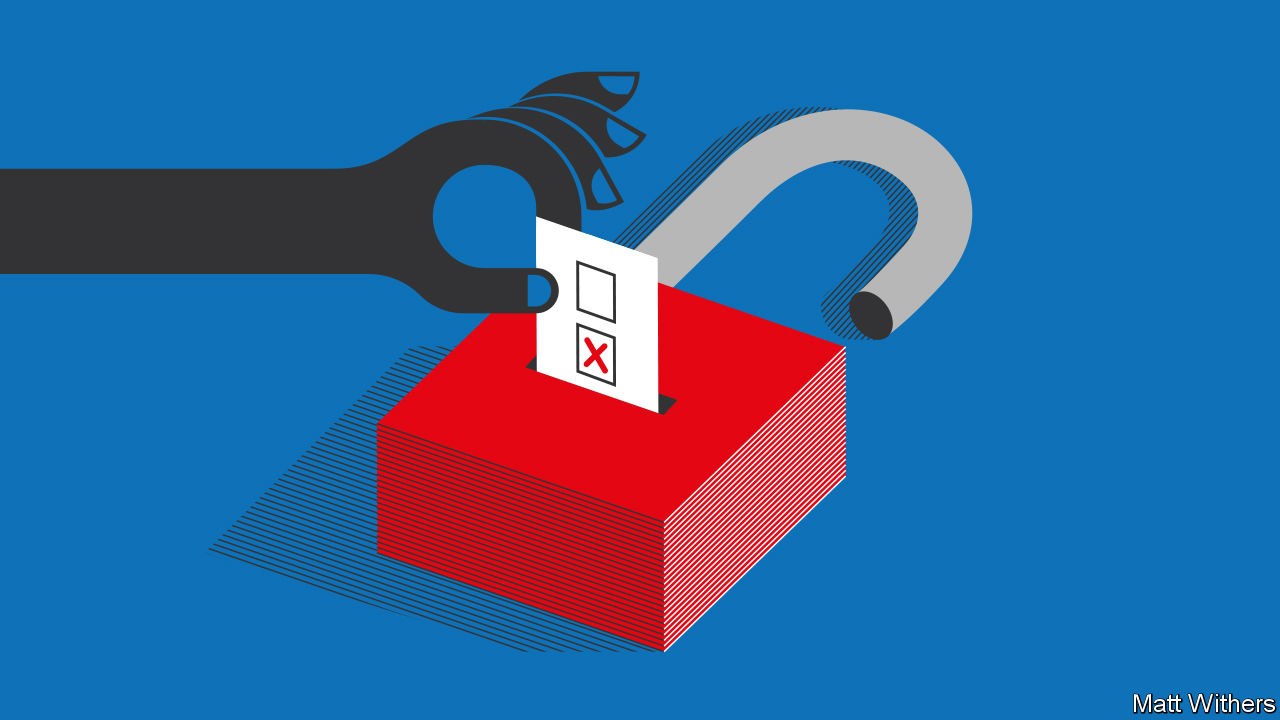
On august 29th, as Hurricane Dorian tracked towards America’s east coast, Elon Musk, the boss of Tesla, an electric-car maker, announced that some of his customers in the storm’s path would find that their cars had suddenly developed the ability to drive farther on a single battery charge. Like many modern vehicles, Mr Musk’s products are best thought of as internet-connected computers on wheels. The cheaper models in Tesla’s line-up have parts of their batteries disabled by the car’s software in order to limit their range. At the tap of a keyboard in Palo Alto, the firm was able to remove those restrictions and give drivers temporary access to the full power of their batteries.
Mr Musk’s computerised cars are just one example of a much broader trend. As computers and connectivity become cheaper, it makes sense to bake them into more and more things that are not, in themselves, computers—from nappies and coffee machines to cows and factory robots—creating an “internet of things”, or iot (see Technology Quarterly). It is a slow revolution that has been gathering pace for years, as computers have found their way into cars, telephones and televisions. But the transformation is about to go into overdrive. One forecast is that by 2035 the world will have a trillion connected computers, built into everything from food packaging to bridges and clothes.
Get our daily newsletterUpgrade your inbox and get our Daily Dispatch and Editor's Picks.
Such a world will bring many benefits. Consumers will get convenience, and products that can do things non-computerised versions cannot. Amazon’s Ring smart doorbells, for instance, come equipped with motion sensors and video cameras. Working together, they can also form what is, in effect, a private cctv network, allowing the firm to offer its customers a “digital neighbourhood-watch” scheme and pass any interesting video along to the police.
Businesses will get efficiency, as information about the physical world that used to be ephemeral and uncertain becomes concrete and analysable. Smart lighting in buildings saves energy. Computerised machinery can predict its own breakdowns and schedule preventive maintenance. Connected cows can have their eating habits and vital signs tracked in real time, which means they produce more milk and require less medicine when they fall ill. Such gains are individually small but, compounded again and again across an economy, they are the raw material of growth—potentially a great deal of it.
In the long term, though, the most conspicuous effects of the iot will be in how the world works. One way to think of it is as the second phase of the internet. This will carry with it the business models that have come to dominate the first phase—all-conquering “platform” monopolies, for instance, or the data-driven approach that critics call “surveillance capitalism”. Ever more companies will become tech companies; the internet will become all-pervasive. As a result, a series of unresolved arguments about ownership, data, surveillance, competition and security will spill over from the virtual world into the real one.
Start with ownership. As Mr Musk showed, the internet gives firms the ability to stay connected to their products even after they have been sold, transforming them into something closer to services than goods. That has already blurred traditional ideas of ownership. When Microsoft closed its ebook store in July, for instance, its customers lost the ability to read titles they had bought (the firm offered refunds). Some early adopters of “smart home” gadgets have found that they ceased to work after the firms that made them lost interest.
That tilts the balance of power from the customer to the seller. John Deere, an American maker of high-tech tractors, has been embroiled in a row over software restrictions that prevent its customers from repairing their tractors themselves. And since software is not sold but licensed, the firm has even argued that, in some circumstances, a tractor-buyer may not be buying a product at all, instead receiving only a licence to operate it.
Virtual business models will jar in the physical world. Tech firms are generally happy to move fast and break things. But you cannot release the beta version of a fridge. Apple, a smartphone-maker, provides updates for its phones for only five years or so after their release; users of Android smartphones are lucky to get two. But goods such as washing machines or industrial machinery can have lifespans of a decade or more. Firms will need to work out how to support complicated computerised devices long after their original programmers have moved on.
Data will be another flashpoint. For much of the internet the business model is to offer “free” services that are paid for with valuable and intimate user data, collected with consent that is half-informed at best. That is true of the iot as well. Smart mattresses track sleep. Medical implants observe and modify heartbeats and insulin levels, with varying degrees of transparency. The insurance industry is experimenting with using data from cars or fitness trackers to adjust customers’ premiums. In the virtual world, arguments about what should be tracked, and who owns the resulting data, can seem airy and theoretical. In the real one, they will feel more urgent.
Then there is competition. Flows of data from iot gadgets are just as valuable as those gleaned from Facebook posts or a Google search history. The logic of data-driven businesses, which do ever better as they collect and process more information, will replicate the market dynamics that have seen the rise of giant platform companies on the internet. The need for standards, and for iot devices to talk to each other, will add to the leaders’ advantages—as will consumer fears, some of them justified, over the vulnerability of internet-connected cars, medical implants and other devices to hacking.
Predicting the consequences of any technology is hard—especially one as universal as computing. The advent of the consumer internet, 25 years ago, was met with starry-eyed optimism. These days it is the internet’s defects, from monopoly power to corporate snooping and online radicalisation, that dominate the headlines. The trick with the iot, as with anything, will be to maximise the benefits while minimising the harms. That will not be easy. But the people thinking about how to do it have the advantage of having lived through the first internet revolution—which should give them some idea of what to expect. ■
Parliamentary deadlock means it may be necessary to go back to the people
Britain
SINCE the vote to leave the European Union in June 2016, the more optimistic among those on the losing side have been lobbying for a rematch. Some argue for a re-run on the basis that Brexiteers lied during the campaign and broke election law (on July 17th the Electoral Commission fined the official Vote Leave campaign £61,000, or $80,000, for deliberately exceeding spending limits). Others say the public deserves a chance to vote on the final deal, which will bear little resemblance to the glittering one they were promised. Yet the idea of a second vote has never taken off. Polls have shifted only slightly in favour of remaining, and there is no great enthusiasm for another plebiscite, which would be the fourth nationwide vote in as many years.
But the idea of revisiting the referendum is back in play. By law, Theresa May’s government cannot sign a Brexit deal without MPs’ approval. And in the past couple of weeks it has begun to look as if Parliament will reject any deal. The Labour opposition has set six tests for the agreement, which look designed to be unpassable. The Conservative Party, meanwhile, is in a rebellious mood. This week hardline Tory Brexiteers forced the government to toughen its approach to customs, before a faction of Tory Remainers forced it to soften its policy on medical regulation. More defeats were avoided by as few as three votes. It is hard to imagine MPs agreeing to the unappealing deal that Mrs May is likely to bring back from Brussels later this year. And if they don’t, Britain could crash out of the EU on March 29th with no deal at all.
Get our daily newsletterUpgrade your inbox and get our Daily Dispatch and Editor's Picks.
Many in Westminster therefore wonder if the only way to break the deadlock may be to send the matter back to the people. One way would be with yet another election. Tory whips reportedly told their MPs that the government would call one over the summer if they defied it on key parts of its Brexit plan. But would Mrs May, election-flunker extraordinaire, risk it? Polls put Labour narrowly ahead of the Tories. In any case, a narrow victory for either party could leave Parliament in the same stalemate, since Labour is also divided over the best approach to Brexit.
So a second referendum is being proposed as a way to get a clear answer. On July 16th Justine Greening, one of Mrs May’s former cabinet ministers, proposed a vote with three options: stay in the EU; accept the deal that Mrs May agrees on with Brussels; or leave with no deal.
There are formidable obstacles to such a vote. Parliament would have to legislate for the referendum, which might be tricky if that same Parliament is against the Brexit deal that would be its subject. Labour says a referendum is “not its policy” and that MPs should sort out the mess. But it has left the door ajar: “To take [a second referendum] off the table completely, when there might be a set of circumstances where Parliament cannot deliver a meaningful vote, would be a mistake,” Tom Watson, Labour’s deputy leader, said on July 15th. The Scottish Nationalists would not oppose a second referendum; the Liberal Democrats would vote for one (provided they remembered to show up, as their leader failed to do at a vital Brexit vote this week). Mrs May has ruled out the idea—but of course, two years ago, she ruled out a snap election.
There would be little time to organise a new plebiscite. It took seven months to pass the bill for the original referendum. That process could be speeded up, especially now that Britain has a “here’s one I made earlier” template for such a vote, argues Eloise Todd of Best for Britain, which wants a second referendum. But it would almost certainly be necessary for Britain to ask the EU for more time. It would probably agree, believes Charles Grant of the Centre for European Reform, a think-tank, though it would hope to resolve matters before elections to the European Parliament at the end of May.
If all this could be done in time, what would be the question on the ballot? Britain has never had a multiple-choice referendum of the sort that Ms Greening suggests, though they are not unknown internationally. Finns were asked in 1931 if they wanted to scrap prohibition, maintain it, or remove it only for weak drinks (they overwhelmingly chose to abolish it). In 1977 Australians opted for “Advance Australia Fair” as their national song, from a line-up of four.
The difficulty is deciding how to pick a winner. Peter Kellner, a polling expert and Prospect columnist, notes that the same set of results could produce three possible winners, via first-past-the-post (picking the option with most first-preference votes), alternative vote (adding the second preferences of the bottom-ranked option to the tallies of the top two) or the Condorcet system (picking the overall winner of the three possible head-to-head contests). A poll last month for The Economist by YouGov, asking voters to rank hard Brexit, soft Brexit and Remain, returned exactly such a result (see table). With a second referendum, “there is already potential for a crisis of democratic legitimacy,” notes Akash Paun of the Institute for Government, a think-tank. A complex vote with multiple interpretations would not help.
Such a referendum would also introduce dangers that might make Remainers think twice. One is that the EU would have less incentive to offer a good deal if a referendum was on the cards—indeed, it might have an incentive to offer a bad one, in the hope that Britain would therefore choose to remain, as most Eurocrats would prefer.
It would also be fantastically risky to put “no deal” on the ballot, giving voters an option that no one except the loopiest Brexiteers supports. Ms Greening calls such an option a “clean break”, a phrase which Malcolm Barr of J.P. Morgan, a bank, describes as “a big misrepresentation”. Trading with the EU on World Trade Organisation terms is one thing. Leaving with no agreement on anything from aviation to citizens’ rights and radioactive materials would be dramatically worse, and not a “clean” break at all.
As the Brussels talks enter their closing phase, Remainers may be excited by the faint prospect of annulling Brexit. Yet the price of this is a corresponding rise in the probability of crashing out of the EU with no agreement. Mrs May has foolishly spent the past two years repeating the bluff, aimed at Brussels, that “no deal is better than a bad deal”. There is a terrible risk that the British public take her at her word.
You’ve seen the news, now discover the story
Get incisive analysis on the issues that matter. Whether you read each issue cover to cover, listen to the audio edition, or scan the headlines on your phone, time withThe Economist is always well spent.
A REALLY sensible government would have drawn up a plan for how to leave the European Union before calling a referendum on whether to do so. A sane one would have devised a strategy before triggering exit negotiations. Britain, by contrast, announced its departure plan on July 6th, when three-quarters of the time it has for talking to Brussels had already been used up. And even then the long-overdue reckoning with reality sent the government reeling.
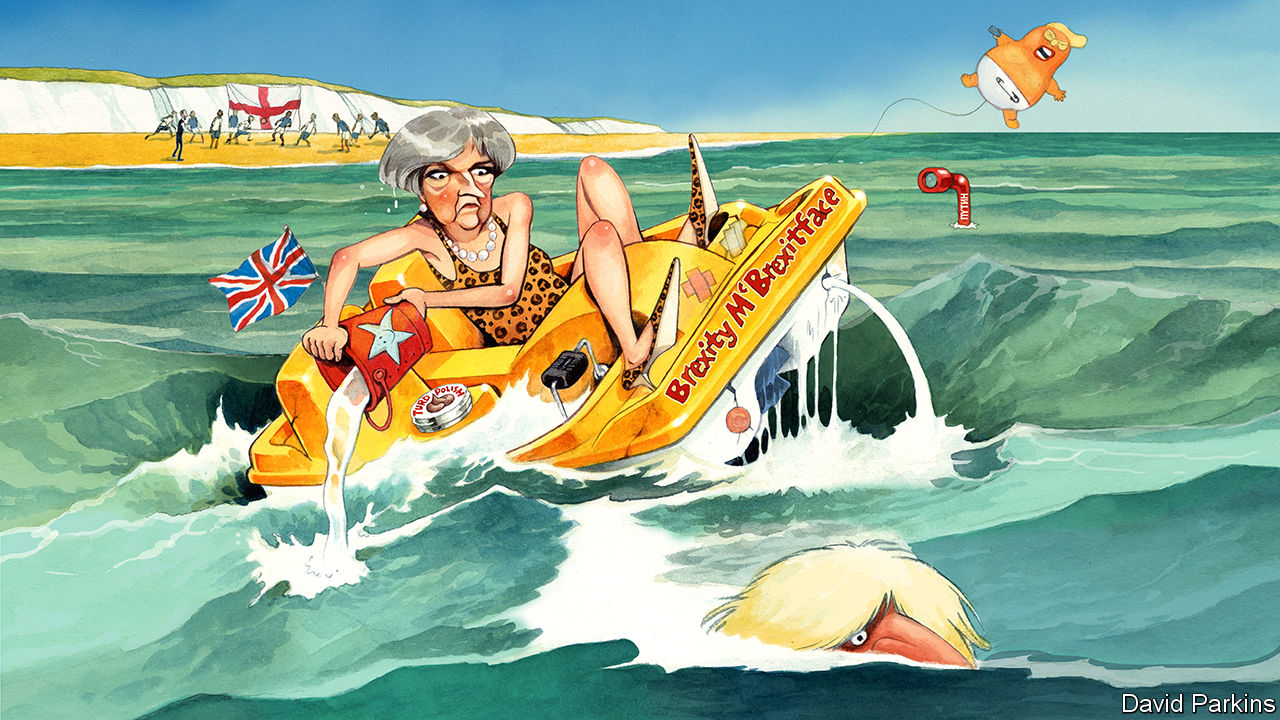
Two cabinet ministers and two Conservative Party vice-chairmen have quit; the foreign secretary, Boris Johnson, said in his resignation letter that the Brexit “dream is dying”. Those abandoning ship are furious that Theresa May has dropped a hard separation from the EU for a softer deal, preserving many legal and economic ties. For now, the prime minister seems unsinkable (wooden objects tend to be). But her belated move towards a realistic Brexit has just begun. As the truth sinks in, more turmoil is in store. The task for Mrs May and the EU is to ensure that the Brexit project does not descend into anarchy.
Mrs May’s Brexit plan marks a decisive shift. Her approach had previously consisted mainly of ruling things out: no single-market membership, no free movement of labour, no obedience to foreign judges. Now she has said what she wants. She proposes that Britain remain, in effect, in the single market for goods, and in a looser system of mutual recognition for services. In return she promises not to undercut EU standards for the environment, social policies or state aid. She proposes a dispute-resolution mechanism that implies a role for the European Court of Justice. And she suggests that Britain stay in a customs union with the EU until a clever new tariff-collection mechanism can be set up (which may well mean for ever).
This is Mrs May’s most realistic plan so far, and yet European leaders will demand that she go further. They say she has still not made clear how Britain plans to avoid a hard border in Ireland, something they insist is settled before any deal can be signed. Britain is likely to be told that, if it wants the benefits of the single market for goods, it must seek membership of the whole thing—which in turn means observing other rules, including free movement of labour. The EU will probably want ongoing payments into its budget, too (see article).
This will lead to a Brexit that satisfies almost nobody. Hardline Brexiteers already feel betrayed. This week Mr Johnson complained that Britain would be subject to EU laws without having a say in how they were made, and that obeying these rules would make it harder to do trade deals with other countries. That is true, and adding in budget payments and free movement will surely prompt further cabinet resignations and backbench rebellions.
Remainers are hardly jubilant, either. Many, including this newspaper, see ending up in a situation similar to Norway, bound to the EU but with little say in how it works, as the best Brexit possible—and certainly less bad than the hard sort, which would cause enduring harm to the country’s prosperity. But a soft Brexit is so obviously worse than what Britain has today as a member of the EU that it would underline more clearly than ever the folly of leaving.
As a result Mrs May might struggle to get a deal through Parliament, even though most MPs probably favour a soft Brexit. Although pragmatic Brexiteers and Remainers may back her, hardliners may be tempted to hold out for either a harder deal or for stopping Brexit altogether. Her task will be further complicated by Labour under Jeremy Corbyn, which has yet to produce its own coherent plan. It is likely to put party before country by voting against whatever deal Mrs May brings home, in the hope of bringing down the government. That means even a small rebellion by Tory hardliners could be enough to defeat the plan.
Where does this leave Britain? Do not look to Brexiteers for answers. Although they complain that the people have been betrayed, they have still not explained how Britain could cut all ties with the EU while preserving trade links to what is by far Britain’s largest market. Mr Johnson did not even mention Ireland in his resignation letter this week. It is as if Brexiteers have spent so many years in opposition attacking the EU that they are flummoxed by the idea of coming up with a workable plan. While Mrs May at last faces up to the painful trade-offs that Brexit always required, those who condemned her this week prefer to indulge their fantasies.
The EU could help—and has reason to. It is reluctant to give Britain a bespoke deal, for fear that its other restless members will angle for special treatment, too. This is why Eurocrats solemnly vow that nothing must undermine the single market.
But if the Brexit negotiations fail, and Britain crashes out without any deal at all, it would cause grave damage across Europe and beyond. And in some areas the EU has an incentive to offer concessions. The most glaring is security, where its hardline position is self-defeating. Britain is one of Europe’s two big military and intelligence powers. Limiting its role in projects such as the Galileo geolocation system, at a time when America is wavering on its NATO commitments and Russia is stirring up trouble, endangers all Europeans. Bending rules such as freedom of movement is harder. But the EU can help give Mrs May the cover she needs to sell the deal at home. If she wants to replace free movement with a “mobility framework” that does much the same thing, let her. If she wants market alignment on goods but not on services, so what?
Throw her a lifebelt
And if Mrs May cannot win a Brexit vote? Then the EU should be prepared to grant Britain more time, to avoid it crashing out without a deal. To break the parliamentary impasse, Mrs May might have to go back to the people, either with yet another election or even a second referendum, setting out a concrete plan for Brexit rather than the vague, incompatible promises put before voters the last time round.
That Britain has at last set a course for a soft Brexit is welcome. Getting there will be a very rough crossing indeed.