Biodun Iginla, BBC News

Biodun Iginla, BBC News
Showing posts with label Socialist party. Show all posts

Sunday, December 10, 2017

Venezuela opposition banned from running in 2018 election


December 11, 2017  04H:25  GMT/UTC/ZULU TIME
Related Topics
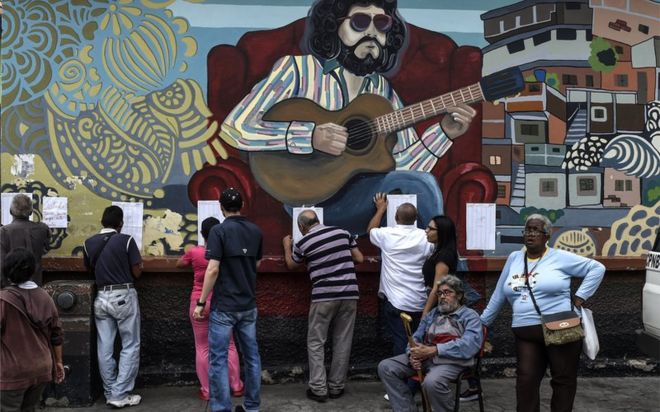
People look for their names on electoral rolls before voting in the municipal elections in Caracas on December 10, 2017.Image copyrightAFP
Image captionVenezuelans look for their names on electoral rolls before voting in Sunday's mayoral polls
by Renee Celeste and Biodun Iginla, BBC News, Caracas
Venezuela's president, Nicolas Maduro, says the country's main opposition parties are banned from taking part in next year's presidential election.
He said only parties which took part in Sunday's mayoral polls would be able to contest the presidency.
Leaders from the Justice First, Popular Will and Democratic Action parties boycotted the vote and said the electoral system is biased.
President Maduro insists the Venezuelan system is entirely trustworthy.
In a speech on Sunday, he said the opposition parties had "disappeared from the political map".
"A party that has not participated today and has called for the boycott of the elections can't participate anymore", he said.
In October, the three main opposition parties announced they would be boycotting Sunday's vote to elect mayors in more than 300 towns and cities.
They said the vote served what they called President Maduro's dictatorship.
President Maduro's governing Socialist Party is expected to win the largest number of votes in the mayoral elections, despite a worsening economic crisis characterised by shortages of basic goods and soaring inflation.

Presentational grey line

Maduro divides and conquers

Katy Watson, BBC Latin America correspondent - Barquisimeto, Venezuela
Mr Maduro's pronouncement is designed to provoke the opposition. Especially since he justified the move saying it was a condition set out by the National Constituent Assembly - a body that the opposition refuses to recognise because they say it's undemocratic.
Mr Maduro has lost popularity because of the worsening economic crisis. In the face of criticism, his strategy has been one of 'divide and conquer' - find ways of weakening the opposition to make them less of a threat.
And he's succeeded - he's imprisoned some of the most popular opposition leaders like Leopoldo Lopez. He's prevented others like Henrique Capriles from running for office. And now this threat - banning the most influential parties from taking part in future elections. The opposition is in crisis and Mr Maduro is gloating.
Presentational grey line
Mr Maduro said he was following the criteria set by the National Constituent Assembly in banning opposition parties from contesting next year's election.
But the assembly, which came into force in August and has the ability to rewrite the constitution, is dominated by government loyalists. Opposition parties see it as a way for the president to cling to power.
Media captionYour video guide to the crisis gripping Venezuela
Venezuela, in the north of South America, is home to more than 30 million people. It has some of the world's largest oil deposits as well as huge quantities of coal and iron ore.
Despite its rich natural resources many Venezuelans live in poverty. This led President Maduro's predecessor, Hugo Chavez, to style himself as a champion of the poor during his 14 years in office.
Now the country is starkly divided between supporters of President Maduro and those who want an end to the Socialist Party's 18 years in government.
Supporters of Mr Maduro say his party has lifted many people out of poverty, but critics say it has eroded Venezuela's democratic institutions and mismanaged its economy.
More on this story

Friday, November 24, 2017

Drugs probe of ex-minister rattles EU hopeful Albania


by Elodie Bagnol and Biodun Iginla, France24, Tirana


    © AFP/File / by Briseida MEMA, Nicolas GAUDICHET | Albania, which is known as Europe's cannabis capital, for years has been the largest exporter of cannabis to the EU, notably Italy, according to Europol reports

    TIRANA  - 
    An investigation into a former Albanian interior minister and his alleged links to international cannabis trafficking is ill-timed for the Balkan country bidding to join the European Union.
    A candidate for membership in the bloc since 2014, Albania intends to convince Brussels to open accession negotiations early next year.
    But the scandal involving Saimir Tahiri, 38, interior minister until March and a close ally of socialist Prime Minister Edi Rama, has forced the country to defend its history with drug trafficking.
    "Albania has a problem with the connection between criminal groups and politicians," US ambassador to Albania Donald Lu said earlier this month.
    "This is a problem not of one party," he said.
    The ambassador's outspokenness contrasts with the cautious silence of European embassies which have been supporting Rama since he took over in 2013.
    In an open letter to European leaders earlier this month, Rama defended his record.
    "Albania is no longer Europe's cannabis capital, as some media have enjoyed calling it," he said.
    But right-wing opposition leader Lulzim Basha claimed "we have a government of drug traffickers that must fall and give space to an anti-mafia government".
    They claim Rama's Socialist party has made Albania the "Colombia of Europe".
    - Cumbersome cousins -
    Rama hit back that it was his government which dismantled the "Cannabis kingdom", a trafficking ring in the village of Lazarat, which he claims the right ignored when they were in power.
    However, six months after an electoral triumph at parliamentary elections, the prime minister appears weakened.
    The scandal exploded in mid-October, after the arrest of an Albanian trafficker in Italy.
    Local papers then revealed the existence of tapped phone conversations that appear to compromise Tahiri.
    "Two criminals, my 10th cousins, arrested for drug trafficking, mentioned my name," Tahiri said on television, defending himself.
    "Criminals use to brag to each other, quoting the names of a particular minister in their dirty business."
    He said his "only mistake" was to sell a car without checking the credentials of the new owners, who allegedly used it for trafficking.
    But Albanian judiciary, itself considered deeply corrupt, asked prosecutors to lift Tahiri's parliamentary immunity in order to arrest him.
    The Socialist parliamentary majority rejected the request.
    Rama insists he was not protecting his political ally, who was suspended from the Socialists.
    "If the accusations against Tahiri are proved, I will applaud justice."
    "There is no evidence" against Tahiri, said Interior Minister Fatmir Xhafaj.
    "Some segments of the prosecutor's office let themselves be used politically to serve well-defined political interests."
    "The majority wants at any price to make the investigation fail, cover up the evidence and intimidate witnesses," accused Basha.
    - Production down? -
    For years Albania has been the largest exporter of cannabis to the EU, notably Italy, according to Europol reports.
    The trade would make up one-third of the country's gross domestic product (GDP) or more, Western diplomatic sources estimate.
    In its latest progress report, Brussels said the authorities have "failed in the identification of criminal groups."
    Small farmers are regularly prosecuted, but never the drug lords.
    Only about 20 police officers, three of whom are facing an arrest warrant issued on Wednesday, were charged for corruption linked to cannabis trafficking.
    Tahiri is the first senior official to be investigated.
    The government recently presented a plan "against organised crime and in particular, against the links between crime and senior officials or state leaders."
    "I am well aware that some people, if you mention Albania, think of crime and drugs," Rama wrote in an open letter to the Financial Times.
    "For years labelled the cannabis capital of Europe, Albania has had enough and we have fought back."
    This year, 88 plantations were identified and destroyed compared with 2,086 in 2016, said Rama which he said showed a collapse in production.
    Albanian cannabis is a "European problem," said the prime minister who is appealing for help from the international community.