Biodun Iginla, BBC News

Biodun Iginla, BBC News
Showing posts with label deep economic crisis. Show all posts

Sunday, December 10, 2017

Venezuela opposition banned from running in 2018 election


December 11, 2017  04H:25  GMT/UTC/ZULU TIME
Related Topics
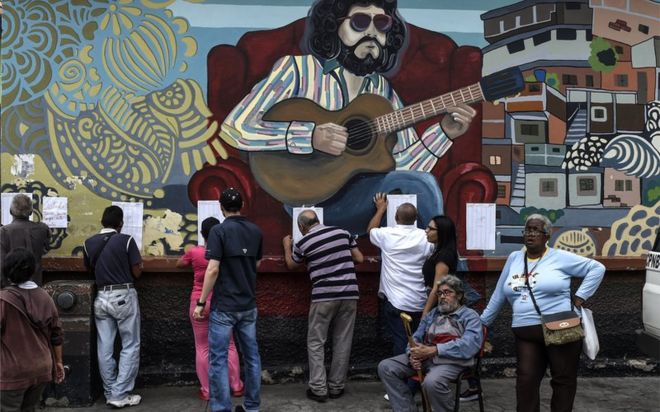
People look for their names on electoral rolls before voting in the municipal elections in Caracas on December 10, 2017.Image copyrightAFP
Image captionVenezuelans look for their names on electoral rolls before voting in Sunday's mayoral polls
by Renee Celeste and Biodun Iginla, BBC News, Caracas
Venezuela's president, Nicolas Maduro, says the country's main opposition parties are banned from taking part in next year's presidential election.
He said only parties which took part in Sunday's mayoral polls would be able to contest the presidency.
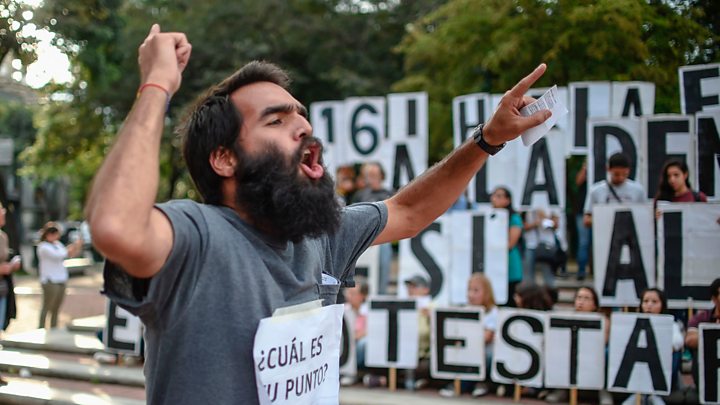
Leaders from the Justice First, Popular Will and Democratic Action parties boycotted the vote and said the electoral system is biased.
President Maduro insists the Venezuelan system is entirely trustworthy.
In a speech on Sunday, he said the opposition parties had "disappeared from the political map".
"A party that has not participated today and has called for the boycott of the elections can't participate anymore", he said.
In October, the three main opposition parties announced they would be boycotting Sunday's vote to elect mayors in more than 300 towns and cities.
They said the vote served what they called President Maduro's dictatorship.
President Maduro's governing Socialist Party is expected to win the largest number of votes in the mayoral elections, despite a worsening economic crisis characterised by shortages of basic goods and soaring inflation.

Presentational grey line

Maduro divides and conquers

Katy Watson, BBC Latin America correspondent - Barquisimeto, Venezuela
Mr Maduro's pronouncement is designed to provoke the opposition. Especially since he justified the move saying it was a condition set out by the National Constituent Assembly - a body that the opposition refuses to recognise because they say it's undemocratic.
Mr Maduro has lost popularity because of the worsening economic crisis. In the face of criticism, his strategy has been one of 'divide and conquer' - find ways of weakening the opposition to make them less of a threat.
And he's succeeded - he's imprisoned some of the most popular opposition leaders like Leopoldo Lopez. He's prevented others like Henrique Capriles from running for office. And now this threat - banning the most influential parties from taking part in future elections. The opposition is in crisis and Mr Maduro is gloating.
Presentational grey line
Mr Maduro said he was following the criteria set by the National Constituent Assembly in banning opposition parties from contesting next year's election.
But the assembly, which came into force in August and has the ability to rewrite the constitution, is dominated by government loyalists. Opposition parties see it as a way for the president to cling to power.
Media captionYour video guide to the crisis gripping Venezuela
Venezuela, in the north of South America, is home to more than 30 million people. It has some of the world's largest oil deposits as well as huge quantities of coal and iron ore.
Despite its rich natural resources many Venezuelans live in poverty. This led President Maduro's predecessor, Hugo Chavez, to style himself as a champion of the poor during his 14 years in office.
Now the country is starkly divided between supporters of President Maduro and those who want an end to the Socialist Party's 18 years in government.
Supporters of Mr Maduro say his party has lifted many people out of poverty, but critics say it has eroded Venezuela's democratic institutions and mismanaged its economy.
More on this story

Monday, December 4, 2017

Venezuela unveils virtual currency amid economic crisis


Related Topics
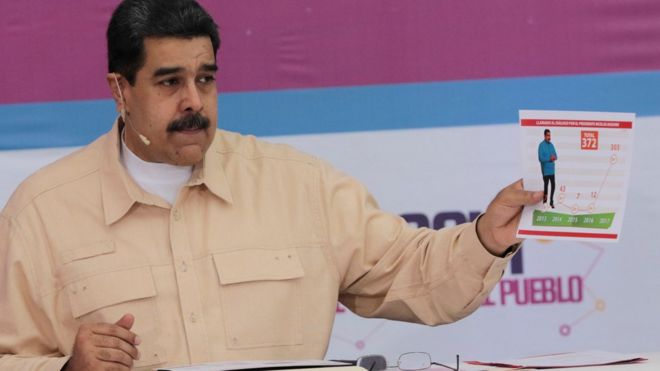
President Nicolas Maduro speaks during his weekly radio and TV broadcast Sundays with Maduro in Caracas, Venezuela, December 3, 2017Image copyrightREUTERS
Image captionPresident Maduro made the announcement during his weekly TV and radio programme
by Renee Celeste, Tamara Kachelmeier, and Biodun Iginla, BBC News Technology reporters, Caracas
Venezuelan President Nicolas Maduro has announced the creation of a new virtual currency in a bid to ease the country's economic crisis.
He said the Petro would be backed by Venezuela's oil, gas, gold and diamond wealth.
Opposition MPs, however, poured scorn on the plan.
Venezuela's economy has been hit by falling oil revenue and the plummeting value of its existing currency, the bolivar.
President Maduro has also railed against US sanctions which he describes as a "blockade".
In a televised announcement on Sunday, Mr Maduro said the new crypto-currency would allow Venezuela "to advance in issues of monetary sovereignty, to make financial transactions and overcome the financial blockade".
"The 21st Century has arrived!" he added to cheers from supporters.
He gave no details on how, or when, the new currency would be launched.
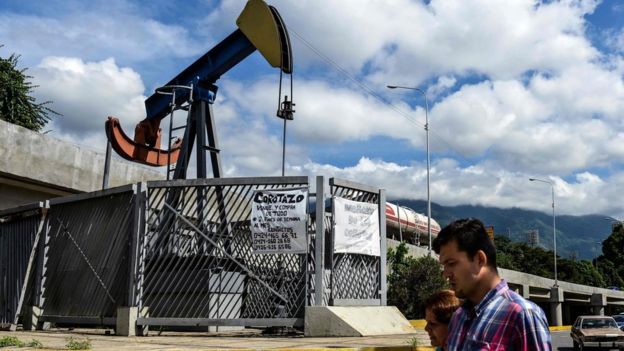
People walk by oil pump in Caracas on November 14, 2017Image copyrightAFP
Image captionOil has long been the mainstay of the Venezuelan economy
The move follows increasing global interest in the crypto-currency Bitcoin.
Venezuela owes an estimated $140bn (£103bn) to foreign creditors and economists suggest Mr Maduro is looking to try to pay them with Petros as he seeks to restructure the country's debt.
Opposition MPs insisted the proposed currency would need the backing of Congress, and some doubted it would ever happen.
"It's Maduro being a clown. This has no credibility," opposition MP and economist Angel Alvarado told Reuters news agency.
Venezuela has historically relied on its oil wealth to support its economy but a decline in oil prices has sent the country into economic and political crisis.
The US and European Union have imposed sanctions, citing repressive policies by the government.
Last month, Russia agreed to restructure $3.15bn (£2.4bn) in debt owed by Venezuela. The deal allows Venezuela to make "minimal" repayments on its Russian obligations over the next six years.

More on this story